Съдържание
УсловиеPart A: Moon's Apparent Motion Against the Background Stars (1,8 т.)Part B: Using Lunar Occultations to Precisely Determine Radio Source Positions: The Case of 3C 273 (1,8 т.)Part C: The Breakthrough Discovery of 3C 273's True Nature (1,8 т.)Part D: The Intrinsic Luminosity of the Radio Source 3C 273 (1,8 т.)Part E: The Power Source of 3C 273 (1,4 т.)Part F: Modern Observations and the Nature of 3C 273's Components (1,4 т.)ОтговориРешениеAPhO 2024, Теория — Задача 3. The First Discovered Quasar: Unveiling the Mysteries of the Astrophysical Source 3C 273
24th Asian Physics Olympiad, Malaysia 2024 — APHO 2024 Theory, English (Official) · 10 т.
General Instructions for Theoretical Examination
Before the Exam
- The allocated time for theoretical examination is 5 hours for answering 3 questions that carry 10 points each.
- Please ensure that your student code matches the one on your desk. Place your ID / tag on the top right corner of the desk.
- Kindly ensure that you have the following items on the desk: (i) A sealed envelope containing the Question Papers and Answer Scripts.
(ii) A labelled envelope.
(iii) Pens/relevant stationery (You need to bring in your own calculator).
If you find that the items are incomplete, kindly raise your hands. - You must not open the sealed envelopes before the start of the examination.
During the Exam
- You must use the dedicated answer scripts provided for writing your answers. Write your answers only in boxed answer scripts. If you need more boxed answer scripts, please raise your hand and ask an invigilator. Clearly write your student code and write which question you are attempting on each of your extra requested answer scripts.
- There are additional blank draft papers. These will not be marked.
- Try to be as concise as possible in your answers: use equations, logical operators, and sketches to illustrate your thoughts whenever possible. Avoid the use of long sentences.
- Use an appropriate number of significant figures when stating numbers.
- You are not allowed to leave your working place without permission. If you need any assistance (malfunctioning calculator, need to visit a restroom, insufficient Draft Papers, etc), please draw the attention of the invigilator by raising your hand.
At the end of the Exam
- At the end of the examination, you must stop writing immediately.
- Put all the Answer Scripts into the labelled envelope and seal it, including any blank Answer Scripts. It is your responsibility to ensure all Answer Scripts are inside the envelope and submitted to the invigilator.
- Put question papers and draft papers into another envelope. You are not allowed to take any sheets of paper out of the examination hall.
- Wait at your table in silence till your envelopes are collected. Once all envelopes are collected, your guide will escort you out of the examination area.
Answer Scripts
You must use the dedicated Answer Scripts provided for writing your answers. Write your answers only in boxed answer scripts. If you need more boxed answer scripts, please raise your hand and ask an invigilator. Clearly write your student code and write which question number you are attempting on each of your extra requested answer scripts.
There are additional blank draft papers. These will not be marked.
Physical Constants
| Acceleration due to gravity | |
|---|---|
| Boltzmann constant | |
| Current Mass of the Sun | |
| Current Radius of the Sun | |
| Average Mass of a Galaxy | |
| Magnitude of the electron charge | |
| Mass of the electron | |
| Mass of the proton | |
| Mass of the neutron | |
| Permeability of free space | |
| Permittivity of free space | |
| Intrinsic impedance of free space | |
| Planck’s constant | |
| Speed of light in vacuum | |
| Stefan-Boltzmann constant | |
| Universal Gravitational constant |
Условие
Part A: Moon's Apparent Motion Against the Background Stars (1,8 т.)
The Moon takes 27.3 days to complete 1 orbit of the Earth with respect to the stars, a period known as a sidereal month. Through a telescope, the moon’s motion is readily apparent, but to the eye, it requires careful observation over several hours to notice the Moon’s changing position. Remembering that 3600 arcseconds = 60 arcminutes = 1 degree then, through how many degrees, arcminutes, and arcseconds does the Moon move against the background of stars in
A.1 one hour? One minute? One second? [1,3 т.]
A.2 How long does it take the Moon to move a distance equal to its own diameter on the sky? (Note: the angular diameter of the moon as viewed from Earth is 30 arcminutes) [0,5 т.]
Part B: Using Lunar Occultations to Precisely Determine Radio Source Positions: The Case of 3C 273 (1,8 т.)
In the late 1950s and early 1960s, radio position measurements with this precision were not available. While occultations had been used previously, Hazard was specifically interested in their ability to determine radio positions and structure with arcsecond precision. Such measurements were made in the optical reference frame thereby allowing reliable optical identifications. Hazard had noted that the strong Class II radio source 3C 273 would be hidden by the Moon (also known as occultation) several times during 1962 and 1963.
The 1962 August 5 occultation was undertaken at 410 and 136 MHz. Both disappearance and reappearance were observed and the disappearance record revealed the presence of two components, A and B, in the source. The disappearance on the right and the reappearance records on the left, at 410 MHz are plotted in Fig. 1.
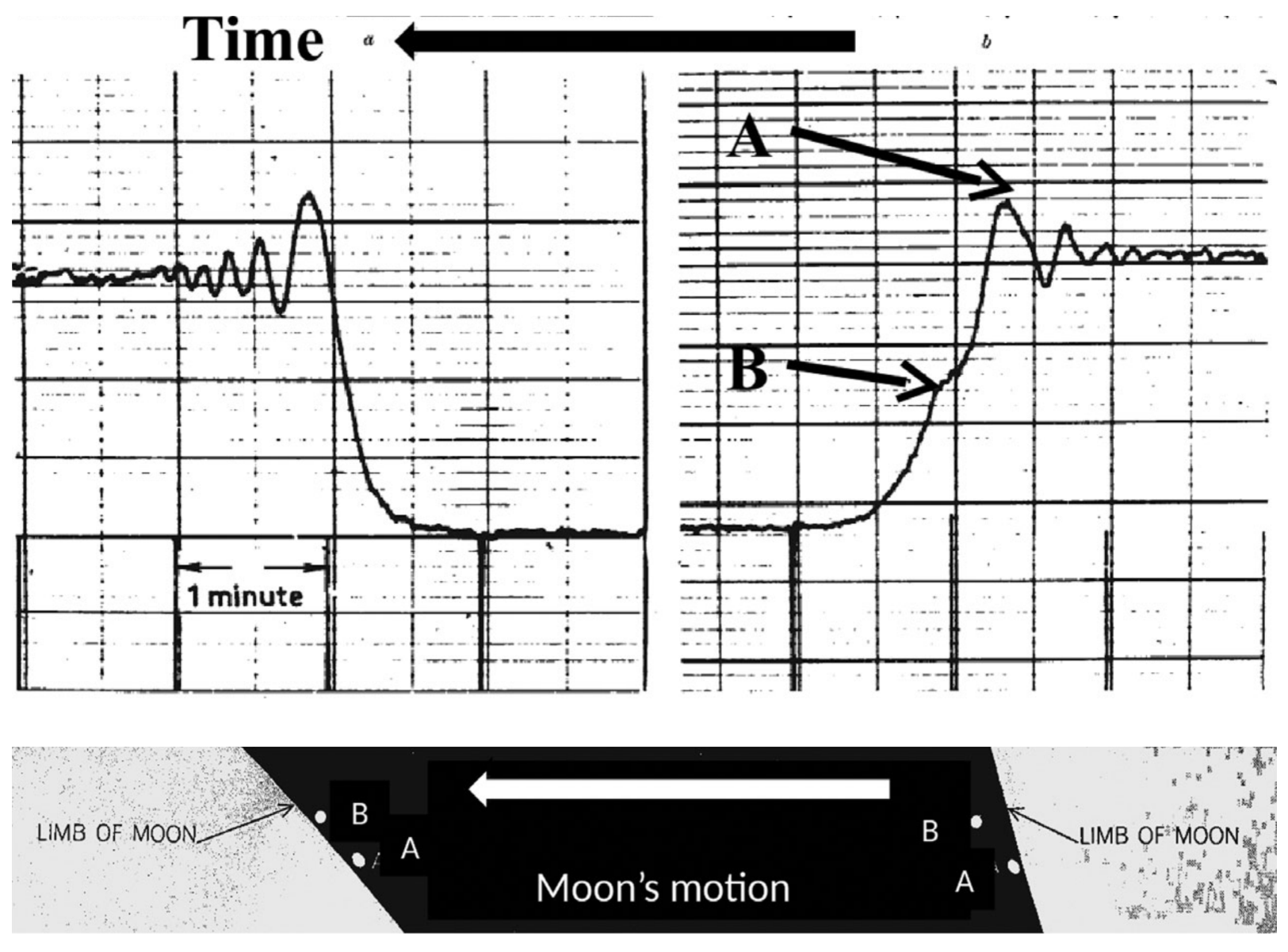
B.1 What is causing the oscillation in the observed intensity?
A. The diffraction pattern of the telescope
B. Instabilities in the mount of the telescope
C. The features of the surface of the Moon
D. Earth's atmospheric conditions [0,6 т.]
B.2 Why there is no extra bump for the B component in the left plot for the reappearance of the source? How does it help to understand the structure of the source?
A. The two components have been orbiting around the Moon.
B. Our line-of-sight has changed with respect to the two components.
C. Both components are aligned with the limb of the Moon when they reappear.
D. The time scales of the physics behind the luminosity of the two components were long enough to make one of them fade. [0,6 т.]
B.3 Based on your answer in A.1 to A.4, and the data in Fig. 1, estimate the approximate apparent (projected) angular separation between the two components of 3C 273. [0,6 т.]
Part C: The Breakthrough Discovery of 3C 273's True Nature (1,8 т.)
In 1962, the year of these observations, Maarten Schmidt was working on the programme of optical identification and spectroscopy of the optical objects identified with radio sources. Whiteoak mentions as an afterthought that the ‘current Caltech thinking’ is that the potential 3C 273 identification is with a star and a strange jet. Given that no other bright star had been proposed as a radio source identification, he assumed that the bright magnitude 13 ‘star’ (magnitude accounts as a way to measure how bright a star is; the brighter the star, the smaller the number) was merely a confusing foreground very bright star. To obtain a spectrum of the faint jet, which he saw as by far the most likely identification, it was inevitable that the bright confusing star some arcseconds away would spill over into any spectrum of the jet he would obtain. To offset this, Maarten Schmidt had decided to first obtain a spectrum of this bright star. On the night of December 29, he managed to obtain a spectrum of the bright ‘star’ which showed some faint emission lines (Fig. 2), but with no obvious explanation in terms of any expected stellar lines. Only when Schmidt decided to compare the strange spectrum with the Balmer lines of hydrogen, things became clear:
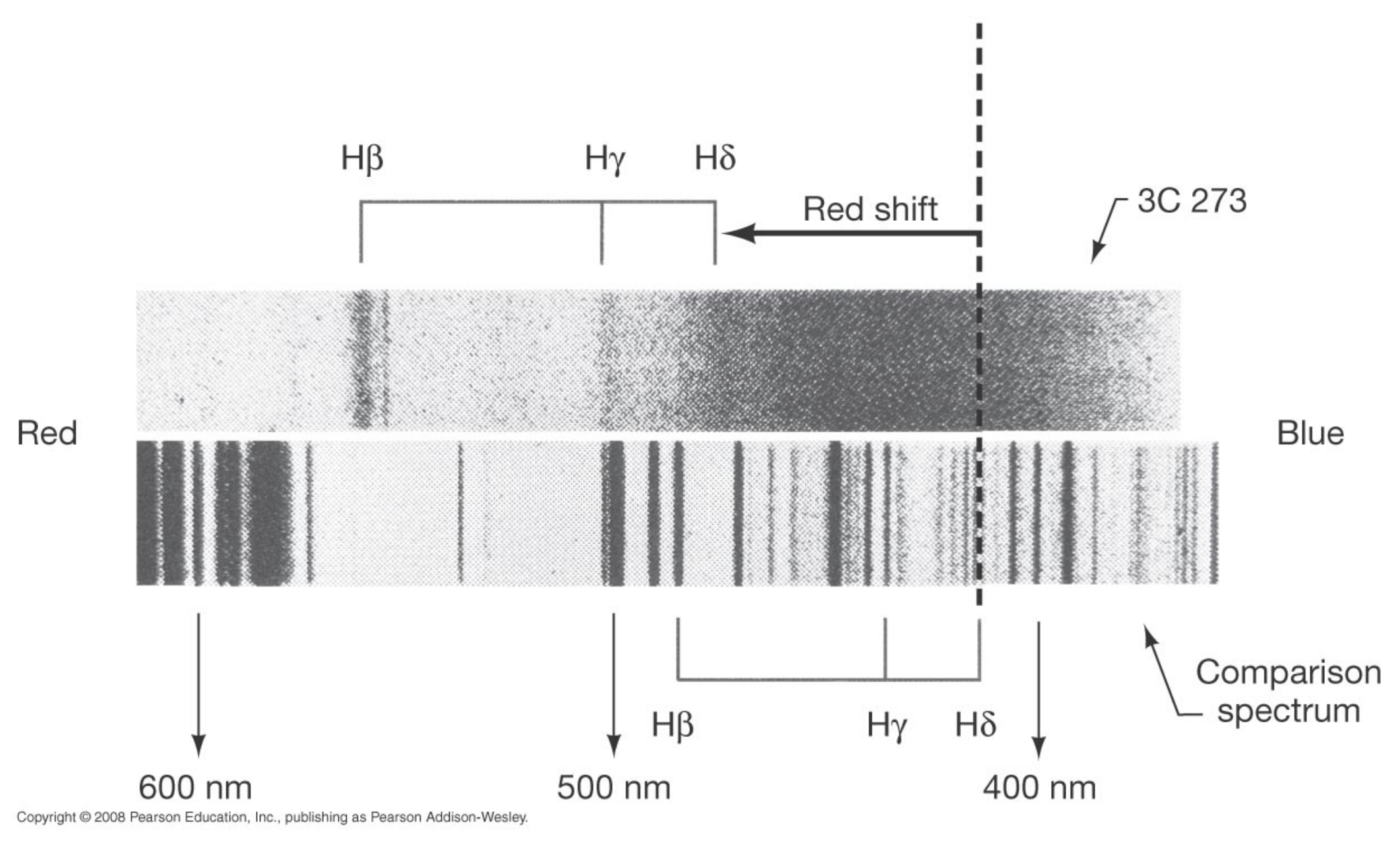
C.1 Compare the wavelength ratios of the lines shown in Fig. 2. Based on these ratios, what is the redshift of this source? [0,6 т.]
C.2 Consider that this redshift is arising due to relativistic gravitational effects from the mass of the object. In this case, we can estimate the gravitational redshift as . Prove that, whether you put 3C 273 at any distance (e.g, edge of the Milky Way, 100 kpc m; edge of the Solar System, 100 AU m), the mass of 3C 273 would be so large it would disrupt the entire galaxy / solar system. [0,6 т.]
C.3 Hubble's law states that the farther the galaxies, the faster they are moving away from Earth. The Hubble's constant is the ratio between the speed and the distance of those galaxies, and equal to H=75 km/s/Mpc. With this idea in mind, we can consider instead that the calculated redshift is due to the cosmological expansion, and we can approximate that . In that case, what is the distance of this object? Compare this with the size of the Milky Way. [0,6 т.]
Part D: The Intrinsic Luminosity of the Radio Source 3C 273 (1,8 т.)
The flux of the source 3C 273 has been measure across the radio spectrum and has been found to follow the equation , where is the observed frequency in Hertz and a Jansky is defined as . Of course, since the source is radiating over a sphere of radius the distance from us, the intrinsic luminosity will be given by . With this,
D.1 What is the luminosity of the source per unit frequency?
(help: ) [0,6 т.]
D.2 What is the total luminosity in the radio band (ie., from Hz to Hz)? [0,6 т.]
D.3 How does the luminosity of 3C 273 compare with the luminosity of the Sun ( W) and the Milky Way () in the same frequency range? [0,6 т.]
Part E: The Power Source of 3C 273 (1,4 т.)
We have seen that the brightness of 3C 273 is too large for a single star, even for an entire galaxy. Therefore, there should be another mechanism, other than stars, producing all this power.
E.1 Check that the annihilation of matter with antimatter (e.g., ) would not explain this, since it would produce very energetic X-rays rays rather than optical and radio emission. [0,7 т.]
E.2 Something that was immediately proposed was the accretion of matter into a supermassive black hole. Let’s check that potential energy can give all this energy: Consider that the black hole accretes one solar mass ( kg) towards its Schwarzschild radius () every year. What is the power that can be obtained for the accretion? Would this be enough to explain the observations discussed in D1 to D3? [0,7 т.]
Part F: Modern Observations and the Nature of 3C 273's Components (1,4 т.)
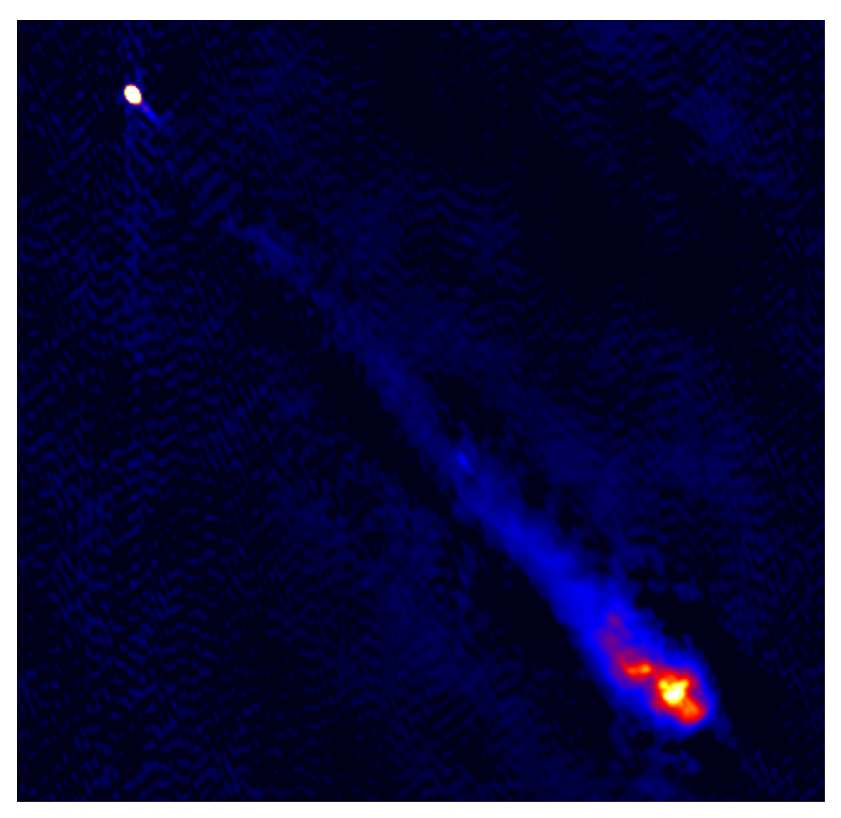
Modern images from various telescopes (see e.g., Fig. 3) have found that the two components A and B that were measured with the lunar occultation actually refer to a compact core, which hosts the black hole, and a jet that extends the distance that you calculated before. This jet is thought to be produced via acceleration of the accreted particles via the strong black hole magnetic field, in a similar way particles from the Solar wind hit the magnetic field of Earth to produce the auroras near the poles, but at much larger scale.
The energy density required for the production of such jet can be written in terms of the magnetic fields as the sum of the particle energy density and the magnetic energy density .
F.1 Show that the minimum energy density is given by [0,7 т.]
F.2 If we assume that the total power of the 3C 273 jet is given by half of the energy released by 3C 273 in one second calculated in D.1 and D.2, and the jet has a volume of , estimate the magnetic field of the jet.
(hint: use that the magnetic permeability is ) [0,7 т.]
Отговори
Part A: Moon's Apparent Motion Against the Background Stars, A.1 ≈ 0.55° (33 arcminutes, ≈ 1978 arcseconds) per hour; ≈ 0.0092° (0.55 arcminutes, 33 arcseconds) per minute; ≈ 0.000153° (0.0092 arcminutes, ≈ 0.55 arcseconds) per second.
В официалното решение последният ред е отпечатан като „0.55deg per second of time“ — по смисъла на пресмятането това са дъгови секунди; текстът на решението е запазен както е отпечатан.
Part A: Moon's Apparent Motion Against the Background Stars, A.2 54.5 min
Малко под един час.
Part B: Using Lunar Occultations to Precisely Determine Radio Source Positions: The Case of 3C 273, B.1 A
A. The diffraction pattern of the telescope.
Part B: Using Lunar Occultations to Precisely Determine Radio Source Positions: The Case of 3C 273, B.2 C
C. Both components are aligned with the limb of the Moon when they reappear.
Part B: Using Lunar Occultations to Precisely Determine Radio Source Positions: The Case of 3C 273, B.3 15 arcsec
Официалното решение приема всяка обоснована оценка от този порядък.
Part C: The Breakthrough Discovery of 3C 273's True Nature, C.1 0.158
Оценка по фигурата; официалното решение приема близки стойности при разумно оценени дължини на вълната.
Part C: The Breakthrough Discovery of 3C 273's True Nature, C.2 M ∼ 10¹⁷ M⊙ at 100 kpc (more than the mass of the Milky Way); M ∼ 10⁹ M⊙ at 100 au (would disrupt the Solar System).
Part C: The Breakthrough Discovery of 3C 273's True Nature, C.3 632 Mpc
Хиляди пъти по-далеч от размера на Млечния път.
Part D: The Intrinsic Luminosity of the Radio Source 3C 273, D.1
В официалното решение единицата е отпечатана като „W m⁻² Hz⁻¹“ (за светимост на единица честота е W Hz⁻¹); оставена е както е отпечатана.
Part D: The Intrinsic Luminosity of the Radio Source 3C 273, D.2 W
Part D: The Intrinsic Luminosity of the Radio Source 3C 273, D.3
L/Lsun ≈ 2.3 × 10¹¹; по-ярък и от Млечния път.
Part E: The Power Source of 3C 273, E.1 The annihilation photons (0.5 MeV each) have wavelength ≈ 0.000002 nm — well within the X-rays, not optical or radio.
В официалното решение енергията е отпечатана като „8 × 10¹⁴ J“ (положителен показател); оставена е както е отпечатана.
Part E: The Power Source of 3C 273, E.2 W
≈ 1.8 × 10⁴⁷ J/yr; с порядък повече от необходимото, така че е достатъчно.
Part F: Modern Observations and the Nature of 3C 273's Components, F.1 Доказателство: dU/dB = 0 дава Ue/Ub = 4/3.
Part F: Modern Observations and the Nature of 3C 273's Components, F.2 T
Решение
Part A: Moon's Apparent Motion Against the Background Stars
A.1 The moon completes one orbit in about a month, or more quantitatively, moves through 360 degrees in 27.3 days. 360 divided by 27.3 = 13.19 degrees per day. Each day the moon will appear about 13deg to the east of its position at the same time on the previous day.
Now convert to motion per hour. 13.19 degrees/day divided by 24 hrs/day = 0.55 degrees/hr. The moon passes through a little more than ½ of a degree in one hour of time. [0.5pt]
Since 1deg = 60 arcminutes, then 0.55deg = 33 arcminutes (this is a ratio, 1:60 as 0.55:33). Therefore the moon moves through 33 arcminutes per hour of time.
Since 1 arcminute = 60 arcseconds, then the moon moves through 33 x 60 arcseconds in a hour = 1978 arcsec per hour of time.
Moving 0.55 degrees / hr divided by 60 minutes per hr = 0.0092 degrees / min. The moon moves through a small fraction of a degree in one minute of time.
As 1deg = 60 arcminutes, then 0.0092deg = 0.55 arcminutes. The moon moves through 0.55 arcminutes per minute of time. [0.4pt]
Since 1 arcminute = 60 arcseconds, the moon moves through 33 arcseconds per minute of time.
Moving 0.55 degrees per hour divided by 3600 seconds per hour = 0.000153 degrees in a second of time.
If the moon moves 0.55 arcminute per minute of time (from part b) then the moon will move 0.55 / 60 = 0.0092 arcminutes in one second of time. [0.4pt]
0.0092 arcminutes X 60 arcseconds per arcminute = 0.55deg per second of time. [1,3 т.]
A.2 The diameter of the moon = 30 arcminutes = 0.5 degree (given in the notes).
From part (b), the moon moves through 0.55 arcminutes per minute of time
The time it takes to move a specific distance = that distance divided by the rate of motion. The time it take the Moon to move one lunar diameter = distance traveled (30 arcminutes) / divided by rate (0.55 arcminutes per minute) = 54.5 minutes, just under an hour. [0.5pt] [0,5 т.]
Part B: Using Lunar Occultations to Precisely Determine Radio Source Positions: The Case of 3C 273
B.1 The correct answer is: A. The diffraction pattern of the telescope. [0.6pt] [0,6 т.]
B.2 The correct answer is: C. Both components are aligned with the limb of the Moon when they reappear. [0.6pt] [0,6 т.]
B.3 Since it was calculated that the moon travels at 33 arcsec per minute w.r.t the background stars, and the panel shows about 1/2 minute between the components A and B, this suggests that these two components are separated about 15 arcsec. (any number within this estimation shall be considered valid as long as it is properly explained). [0.6pt] [0,6 т.]
Part C: The Breakthrough Discovery of 3C 273's True Nature
C.1 The student can check the figure to estimate the wavelengths by eye where certain emission lines are happening. The reasoning shall be written. For example, one could say that the H-gamma line for 3C 273 is located almost at 500nm, so maybe 490 or 495 nm would be a good estimate. For the comparison spectrum, since it is closer to 400nm, maybe the H-gamma of the comparison spectrum maybe be around 440nm (actually, 434nm). [0.3pt]
The resulting redshift of 3C273 is . Other results that are similar to this one will be also considered correct as long as the wavelengths are reasonably estimated. [0.3pt] [0,6 т.]
C.2 Solving for the mass, we have that . [0.2pt]
If we put it at the edge of the Milky Way (at 100 kpc), then m and (larger than the entire mass of the Milky Way!) [0.2pt]
if we put it at the edge of the Solar System (at 100 au), then m and . This would totally disrupt the Solar System. [0.2pt] [0,6 т.]
C.3 Since for small redshift and Hubble’s law is , we can combine these two equations to obtain . [0.3pt]
If we use that H=75 km/s/Mpc, then Mpc. (The current estimation is that the distance is 749 Mpc). This is thousands of times farther away than the size of the Milky Way, and must therefore, be an independent object very much farther away. [0.3pt] [0,6 т.]
Part D: The Intrinsic Luminosity of the Radio Source 3C 273
D.1 If we use the distance of 632 Mpc that has been obtained before, that gives us m. Therefore, .
The Luminosity is . [0.6pt] [0,6 т.]
D.2 The total radio luminosity can be calculated by integrating for all frequencies:
[0.6pt] [0,6 т.]
D.3 Comparing with the Sun, . It’s almost a trillion times brighter, and brighter than our Milky Way. [0.6pt] [0,6 т.]
Part E: The Power Source of 3C 273
E.1 We are going to be using the mass-energy expression. Electrons have a mass-energy of 0.5 MeV (other units; e.g, J will also be considered valid). [0.4pt]
This energy, converted into wavelength, goes into 0.000002 nm. (other units, or solution expressed as frequency e.g, GHz will also be considered valid). This is well within the X-rays. [0.3pt] [0,7 т.]
E.2 The gravitational potential energy of a mass m is given by . Since the smallest radius the particle reaches is the Schwarzschild radius, . Therefore, one solar mass provides J/yr J/s. This is still an order of magnitude more than what is needed to power 3C273, so it even leaves room for a certain efficiency. [0.7pt] [0,7 т.]
Part F: Modern Observations and the Nature of 3C 273's Components
F.1 To calculate the minimum we have to derive and equal to zero
Therefore,
[0.2pt]
Doing each of the terms separately,
Therefore, [0.5pt] [0,7 т.]
F.2 The total energy, from the calculations in terms of the magnetic energy is .
Therefore, If , then the magnetic energy will be . [0.3pt]
For a volume of , the energy density will be . [0.2pt]
Now, since , with = magnetic permeability = , we have that Tesla. [0.2pt] [0,7 т.]
Оригинал в Архива: th.pdf · официални решения: th_sol.pdf