BAAO 2016, Теория — Задача 3. Interstellar
British Astronomy and Astrophysics Olympiad 2015-2016 — Astronomy & Astrophysics Competition Paper — Monday 18th January 2016 · 18 януари 2016 г.
Внимание: Бележка към темата
The official solutions cover Questions 1–3 only (Question 3 as a handwritten scan); there are no official solutions for Questions 4 and 5.
Указания
Time: 3 hours (approximately 35 minutes per question).
Questions: All five questions should be attempted.
Marks: The questions carry similar marks.
Solutions: Answers and calculations are to be written on loose paper or in examination booklets. Students should ensure their name and school is clearly written on all answer sheets and pages are numbered. A standard formula booklet may be supplied.
Instructions: To accommodate students sitting the paper at different times, please do not discuss any aspect of the paper on the internet until 8 am Saturday 23rd January.
Clarity: Solutions must be written legibly, in black pen (the papers are photocopied), and working down the page. Scribble will not be marked and overall clarity is an important aspect of this exam paper.
Eligibility: The International Olympiad will be held during December 2016; all A Level students are eligible to participate, even if they will be attending university in December.
Training Dates and the International Astronomy and Astrophysics Olympiad
Following this round the best students eligible to represent the UK at the International Olympiad in Astronomy and Astrophysics (IOAA) will be invited to attend the Training Camp to be held in the Physics Department at the University of Oxford, (Monday 4th April –Thursday 7th April 2016). Astronomy material will be covered; problem solving skills and observational skills (telescope and naked eye observations) will be developed. At the Training Camp a practical exam and a short theory paper will be sat. Five will be selected for further training. From May there will be mentoring by email to cover some topics and problems, followed by a training camp at the beginning of July and a weekend training camp in autumn.
The IOAA this year will be held in Bhubaneswar, India, from 9th to 19th December 2016.
Important constants
| Speed of light in free space | ||
| Earth’s rotation period | 1 day | 24 hours |
| Earth’s orbital period | 1 year | 365.25 days |
| Parsec | pc | |
| Astronomical Unit | AU | |
| Radius of the Earth | ||
| Radius of the Earth’s orbit | 1 AU | |
| Radius of the Sun | ||
| Mass of the Sun | ||
| Mass of the Earth | ||
| Luminosity of the Sun | ||
| Gravitational constant |
You might find the diagram of an elliptical orbit below useful in solving some of the questions: (see the ellipse figure attached to Qu 2)
Elements of an elliptic orbit:
- a = OA (=PO) semi-major axis
- b = OB (=CO) semi-minor axis
- eccentricity
- F – focus
- P – periapsis (point nearest to F)
- A – apoapsis (point furthest from F)
Kepler’s Third Law: For an elliptical orbit, the square of the period, T, of orbit of an object about the focus is proportional to the cube of the semi-major axis, a (the average of the minimum and maximum distances from the Sun). The constant of proportionality is , where is the mass of the central object.
Magnitudes: The apparent magnitudes of two objects, and , are related to their apparent brightnesses, and , via the formula:
Условие
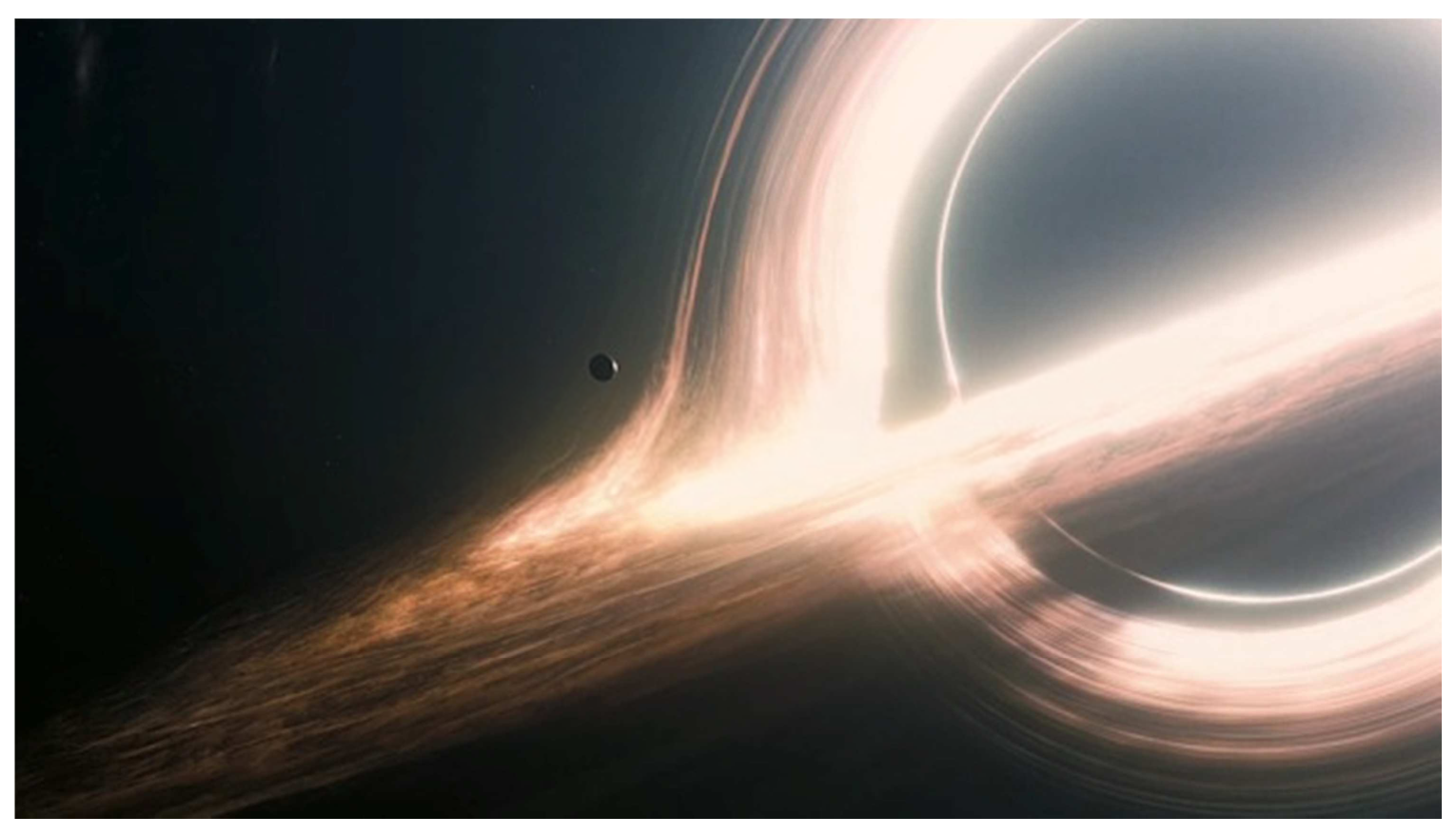
In the science fiction movie Interstellar, the crops on Earth are failing, making farming difficult, and the existence of humanity is threatened. To save the human race, a crew of astronauts travelled through a wormhole in search of a new home and they sent encouraging data from planets near Gargantua, a supermassive black hole:
Miller’s planet is the first planet in the system orbiting Gargantua. It is a water world with a similar composition to the Earth, covered in an endless shallow ocean. The planet's gravity is 130% of the Earth's, forcing human astronauts to move slowly and with some difficulty while on its surface. Being well within the tremendous gravitational field of Gargantua, time on the surface of Miller's planet passes very slowly relative to the rest of the universe: a single hour on Miller would equate to seven years back on Earth. Because of the planet's proximity to Gargantua, the immense gravitational pull from the black hole causes the planet to be afflicted by massive tidal waves as tall as 1 km. There is no sign of dry land on Miller, which may not exist due to the enormous erosive power of the planet's waves.
The gravitational time dilation is given by:
where is the time for a slow-ticking observer within the gravitational field, , is the time for a fast-ticking observer at an arbitrarily large distance from the massive object, is the mass of the massive body, and is the distance of the observer from the centre of the body.
You are asked to estimate the following:
a. The characteristics of the planet (mass and radius).
b. The mass of the supermassive black hole.
c. The orbital parameters of the planet (orbital radius and period).
d. The planet orbits the black hole, but the Hollywood director seems not to have checked his numbers carefully. In what way is this apparent from the values given and the results you have calculated? (the radius of the black hole is the event horizon, the value of when .)
Отговори
a. R = 1.3 RE = 8280 km, M = 1.3³ ME = 1.31 × 10²⁵ kg
b. kg
= 7.48 × 10⁹ solar masses
c. r = 2.20 × 10¹³ m (147 AU), T = 6.52 × 10⁵ s = 181 hours
d. r − rB = 5840 m = 5.84 km, much smaller than the planet radius R
Решение
Qu. 3 Interstellar Given , tidal height = 1000 m, = 7 years, = 1 hour
(a) = planet radius
= radius of orbit
= Schwarzschild radius
= Mass of BH
density of planet = density of Earth.
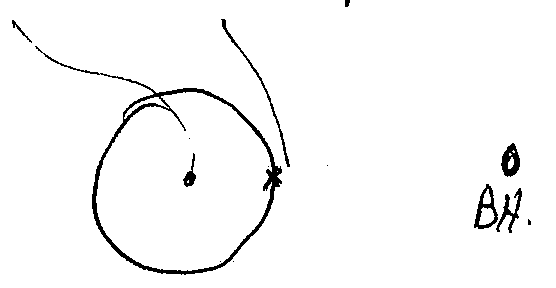
(b) Calculate the difference in grav. field strength between centre and near side of planet due to Black Hole.
But we may write
i.e. .
So
From time dilation
Hence
(c)
so that So motion is relativistic.
(d) and with
So
Оригинал в Архива: BAAO_2016.pdf · официални решения: BAAO_2016_solutions.pdf