BAAO 2016, Теория — Задача 4. Dyson structures
British Astronomy and Astrophysics Olympiad 2015-2016 — Astronomy & Astrophysics Competition Paper — Monday 18th January 2016 · 18 януари 2016 г.
Внимание: Бележка към темата
The official solutions cover Questions 1–3 only (Question 3 as a handwritten scan); there are no official solutions for Questions 4 and 5.
Указания
Time: 3 hours (approximately 35 minutes per question).
Questions: All five questions should be attempted.
Marks: The questions carry similar marks.
Solutions: Answers and calculations are to be written on loose paper or in examination booklets. Students should ensure their name and school is clearly written on all answer sheets and pages are numbered. A standard formula booklet may be supplied.
Instructions: To accommodate students sitting the paper at different times, please do not discuss any aspect of the paper on the internet until 8 am Saturday 23rd January.
Clarity: Solutions must be written legibly, in black pen (the papers are photocopied), and working down the page. Scribble will not be marked and overall clarity is an important aspect of this exam paper.
Eligibility: The International Olympiad will be held during December 2016; all A Level students are eligible to participate, even if they will be attending university in December.
Training Dates and the International Astronomy and Astrophysics Olympiad
Following this round the best students eligible to represent the UK at the International Olympiad in Astronomy and Astrophysics (IOAA) will be invited to attend the Training Camp to be held in the Physics Department at the University of Oxford, (Monday 4th April –Thursday 7th April 2016). Astronomy material will be covered; problem solving skills and observational skills (telescope and naked eye observations) will be developed. At the Training Camp a practical exam and a short theory paper will be sat. Five will be selected for further training. From May there will be mentoring by email to cover some topics and problems, followed by a training camp at the beginning of July and a weekend training camp in autumn.
The IOAA this year will be held in Bhubaneswar, India, from 9th to 19th December 2016.
Important constants
| Speed of light in free space | ||
| Earth’s rotation period | 1 day | 24 hours |
| Earth’s orbital period | 1 year | 365.25 days |
| Parsec | pc | |
| Astronomical Unit | AU | |
| Radius of the Earth | ||
| Radius of the Earth’s orbit | 1 AU | |
| Radius of the Sun | ||
| Mass of the Sun | ||
| Mass of the Earth | ||
| Luminosity of the Sun | ||
| Gravitational constant |
You might find the diagram of an elliptical orbit below useful in solving some of the questions: (see the ellipse figure attached to Qu 2)
Elements of an elliptic orbit:
- a = OA (=PO) semi-major axis
- b = OB (=CO) semi-minor axis
- eccentricity
- F – focus
- P – periapsis (point nearest to F)
- A – apoapsis (point furthest from F)
Kepler’s Third Law: For an elliptical orbit, the square of the period, T, of orbit of an object about the focus is proportional to the cube of the semi-major axis, a (the average of the minimum and maximum distances from the Sun). The constant of proportionality is , where is the mass of the central object.
Magnitudes: The apparent magnitudes of two objects, and , are related to their apparent brightnesses, and , via the formula:
Условие
Since its first light in 2009, the Kepler Telescope has been scanning the universe in search of habitable worlds beyond our Solar System. Kepler is designed to observe stars and look for tiny dips in their brightness. These dips, especially if they repeat, can be a sign the star has planets orbiting it. By measuring the timing and the size of the dips, scientists can learn a lot about the transiting planet.
During its routine observations of the star KIC 8462852, similar to our Sun (same radius and mass), the telescope observed something very unusual. A group of citizen scientists noticed that this star appeared to have two small dips in 2009, followed by a large dip lasting almost a week in 2011, and finally a series of multiple dips significantly dimming the star’s light in 2013. The pattern of the dips indicates that a large, irregular-shaped object orbits the star. Some people have speculated that the star might be orbited by a giant alien megastructure, called a “Dyson structure”. It is a structure that harnesses a star’s energy to be used by a civilisation, like solar power, but on a massive scale. It would be composed of thousands of spacecraft that would be theoretically large enough to block out a significant portion of a star's light.
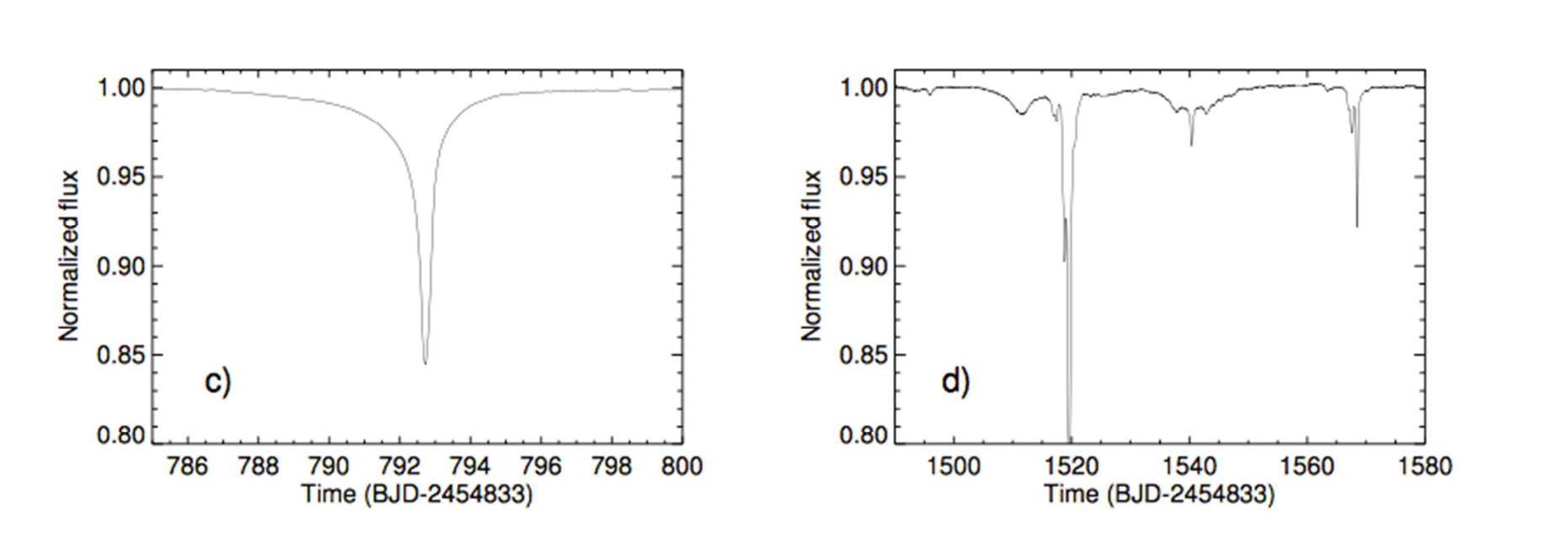
a. Explain why the scientists believe that the object is unlikely to be a star or a planet.
b. Judging from the light curves in the plots above, what would be the area of the Dyson structure?
c. Based on the largest dips, what is the average distance of the Dyson structure from the star? Assume its mass is much smaller than the mass of the central star.
The problem of creating a Dyson structure is that it cannot be free floating in space. One possible solution is creating a cloud of solar sails. These objects would be in perfect balance between the gravity pulling them inwards, and the light pressure pushing them outwards. The luminosity (power output) of the star is .
d. Assuming that the sails are made of a reflective material with reflectivity R, what is the pressure on the sail due to photon bombardment? (momentum of a photon is E/c)
e. What is the force exerted by the photons on the Dyson structure? Assume R = 1.
f. Assuming that the net acceleration of the solar sails is zero, what would be the mass of the structure?
g. Explain why the scenario of building such a structure is unrealistic.
Решение
Внимание: Непълно решение
В архива няма официално решение на тази задача.
Оригинал в Архива: BAAO_2016.pdf · официални решения: BAAO_2016_solutions.pdf