BAAO 2016, Теория — Задача 5. Gravitational lensing
British Astronomy and Astrophysics Olympiad 2015-2016 — Astronomy & Astrophysics Competition Paper — Monday 18th January 2016 · 18 януари 2016 г.
Внимание: Бележка към темата
The official solutions cover Questions 1–3 only (Question 3 as a handwritten scan); there are no official solutions for Questions 4 and 5.
Указания
Time: 3 hours (approximately 35 minutes per question).
Questions: All five questions should be attempted.
Marks: The questions carry similar marks.
Solutions: Answers and calculations are to be written on loose paper or in examination booklets. Students should ensure their name and school is clearly written on all answer sheets and pages are numbered. A standard formula booklet may be supplied.
Instructions: To accommodate students sitting the paper at different times, please do not discuss any aspect of the paper on the internet until 8 am Saturday 23rd January.
Clarity: Solutions must be written legibly, in black pen (the papers are photocopied), and working down the page. Scribble will not be marked and overall clarity is an important aspect of this exam paper.
Eligibility: The International Olympiad will be held during December 2016; all A Level students are eligible to participate, even if they will be attending university in December.
Training Dates and the International Astronomy and Astrophysics Olympiad
Following this round the best students eligible to represent the UK at the International Olympiad in Astronomy and Astrophysics (IOAA) will be invited to attend the Training Camp to be held in the Physics Department at the University of Oxford, (Monday 4th April –Thursday 7th April 2016). Astronomy material will be covered; problem solving skills and observational skills (telescope and naked eye observations) will be developed. At the Training Camp a practical exam and a short theory paper will be sat. Five will be selected for further training. From May there will be mentoring by email to cover some topics and problems, followed by a training camp at the beginning of July and a weekend training camp in autumn.
The IOAA this year will be held in Bhubaneswar, India, from 9th to 19th December 2016.
Important constants
| Speed of light in free space | ||
| Earth’s rotation period | 1 day | 24 hours |
| Earth’s orbital period | 1 year | 365.25 days |
| Parsec | pc | |
| Astronomical Unit | AU | |
| Radius of the Earth | ||
| Radius of the Earth’s orbit | 1 AU | |
| Radius of the Sun | ||
| Mass of the Sun | ||
| Mass of the Earth | ||
| Luminosity of the Sun | ||
| Gravitational constant |
You might find the diagram of an elliptical orbit below useful in solving some of the questions: (see the ellipse figure attached to Qu 2)
Elements of an elliptic orbit:
- a = OA (=PO) semi-major axis
- b = OB (=CO) semi-minor axis
- eccentricity
- F – focus
- P – periapsis (point nearest to F)
- A – apoapsis (point furthest from F)
Kepler’s Third Law: For an elliptical orbit, the square of the period, T, of orbit of an object about the focus is proportional to the cube of the semi-major axis, a (the average of the minimum and maximum distances from the Sun). The constant of proportionality is , where is the mass of the central object.
Magnitudes: The apparent magnitudes of two objects, and , are related to their apparent brightnesses, and , via the formula:
Условие
The deflection of light by a gravitational field was first predicted by Albert Einstein a century ago, suggesting that massive objects can bend light like a classical lens. This prediction was confirmed by Sir Arthur Edington in 1919, while observing a solar eclipse.
Consider a spherically symmetric object with mass M. This object will act like a lens, with an impact parameter b measured from the centre of the object. The angle of deflection due to the massive lens, given by General Relativity, is calculated as:
In a simplified model, the impact parameter may be seen as the shortest separation between the centre of the lens and the path of a particular light ray. The diagram below shows the geometric model of a gravitational lens (Figure 5). Light rays emitted from the source S being deflected by the lens are observed as images S and S. The angles are very small.
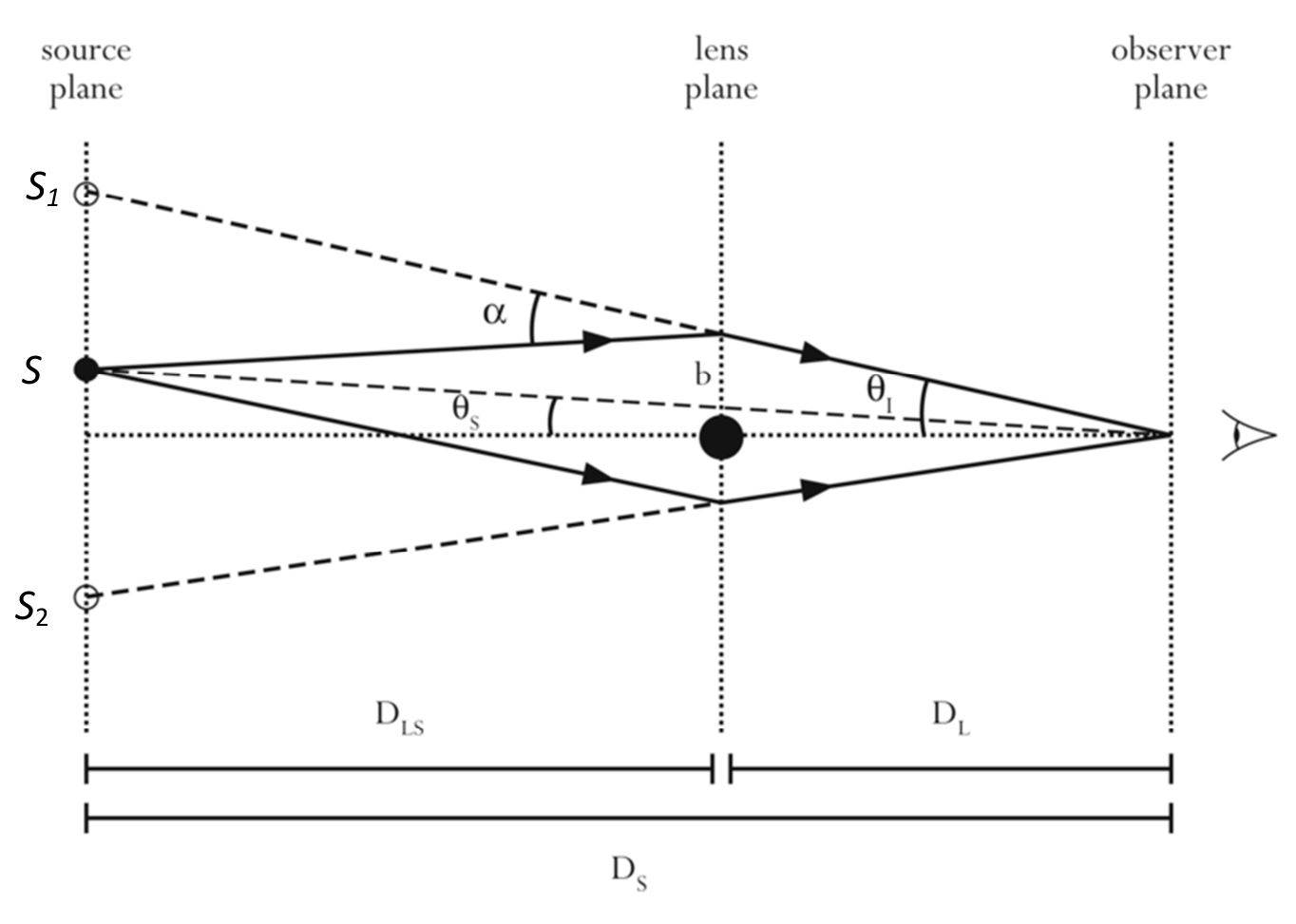
a. Explain how Arthur Eddington might have used the gravitational lens effect to confirm the predictions of General Relativity.
b. Show that the source angle is related to via the expression:
c. For the special case in which the source is perfectly aligned with the lens such that , a ring-like image (called an “Einstein ring”) will occur. Find the angular radius, called the “Einstein radius” , of the ring.
d. Show that the time delay for a photon in the presence of an Einstein Ring is given by:
[You may use the approximation: ]
Extending the example of gravitational lensing into 3 dimensions, instead of two images of the source, sometimes multiple images of the source can be seen, arranged in a cross (called an “Einstein cross”). Last year, astronomers discovered a galaxy that is gravitationally lensed by a giant elliptical galaxy situated in a galaxy cluster in the foreground. Surprisingly, they discovered a supernova explosion (called the Refsdal Supernova) in the image of the lensed galaxy, arranged in an Einstein cross.
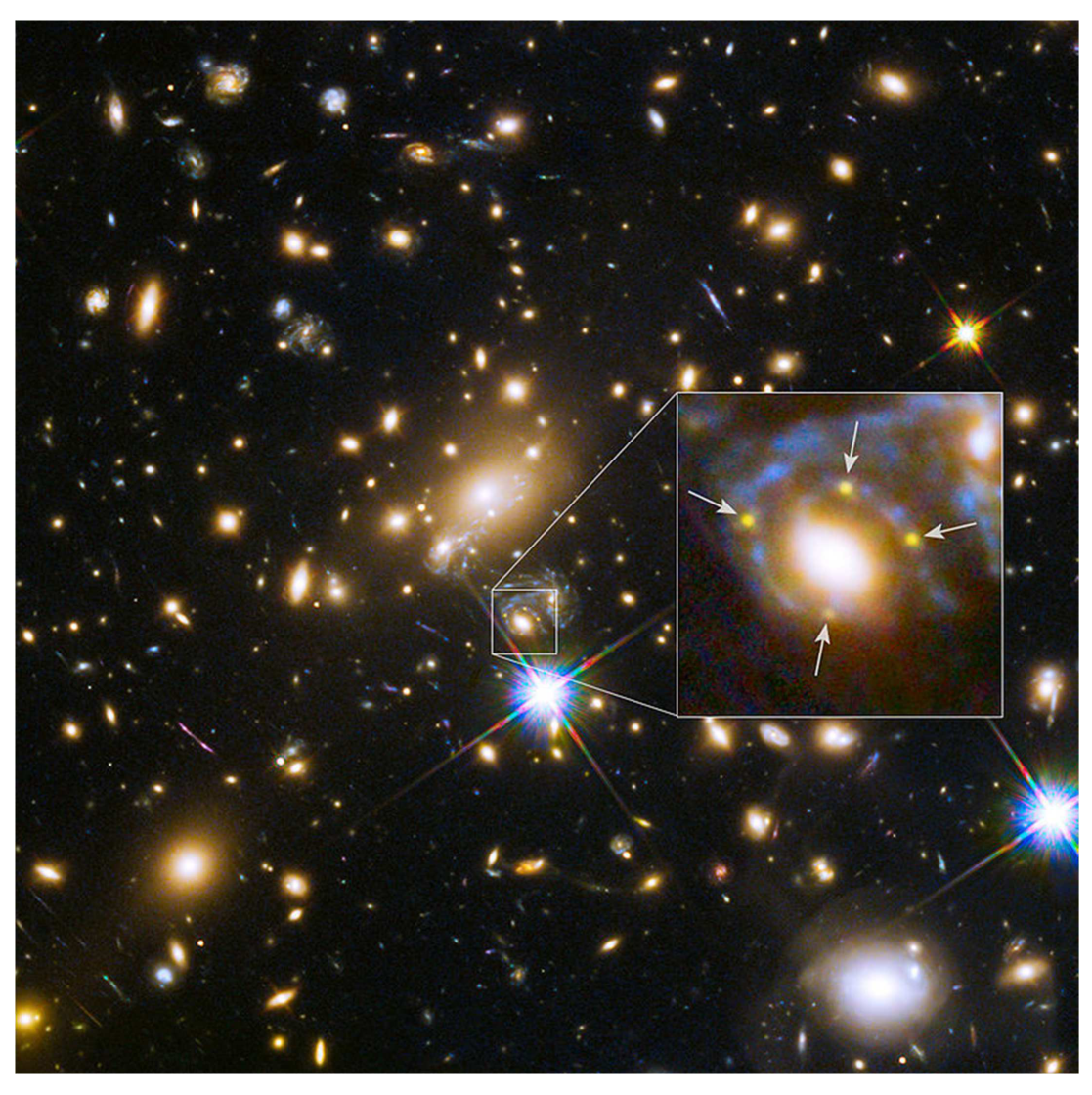
e. By knowing that the distance to the galaxy is 4.4 Gpc, and to the cluster is 2.0 Gpc, find the time delay caused by the lens for a photon from the supernova explosion. You can take the mass of the elliptical galaxy to be = 10^{12}$$M_{\odot}. A Gpc is 10 parsecs.
f. Perhaps even more surprisingly, the astronomers realised that they were seeing the four images of the supernova at different time instances. In some of the pictures they took, images of the supernova were missing. Explain how this is possible.
Решение
Внимание: Непълно решение
В архива няма официално решение на тази задача.
Оригинал в Архива: BAAO_2016.pdf · официални решения: BAAO_2016_solutions.pdf