BAAO 2017, Теория — Задача 1. Martian GPS
British Astronomy and Astrophysics Olympiad 2016-2017 — Astronomy & Astrophysics Competition Paper — Monday 23rd January 2017 · 23 януари 2017 г. · 20 т.
Указания
Time: 3 hours plus 15 minutes reading time (no writing permitted). Approx 35 minutes per question.
Questions: All five questions should be attempted.
Marks: The questions carry similar marks.
Solutions: Answers and calculations are to be written on loose paper or in examination booklets. Students should ensure their name and school is clearly written on all answer sheets and pages are numbered. A standard formula booklet with standard physical constants should be supplied.
Instructions: To accommodate students sitting the paper at different times, please do not discuss any aspect of the paper on the internet until 8 am Saturday 28th January.
Clarity: Solutions must be written legibly, in black pen (the papers are photocopied), and working down the page. Scribble will not be marked and overall clarity is an important aspect of this exam paper.
Eligibility: The International Olympiad will be held during November 2017; all sixth form students are eligible to participate, even if they will be attending university in November.
Training Dates and the International Astronomy and Astrophysics Olympiad (IOAA)
The IOAA this year will be held in Phuket, Thailand, from 12th to 21st November 2017.
The team will be selected from sixth form students taking this paper and Y12 students taking the AS Challenge in March. The best students eligible to represent the UK at the IOAA will be invited to attend the Training Camp to be held in the Physics Department at the University of Oxford, (Tuesday 4th April to Friday 7th April 2017). Astronomy material will be covered; problem solving skills and observational skills (telescope and naked eye observations) will be developed. At the Training Camp a data analysis exam and a short theory paper will be sat. Five students (plus one reserve) will be selected for further training. From May there will be mentoring by email to cover some topics and problems, followed by a training camp in the summer and also one in the autumn.
Important Constants
| Constant | Symbol | Value |
|---|---|---|
| Speed of light | ||
| Earth’s rotation period | 1 day | 24 hours |
| Earth’s orbital period | 1 year | 365.25 days |
| parsec | pc | |
| Astronomical Unit | AU | |
| Radius of the Earth | ||
| Semi-major axis of the Earth’s orbit | 1 AU | |
| Radius of the Sun | ||
| Mass of the Sun | ||
| Mass of the Earth | ||
| Luminosity of the Sun | ||
| Gravitational constant |
You might find the diagram of an elliptical orbit below useful in solving some of the questions:
Elements of an elliptic orbit:
semi-major axis
semi-minor axis
eccentricity
F focus
P periapsis (point nearest to F)
A apoapsis (point furthest from F)
Keplers Third Law: For an elliptical orbit, the square of the period, , of orbit of an object about the focus is proportional to the cube of the semi-major axis, (the average of the minimum and maximum distances from the Sun). The constant of proportionality is , where is the mass of the central object and is the universal gravitational constant.
Magnitudes: The apparent magnitudes of two objects, and , are related to their apparent brightnesses, and , via the formula:
Note for markers
BAAO 2016/17 Solutions and Marking Guidelines
Note for markers:
- Answers to two or three significant figures are generally acceptable. The solution may give more in order to make the calculation clear.
- There are multiple ways to solve some of the questions; please accept all good solutions that arrive at the correct answer. If a candidate gets the final (numerical) answer then allow them all the marks for that part of the question (as indicated in red), so long as there are no unphysical / nonsensical steps or assumptions made.
Условие
On Earth the Global Positioning System (GPS) requires a minimum of 24 satellites in orbit at any one time (there are typically more than that to allow for redundancies, with the current constellation having more than 30) so that at least 4 are visible above the horizon from anywhere on Earth (necessary for an x, y, z and time co-ordinate). This is achieved by having 6 different orbital planes, separated by , and each orbital plane has 4 satellites.
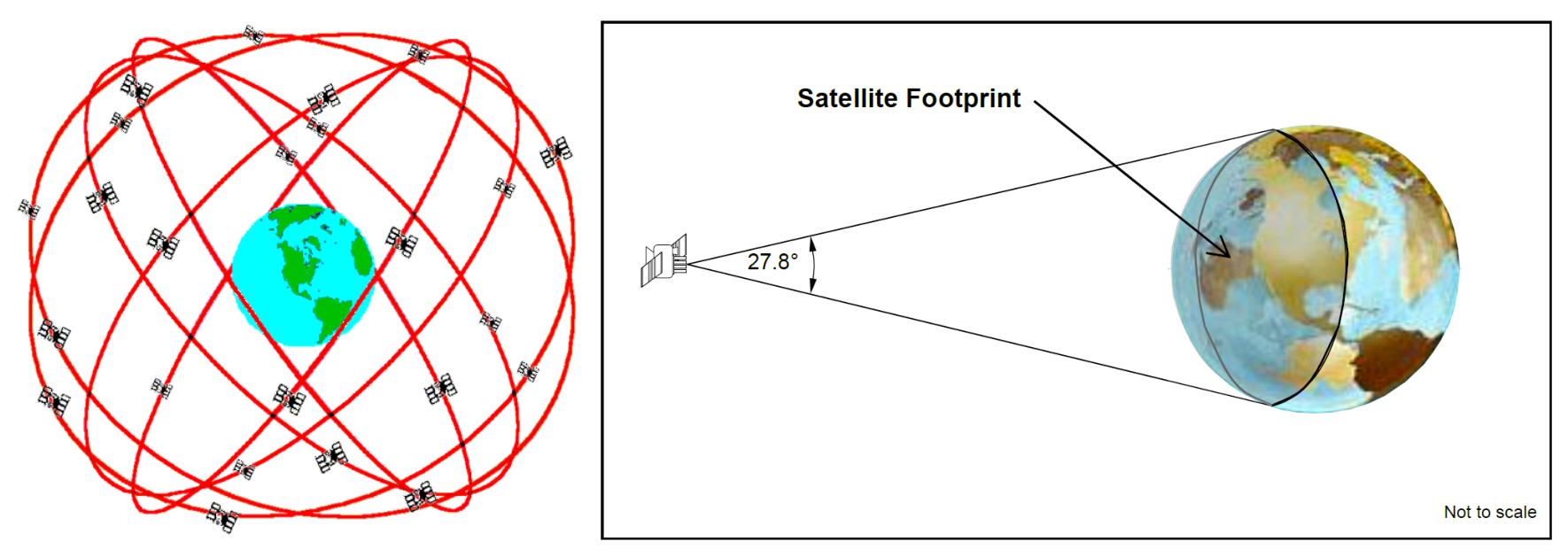
The orbits are essentially circular with an eccentricity , an inclination of , and an orbital period of exactly half a sidereal day (called a semi-synchronous orbit). The receiving angle of each satellite’s antenna needs to be about , and hence about 38% of the Earth’s surface is within each satellite’s footprint (see Figure 1), allowing the excellent coverage required.
a. Given that the Earth’s sidereal day is 23h 56 mins, calculate the orbital radius of a GPS satellite. Express your answer in units of . [3 т.]
b. How long would it take a radio signal to travel directly between a satellite and its closest neighbour in its orbital plane (assuming they’re evenly spaced)? How far would a car on a motorway (with a speed of ) travel in that time? [This can be taken to be a very crude estimate of the positional accuracy of the system for that car.] [3 т.]
In the future we hope to colonise Mars, and so for navigation purposes it is likely that a type of GPS system will eventually be established on Mars too. Mars has a mass of , a mean radius of , a sidereal day of 24h 37 mins, and two (low mass) moons with essentially circular orbits and semi-major axes of (Phobos) and (Deimos).
c. Using suitable calculations, explore the viability of a 24-satellite GPS constellation similar to the one used on Earth, in a semi-synchronous Martian orbit, by considering:
(i) Would the moons prevent such an orbit? [4 т.]
(ii) How would the GPS positional accuracy compare to Earth? [3 т.]
(iii) What would the receiving angle of each satellite’s antenna need to be, and what would be the associated satellite footprint? By comparing these with the ones utilised by Earth’s GPS, make a final comment on the viability of future Martian GPS. [7 т.]
Отговори
a. 4.17 R⊕
b. t = 0.125 s; d = 3.76 m
Решение
Q1 - Martian GPS [Total = 20]
a. Given that the Earth’s sidereal day is 23h 56 mins, calculate the orbital radius of a GPS satellite. Express your answer in units of .
[1]
[1]
[1] [3]
b. How long would it take a radio signal to travel directly between a satellite and its closest neighbour in its orbital plane (assuming they’re evenly spaced)? How far would a car on a motorway (with a speed of 30 m s⁻¹) travel in that time? [This can be taken to be a very crude estimate of the positional accuracy of the system for that car.].
Closest neighbour in orbital plane should be 90° away (since evenly spaced) so can use Pythagoras
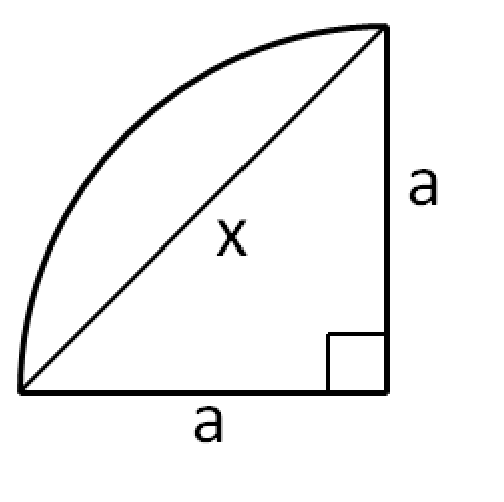
[1]
Time for the signal to travel that distance:
[1] [2]
Distance travelled by a car on a motorway in that time:
[1] [1]
[In practice the positional accuracy of a GPS system is much harder to calculate; at low speeds it is typically a function of fluctuations and reflections of the signal within the atmosphere, as well as the presence of objects that might block the signal]
c. Using suitable calculations, explore the viability of a 24-satellite GPS constellation similar to the one used on Earth, in a semi-synchronous Martian orbit, by considering:
i. Would the moons prevent such an orbit?
[1]
[1]
[1] [3]
This is about ½ the distance to Diemos and about 3500 km (about ) away from Phobos so the moons should not provide a problem for any GPS satellite constellation [1] [1]
ii. How would the GPS positional accuracy compare to Earth?
(Using similar reasoning to part b.)
[1]
[1] [2]
The positional accuracy is about twice as good as on Earth [1] [1]
iii. What would the receiving angle of each satellite’s antenna need to be, and what would be the associated satellite footprint? By comparing these with the ones utilised by Earth’s GPS, make a final comment on the viability of future Martian GPS.
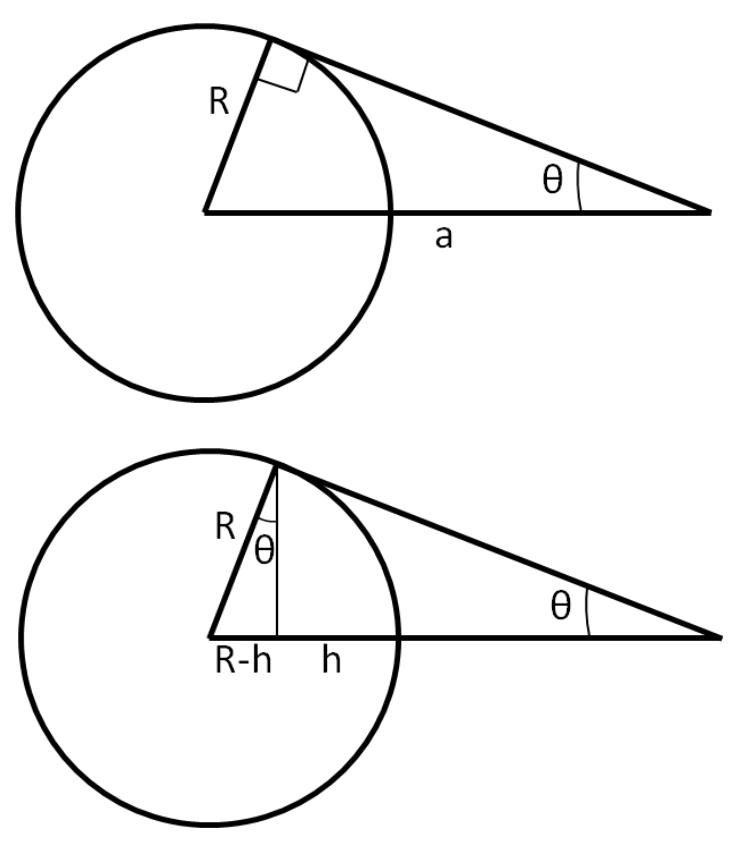
Receiving angle:
[1]
[1] [2]
The area of a 'zone' of a sphere is where is the radial height of the zone. From the geometry of the situation:
[1]
[1]
Fraction of surface area:
[1] [3]
Receiving angle similar to Earth's so can use current GPS satellite technology [0.5]
Satellite footprint similar to Earth's so should get sufficient coverage [0.5]
Martian GPS system is viable [1] [2]
Questions proposed by
END OF PAPER
Questions proposed by:
Dr Alex Calverley (Bedford School)
Dr Emile Doran (The Langley Academy)
Sandor Kruk (University of Oxford)
Оригинал в Архива: BAAO_2017.pdf · официални решения: BAAO_2017_solutions.pdf