BAAO 2017, Теория — Задача 2. Hohmann Transfer Orbits
British Astronomy and Astrophysics Olympiad 2016-2017 — Astronomy & Astrophysics Competition Paper — Monday 23rd January 2017 · 23 януари 2017 г. · 20 т.
Указания
Time: 3 hours plus 15 minutes reading time (no writing permitted). Approx 35 minutes per question.
Questions: All five questions should be attempted.
Marks: The questions carry similar marks.
Solutions: Answers and calculations are to be written on loose paper or in examination booklets. Students should ensure their name and school is clearly written on all answer sheets and pages are numbered. A standard formula booklet with standard physical constants should be supplied.
Instructions: To accommodate students sitting the paper at different times, please do not discuss any aspect of the paper on the internet until 8 am Saturday 28th January.
Clarity: Solutions must be written legibly, in black pen (the papers are photocopied), and working down the page. Scribble will not be marked and overall clarity is an important aspect of this exam paper.
Eligibility: The International Olympiad will be held during November 2017; all sixth form students are eligible to participate, even if they will be attending university in November.
Training Dates and the International Astronomy and Astrophysics Olympiad (IOAA)
The IOAA this year will be held in Phuket, Thailand, from 12th to 21st November 2017.
The team will be selected from sixth form students taking this paper and Y12 students taking the AS Challenge in March. The best students eligible to represent the UK at the IOAA will be invited to attend the Training Camp to be held in the Physics Department at the University of Oxford, (Tuesday 4th April to Friday 7th April 2017). Astronomy material will be covered; problem solving skills and observational skills (telescope and naked eye observations) will be developed. At the Training Camp a data analysis exam and a short theory paper will be sat. Five students (plus one reserve) will be selected for further training. From May there will be mentoring by email to cover some topics and problems, followed by a training camp in the summer and also one in the autumn.
Important Constants
| Constant | Symbol | Value |
|---|---|---|
| Speed of light | ||
| Earth’s rotation period | 1 day | 24 hours |
| Earth’s orbital period | 1 year | 365.25 days |
| parsec | pc | |
| Astronomical Unit | AU | |
| Radius of the Earth | ||
| Semi-major axis of the Earth’s orbit | 1 AU | |
| Radius of the Sun | ||
| Mass of the Sun | ||
| Mass of the Earth | ||
| Luminosity of the Sun | ||
| Gravitational constant |
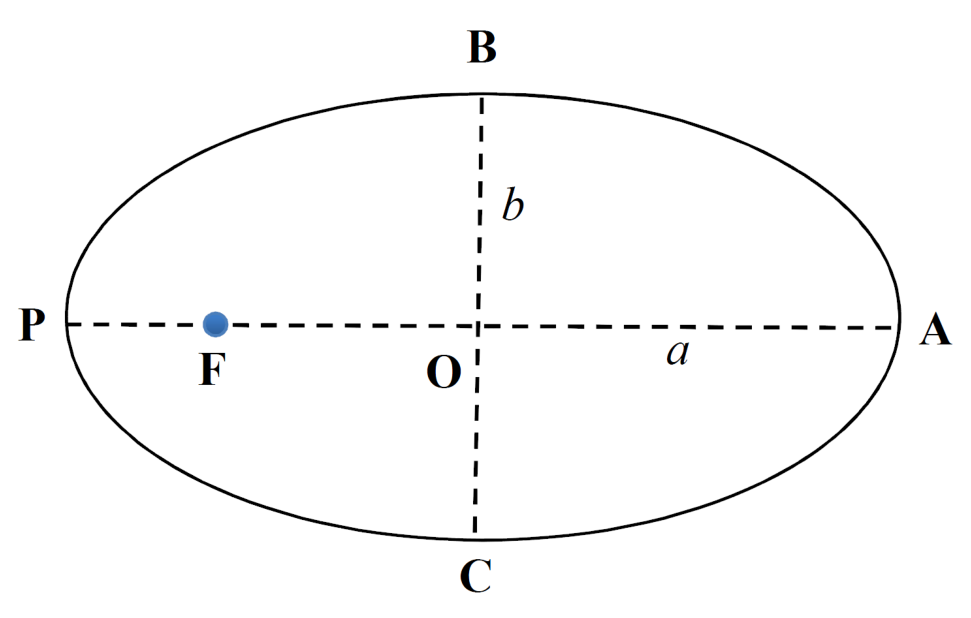
You might find the diagram of an elliptical orbit below useful in solving some of the questions:
Elements of an elliptic orbit:
semi-major axis
semi-minor axis
eccentricity
F focus
P periapsis (point nearest to F)
A apoapsis (point furthest from F)
Keplers Third Law: For an elliptical orbit, the square of the period, , of orbit of an object about the focus is proportional to the cube of the semi-major axis, (the average of the minimum and maximum distances from the Sun). The constant of proportionality is , where is the mass of the central object and is the universal gravitational constant.
Magnitudes: The apparent magnitudes of two objects, and , are related to their apparent brightnesses, and , via the formula:
Note for markers
BAAO 2016/17 Solutions and Marking Guidelines
Note for markers:
- Answers to two or three significant figures are generally acceptable. The solution may give more in order to make the calculation clear.
- There are multiple ways to solve some of the questions; please accept all good solutions that arrive at the correct answer. If a candidate gets the final (numerical) answer then allow them all the marks for that part of the question (as indicated in red), so long as there are no unphysical / nonsensical steps or assumptions made.
Условие
In order to move a spacecraft between orbits we must apply a thrust using rockets, which changes the velocity of the spacecraft by . In this question we will ignore changes in the mass of the spacecraft due to the burning of fuel.
For an object of mass in a circular orbit of radius around an object with mass (where ) the orbital velocity, , is given by the formula .
a. Show that in low Earth orbit (LEO; about above the surface), is about . This is an estimate of the the rockets need to provide for the spacecraft to reach LEO. [2 т.]
An economical route to take when travelling between planets is called a Hohmann transfer orbit. This is an ellipse for which the perihelion coincides with the inner planetary orbit (with radius ) and the aphelion coincides with the outer planetary orbit (with radius ). It is achieved by increasing the velocity of the spacecraft at point A by before then increasing it again at point B by .
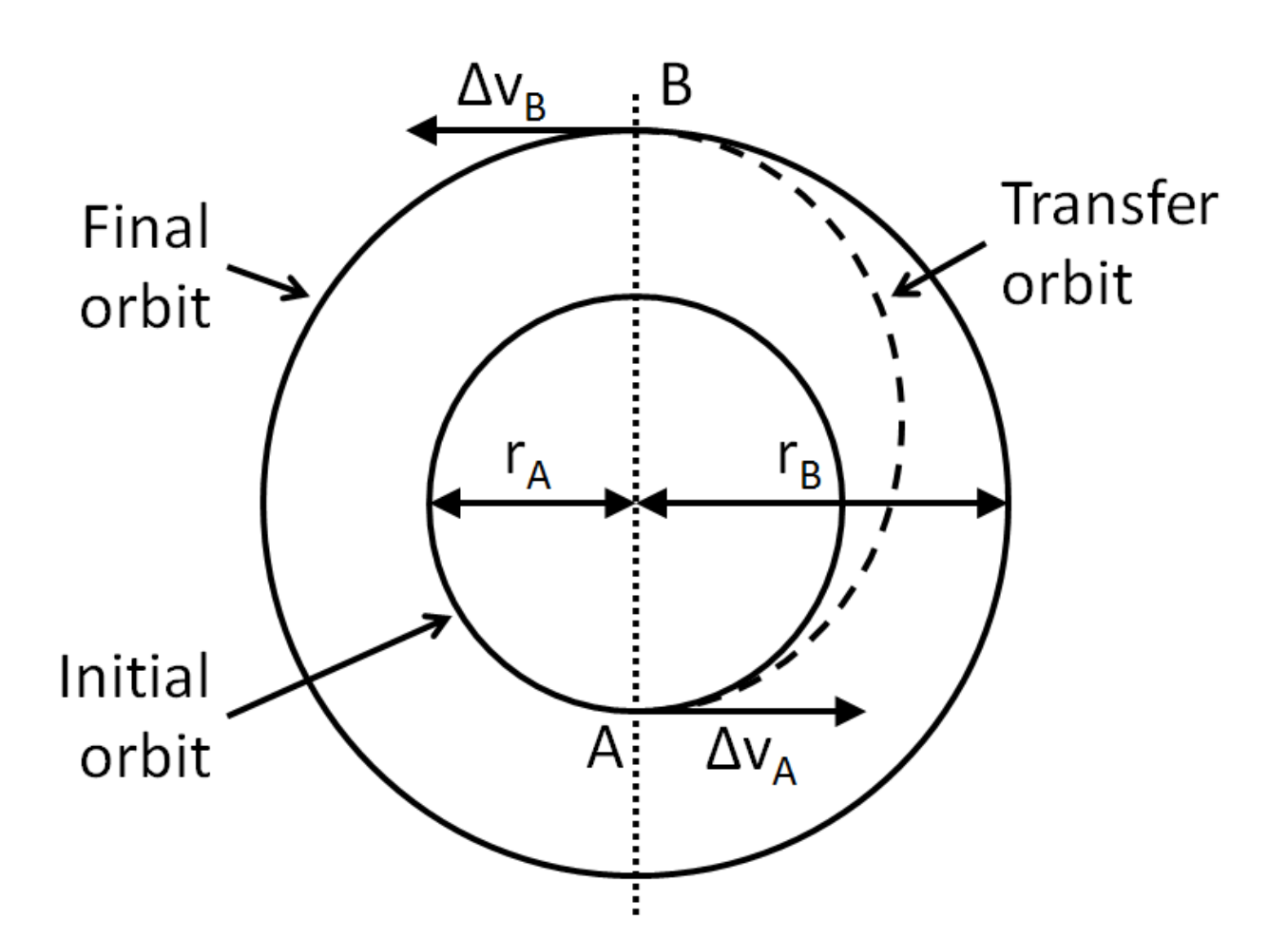
For an ellipse with semi-major axis it can be shown that the velocity , at a distance from mass , can be written as:
b. Derive expressions for and by comparing their circular orbital speeds with their transfer orbit speeds. Simplify your final expressions to include , , and only. [3 т.]
c. Approximating Mars’ orbit as circular with a radius of , calculate the to go from Earth LEO to Mars i.e. . Compare your answer to the to reach Earth LEO. [4 т.]
d. Derive an expression for the total time spent on the transfer orbit, , and calculate it for an Earth to Mars transfer. Give your answer in months. (Use 1 month = 30 days.) [3 т.]
e. Hence calculate the direct distance between Earth and Mars at the moment the spacecraft reaches Mars. How long would it take a radio message from the spacecraft to reach Earth? [3 т.]
f. How long would any astronauts on board the spacecraft need to wait until they could use a Hohmann transfer orbit to return to Earth? Hence calculate the total duration of the mission. [5 т.]
Отговори
- c. 5.58 km s⁻¹
- d. 8.56 months
- e. x = 2.41 × 10¹¹ m (= 1.62 AU); t = 803 s (= 13.4 minutes)
- f. wait 14.8 months (= 443 days); total 31.9 months (= 956 days = 2.66 years)
Решение
Q2 - Hohmann Transfer [Total = 20]
a. Show that in low Earth orbit (LEO; about 200 km above the surface) is about 8 km s⁻¹. This is an estimate of the Δv the rockets need to provide for the spacecraft to reach LEO.
[1]
[1] [2]
[In practice a Δv of 8 km s⁻¹ assumes no external forces, but atmospheric drag can increase the necessary Δv by 1.3 – 1.8 km s⁻¹. When travelling between objects in space, however, such drag forces are absent and so the Δv calculated is much more accurate]
b. Derive expressions for and by comparing their circular orbital speeds with their transfer orbit speeds. Simplify your final expressions to include G, , and only.
[1]
But
[1] [2]
Similarly:
[1] [1]
[These equations have been written so that the change in speed is positive, however give full credit for reversed signs (so long as they are consistent)]
c. Approximating Mars' orbit as circular with a radius of 1.52 AU, calculate the Δv to go from Earth LEO to Mars i.e. . Compare your answer to the Δv to reach Earth LEO.
[1]
[1]
[1] [3]
This is less than the Δv to get into LEO [1] [1]
(So most of the effort needed in going to Mars simply comes from leaving Earth)
[The Δv calculated here would be for the spacecraft to enter a circular orbit around the Sun at the same distance as Mars, but this would not constitute landing – the extra Δv to get to the Martian surface increases the total for the whole transfer to roughly 8 km s⁻¹ (same as to get into LEO). Other, more complicated routes can be taken, some of which offer substantial efficiencies so the Δv for the trip can be much lower (although the time taken to complete the manoeuvre will be longer, and the Δv to reach LEO will still be the biggest single step)]
d. Derive an expression for the total time spent on the transfer orbit, , and calculate it for an Earth to Mars transfer. Give your answer in months. (Use 1 month = 30 days).
From Kepler's third law:
Since the spacecraft only covers half of the ellipse the time on the journey is half the period, and given that then:
[1] [1]
[1]
[1] [2]
e. Hence calculate the direct distance between Earth and Mars at the moment the spacecraft reaches Mars. How long would it take a radio message from the spacecraft to reach Earth?
Initially Earth is at A. When the spacecraft reaches B (after 8.56 months), the Earth has moved round the Sun in its orbit and is now at A'.
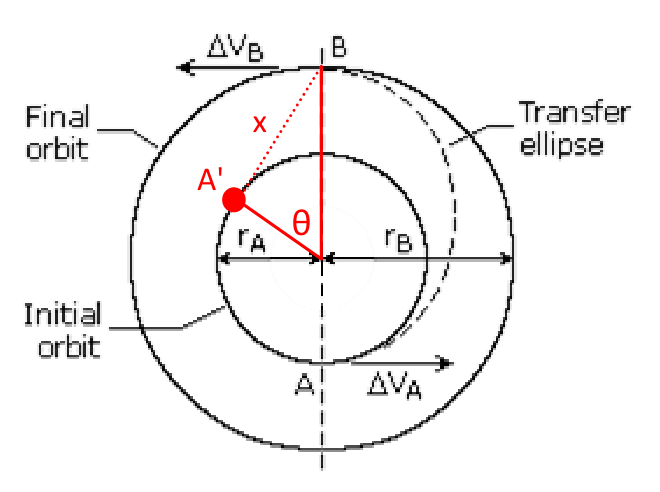
Angle between A' and B:
[1]
Using the cosine rule:
[1] [2]
Since radio waves travel at the speed of light the time taken by the message is:
[1] [1]
[In practice, due to the eccentricity of Mars' orbit, the signal transmission time varies depending on the year the spacecraft was launched. When the rover Curiosity arrived at Mars the engineers described the landing as 7 minutes of terror, since the signal from the spacecraft would take 14 minutes to reach Earth but the time to transverse the Martian atmosphere was only 7 minutes (hence the process had to be completely automated)]
f. How long would any astronauts on board the spacecraft need to wait until they could use a Hohmann transfer orbit to return to Earth? Hence calculate the total duration of the mission.
During the transfer the Earth moves by , so the spacecraft should launch from Mars when Earth is at position A" (exhibiting symmetry with when it arrived).
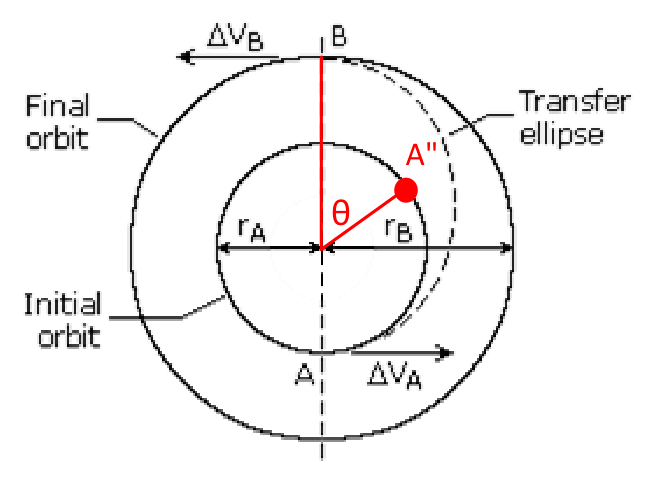
Since the planets move anti-clockwise in this diagram the angle covered by Earth from A' to A" is [1]
From Kepler's third law, the period of Mars [1]
Therefore, the relative angular velocity of Earth if Mars' motion is subtracted out is:
[1]
(allow any equivalent units e.g. 168° year⁻¹, 9.38 × 10⁻⁸ rad s⁻¹ etc.)
Consequently, the time the astronauts need to wait for Earth to get from position A' to A" is:
[1] [4]
Thus the total duration of a return mission to Mars is:
[1] [1]
[Shorter missions are possible, but would require a greater Δv and hence need much more fuel - any future mission will have to balance the cost (and mass) of more fuel on a fast trip with the cost (and mass) of more supplies on a slow trip]
Questions proposed by
END OF PAPER
Questions proposed by:
Dr Alex Calverley (Bedford School)
Dr Emile Doran (The Langley Academy)
Sandor Kruk (University of Oxford)
Оригинал в Архива: BAAO_2017.pdf · официални решения: BAAO_2017_solutions.pdf