BAAO 2017, Теория — Задача 3. Starkiller Base
British Astronomy and Astrophysics Olympiad 2016-2017 — Astronomy & Astrophysics Competition Paper — Monday 23rd January 2017 · 23 януари 2017 г. · 20 т.
Указания
Time: 3 hours plus 15 minutes reading time (no writing permitted). Approx 35 minutes per question.
Questions: All five questions should be attempted.
Marks: The questions carry similar marks.
Solutions: Answers and calculations are to be written on loose paper or in examination booklets. Students should ensure their name and school is clearly written on all answer sheets and pages are numbered. A standard formula booklet with standard physical constants should be supplied.
Instructions: To accommodate students sitting the paper at different times, please do not discuss any aspect of the paper on the internet until 8 am Saturday 28th January.
Clarity: Solutions must be written legibly, in black pen (the papers are photocopied), and working down the page. Scribble will not be marked and overall clarity is an important aspect of this exam paper.
Eligibility: The International Olympiad will be held during November 2017; all sixth form students are eligible to participate, even if they will be attending university in November.
Training Dates and the International Astronomy and Astrophysics Olympiad (IOAA)
The IOAA this year will be held in Phuket, Thailand, from 12th to 21st November 2017.
The team will be selected from sixth form students taking this paper and Y12 students taking the AS Challenge in March. The best students eligible to represent the UK at the IOAA will be invited to attend the Training Camp to be held in the Physics Department at the University of Oxford, (Tuesday 4th April to Friday 7th April 2017). Astronomy material will be covered; problem solving skills and observational skills (telescope and naked eye observations) will be developed. At the Training Camp a data analysis exam and a short theory paper will be sat. Five students (plus one reserve) will be selected for further training. From May there will be mentoring by email to cover some topics and problems, followed by a training camp in the summer and also one in the autumn.
Important Constants
| Constant | Symbol | Value |
|---|---|---|
| Speed of light | ||
| Earth’s rotation period | 1 day | 24 hours |
| Earth’s orbital period | 1 year | 365.25 days |
| parsec | pc | |
| Astronomical Unit | AU | |
| Radius of the Earth | ||
| Semi-major axis of the Earth’s orbit | 1 AU | |
| Radius of the Sun | ||
| Mass of the Sun | ||
| Mass of the Earth | ||
| Luminosity of the Sun | ||
| Gravitational constant |
You might find the diagram of an elliptical orbit below useful in solving some of the questions:
Elements of an elliptic orbit:
semi-major axis
semi-minor axis
eccentricity
F focus
P periapsis (point nearest to F)
A apoapsis (point furthest from F)
Keplers Third Law: For an elliptical orbit, the square of the period, , of orbit of an object about the focus is proportional to the cube of the semi-major axis, (the average of the minimum and maximum distances from the Sun). The constant of proportionality is , where is the mass of the central object and is the universal gravitational constant.
Magnitudes: The apparent magnitudes of two objects, and , are related to their apparent brightnesses, and , via the formula:
Note for markers
BAAO 2016/17 Solutions and Marking Guidelines
Note for markers:
- Answers to two or three significant figures are generally acceptable. The solution may give more in order to make the calculation clear.
- There are multiple ways to solve some of the questions; please accept all good solutions that arrive at the correct answer. If a candidate gets the final (numerical) answer then allow them all the marks for that part of the question (as indicated in red), so long as there are no unphysical / nonsensical steps or assumptions made.
Условие
As part of their plan to rule the galaxy the First Order has created the Starkiller Base. Built within an ice planet and with a superweapon capable of destroying entire star systems, it is charged using the power of stars. The Starkiller Base has moved into the solar system and seeks to use the Sun to power its weapon to destroy the Earth.
For this question you will need that the gravitational binding energy, , of a uniform density spherical object with mass and radius is given by
and that the mass-luminosity relation of low-mass main sequence stars is given by .
a. Assume the Sun was initially made of pure hydrogen, carries out nuclear fusion at a constant rate and will continue to do so until the hydrogen in its core is used up. If the mass of the core is 10% of the mass of the star, and 0.7% of the mass in each fusion reaction is converted into energy, show that the Sun’s lifespan on the main sequence is approximately 10 billion years. [2 т.]
b. The Starkiller Base is able to stop nuclear fusion in the Sun’s core.
(i) At its current luminosity, how long would it take the Sun to radiate away all of its gravitational binding energy? (This is an estimate of how long it would take to drain a whole star when radiatively charging the superweapon.) [2 т.]
(ii) How does your value compare to the main sequence lifetime of the Sun calculated in part a.? [1 т.]
(iii) Comment on whether there were (or will be) any events in the life of the Sun with a timescale of this order of magnitude. [1 т.]
c. In practice, the gravitational binding energy of the Earth is much lower than that of the Sun, and so the First Order would not need to drain the whole star to get enough energy to destroy the Earth. Assuming the weapon is able to channel towards it all the energy being radiated from the Sun’s entire surface, how long would it take them to charge the superweapon sufficiently to do this? [2 т.]
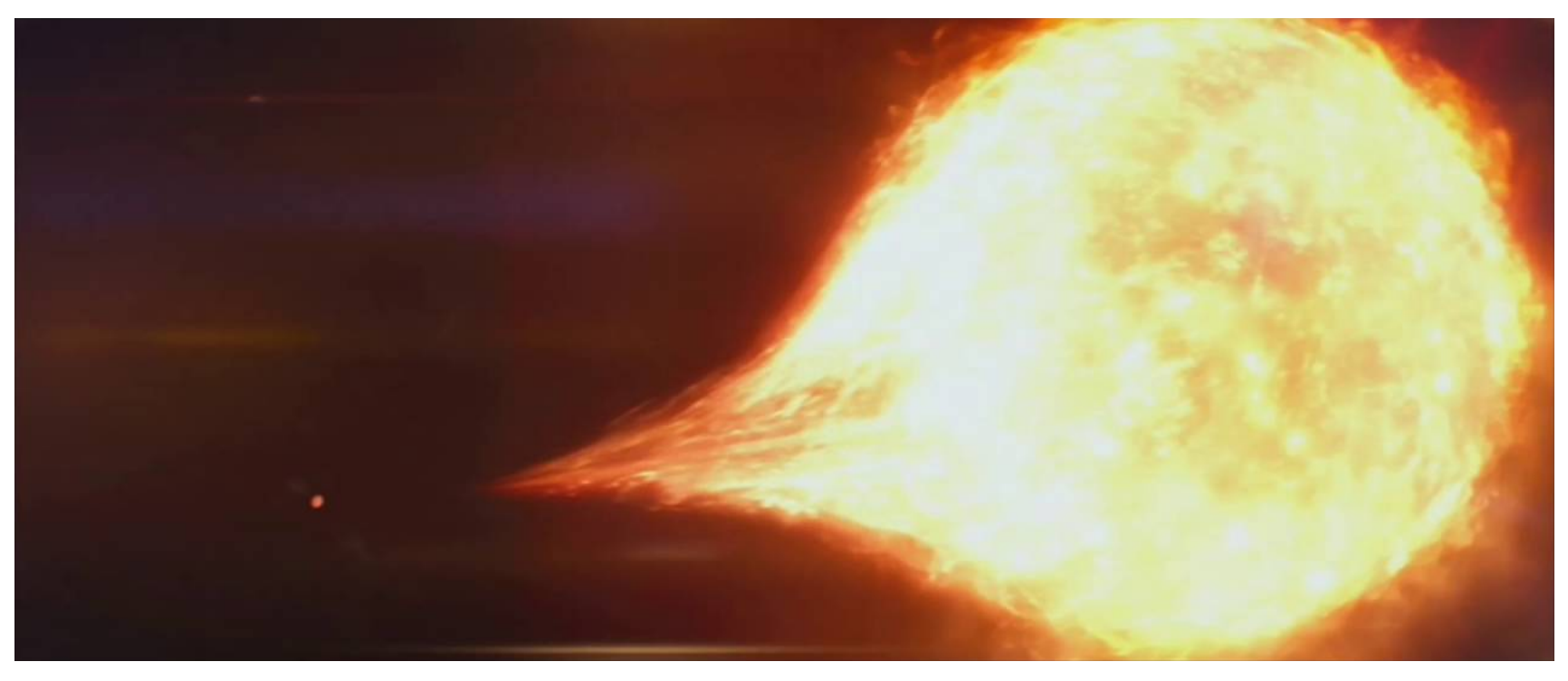
The First Order find that radiative charging of the weapon is too slow to satisfy their plans for galactic domination, and so instead the weapon charging process compresses and stores part of the star within the Starkiller Base (as shown in Figure 3). To avoid creating a black hole, the First Order cannot compress stellar matter below its Schwarzschild radius, .
d. Taking the Starkiller Base’s ice planet to have a diameter of 660 km, show that the Sun can be safely contained, even if it was fully drained. [2 т.]
e. The Starkiller Base wants to destroy all the planets in a stellar system on the far side of the galaxy and so drains from the Sun to charge its weapon. Assuming that the per unit volume of the Sun stays approximately constant during this process, calculate:
(i) The new luminosity of the Sun. [1 т.]
(ii) The new radius of the Sun. [2 т.]
(iii) The new temperature of the surface of the Sun (current K), and suggest (with a suitable calculation) what change will be seen in terms of its colour. [4 т.]
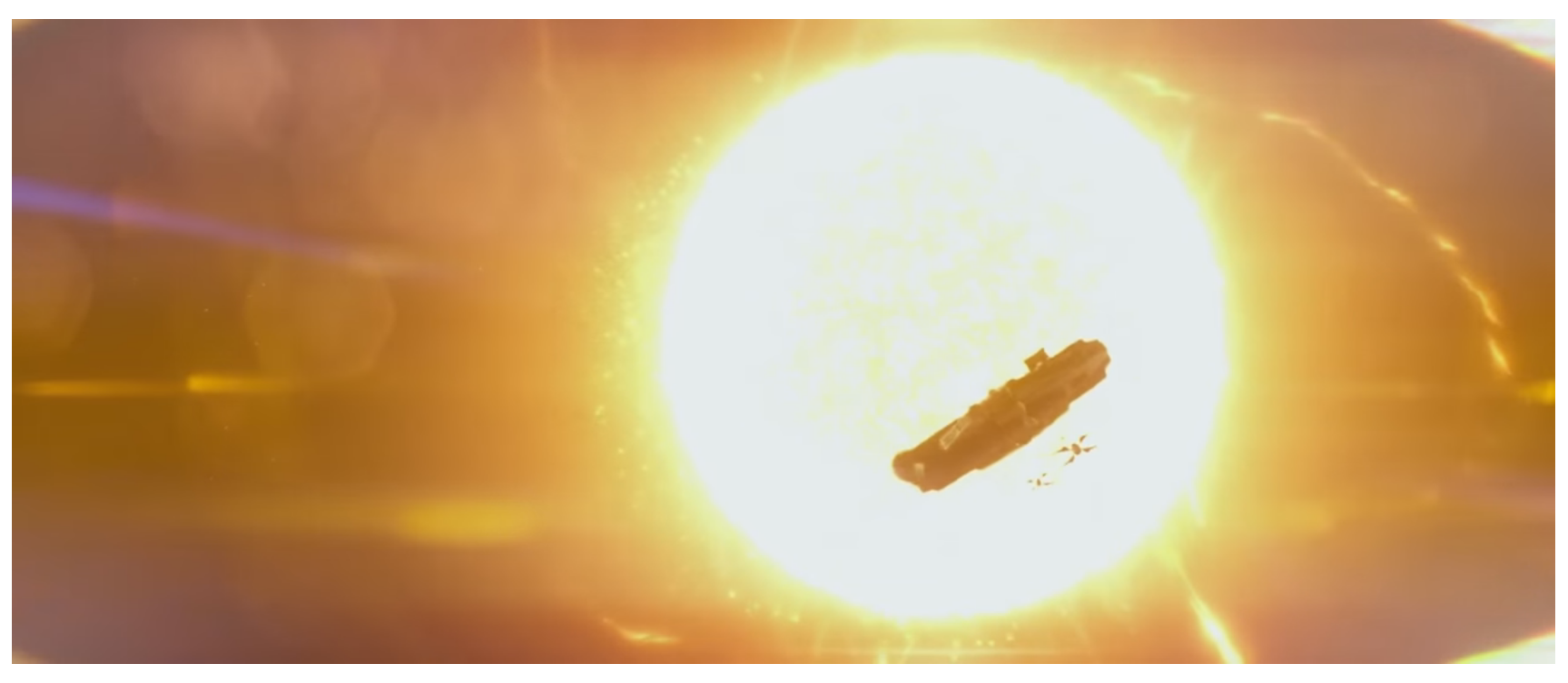
The Resistance defeat the First Order and destroy the Starkiller Base when it was almost fully charged. Upon releasing the energy stored in the base it causes the planet to turn into a small star.
f. Assume that at the moment of destruction of the Starkiller Base the mass of the new star formed is equal to the mass drained from the Sun (). Derive an expression for the main sequence lifetime in terms of stellar mass, and hence calculate the main sequence lifetime of this new star. [3 т.]
Отговори
(i) s
= 18.7 Myr
c. 582000 s
= 6.7 days
f. years
Решение
Q3 - Starkiller Base [Total = 20]
a. Assume the Sun was initially made of pure hydrogen, carries out nuclear fusion at a constant rate and will continue to do so until the hydrogen in its core is used up. If the mass of the core is 10% of the star, and 0.7% of the mass in each fusion reaction is converted into energy, show that the Sun’s lifespan on the main sequence is approximately 10 billion years.
Time on main sequence = total nuclear energy available / luminosity
[1]
[1] [2]
b. The Starkiller Base is able to stop nuclear fusion in the Sun’s core
i. At its current luminosity, how long would it take the Sun to radiate away all of its gravitational binding energy? (This is an estimate of how long it would take to drain a whole star when radiatively charging the superweapon.)
Time radiating energy = total gravitational binding energy / luminosity
[1]
[1] [2]
ii. How does your value compare to the main sequence lifetime of the Sun calculated in part a.?
This is much shorter than [1] [1]
iii. Comment on whether there were (or will be) any events in the life of the Sun with a timescale of this order of magnitude.
An event in the Sun's life that happened on a timescale of this order of magnitude is the gravitational collapse of the protostar before it joined the main sequence [1] [1]
[The Sun will also be on the asymptotic giant branch (AGB) for a similar order of magnitude of time - this is when the core is completely carbon / oxygen (but no longer undergoing fusion) and there is a spherical shell of helium burning happening just outside the core (with a shell outside that of hydrogen burning). Credit this answer too if a student mentions it.]
c. In practice, the gravitational binding energy of the Earth is much lower than that of the Sun, and so the First Order would not need to drain the whole star to get enough energy to destroy the Earth. Assuming the weapon is able to channel towards it all the energy being radiated from the Sun’s entire surface, how long would it take them to charge the superweapon sufficiently to do this?
Time charging the weapon = total energy needed / rate of energy transfer
[1]
[1] [2]
(So it would only take a week to absorb enough energy from the Sun to destroy the Earth!)
d. Taking the Starkiller Base’s ice planet to have a diameter of 660 km, show that the Sun can be safely contained, even if it was fully drained.
Need to work out the Schwarzschild radius for the Sun, and compare it to the size of the base
[1] [1]
(About 100 times) Smaller than the radius of the base the Sun can be safely contained [1] [1]
e. The Starkiller Base wants to destroy all the planets in a stellar system on the far side of the galaxy and so drains 0.10 from the Sun to charge its weapon. Assuming that the U per unit volume of the Sun stays approximately constant during this process, calculate:
i. The new luminosity of the Sun.
Need to use the mass-luminosity relation for main sequence stars () to work out the luminosity of a star (since that is the new mass of the Sun)
[1] [1]
ii. The new radius of the Sun.
Energy density = U / V = constant
[1]
[1] [2]
iii. The new temperature of the surface of the Sun (current = 5780 K), and suggest (with a suitable calculation) what change will be seen in terms of its colour.
Need to use the Stephan-Boltzmann Law to get the new temperature and then Wien's Law to determine the effect on the peak wavelength (and hence the colour)
[1]
[1] [2]
[1] [1]
This is a longer wavelength than the current peak (500 nm) so the Sun is redder [1] [1]
f. Assume that at the moment of destruction of the Starkiller Base the mass of the new star formed is equal to the mass drained from the Sun (0.10 ). Derive an expression for the main sequence lifetime in terms of stellar mass, and hence calculate the main sequence lifetime of this new star.
We can combine the mass-luminosity relation with the expression we used in part a.
[1] [1]
[1]
[1] [2]
Questions proposed by
END OF PAPER
Questions proposed by:
Dr Alex Calverley (Bedford School)
Dr Emile Doran (The Langley Academy)
Sandor Kruk (University of Oxford)
Оригинал в Архива: BAAO_2017.pdf · официални решения: BAAO_2017_solutions.pdf