BAAO 2017, Теория — Задача 4. Hanny’s Voorwerp
British Astronomy and Astrophysics Olympiad 2016-2017 — Astronomy & Astrophysics Competition Paper — Monday 23rd January 2017 · 23 януари 2017 г. · 20 т.
Указания
Time: 3 hours plus 15 minutes reading time (no writing permitted). Approx 35 minutes per question.
Questions: All five questions should be attempted.
Marks: The questions carry similar marks.
Solutions: Answers and calculations are to be written on loose paper or in examination booklets. Students should ensure their name and school is clearly written on all answer sheets and pages are numbered. A standard formula booklet with standard physical constants should be supplied.
Instructions: To accommodate students sitting the paper at different times, please do not discuss any aspect of the paper on the internet until 8 am Saturday 28th January.
Clarity: Solutions must be written legibly, in black pen (the papers are photocopied), and working down the page. Scribble will not be marked and overall clarity is an important aspect of this exam paper.
Eligibility: The International Olympiad will be held during November 2017; all sixth form students are eligible to participate, even if they will be attending university in November.
Training Dates and the International Astronomy and Astrophysics Olympiad (IOAA)
The IOAA this year will be held in Phuket, Thailand, from 12th to 21st November 2017.
The team will be selected from sixth form students taking this paper and Y12 students taking the AS Challenge in March. The best students eligible to represent the UK at the IOAA will be invited to attend the Training Camp to be held in the Physics Department at the University of Oxford, (Tuesday 4th April to Friday 7th April 2017). Astronomy material will be covered; problem solving skills and observational skills (telescope and naked eye observations) will be developed. At the Training Camp a data analysis exam and a short theory paper will be sat. Five students (plus one reserve) will be selected for further training. From May there will be mentoring by email to cover some topics and problems, followed by a training camp in the summer and also one in the autumn.
Important Constants
| Constant | Symbol | Value |
|---|---|---|
| Speed of light | ||
| Earth’s rotation period | 1 day | 24 hours |
| Earth’s orbital period | 1 year | 365.25 days |
| parsec | pc | |
| Astronomical Unit | AU | |
| Radius of the Earth | ||
| Semi-major axis of the Earth’s orbit | 1 AU | |
| Radius of the Sun | ||
| Mass of the Sun | ||
| Mass of the Earth | ||
| Luminosity of the Sun | ||
| Gravitational constant |
You might find the diagram of an elliptical orbit below useful in solving some of the questions:
Elements of an elliptic orbit:
semi-major axis
semi-minor axis
eccentricity
F focus
P periapsis (point nearest to F)
A apoapsis (point furthest from F)
Keplers Third Law: For an elliptical orbit, the square of the period, , of orbit of an object about the focus is proportional to the cube of the semi-major axis, (the average of the minimum and maximum distances from the Sun). The constant of proportionality is , where is the mass of the central object and is the universal gravitational constant.
Magnitudes: The apparent magnitudes of two objects, and , are related to their apparent brightnesses, and , via the formula:
Note for markers
BAAO 2016/17 Solutions and Marking Guidelines
Note for markers:
- Answers to two or three significant figures are generally acceptable. The solution may give more in order to make the calculation clear.
- There are multiple ways to solve some of the questions; please accept all good solutions that arrive at the correct answer. If a candidate gets the final (numerical) answer then allow them all the marks for that part of the question (as indicated in red), so long as there are no unphysical / nonsensical steps or assumptions made.
Условие
Hanny’s Voorwerp (Dutch for ‘object’) is a rare type of astronomical object discovered in 2007 by the school teacher Hanny van Arkel whilst participating as a volunteer in the Galaxy Zoo project. When inspecting the image of the galaxy IC 2497 in the constellation Leo Minor, she observed a bright green blob close to the galaxy.
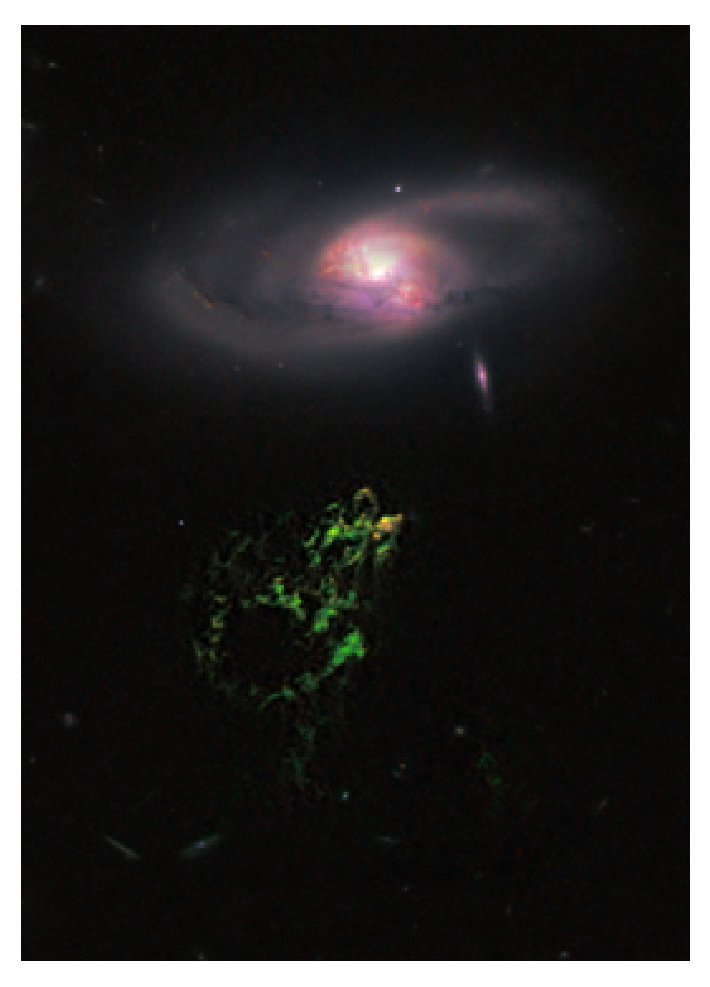
Subsequent observations have shown that the galaxy IC 2497 is at a redshift of , with the Voorwerp at a similar distance and with a projected angular separation of 20 arcseconds from the centre of the galaxy (3600 arcseconds = ). Radio observations suggest that the Voorwerp is a massive cloud of gas, made of ionized hydrogen, with a size of 10 kpc and a mass of . It is probably a cloud of gas that was stripped from the galaxy during a merger with another nearby galaxy.
In this question you will explore the cause of the ‘glow’ of the Voorwerp and will learn about a new type of an astronomical object; a quasar.
a. Given that Hubble’s constant is measured as , calculate the distance to the galaxy (in Mpc). [2 т.]
The rate of ionizing photons from a source (in photons per second) can be expressed as:
where is the volume of the ionized region, is the number density of the ionized gas and is the ionization coefficient, .
b. Calculate the power (luminosity) of the source required to completely ionize the Voorwerp (assumed to be spherical), given that the mass of a hydrogen atom is kg and the ionization energy of hydrogen is 13.6 eV, where 1 eV = J. [5 т.]
One possible source of ionizing radiation is the jet arising from the accretion of material onto the supermassive black hole (SMBH) situated in the centre of the galaxy. This produces an enormous amount of energy, greatly brightening the galaxy; a galaxy shining due to this process is known as a quasar.
c. The gravitational potential energy of the material falling to radius , which in this case is a black hole with radius equal to the Schwarzschild radius, , at a mass accretion rate , is converted into radiation with an efficiency of . Show that the power (luminosity) output of the SMBH is given by:
[2 т.]
d. The typical mass accretion rate onto an active SMBH is and the typical efficiency is . Calculate the typical luminosity of a quasar. Compare the luminosity of the quasar with the power needed to ionize the Voorwerp. [3 т.]
Detailed astronomical observations have shown than the nucleus of the galaxy has a modest luminosity of W, thus the black hole in IC 2497 is not currently active (i.e. the accretion rate is very low). Quasars are thought to ignite every time the black hole starts accreting a fresh source of matter, and switch off once that supply is exhausted. Therefore, this might be the first evidence of a quasar switching off recently (by astronomical standards), with the Voorwerp reflecting the light emitted by the quasar whilst it was still active. This would make the Voorwerp a ‘quasar ionization echo’ and IC 2497 the nearest galaxy to us to host a quasar.
e. Calculate the projected physical separation, , between the galaxy and the Voorwerp. [2 т.]
f. Derive an expression for the difference in the light travel time between photons travelling directly to Earth from the galaxy and photons reflected off the Voorwerp first. Give your formula as a function of and , where is the angle between the lines of sight to the Earth and to the centre of the Voorwerp as measured by an observer at the centre of IC 2497. (For example would correspond to the galaxy and Voorwerp both being the exact same distance from the Earth, and so the projected distance is therefore also the true distance between them.) [5 т.]
g. High precision measurements showed that the Voorwerp is slightly further away than the galaxy, and so . Use this with your expression from the previous part of the question to estimate an upper limit for the number of years that have passed since the quasar was last active. [1 т.]
Отговори
a. 214 Mpc
b. W
Full credit also for taking 10 kpc as the diameter: photons s⁻¹, W.
d. W
e. 20.8 kpc
f.
g. 130000 years
s
Решение
Q4 - Hanny's Voorwerp [Total = 20]
a. Given that Hubble’s constant is measured as = 70 km s⁻¹ Mpc⁻¹, calculate the distance to the galaxy (in Mpc).
Need to turn the redshift into a recessional velocity and then combine with Hubble's Law
[1]
[1] [2]
b. Calculate the power (luminosity) of the source required to completely ionize the Voorwerp (assumed to be spherical), given that the mass of a hydrogen atom is 1.67 × 10⁻²⁷ kg and the ionization energy of hydrogen is 13.6 eV, where 1 eV = 1.60 × 10⁻¹⁹ J.
Given we know the radius of the cloud (10 kpc) and the mass () we can work out the number density of hydrogen atoms
[1]
[1]
[1]
(watch that the units of α are converted correctly to SI)
The luminosity can then be calculated as we know the energy of each photon
[1]
[1] [5]
(Allow full credit for interpreting the 10 kpc 'size' of the cloud to mean its diameter rather than its radius, giving S* = 2.39 × 10⁵⁶ photons s⁻¹ and L = 5.20 × 10³⁸ W)
[Working out S* directly may prove difficult for some calculators as (M/m)² may exceed their largest power of ten, in which case students should work out √S* and then square it later.]
c. The gravitational potential energy of the material falling to radius R, which in this case is a black hole with radius equal to the Schwarzschild radius, , at a mass accretion rate , is converted into radiation with an efficiency of . Show that the power (luminosity) output of the SMBH is given by .
We know the gravitational potential energy of a particle of mass m at the Schwarzschild radius is the same as the kinetic energy it has gained moving from infinity to that point, so
[1]
Given that a fraction η is converted into radiation and the given mass accretion rate then
[1] [2]
(So the maximum energy you can get from a black hole is half the rest mass energy of the material falling in – this is a much more efficient process for generating energy than the 0.7% you get from nuclear fusion in stars, which in themselves are much more efficient than chemical reactions!)
d. The typical mass accretion rate onto an active SMBH is ∼2 yr⁻¹ and the typical efficiency is η = 0.1. Calculate the typical luminosity of a quasar. Compare the luminosity of the quasar with the power needed to ionize the Voorwerp.
Need to convert the mass accretion rate into kg s⁻¹ and then put into the formula
[1]
[1] [2]
The luminosity of the quasar is high enough to ionize the Voorwerp [1] [1]
e. Calculate the projected physical separation, , between the galaxy and the Voorwerp.
Since the angle is so small, we can use the small angle approximation for tan θ ≈ θ
[0.5]
[0.5]
[1] [2]
f. Derive an expression for the difference in the light travel time between photons travelling directly to Earth from the galaxy and photons reflected off the Voorwerp first. Give your formula as a function of and θ, where θ is the angle between the lines of sight to the Earth and to the centre of the Voorwerp as measured by an observer at the centre of IC 2497. (For example θ = 90° would correspond to the galaxy and Voorwerp both being the exact same distance from the Earth, and so the projected distance is therefore also the true distance between them.)
Given the small angular separation we can treat the light rays from the galaxy to Earth and from the Voorwerp to Earth as essentially parallel, and so the difference in light travel time comes from the extra distance travelled in being reflected off the Voorwerp
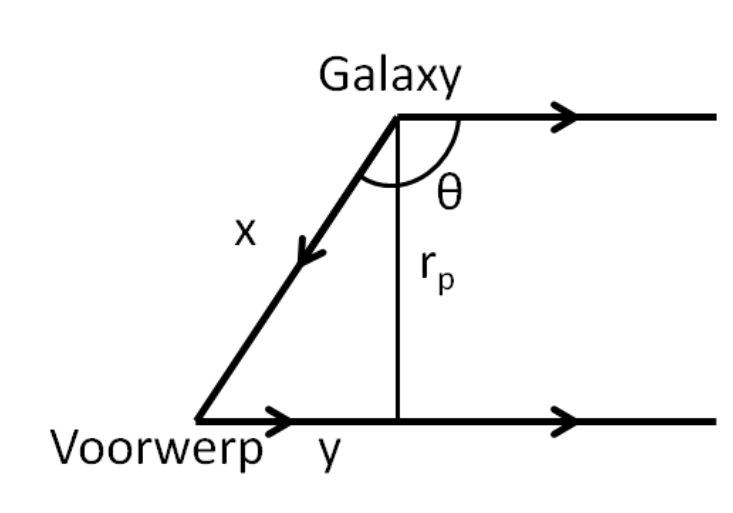
Relevant diagram, suitably labelled [2]
Extra distance = x + y
[1]
[1]
[1] [5]
(alternative form)
[Allow any equivalent formula, for example expressing it in terms of csc θ and cot θ, so long as some attempt has been made to simplify it. It is quicker and simpler to derive if θ is assumed to be acute – we show it this way in case students see that the angle is obtuse from the next part of the question and want to have a consistent picture throughout]
g. High precision measurements showed that the Voorwerp is slightly further away than the galaxy, and so θ = 125°. Use this with your expression from the previous part of the question to estimate an upper limit for the number of years that have passed since the quasar was last active.
[0.5]
[0.5] [1]
(This is remarkably recent on astronomical timescales!)
Questions proposed by
END OF PAPER
Questions proposed by:
Dr Alex Calverley (Bedford School)
Dr Emile Doran (The Langley Academy)
Sandor Kruk (University of Oxford)
Оригинал в Архива: BAAO_2017.pdf · официални решения: BAAO_2017_solutions.pdf