BAAO 2017, Теория — Задача 5. Imaging an Exoplanet
British Astronomy and Astrophysics Olympiad 2016-2017 — Astronomy & Astrophysics Competition Paper — Monday 23rd January 2017 · 23 януари 2017 г. · 20 т.
Указания
Time: 3 hours plus 15 minutes reading time (no writing permitted). Approx 35 minutes per question.
Questions: All five questions should be attempted.
Marks: The questions carry similar marks.
Solutions: Answers and calculations are to be written on loose paper or in examination booklets. Students should ensure their name and school is clearly written on all answer sheets and pages are numbered. A standard formula booklet with standard physical constants should be supplied.
Instructions: To accommodate students sitting the paper at different times, please do not discuss any aspect of the paper on the internet until 8 am Saturday 28th January.
Clarity: Solutions must be written legibly, in black pen (the papers are photocopied), and working down the page. Scribble will not be marked and overall clarity is an important aspect of this exam paper.
Eligibility: The International Olympiad will be held during November 2017; all sixth form students are eligible to participate, even if they will be attending university in November.
Training Dates and the International Astronomy and Astrophysics Olympiad (IOAA)
The IOAA this year will be held in Phuket, Thailand, from 12th to 21st November 2017.
The team will be selected from sixth form students taking this paper and Y12 students taking the AS Challenge in March. The best students eligible to represent the UK at the IOAA will be invited to attend the Training Camp to be held in the Physics Department at the University of Oxford, (Tuesday 4th April to Friday 7th April 2017). Astronomy material will be covered; problem solving skills and observational skills (telescope and naked eye observations) will be developed. At the Training Camp a data analysis exam and a short theory paper will be sat. Five students (plus one reserve) will be selected for further training. From May there will be mentoring by email to cover some topics and problems, followed by a training camp in the summer and also one in the autumn.
Important Constants
| Constant | Symbol | Value |
|---|---|---|
| Speed of light | ||
| Earth’s rotation period | 1 day | 24 hours |
| Earth’s orbital period | 1 year | 365.25 days |
| parsec | pc | |
| Astronomical Unit | AU | |
| Radius of the Earth | ||
| Semi-major axis of the Earth’s orbit | 1 AU | |
| Radius of the Sun | ||
| Mass of the Sun | ||
| Mass of the Earth | ||
| Luminosity of the Sun | ||
| Gravitational constant |
You might find the diagram of an elliptical orbit below useful in solving some of the questions:
Elements of an elliptic orbit:
semi-major axis
semi-minor axis
eccentricity
F focus
P periapsis (point nearest to F)
A apoapsis (point furthest from F)
Keplers Third Law: For an elliptical orbit, the square of the period, , of orbit of an object about the focus is proportional to the cube of the semi-major axis, (the average of the minimum and maximum distances from the Sun). The constant of proportionality is , where is the mass of the central object and is the universal gravitational constant.
Magnitudes: The apparent magnitudes of two objects, and , are related to their apparent brightnesses, and , via the formula:
Note for markers
BAAO 2016/17 Solutions and Marking Guidelines
Note for markers:
- Answers to two or three significant figures are generally acceptable. The solution may give more in order to make the calculation clear.
- There are multiple ways to solve some of the questions; please accept all good solutions that arrive at the correct answer. If a candidate gets the final (numerical) answer then allow them all the marks for that part of the question (as indicated in red), so long as there are no unphysical / nonsensical steps or assumptions made.
Условие
Recently a group of researchers announced that they had discovered an Earth-sized exoplanet around our nearest star, Proxima Centauri. Its closeness raises an intriguing possibility about whether or not we might be able to image it directly using telescopes. The difficulty comes from the small angular scales that need to be resolved and the extreme differences in brightness between the reflected light from the planet and the light given out by the star.
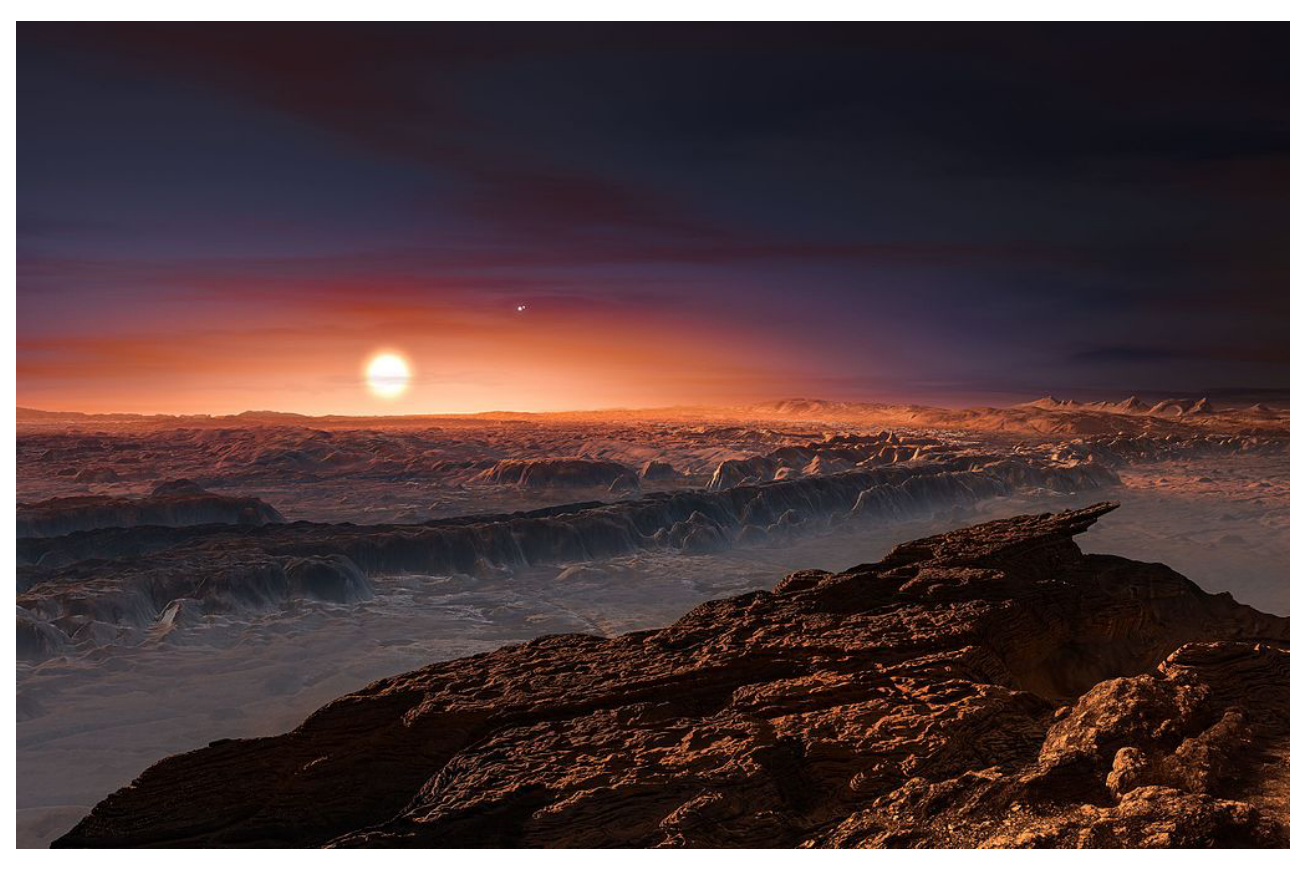
Data about the star and the planet are summarised below:
| Proxima Centauri (star) | Proxima Centauri b (planet) | ||
|---|---|---|---|
| Distance | 1.295 pc | Orbital period | 11.186 days |
| Mass | Mass (min) | ||
| Radius | Radius (min) | ||
| Surface temperature | 3042 K | ||
| Apparent magnitude | 11.13 |
The following formulae may also be helpful:
where is the apparent magnitude, is the absolute magnitude, is the distance in parsecs, and the contrast ratio () is defined as the ratio of fluxes from the star and planet, .
a. Calculate the maximum angular separation between the star and the planet, assuming a circular orbit. Give your answer in arcseconds (3600 arcseconds = ). [3 т.]
b. Determine the luminosity of the star and hence calculate the flux received on the Earth (in ) from both the star and the planet. Use them to work out the contrast ratio and thus the apparent magnitude of the planet. Assume the planet reflects half of the incident light and that . [8 т.]
The resolving power of a diffraction limited telescope is given by
where is the wavelength being observed at, is the diameter of the telescope aperture, and is the smallest angular separation (in radians) the telescope can distinguish.
Data about some current and planned telescopes are summarised below:
| Telescope | Diameter (m) | Faintest detectable |
|---|---|---|
| Hubble Space Telescope (HST) | 2.4 | 31 |
| Keck II (based in Hawaii) | 10.0 | (variable) |
| James Webb Space Telescope (JWST) | 6.5 | 34 |
c. Verify that the HST (which is diffraction limited since it’s in space) would be sensitive enough to image the planet in the visible, but is unable to resolve it from its host star (take nm). [2 т.]
Ground-based telescopes have bigger mirrors than the HST, but are not diffraction limited due to movements in the atmosphere and so need to be fitted with ‘adaptive optics’ (AO) to compensate for this effect. However, even with perfect AO the faintest object the telescope can detect is limited by the brightness of the atmosphere.
The signal-to-noise ratio () can be approximated as:
where is the flux from the object (in photons ), is the area of the telescope mirror, is the overall efficiency of the telescope and detector, is the flux from the sky (in photons ), and is the length of the exposure.
d. Calculate the exposure time needed for a Keck II image of the exoplanet to have an of 3 (i.e. barely detectable). Assume that the telescope has perfect AO (so it is diffraction limited), is observed at the longest wavelength for which the planet can still be resolved from the star, all the received flux from the planet consists of photons of that longest wavelength, and photons (so ). Comment on your answer. [4 т.]
The James Webb Space Telescope (JWST) is the successor to the HST and is due to launch in 2018. It should be able to both resolve the system and cope with the contrast ratio. Since it is in space it is diffraction limited, and the should be dominated by the flux from the planet (i.e. ).
e. How long an exposure would JWST need in order to get the same as Keck II, again if observed at the longest wavelength for which the planet can still be resolved from the star by the telescope? (Make similar assumptions about the received flux and use the same value of .) [3 т.]
Отговори
- a. 0.038 arcsec
- b. L = 1.95 × 10²² W; fstar = 9.69 × 10⁻¹³ W m⁻²; fplanet = 1.12 × 10⁻¹⁹ W m⁻²; CR = 8.64 × 10⁶; mplanet = 28.5
- d. s
- e. 4.96 s
Решение
Q5 - Imaging an Exoplanet [Total = 20]
a. Calculate the maximum angular separation between the star and the planet, assuming a circular orbit. Give your answer in arcseconds (where 3600 arcseconds = 1°).
[1]
[1]
[0.5]
[0.5] [3]
b. Determine the luminosity of the star and hence calculate the flux received on the Earth (in W m⁻²) from both the star and the planet. Use them to work out the contrast ratio and thus the apparent magnitude of the planet. Assume the planet reflects half of the incident light and that = 4.83.
[1]
[1] [2]
[1] [1]
[1]
[1] [2]
[1] [1]
[1]
[1] [2]
[Since we only know the minimum radius of the exoplanet it could be larger and hence brighter, however it may also reflect less than half the incident light from the star and so be fainter – in practice the numbers used here are an optimistic estimate and it is more likely to be fainter.]
(Accepted alternative methods: if they use Stephan-Boltzmann's Law then L = 5.88 × 10²³ W, f = 2.92 × 10⁻¹¹ W m⁻², and f = 3.39 × 10⁻¹⁸ W m⁻², though the contrast ratio and magnitude should be the same. Also accept if they assume only the day side is able to reflect and hence the apparent magnitude brightens to 27.9)
c. Verify that the HST (which is diffraction limited since it's in space) would be sensitive enough to image the planet in the visible, but is unable to resolve it from its host star (take λ = 550 nm).
[0.5]
Since then the HST can't resolve it [0.5] [1]
Apparent magnitude of planet (28.5) is brighter (greater) than limiting magnitude (31) [1] [1]
d. Calculate the exposure time needed for a Keck II image of the exoplanet to have an SNR of 3. Assume that the telescope has perfect AO, is observed at the longest wavelength for which the planet can still be resolved from the star, all the received flux from the planet consists of photons of that longest wavelength , ε = 0.1 and b = photons s⁻¹ (so ). Comment on your answer.
[1]
Photon flux:
[1]
(SB-Law f gives f = 25.4 photons m⁻² s⁻¹, and day side reflection increases f by a factor of 2)
Since we can simplify the denominator of the SNR formula by ignoring the first term, so
[1] [3]
This is really long ( 50 years!) so it is unlikely Keck will ever be able to directly image it [1] [1]
(alternative f gives 22.7 ks, and hence the conclusion is that it is feasible)
e. How long an exposure would JWST need in order to get the same SNR as Keck II, again if observed at the longest wavelength for which the planet can still be resolved from the star by the telescope? (Make similar assumptions about the received flux and use the same value of ε).
(using similar reasoning to the previous part of the question)
[1]
[1]
(alternative method gives f = 16.5 photons m⁻² s⁻¹)
Since we can simplify the denominator of the SNR formula by ignoring the second term, so
[1] [3]
(alternative method gives t = 0.16 s, and day side reflection decreases t by a factor of 2)
[This is much more reasonable – the optimistic assumptions we have made throughout this question mean this is just a lower limit and so the actual exposure time will be longer, perhaps several minutes to get a much higher SNR and to compensate for the fact for that the sensitivity is lower at 970 nm than we have quoted since it varies with wavelength. The main thing that would prevent direct observation of the exoplanet by JWST would be if the contrast ratio was much higher than calculated here as that would mean the star's light would need to be blocked out by the Near Infrared Camera's coronagraph – unfortunately this can only be used at wavelengths too long to resolve the system.]
END OF PAPER
Questions proposed by
END OF PAPER
Questions proposed by:
Dr Alex Calverley (Bedford School)
Dr Emile Doran (The Langley Academy)
Sandor Kruk (University of Oxford)
Оригинал в Архива: BAAO_2017.pdf · официални решения: BAAO_2017_solutions.pdf