BAAO 2018, Теория — Задача 2. Multi-Messenger Astronomy
British Astronomy and Astrophysics Olympiad 2017-2018 — Astronomy & Astrophysics Competition Paper — Monday 22nd January 2018 · 22 януари 2018 г. · 25 т.
Указания
This question paper must not be taken out of the exam room
Time: 3 hours plus 15 minutes reading time (no writing permitted). Approx 45 minutes per question.
Questions: All four questions should be attempted.
Marks: The questions carry similar marks.
Solutions: Answers and calculations are to be written on loose paper or in examination booklets. Students should ensure their name and school is clearly written on all answer sheets and pages are numbered. A standard formula booklet with standard physical constants should be supplied.
Instructions: To accommodate students sitting the paper at different times, please do not discuss any aspect of the paper on the internet until 8 am Saturday 27th January.
Clarity: Solutions must be written legibly, in black pen (the papers are photocopied), and working down the page. Scribble will not be marked and overall clarity is an important aspect of this exam paper.
Eligibility: The International Olympiad will be held during September 2018; all sixth form students are eligible to participate, even if they will be attending university from October.
Training Dates and the International Astronomy and Astrophysics Olympiad (IOAA)
The team will be selected from sixth form students taking this paper and Y12 students taking the AS Challenge in March. The best students eligible to represent the UK at the IOAA will be invited to attend the Training Camp to be held in the Physics Department at the University of Oxford, (Monday 9th April to Thursday 12th April 2018). Astronomy material will be covered; problem solving skills and observational skills (telescope and naked eye observations) will be developed. At the Training Camp a data analysis exam and a short theory paper will be sat. Five students (plus one reserve) will be selected for further training. From May there will be mentoring by email to cover some topics and problems, followed by additional training camps in the summer.
Important Constants
| Constant | Symbol | Value |
|---|---|---|
| Speed of light | ||
| Earth’s rotation period | 1 day | 24 hours |
| Earth’s orbital period | 1 year | 365.25 days |
| parsec | pc | |
| Astronomical Unit | au | |
| Radius of the Earth | ||
| Semi-major axis of the Earth’s orbit | 1 au | |
| Radius of the Sun | ||
| Mass of the Sun | ||
| Mass of the Earth | ||
| Luminosity of the Sun | ||
| Stephan-Boltzmann constant | ||
| Gravitational constant |
You might find the diagram of an elliptical orbit below useful in solving some of the questions (the diagram is shown with Question 3).
Elements of an elliptic orbit:
| semi-major axis | |
| semi-minor axis | |
| eccentricity | |
| F | focus |
| P | periapsis (point nearest to F) |
| A | apoapsis (point furthest from F) |
Keplers Third Law: For an elliptical orbit, the square of the period, , of orbit of an object about the focus is proportional to the cube of the semi-major axis, (the average of the minimum and maximum distances from the Sun). The constant of proportionality is , where is the mass of the central object and is the universal gravitational constant.
Magnitudes: The apparent magnitudes of two objects, and , are related to their apparent brightnesses, and , via the formula:
Note for markers
BAAO 2017/18 Solutions and Marking Guidelines
Note for markers:
- Answers to two or three significant figures are generally acceptable. The solution may give more in order to make the calculation clear.
- There are multiple ways to solve some of the questions; please accept all good solutions that arrive at the correct answer. If a candidate gets the final (numerical) answer then allow them all the marks for that part of the question (as indicated in red), so long as there are no unphysical / nonsensical steps or assumptions made.
Условие
GW170817 was the first gravitational wave event arising from a binary neutron star merger to have been detected by the LIGO & Virgo experiments, and careful localization of the source meant that the electromagnetic counterpart was quickly found in galaxy NGC 4993 (see Figure 2). Such a combination of two completely separate branches of astronomical observation begins a new era of ‘multi-messenger astronomy’. Since the gravitational waves allow an independent measurement of the distance to the host galaxy and the light allows an independent measurement of the recessional speed, this observation allows us to determine a new, independent value of the Hubble constant .
a. The galaxy NGC 4993 is measured to have a redshift of . Assuming it follows Hubble’s Law, , where km s Mpc, as determined by Hubble Space Telescope (HST) measurements of Cepheid variables, calculate the distance to the galaxy (in Mpc) and its (absolute) uncertainty. Give your distance to an appropriate number of significant figures. [5 т.]
Another way of measuring distances to galaxies is to use the Fundamental Plane (FP) relation, which relies on the assumption there is a fairly tight relation between radius, surface brightness, and velocity dispersion for bulge-dominated galaxies, and is widely used for galaxies like NGC 4993. It can be described by the relation
where is the distance in Mpc, is the effective radius measured in arcseconds, is the velocity dispersion in , is the mean intensity inside the effective radius measured in pc, and is the distance-dependent zero point of the relation. Calibrating the zero point to the Leo I galaxy group, the constants in the FP relation become , , and .
b. For NGC 4993 we measure arcseconds, , and pc. Given that the scatter in the FP relation introduces an uncertainty in of , calculate the distance to the galaxy (in Mpc) and its (absolute) uncertainty using the FP relation. [3 т.]
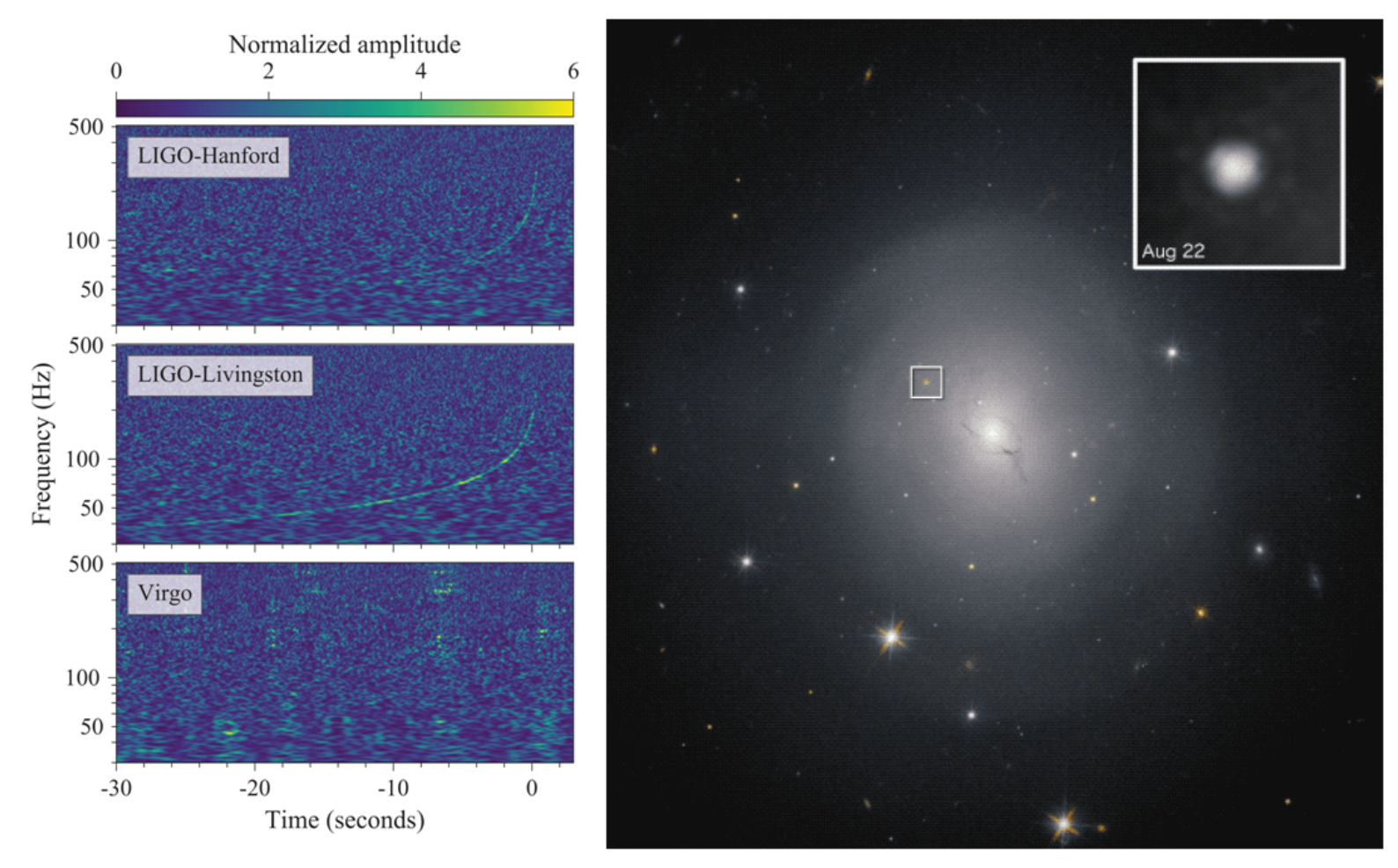
By measuring the amplitude (called strain, ) and the frequency of the gravitational waves, , one can determine the distance to the source without having to rely on ‘standard candles’ like Cepheid variables or Type Ia supernovae. For two masses, and , orbiting the centre of mass with separation with orbital angular velocity , then the dimensionless strain parameter is
where is the luminosity distance, is the speed of light, is the reduced mass and is the total mass.
c. Given that the gravitational frequency, , is twice the orbital frequency (i.e. ) and the ‘chirp mass’, , express in terms of only , , , and various fundamental constants. [5 т.]
The rate of change of frequency of the gravitational waves (called the ‘chirp’) from a merging binary can be written as
d. Combine your result from c. with the above equation to cancel out and so express the distance to the gravitational wave source, , as a function of fundamental constants and the measurables , , and only. [3 т.]
e. Typically, you measure , rather than directly. Given that just as the merger began the detectors measured s, Hz and , estimate the distance to GW170817 (in Mpc) and its absolute uncertainty (assuming a percentage uncertainty of ). How does this compare with your answers in parts a. and b.? [4 т.]
f. Using the redshift information from NGC 4993 and the gravitational wave distance you have just calculated, determine the Hubble constant in units of km s Mpc, along with its absolute uncertainty. Is this value consistent with the one derived by the HST using Cepheid variables (given in part a.)? [5 т.]
Отговори
- a. d = 40.1 ± 4.2 Mpc
- b. D = 43.8 ± 7.4 Mpc
- c.
- d.
- e. r = 41 ± 4 Mpc (41.3 Mpc), consistent with d and D within uncertainties
- f. H0 = 71 ± 13 km s⁻¹ Mpc⁻¹ (71.3), consistent with the HST value
Решение
Q2 - Multi-Messenger Astronomy [Total = 25]
a.
(c must be in km s) [1]
[1]
Answer given to 3 s.f. as redshift has lowest precision (penalise more s.f.) [1] [3]
Uncertainty: [1]
[1] [2]
Overall:
[Allow uncertainties added in quadrature to give 8.4%, leading to Δd = 3.4 Mpc. Also, this is the only part of the question with a s.f. penalty]
b.
[1]
[1] [2]
of [1] [1]
Overall:
[Allow the uncertainty in z to be propagated too, giving ΔD = 14.5 Mpc or 9.0 Mpc (in quadrature)]
c.
Using Kepler's 3rd Law: [1]
Using the definition of chirp mass: [1]
Putting these into the given equation:
[1]
[1]
Finally, using that : [1] [5]
d.
Given that [1]
Using our result from part c. [1]
Combining these together: [1] [3]
e.
[1]
[1] [2]
of [1] [1]
Overall:
The values of d, D and r are consistent with each other within their uncertainties [1] [1]
f.
(c must be in km s) [1]
[1] [2]
Uncertainty: [1]
[1] [2]
Overall:
The value of H derived from multi-messenger astronomy is consistent with the value derived by the HST using Cepheid variables [1] [1]
[Allow uncertainties added in quadrature, giving ΔH = 9.2 km s Mpc]
Questions proposed by
END OF PAPER
Questions proposed by:
Dr Alex Calverley (Royal Grammar School, Guildford)
Dr Emile Doran (The Langley Academy)
Sandor Kruk (University of Oxford)
Оригинал в Архива: BAAO_2018.pdf · официални решения: BAAO_2018_solutions.pdf