BAAO 2018, Теория — Задача 3. Great American Eclipse
British Astronomy and Astrophysics Olympiad 2017-2018 — Astronomy & Astrophysics Competition Paper — Monday 22nd January 2018 · 22 януари 2018 г. · 25 т.
Указания
This question paper must not be taken out of the exam room
Time: 3 hours plus 15 minutes reading time (no writing permitted). Approx 45 minutes per question.
Questions: All four questions should be attempted.
Marks: The questions carry similar marks.
Solutions: Answers and calculations are to be written on loose paper or in examination booklets. Students should ensure their name and school is clearly written on all answer sheets and pages are numbered. A standard formula booklet with standard physical constants should be supplied.
Instructions: To accommodate students sitting the paper at different times, please do not discuss any aspect of the paper on the internet until 8 am Saturday 27th January.
Clarity: Solutions must be written legibly, in black pen (the papers are photocopied), and working down the page. Scribble will not be marked and overall clarity is an important aspect of this exam paper.
Eligibility: The International Olympiad will be held during September 2018; all sixth form students are eligible to participate, even if they will be attending university from October.
Training Dates and the International Astronomy and Astrophysics Olympiad (IOAA)
The team will be selected from sixth form students taking this paper and Y12 students taking the AS Challenge in March. The best students eligible to represent the UK at the IOAA will be invited to attend the Training Camp to be held in the Physics Department at the University of Oxford, (Monday 9th April to Thursday 12th April 2018). Astronomy material will be covered; problem solving skills and observational skills (telescope and naked eye observations) will be developed. At the Training Camp a data analysis exam and a short theory paper will be sat. Five students (plus one reserve) will be selected for further training. From May there will be mentoring by email to cover some topics and problems, followed by additional training camps in the summer.
Important Constants
| Constant | Symbol | Value |
|---|---|---|
| Speed of light | ||
| Earth’s rotation period | 1 day | 24 hours |
| Earth’s orbital period | 1 year | 365.25 days |
| parsec | pc | |
| Astronomical Unit | au | |
| Radius of the Earth | ||
| Semi-major axis of the Earth’s orbit | 1 au | |
| Radius of the Sun | ||
| Mass of the Sun | ||
| Mass of the Earth | ||
| Luminosity of the Sun | ||
| Stephan-Boltzmann constant | ||
| Gravitational constant |
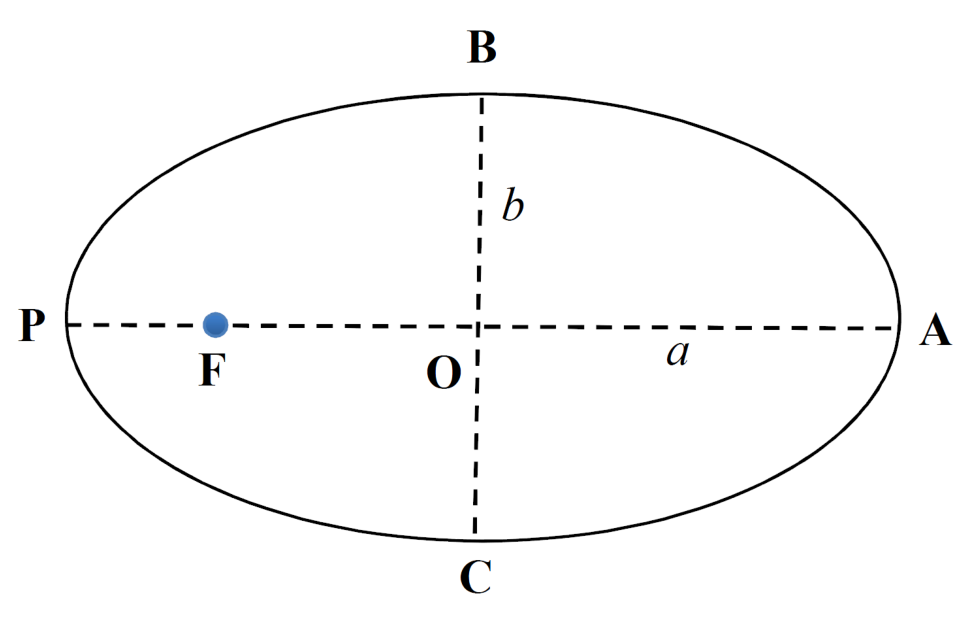
You might find the diagram of an elliptical orbit below useful in solving some of the questions (the diagram is shown with Question 3).
Elements of an elliptic orbit:
| semi-major axis | |
| semi-minor axis | |
| eccentricity | |
| F | focus |
| P | periapsis (point nearest to F) |
| A | apoapsis (point furthest from F) |
Keplers Third Law: For an elliptical orbit, the square of the period, , of orbit of an object about the focus is proportional to the cube of the semi-major axis, (the average of the minimum and maximum distances from the Sun). The constant of proportionality is , where is the mass of the central object and is the universal gravitational constant.
Magnitudes: The apparent magnitudes of two objects, and , are related to their apparent brightnesses, and , via the formula:
Note for markers
BAAO 2017/18 Solutions and Marking Guidelines
Note for markers:
- Answers to two or three significant figures are generally acceptable. The solution may give more in order to make the calculation clear.
- There are multiple ways to solve some of the questions; please accept all good solutions that arrive at the correct answer. If a candidate gets the final (numerical) answer then allow them all the marks for that part of the question (as indicated in red), so long as there are no unphysical / nonsensical steps or assumptions made.
Условие
On 21st August 2017 the continental United States experienced a total solar eclipse. Dubbed the ‘Great American Eclipse’, it was estimated to be one of the most watched eclipses in history.
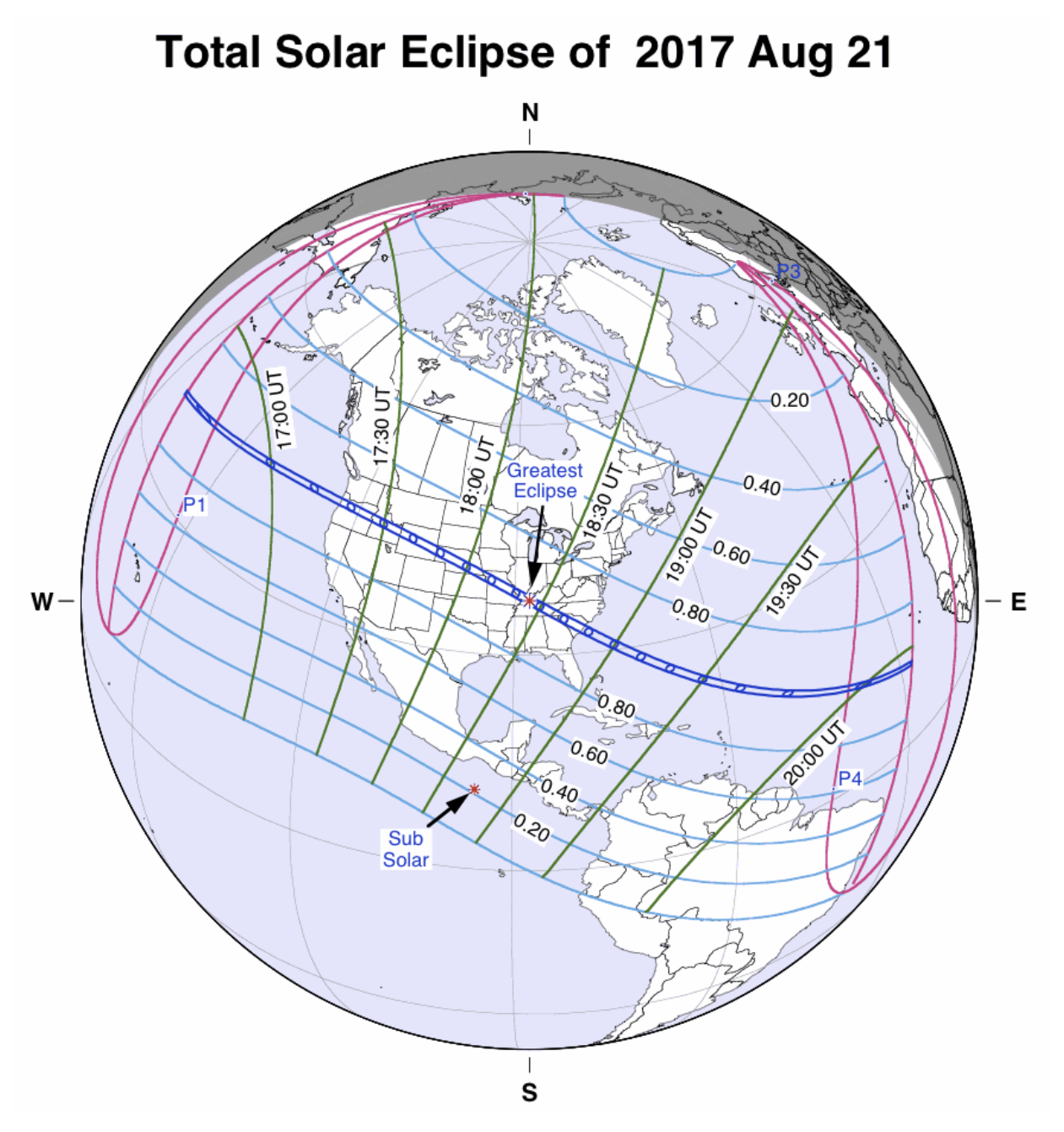
The path of totality (where the Moon completely obscures the Sun) is shown in Figure 3, and the point of greatest eclipse (“GE”; where the path was widest since the axis of the cone of the Moon’s shadow passed closest to the centre of the Earth) was near the village of Cerulean, Kentucky. The following data can be used for this question:
- The angular radii of the Sun and the Moon (if observed from the centre of the Earth) at the moment of GE are and , respectively, where the notation corresponds to arcminutes and arcseconds (60 arcminutes = 1 degree, and 60 arcseconds = 1 arcminute)
- The latitude and longitude of the location of GE are N and W, respectively
- Take the mean radii of the Sun, Earth and Moon to be respectively km, km and km, and a day to be 24 hours
- Take the semi-major axes of the Sun-Earth and Earth-Moon systems to be km and km, respectively
- As viewed from a location far above the North Pole, the Moon orbits in an anticlockwise direction around the Earth, and the Earth spins in an anticlockwise direction
For an ellipse with semi-major axis it can be shown that the velocity , at a distance from mass , can be written as:
a. Calculate the width of the path of totality at GE (in km). You may use the approximation that the Moon is directly overhead so that the shadow is circular, and small enough that the curvature of the Earth can be neglected. [6 т.]
b. Show that at this point the shadow is moving across the Earth’s surface at approximately . You may use the simplifying approximation that for short time intervals it can be considered as travelling with a constant latitude, and that the apparent movement of the Sun due to the Earth’s orbit can be neglected. [5 т.]
c. Hence calculate the duration of the eclipse. Give your answer to the nearest 0.1 s. [1 т.]
The point of greatest eclipse and greatest duration do not generally coincide, as a more elliptical shadow with a major axis aligned with the path of maximum totality (and thinner path width, equal to the minor axis) can compensate for the shadow moving faster at higher latitudes. For this eclipse the point of greatest duration (“GD”) was at co-ordinates of N latitude and W longitude, reached about 4 minutes before GE, and where totality lasted 0.1 s longer than the value calculated in part c.
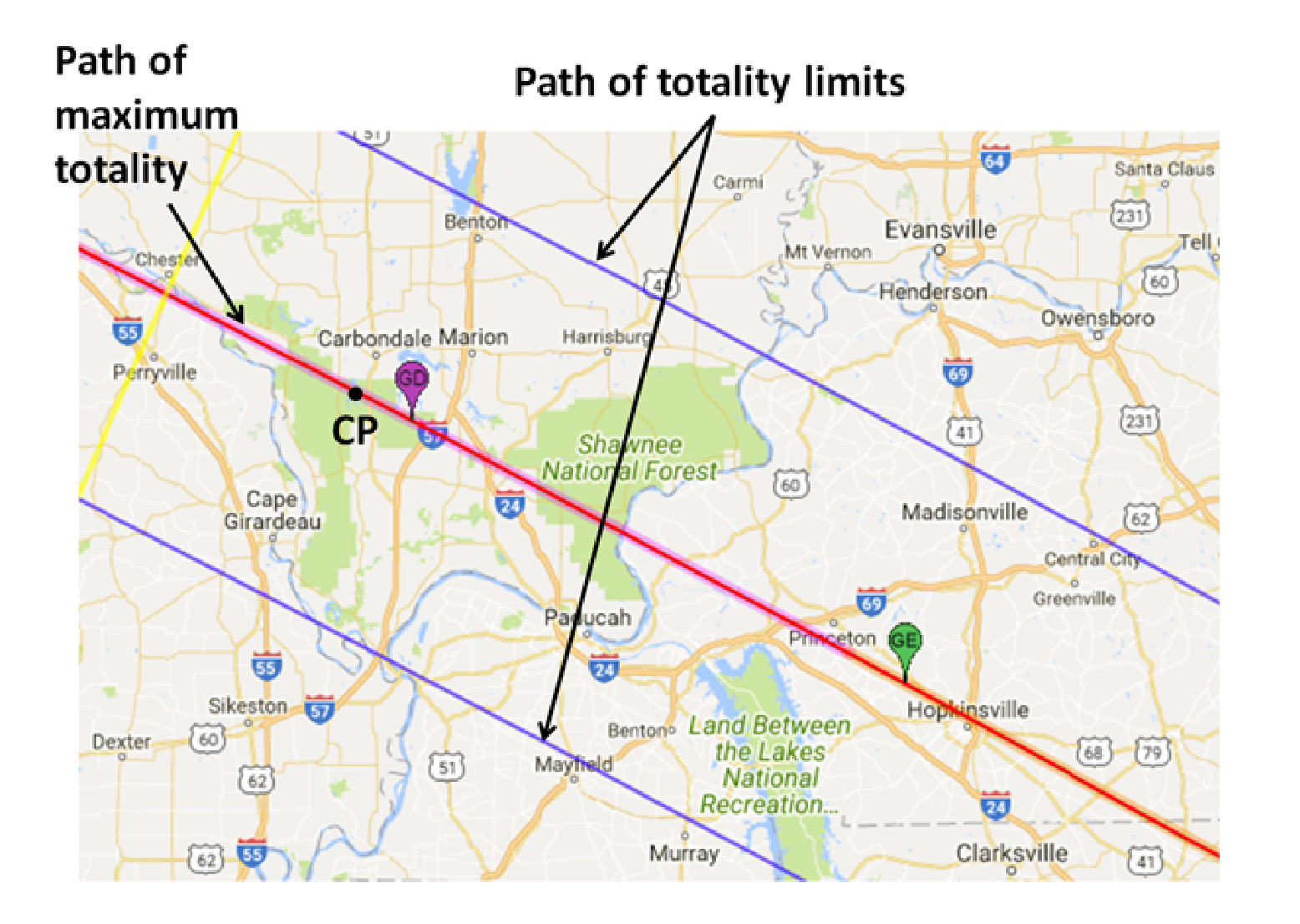
d. (i) d. The town of Carbondale, Illinois, is the closest big town to the point of GD, with co-ordinates N latitude and W longitude. Assuming the path of maximum totality can be treated as linear as it passes through the region around GD and GE:
(i) Calculate the co-ordinates of the closest point (“CP”) to Carbondale on the path of maximum totality. [5 т.]
d. (ii) Calculate the distance (in km) between Carbondale and CP. [2 т.]
d. (iii) Hence calculate (to the nearest 0.1 s) how much shorter totality was for residents in Carbondale compared with CP. Take the duration at CP to be the same as GD, the width of the path to be 0.5 km less than for GE (so the Moon’s shadow is elliptical), and the speed of the Moon’s shadow to have only been affected by the change in latitude. [6 т.]
Отговори
- a. 111.7 km
- b. 0.681 km/s
- c. 164 s
- d. (i) CP: 89.26° W (89°15.3′), 37.64° N (37°38.6′)
- d. (ii) 11 km
- d. (iii) 3.2 s
Решение
Q3 - Great American Eclipse [Total = 25]
a.
Suitable diagram [1]
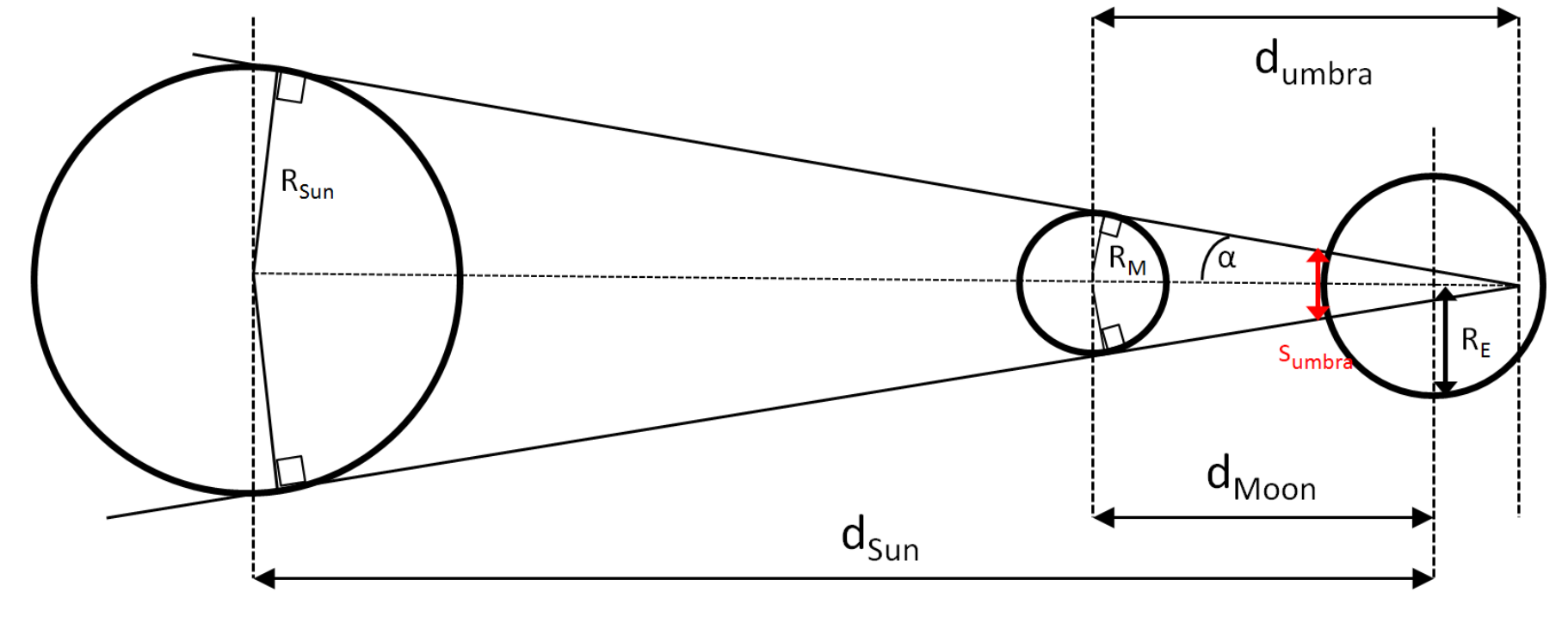
From the apparent angular radii we can calculate the distance to the Moon and the Sun:
Moon: [1]
Sun: [1]
Angle of shadow: [1]
Shadow cone length: [1]
Full width of shadow: [1] [6]
[Allow s = 55.9 km if it is clear that the student recognises that's the radius of the circular shadow, otherwise they lose one mark. Allow use of small angle approximations throughout or other slight variations in the geometry resulting in a width within a few km of the correct answer]
b.
At GE, the latitude is
[1]
[1]
[1]
[1]
Hence: [1] [5]
[Since this is a 'show that' question, ensure the student has shown evidence that they have calculated the correct relative velocity (rather than simply quoted it) for the final mark]
c.
[1] [1]
[Answer must be to the nearest 0.1 s for the mark]
Despite many of the simplifying assumptions made, this is within a few seconds of the measured value of 2 mins 41.6 secs or the official predicted value of 2 mins 40.3 secs
d. (i)
Converting the co-ordinates of GE and GD:
GE: GD:
Equation of a straight line is , so:
[1]
[1]
[Allow reversed signs of m and c so long as internally consistent]
Equation of the line passing through Cardondale (with co-ordinates x, y) and perpendicular to the initial line at CP (with co-ordinates x, y) must satisfy
[1]
[1]
[1] [5]
d. (ii)
We can calculate the angular distance, utilising Pythagoras' theorem since they are very close together:
[1]
Using the small angle approximation (and ignoring the surface curvature on this scale):
[1] [2]
d. (iii)
At CP:
(same as before)
[1]
Eclipse shadow is now elliptical with:
Minor axis
Major axis [1]
For an ellipse, and
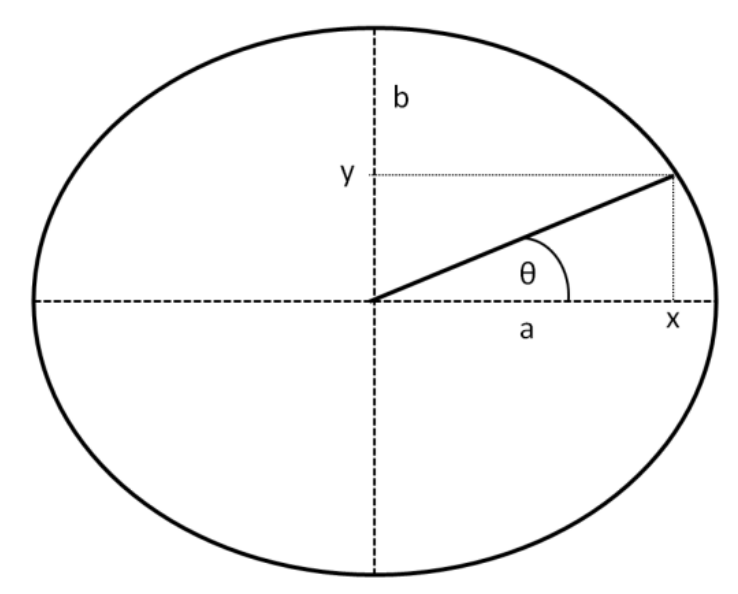
Hence if and [2]
[First mark is for an appropriate diagram and use of the equation of an ellipse]
So the length of the shadow over Carbondale [1]
[1] [6]
[Answer must be to the nearest 0.1 s for the mark]
Carbondale is lucky enough that it will also be on the path of totality of the next eclipse to cross the mainland of the USA on 8th April 2024!
Questions proposed by
END OF PAPER
Questions proposed by:
Dr Alex Calverley (Royal Grammar School, Guildford)
Dr Emile Doran (The Langley Academy)
Sandor Kruk (University of Oxford)
Оригинал в Архива: BAAO_2018.pdf · официални решения: BAAO_2018_solutions.pdf