BAAO 2018, Теория — Задача 4. Super-Earths and Planet Nine
British Astronomy and Astrophysics Olympiad 2017-2018 — Astronomy & Astrophysics Competition Paper — Monday 22nd January 2018 · 22 януари 2018 г. · 25 т.
Указания
This question paper must not be taken out of the exam room
Time: 3 hours plus 15 minutes reading time (no writing permitted). Approx 45 minutes per question.
Questions: All four questions should be attempted.
Marks: The questions carry similar marks.
Solutions: Answers and calculations are to be written on loose paper or in examination booklets. Students should ensure their name and school is clearly written on all answer sheets and pages are numbered. A standard formula booklet with standard physical constants should be supplied.
Instructions: To accommodate students sitting the paper at different times, please do not discuss any aspect of the paper on the internet until 8 am Saturday 27th January.
Clarity: Solutions must be written legibly, in black pen (the papers are photocopied), and working down the page. Scribble will not be marked and overall clarity is an important aspect of this exam paper.
Eligibility: The International Olympiad will be held during September 2018; all sixth form students are eligible to participate, even if they will be attending university from October.
Training Dates and the International Astronomy and Astrophysics Olympiad (IOAA)
The team will be selected from sixth form students taking this paper and Y12 students taking the AS Challenge in March. The best students eligible to represent the UK at the IOAA will be invited to attend the Training Camp to be held in the Physics Department at the University of Oxford, (Monday 9th April to Thursday 12th April 2018). Astronomy material will be covered; problem solving skills and observational skills (telescope and naked eye observations) will be developed. At the Training Camp a data analysis exam and a short theory paper will be sat. Five students (plus one reserve) will be selected for further training. From May there will be mentoring by email to cover some topics and problems, followed by additional training camps in the summer.
Important Constants
| Constant | Symbol | Value |
|---|---|---|
| Speed of light | ||
| Earth’s rotation period | 1 day | 24 hours |
| Earth’s orbital period | 1 year | 365.25 days |
| parsec | pc | |
| Astronomical Unit | au | |
| Radius of the Earth | ||
| Semi-major axis of the Earth’s orbit | 1 au | |
| Radius of the Sun | ||
| Mass of the Sun | ||
| Mass of the Earth | ||
| Luminosity of the Sun | ||
| Stephan-Boltzmann constant | ||
| Gravitational constant |
You might find the diagram of an elliptical orbit below useful in solving some of the questions (the diagram is shown with Question 3).
Elements of an elliptic orbit:
| semi-major axis | |
| semi-minor axis | |
| eccentricity | |
| F | focus |
| P | periapsis (point nearest to F) |
| A | apoapsis (point furthest from F) |
Keplers Third Law: For an elliptical orbit, the square of the period, , of orbit of an object about the focus is proportional to the cube of the semi-major axis, (the average of the minimum and maximum distances from the Sun). The constant of proportionality is , where is the mass of the central object and is the universal gravitational constant.
Magnitudes: The apparent magnitudes of two objects, and , are related to their apparent brightnesses, and , via the formula:
Note for markers
BAAO 2017/18 Solutions and Marking Guidelines
Note for markers:
- Answers to two or three significant figures are generally acceptable. The solution may give more in order to make the calculation clear.
- There are multiple ways to solve some of the questions; please accept all good solutions that arrive at the correct answer. If a candidate gets the final (numerical) answer then allow them all the marks for that part of the question (as indicated in red), so long as there are no unphysical / nonsensical steps or assumptions made.
Условие
Recent years have seen an explosion in the discovery of new exoplanets. About 85% of transiting exoplanets discovered by the NASA Kepler telescope have radii less than Neptune (), meaning we are improving our understanding of what the transition between rocky Earth-size planets and gaseous Neptune-size planets looks like.
Given how common these “super-Earths” and “gas dwarfs” seem to be, it was odd that we didn’t have any in our own Solar System. However, Batygin & Brown (2016) suggested that a hypothetical ninth planet (called ‘Planet Nine’) could explain some of the unusual properties of the orbits of objects in the Kuiper Belt. This planet is inferred to have a mass of , and so would be an example of a super-Earth.
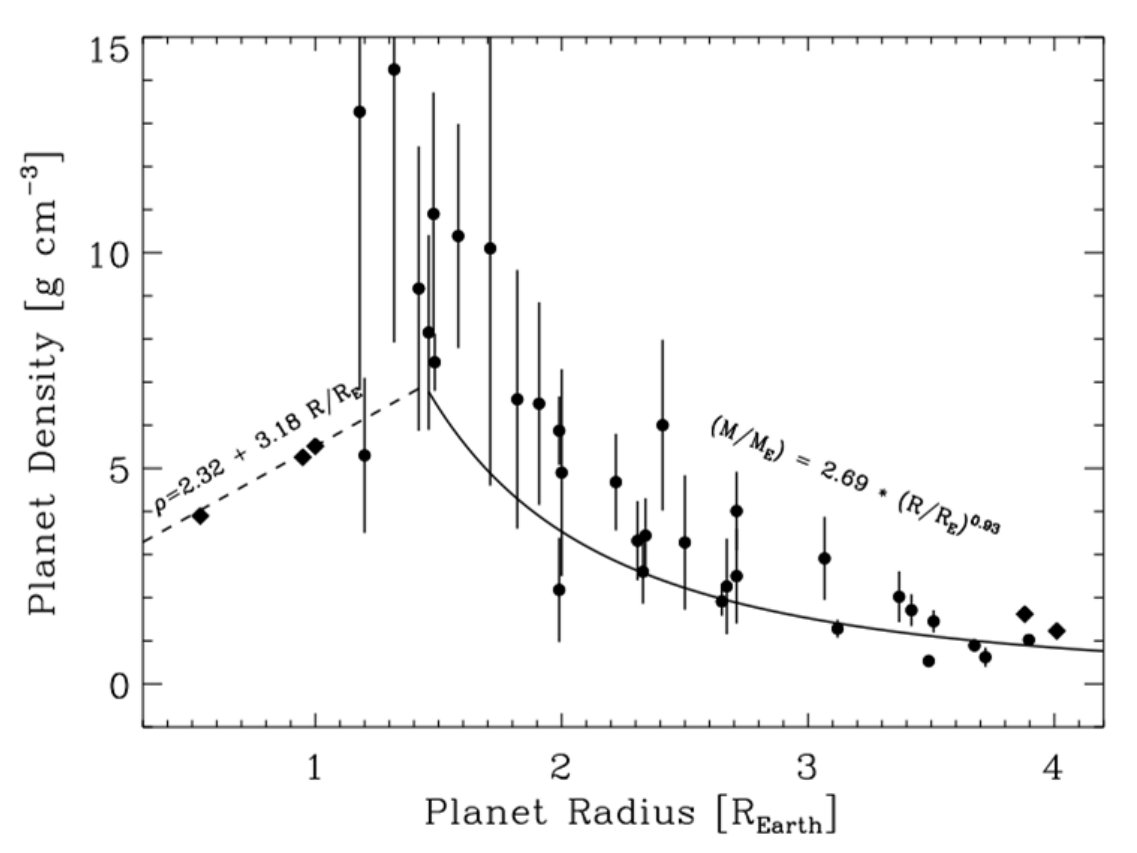
Analysing exoplanets discovered by Kepler, Marcy et al. (2014) used a piecewise function to describe their planetary density data such that:
| For | [g cm] |
| For |
where is the radius of the planet, is the mass of the planet, and the model’s transition between rocky super-Earth and non-rocky gas dwarf occurs at .
a. Based on the Marcy et al. (2014) model, Planet Nine is most likely to be a gas dwarf with a thick gaseous envelope. Calculate (in units of ) for Planet Nine using this model. [2 т.]
b. Planetary formation models suggest such a gas dwarf would have a solid rocky core the size of the Earth, with similar composition and density. Calculate a simple estimate of the atmospheric pressure on the rocky surface. Compare your answer to the atmospheric pressure at sea level on the Earth, kPa. [5 т.]
c. In practice the transition between rocky and gaseous planets is not likely to be sharply at 1.5 , with some planets of both types existing above and below the limit. Calculate (in units of ) for Planet Nine if it was a rocky super-Earth. How does its average density compare to an Earth-sized rocky exoplanet? [6 т.]
The minimum speed necessary to fully escape a planet’s gravity (rather than be put into an elliptical orbit) is called the escape velocity and is calculated as
where is the universal gravitational constant.
In contrast, the maximum speed a rocket can provide is determined by the ejection velocity, , of the gas used, as determined by the chemical energy stored in the bonds of the fuel used, and the fraction of the rocket that is fuel. Since the rocket gets lighter as it burns its fuel the final speed can be bigger than . The rocket equation is
where is the mass at launch and is the mass once all the fuel has been burnt. The most energetic chemical reaction we can use in a rocket is hydrogen-oxygen, which gives , and engineering limits us to a rocket design with a maximum of 96% of launch mass being fuel (as was used with the solid rockets that launched the space shuttle).
d. Verify that the above rocket design is sufficient to escape from Earth but not sufficient to escape from the surface of a rocky Planet Nine. [4 т.]
e. Calculate the maximum value of (for a rocky exoplanet) above which any alien civilization would be unable to escape their planet’s gravity using simple chemical rocket propulsion systems. (They could of course still have orbital satellites, since the speeds for planetary orbit are lower.) [5 т.]
f. In the Marcy et al. (2014) model, above the density of gas dwarfs rapidly decreases with radius. By looking at the piecewise function explain why this does not improve the situation for any alien civilization living on such a gas dwarf hoping to explore their solar system. You do not need to calculate any new escape velocities. [3 т.]
Отговори
a. 4.1 Rearth
b. Pa
About a million times larger than atmospheric pressure on Earth.
c. RP = 1.88 R⊕ (1.20 × 10⁷ m); ρav = 8.30 g cm⁻³ = 1.51 ρEarth
d. vmax = 14.4 km/s; vesc,Earth = 11.2 km/s < vmax < vesc,PN = 25.8 km/s
e. RP,max = 7.73 × 10⁶ m (= 1.21 R⊕)
f. For gas dwarfs MP ∝ RP⁰·⁹³ ≈ RP, so vesc ~ constant, about the value for a rocky planet with RP = 1.5 R⊕ > 1.21 R⊕; the rocket is insufficient for all gas dwarfs.
Решение
Q4 - Super-Earths and Planet Nine [Total = 25]
a.
[1]
[1] [2]
[Allow 1 mark max if they forget to raise to the power of 1/0.93, giving R = 3.72 R]
b.
[1]
[1]
[1]
[1] [4]
This is about a million times larger than atmospheric pressure on Earth [1] [1]
[Allow other models for atmospheric pressure, such as taking the weight of the whole atmosphere and applying it to the surface area of an Earth-sized core, giving 1.03 × 10 Pa. Don't expect to see any attempt to model the variation in g or ρ with height since it only asked for a simple estimate]
c.
[1]
Only positive real root is [3] [4]
[1]
[1] [2]
[Allow any valid method to solve the quartic, such as using their graphical calculator to plot the graph and find roots, or even a trial and error iteration. If when constructing the quartic they forget to convert the densities into kg m (leading to R = 7.20 × 10 m = 11.3 R) then only lose 1 mark]
d.
[1]
[1]
[1] [3]
[1] [1]
So this rocket design is able to allow us to escape Earth's gravity, but is far short of what is needed for Planet Nine (which has implications for any probe that ever lands on it, should it exist)
[Allow the comparisons to be done in terms of gravitational potential rather than escape velocities. If the student did not get a value of R in part c. then allow them to use their value of R from part a. for full credit (giving v = 17.5 km s for R = 4.10 R)]
e.
[1]
[1]
Only positive real root is [3] [5]
[Allow any valid method to solve the cubic, such as using their graphical calculator to plot the graph and find roots, or even a trial and error iteration. If when constructing the cubic they forget to convert the densities into kg m (leading to R = 8.89 × 10 m = 14.0 R) then only lose 1 mark. Forgetting to express v in m s leads to nonsensical values of R (less than R) given they should only be looking at the positive roots]
f.
In the model for gas dwarfs [1]
Since then if [1]
(So the escape velocity will be roughly the same for all gas dwarfs, and approximately the same as the escape velocity for a rocky planet with R = 1.5 R)
Rocket design gives insufficient thrust at R > 1.21 R, so will be insufficient at 1.5 R, and hence will be insufficient for all gas dwarfs too [1] [3]
END OF PAPER
Questions proposed by
END OF PAPER
Questions proposed by:
Dr Alex Calverley (Royal Grammar School, Guildford)
Dr Emile Doran (The Langley Academy)
Sandor Kruk (University of Oxford)
Оригинал в Архива: BAAO_2018.pdf · официални решения: BAAO_2018_solutions.pdf