BAAO 2019, Теория — Задача 1. Parker Solar Probe
British Astronomy and Astrophysics Olympiad 2018-2019 — Astronomy & Astrophysics Competition Paper — Monday 21st January 2019 · 21 януари 2019 г. · 25 т.
Указания
This question paper must not be taken out of the exam room
Time: 3 hours plus 15 minutes reading time (no writing permitted). Approx 45 minutes per question.
Questions: All four questions should be attempted.
Marks: The questions carry similar marks.
Solutions: Answers and calculations are to be written on loose paper or in examination booklets. Students should ensure their name and school is clearly written on all answer sheets and pages are numbered. A standard formula booklet with standard physical constants should be supplied.
Instructions: To accommodate students sitting the paper at different times, please do not discuss any aspect of the paper on the internet until 8 am Saturday 26th January.
Clarity: Solutions must be written legibly, in black pen (the papers are photocopied), and working down the page. Scribble will not be marked and overall clarity is an important aspect of this exam paper.
Eligibility: The International Olympiad will be held during August 2019; all sixth form students are eligible to participate, even if they will be attending university from October.
Training Dates and the International Astronomy and Astrophysics Olympiad (IOAA)
The IOAA this year will be held in Zanka, Hungary, from 2nd to 11th August 2019.
The best students taking this paper that are eligible to represent the UK at the IOAA will be invited to attend the Training Camp to be held in the Physics Department at the University of Oxford, (Saturday 13th April to Wednesday 17th April 2019). Astronomy material will be covered; problem solving skills and observational skills (telescope and naked eye observations) will be developed. At the Training Camp a data analysis exam and a short theory paper will be sat. A team of five students (plus one reserve) will be selected for further training. From May there will be mentoring by email to cover some topics and problems, followed by additional training camps in the summer.
Important Constants
| Constant | Symbol | Value |
|---|---|---|
| Speed of light | ||
| Earth’s rotation period | 1 day | 24 hours |
| Earth’s orbital period | 1 year | 365.25 days |
| parsec | pc | |
| Astronomical Unit | au | |
| Semi-major axis of the Earth’s orbit | 1 au | |
| Radius of the Sun | ||
| Radius of the Earth | ||
| Mass of the Sun | ||
| Mass of the Earth | ||
| Luminosity of the Sun | ||
| Stephan-Boltzmann constant | ||
| Gravitational constant | ||
| Boltzmann constant | ||
| Permittivity of free space | ||
| Permeability of free space | ||
| Planck’s constant | ||
| Elementary charge | ||
| Proton rest mass | ||
| Electron rest mass |
Important Formulae
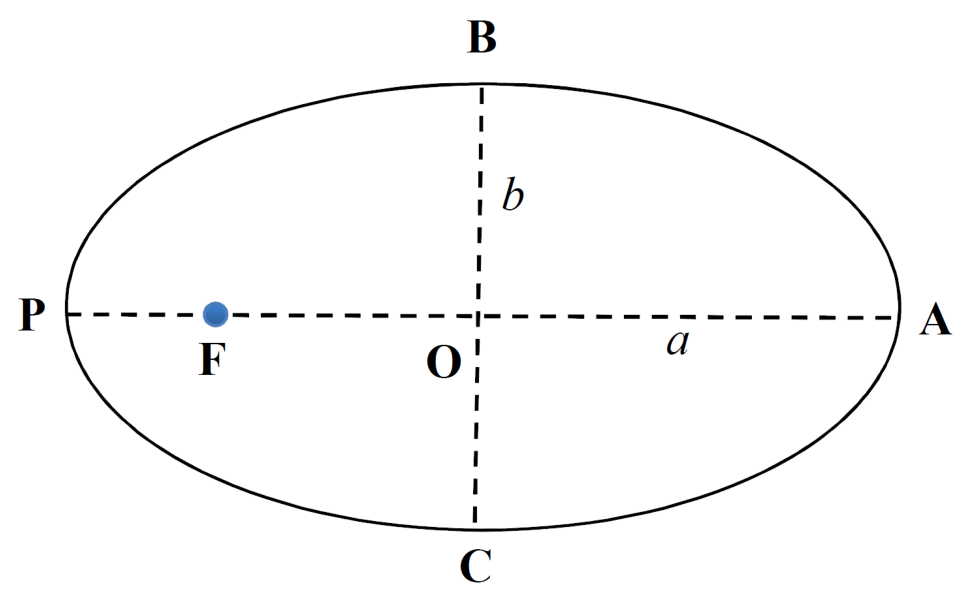
You might find the diagram of an elliptical orbit below useful in solving some of the questions:
Elements of an elliptic orbit:
| semi-major axis | |
| semi-minor axis | |
| eccentricity | |
| F | focus |
| P | periapsis (point nearest to F) |
| A | apoapsis (point furthest from F) |
Kepler’s Third Law: For an elliptical orbit, the square of the period, , of an object about the focus is proportional to the cube of the semi-major axis, (as defined above), such that
where is the total mass of the system (typically dominated by the central object) and is the universal gravitational constant.
Magnitudes: The apparent magnitudes of two objects, and , are related to their apparent brightnesses, and , via the formula
The absolute magnitude of an object, , is the same as its apparent magnitude when viewed from 10 pc, hence the relationship between apparent and absolute magnitude and distance is
where is measured in parsecs.
Note for markers
BAAO 2018/19 Solutions and Marking Guidelines
Note for markers:
- Answers to two or three significant figures are generally acceptable. The solution may give more in order to make the calculation clear. Units should be present on final answers when appropriate.
- There are multiple ways to solve some of the questions; please accept all good solutions that arrive at the correct answer. If a candidate gets the final (numerical) answer then allow them all the marks for that part of the question (as indicated in red), so long as there are no unphysical / nonsensical steps or assumptions made.
Условие
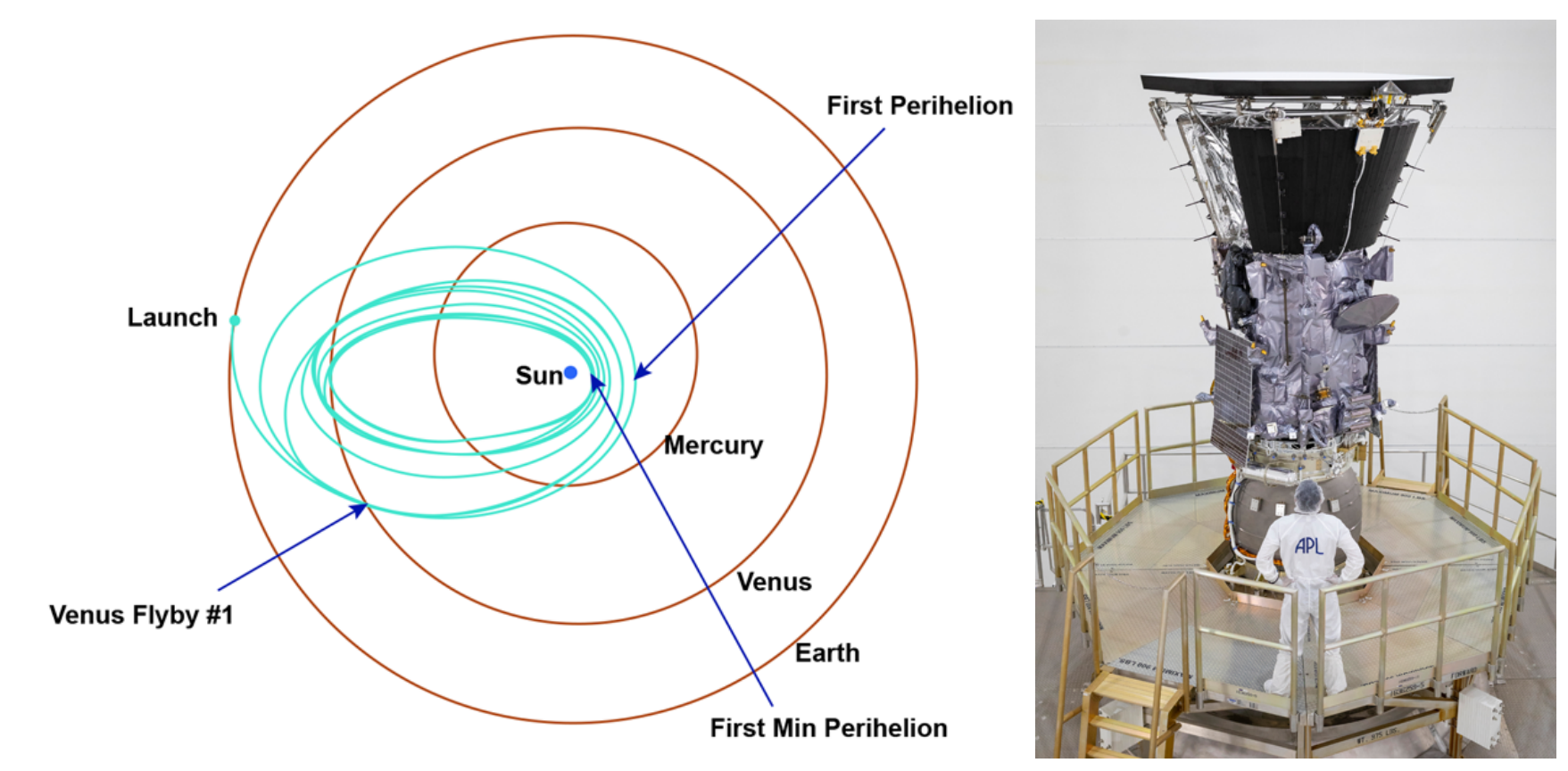
The Parker Solar Probe (PSP) is part of a mission to learn more about the Sun, named after the scientist that first proposed the existence of the solar wind, and was launched on 12th August 2018. Over the course of the 7 year mission it will orbit the Sun 24 times, and through 7 flybys of Venus it will lose some energy in order to get into an ever tighter orbit (see Figure 1). In its final 3 orbits it will have a perihelion (closest approach to the Sun) of only , about 7 times closer than any previous probe, the first of which is due on 24th December 2024. In this extreme environment the probe will not only face extreme brightness and temperatures but also will break the record for the fastest ever spacecraft.
a. (i) When the probe is at its closest perihelion:
(i) Calculate the apparent magnitude of the Sun, given that from Earth . [2 т.]
a. (ii) Calculate the temperature the heat shield must be able to survive. Assume that the heat shield of the probe absorbs all of the incident radiation, radiates as a perfect black body, and that only one side of the probe ever faces the Sun (to protect the instruments) such that the emitting (surface) area is double the absorbing (cross-sectional) area. [3 т.]
b. The speed, , of an object in an elliptical orbit of semi-major axis around an object of mass when a distance away can be calculated as
Given that in its final orbit PSP has a orbital period of 88 days, calculate the speed of the probe as it passes through the minimum perihelion. Give your answer in km s. [4 т.]
c. After the first flyby of Venus on 3rd October 2018 it was moved into an orbit with a 150 day period, and the subsequent first perihelion on 6th November 2018 was at a distance of . Given its mass at launch was 685 kg, calculate the total amount of energy that had to be lost by the probe to get from this first orbit (ignoring the orbital properties prior to the Venus flyby) to the final orbit. Ignore any change in the mass of the probe due to burning fuel. [7 т.]
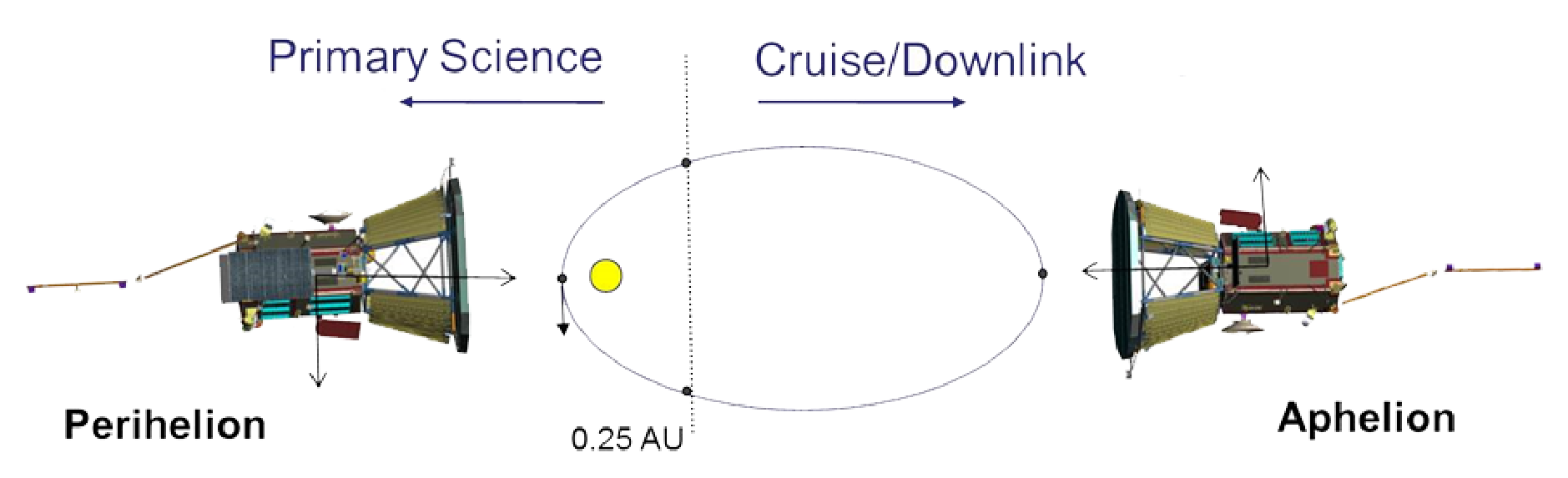
Close to the Sun the communications equipment is very sensitive to the extreme environment, so the mission is planned for the probe to take all of its primary science measurements whilst within 0.25 au of the Sun, and then to spend the rest of the orbit beaming that data back to Earth, as shown in Figure 2.
When considering the position of an object in an elliptical orbit as a function of time, there are two important angles (called ‘anomalies’) necessary to do the calculation, and they are defined in Figure 3. By constructing a circular orbit centred on the same point as the ellipse and with the same orbital period, the eccentric anomaly, , is then the angle between the major axis and the perpendicular projection of the object (some time after perihelion) onto the circle as measured from the centre of the ellipse ( in the figure). The mean anomaly, , is the angle between the major axis and where the object would have been at time if it was indeed on the circular orbit ( in the figure, such that the shaded areas are the same).
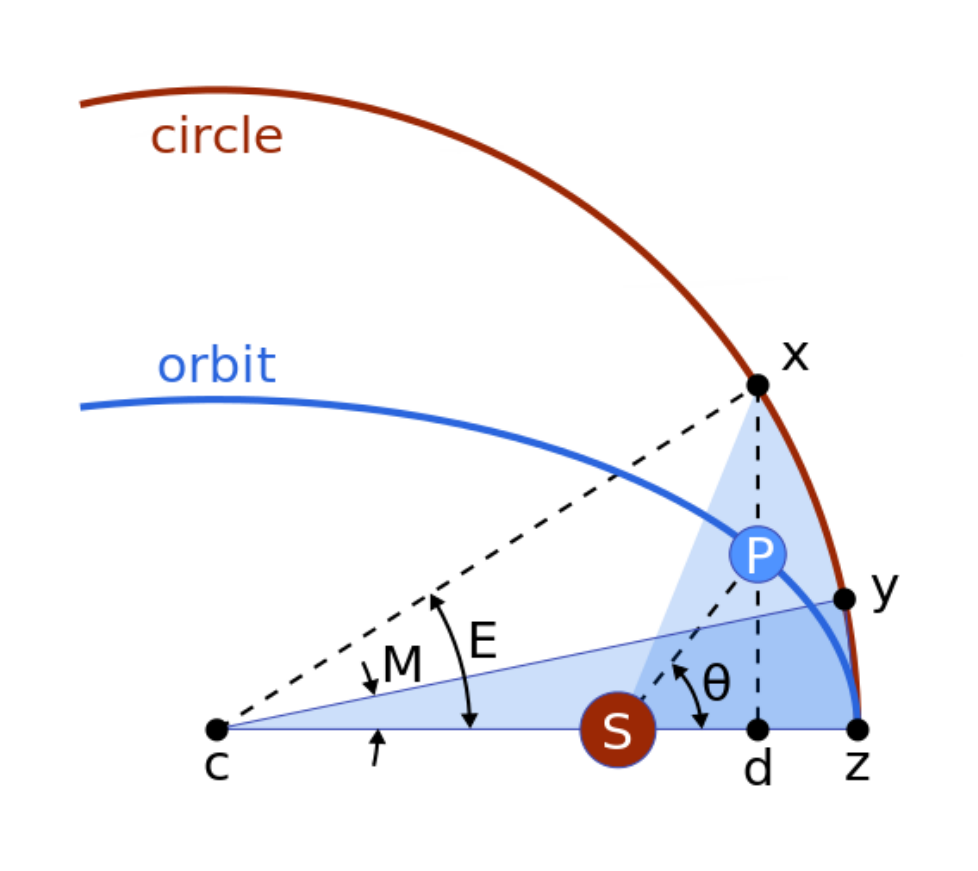
d. Derive a formula for the distance from the focus for an elliptical orbit, ( in the figure) in terms of the semi-major axis , the eccentricity , and the eccentric anomaly . [4 т.]
The eccentric anomaly can be related to the mean anomaly through Kepler’s Equation,
e. Calculate how long PSP spends doing primary science in its final orbit. Give your answer in days. [5 т.]
Отговори
- a. (i) -33.44 mag
- a. (ii) 1550 K
- b. 191 km/s
- c. J
- d.
- e. 9.84 days
Решение
Q1 – Parker Solar Probe [25 marks]
a. (i)
ratio of brightnesses, [1]
[1] [2]
[Allow calculating the solar absolute magnitude, , as an alternative first mark]
a. (ii)
For thermal balance, power absorbed must equal power emitted, so
But since then
[1]
[1]
[1] [3]
b.
Using Kepler’s third law to find the semi-major axis of the final orbit,
[1]
[1]
[1]
[Must be in km s] [1] [4]
[This will mean that the Parker Solar Probe will become the fastest spacecraft (relative to the Sun) ever flown – at this speed you could travel from New York to Tokyo in less than a minute!]
c.
Using a similar method to the previous question to work out the semi-major axis and perihelion speed for the first orbit,
[1]
[1]
The total energy is the sum of the potential and kinetic energies,
and
At the first perihelion,
[Allow 1 mark if only have a correct or term] [2]
At the final perihelion,
[Allow 1 mark if only have a correct or term] [2]
[Ignore a minus sign] [1] [7]
d.
In this diagram:
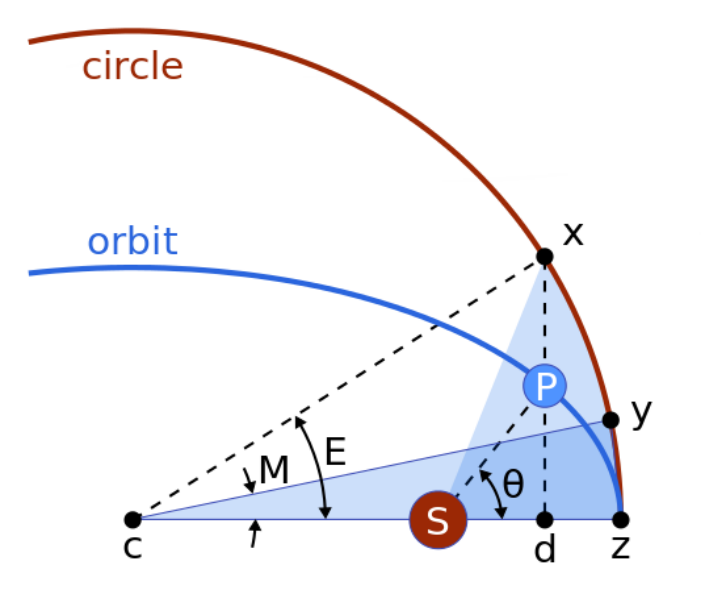
cx = cz = a
SP = r
cS = ae
cd = U
Pd = V
therefore Sd = cd – cs = U – ae
For an ellipse, the general equation is , so the points (U,V) on the ellipse are
and [1]
We are also given that
Using Pythagoras’ theorem,
[1]
[1]
[1] [4]
[Third mark is for eliminating b and writing all expressions in terms of only one trigonometric function. A reasonable attempt at a derivation (allowing alternative methods) must be present to get the marks for this question (simply writing the answer only scores 1 mark)]
e.
With the perihelion distance we can find the eccentricity,
[1]
Using the formula just derived we can find E for r = 0.25 au,
[1]
Using the formula given we can find M,
[1]
Allowing for both sides of the ellipse, [1]
Movement through the circular orbit has constant angular velocity, meaning
[1] [5]
[If they forget the factor of two (so = 4.92 days) allow 4 marks. Allow ±1 hour on the final answer to account for intermediate rounding errors. Allow full ecf for using their value of the semi-major axis from part b. Must be given in days for the final mark]
Questions proposed by
END OF PAPER
Questions proposed by:
Dr Alex Calverley (Royal Grammar School, Guildford)
John Hayton (University of Cambridge)
Josh Brown (University of Cambridge)
Оригинал в Архива: BAAO_2019.pdf · официални решения: BAAO_2019_solutions.pdf