BAAO 2020, Теория — Задача 1. Apollo 11
British Astronomy and Astrophysics Olympiad 2019-2020 — Astronomy & Astrophysics Competition Paper — Monday 20th January 2020 · 20 януари 2020 г. · 35 т.
Указания
This question paper must not be photographed or taken out of the exam room
Time: 3 hours (approximately 60 minutes per question).
Questions: All three questions should be attempted. The last question is worth slightly fewer marks than the rest.
Solutions: Answers and calculations are to be written on loose paper. Students should ensure their name and school is clearly written on all answer sheets and pages are numbered. EACH QUESTION ANSWERED must be started on a new page. A standard formula booklet with standard physical constants should be supplied.
Instructions: To accommodate students sitting the paper at different times, please do not discuss any aspect of the paper on the internet until 8 am Saturday 25th January.
Clarity: Solutions must be written legibly, in black pen (the papers are photocopied), and working down the page. Scribble will not be marked and overall clarity is an important aspect of this exam.
Eligibility: The International Olympiad will be held during September 2020; all sixth form students are eligible to participate, even if they will be attending university from October.
Calculators: Any standard calculator may be used, but calculators cannot be programmable and must not have symbolic algebra capability.
Training Dates and the IOAA (Bogota, Columbia, 13th to 22nd September 2020)
The best students taking this paper that are eligible to represent the UK at the IOAA will be invited to attend the Training Camp to be held in the Physics Department at the University of Oxford, (Friday 27th March to Tuesday 31st March 2020). Astronomy material will be covered; problem solving skills and observational skills (telescope and naked eye observations) will be developed. At the Training Camp a data analysis exam and a short theory paper will be sat. A team of five students (plus one reserve) will be selected for further training. From April there will be mentoring by email to cover some topics and problems, followed by additional training camps in the summer.
Important Constants
| Constant | Symbol | Value |
|---|---|---|
| Speed of light | ||
| Earth’s rotation period | 1 day | 24 hours |
| Earth’s orbital period | 1 year | 365.25 days |
| parsec | pc | |
| Astronomical Unit | au | |
| Semi-major axis of the Earth’s orbit | 1 au | |
| Radius of the Sun | ||
| Radius of the Earth | ||
| Mass of the Sun | ||
| Mass of the Earth | ||
| Luminosity of the Sun | ||
| Stephan-Boltzmann constant | ||
| Gravitational constant | ||
| Boltzmann constant | ||
| Permittivity of free space | ||
| Permeability of free space | ||
| Planck’s constant | ||
| Elementary charge | ||
| Proton rest mass | ||
| Electron rest mass | ||
| Wien’s displacement law |
Basic calculus formulae:
| Chain rule | |
| Product rule | |
| Quotient rule | |
| Integration by parts | |
| Standard integral |
Important Formulae
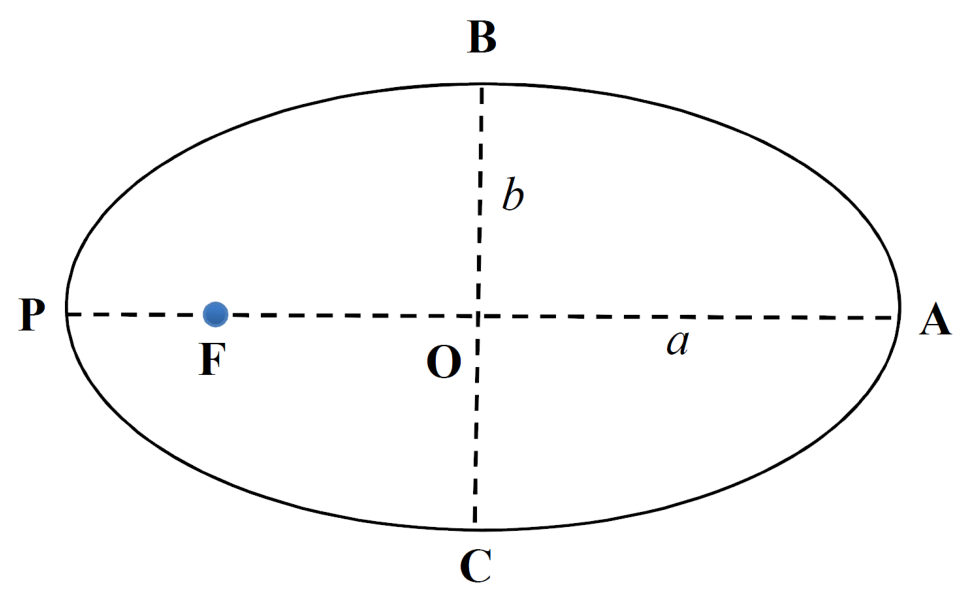
You might find the diagram of an elliptical orbit below useful in solving some of the questions:
Elements of an elliptic orbit:
| semi-major axis | |
| semi-minor axis | |
| eccentricity | |
| F | focus |
| P | periapsis (point nearest to F) |
| A | apoapsis (point furthest from F) |
Kepler’s Third Law: For an elliptical orbit, the square of the period, , of an object about the focus is proportional to the cube of the semi-major axis, (as defined above), such that
where is the total mass of the system (typically dominated by the central object) and is the universal gravitational constant.
Vis-Viva Equation: For an elliptical orbit, the speed of an object at a distance from the focus is related to the semi-major axis, , total mass of the system, , and universal gravitational constant, , (as defined above), such that
Magnitudes: The apparent magnitudes of two objects, and , are related to their apparent brightnesses, and , via the formula
The absolute magnitude of an object, , is the same as its apparent magnitude when viewed from 10 pc, hence the relationship between apparent and absolute magnitude and distance is
where is measured in parsecs.
Note for markers
BAAO 2019/20 Solutions and Marking Guidelines
Note for markers:
- Answers to two or three significant figures are generally acceptable. The solution may give more in order to make the calculation clear. Units should be present on final answers when appropriate.
- There are multiple ways to solve some of the questions; please accept all good solutions that arrive at the correct answer. If a candidate gets the final (numerical) answer then allow them all the marks for that part of the question (as indicated in red), so long as there are no unphysical / nonsensical steps or assumptions made.
Условие
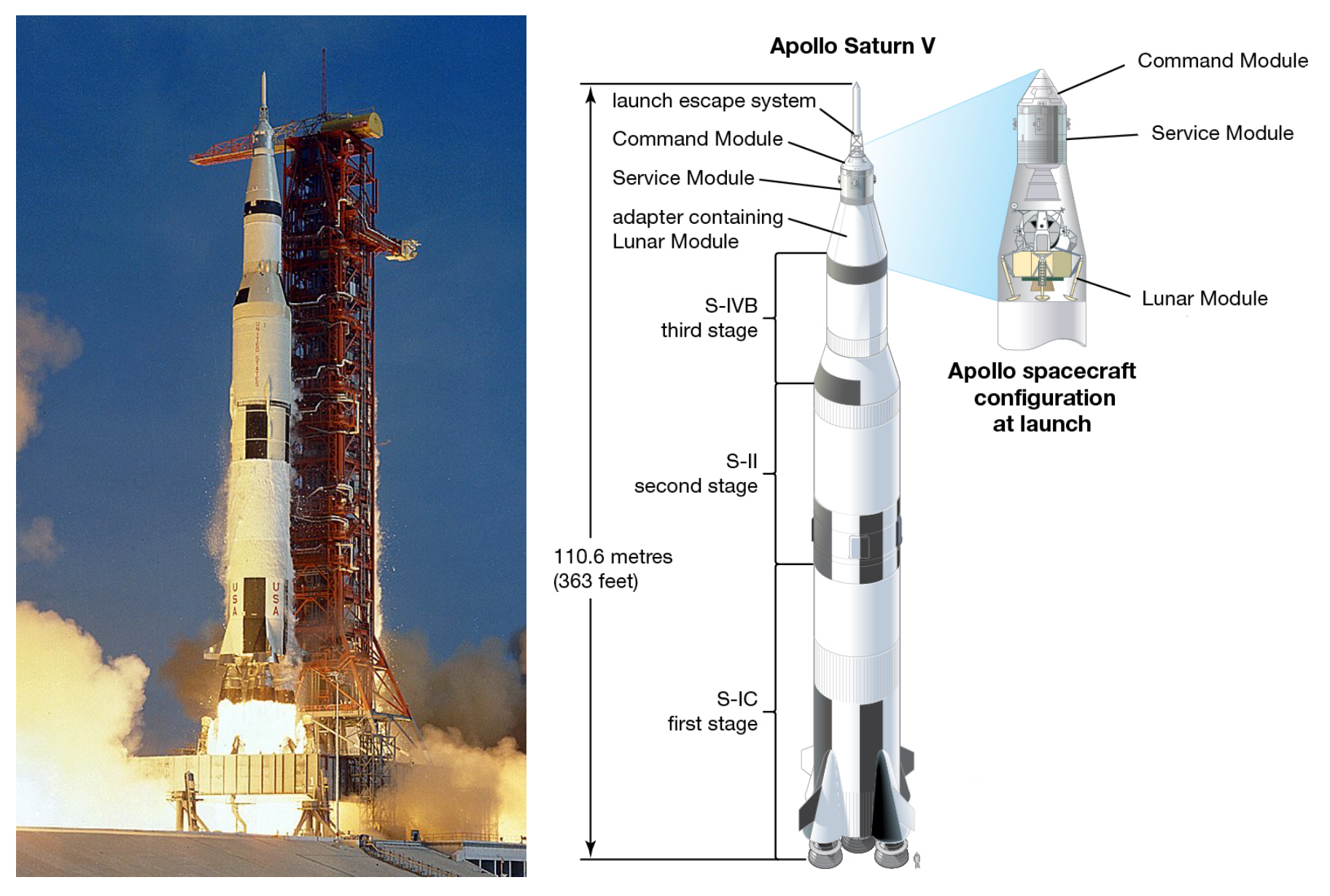
In July 1969 the mission Apollo 11 was the first to successfully allow humans to walk on the Moon. This was an incredible achievement as the engineering necessary to make it a possibility was an order of magnitude more complex than anything that had come before. The Apollo 11 spacecraft was launched atop the Saturn V rocket, which still stands as the most powerful rocket ever made.
| Stage | Initial Mass (t) | Final mass (t) | (s) | Burn duration (s) |
|---|---|---|---|---|
| S-IC | 2283.9 | 135.6 | 263 | 168 |
| S-II | 483.7 | 39.9 | 421 | 384 |
| S-IV (Burn 1) | 121.0 | − | 421 | 147 |
| S-IV (Burn 2) | − | 13.2 | 421 | 347 |
| Apollo Spacecraft | 49.7 | − | − | − |
Table 1: Data about each stage of the rocket used to launch the Apollo 11 spacecraft into a translunar orbit. Masses are given in tonnes (1 t = 1000 kg) and for convenience include the interstage parts of the rocket too. The specific impulse, , of the stage is given at sea level atmospheric pressure for S-IC and for a vacuum for S-II and S-IVB.
The Saturn V rocket consisted of three stages (see Fig 1), since this was the only practical way to get the Apollo spacecraft up to the speed necessary to make the transfer to the Moon. When fully fueled the mass of the total rocket was immense, and lots of that fuel was necessary to simply lift the fuel of the later stages into high altitude - in total about 3000 t (1 tonne, t = 1000 kg) of rocket on the launchpad was required to send about 50 t on a mission to the Moon. The first stage (called S-IC) was the heaviest, the second (called S-II) was considerably lighter, and the third stage (called S-IVB) was fired twice - the first to get the spacecraft into a circular ‘parking’ orbit around the Earth where various safety checks were made, whilst the second burn was to get the spacecraft on its way to the Moon. Once each rocket stage was fully spent it was detached from the rest of the rocket before the next stage ignited. Data about each stage is given in Table 1.
The thrust of the rocket is given as
where the specific impulse, , of each stage is a constant related to the type of fuel used and the shape of the rocket nozzle, is the gravitational field strength of the Earth at sea level (i.e. ) and is the rate of change of mass of the rocket with time.
The thrust generated by the first two stages (S-IC and S-II) can be taken to be constant. However, the thrust generated by the third stage (S-IVB) varied in order to give a constant acceleration (taken to be the same throughout both burns of the rocket).
a. (i) Ignoring the effects of air resistance, the weight of the rocket, and assuming 1-D motion only:
(i) Show that the thrust generated by the S-IC is about N and hence calculate the acceleration experienced by the astronauts firstly at lift-off and secondly when the S-IC finishes its burn (ignore that the S-IC ignites a few seconds before lift off). Give your answer in units of . [3 т.]
a. (ii) Determine the constant acceleration produced by the third stage (S-IVB) of the Saturn V rocket and hence calculate the total mass carried into the parking orbit at the end of the first burn. [3 т.]
a. (iii) Sketch an acceleration-time graph of the journey from lift-off to reaching the parking orbit. Give accelerations in units of . Assume the time between one stage finishing, detaching, and ignition of the next stage is negligible (i.e. you will have discontinuities in the graph at the end of each stage). [5 т.]
a. (iv) By using your graph or otherwise, work out the speed of the rocket when reaching the parking orbit. [3 т.]
b. (i) In reality, the effects of air resistance and the weight of the rocket are substantial. Once in the parking orbit it is travelling at .
(i) What is its height above the Earth’s surface (measured from sea level)? Give your answer in km. [2 т.]
b. (ii) The Apollo 11 spacecraft was in the parking orbit for 2 hours 32 mins 27 secs. How many revolutions of the Earth did it do? [3 т.]
By the end of the second burn the Apollo spacecraft, apart from a few short burns to give mid-course corrections, coasted all the way to the far side of the Moon where the engines were then fired again to circularise the orbit. All of the early Apollo missions were on a orbit known as a ‘free-return trajectory’, meaning that if there was a problem then they were already on an orbit that would take them back to Earth after passing around the Moon. The real shape of such a trajectory (in a rotating frame of reference) is like a stretched figure of 8 and is shown in the top panel of Fig 2. To calculate this precisely is non-trivial and required substantial computing power in the 1960s. However, we can have two simplified models that can be used to estimate the duration of the translunar coast, and they are shown in the bottom panel of the Fig 2.
The first is a Hohmann transfer orbit (dashed line), which is a single ellipse with the Earth at one focus. In this model the gravitational effect of the Moon is ignored, so the spacecraft travels from A (the perigee) to B (the apogee). The second (solid line) takes advantage of a ‘patched conics’ approach by having two ellipses whose apoapsides coincide at point C where the gravitational force on the spacecraft is equal from both the Earth and the Moon. The first ellipse has a periapsis at A and ignores the gravitational effect of the Moon, whilst the second ellipse has a periapsis at B and ignores the gravitational effect of the Earth. If the spacecraft trajectory and lunar orbit are coplanar and the Moon is in a circular orbit around the Earth then the time to travel from A to B via C is double the value attained if taking into account the gravitational forces of the Earth and Moon together throughout the journey, which is a much better estimate of the time of a real translunar coast.
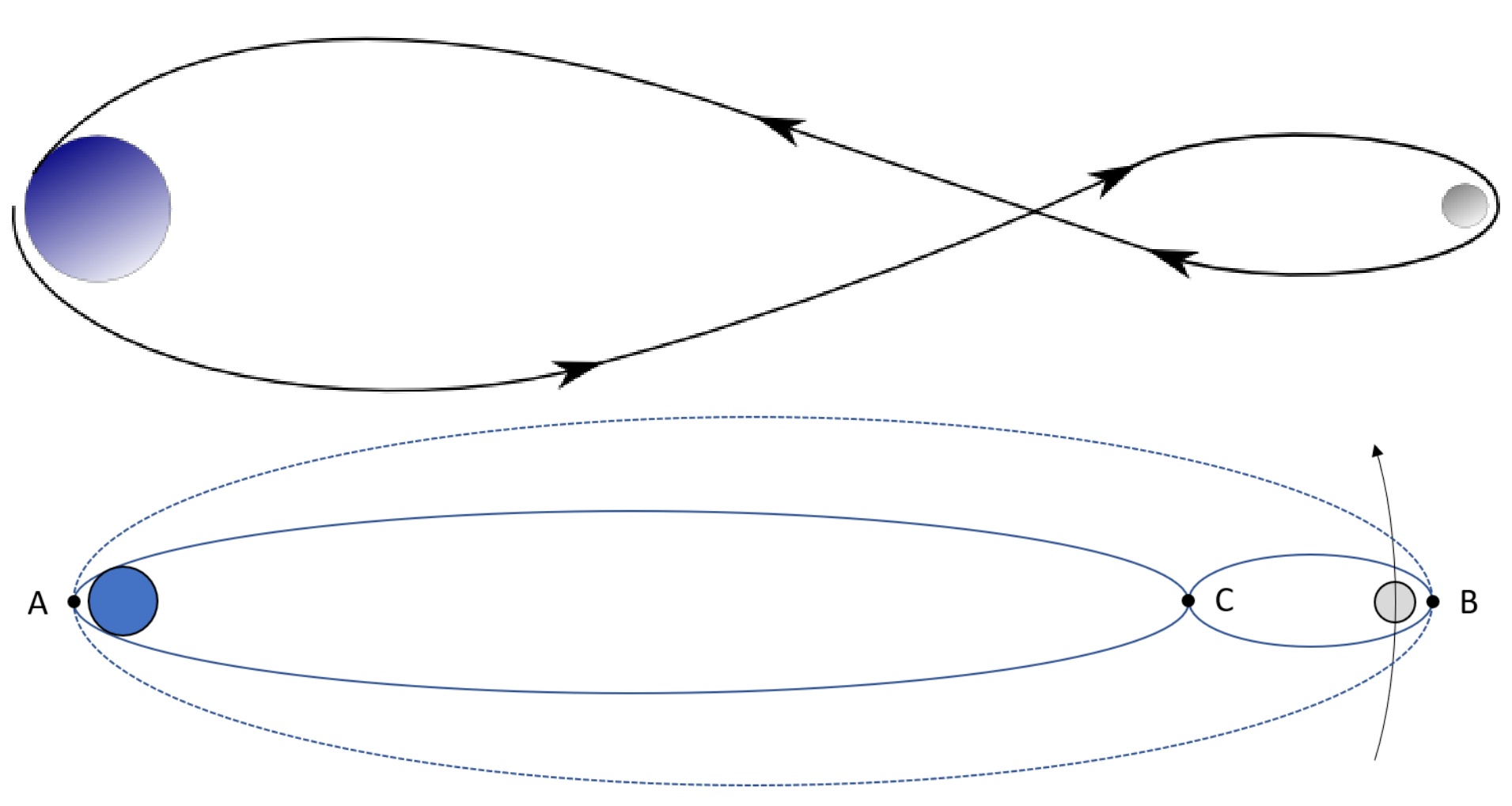
For the Apollo 11 journey, the end of the second burn of the S-IVB rocket (point A) was 334 km above the surface of the Earth, and the end of the translunar coast (point B) was 161 km above the surface of the Moon. The distance between the centres of mass of the Earth and the Moon at the end of the translunar coast was m. Take the radius of the Earth to be 6370 km, the radius of the Moon to be 1740 km, and the mass of the Moon to be kg.
c. For the Hohmann transfer orbit (dashed line), find its semi-major axis and hence the duration of a translunar coast from A to B (expressed in hours and minutes). [4 т.]
d. (i) For the patched conics approach (solid lines):
(i) Find the distance from the centre of the Earth to point C, and hence the semi-major axes of both ellipses. [4 т.]
d. (ii) Calculate the speed of the spacecraft at point A and point B. Give your answer in and as a percentage of the escape speed of the spacecraft at that distance from the relevant closest gravitational body. Comment on what this implies for the eccentricity of the orbits. [5 т.]
d. (iii) Determine the best estimate of the duration of the real Apollo 11 translunar coast. Give your answer in hours and minutes. [3 т.]
Отговори
a. (i) F = 3.30 × 10⁷ N; a = 1.14 g0 at lift-off and 4.26 g0 when the S-IC finishes its burn
a. (ii) a = 8.35 m s⁻² (= 0.85 g0); m = 126.8 tonnes
a. (iii) S-IC: 1.14 g0 to 4.26 g0 (0–168 s); S-II: 0.74 g0 to 2.31 g0 (168–552 s); S-IVB: 0.85 g0 (552–699 s).
a. (iv) 11430 m/s
b. (i) 192 km
b. (ii) 1.73
revolutions
c. a = 2.01 × 10⁸ m; duration 124 hr 54 mins
d. (i) x = 3.55 × 10⁸ m; aAC = 1.81 × 10⁸ m; aBC = 2.06 × 10⁷ m
d. (ii) vA = 10.8 km s⁻¹ (99.1% of vesc,A); vB = 2.22 km s⁻¹ (97.7% of vesc,B); the eccentricities must be very close to 1
d. (iii) 71 hr 33 mins (2.58 × 10⁵ s)
Решение
Q1 – Apollo 11 [35 marks]
a. (i)
[1] [1]
[Since this was a ‘show that’ question, students should have at least given to 3 s.f. Allow the mark whether they’ve done the change in the mass of S-IC (as shown) or in the change in the mass of the whole rocket (i.e. the numbers shown below for )]
At lift off, tonnes
[1] [1]
At the end of S-IC, , tonnes
[1] [1]
[Using only the mass of the S-IC (giving accelerations at lift off and end of S-IC of 1.47 and 24.8 respectively) loses both of these marks, but this conceptual error is only penalised here with full ecf allowed in the rest of the question]
a. (ii)
Combining the given thrust equation with Newton’s 2nd Law to determine m = f(t),
[1]
Rearranging and solving for the initial and final masses during the whole S-IV burn,
[1] [2]
Using the exponential equation to calculate the final mass at the end of the first burn,
tonnes [1] [1]
[Full ecf available for ignoring the mass of the Apollo spacecraft (49.7 t), assuming the same conceptual error was penalised earlier, leading to a = 18.5 m s and m = 62.6 t]
[This is close to the 118 tonnes that the Saturn V was designed to be able to carry into Low Earth Orbit, the largest of any rocket that has ever flown (although planned rockets launched in the coming decade will exceed this)]
a. (iii)
So far we have for S-IC and , plus for S-IV
Doing the same thing for S-II gives,
and [2]
Plotting all of this information,
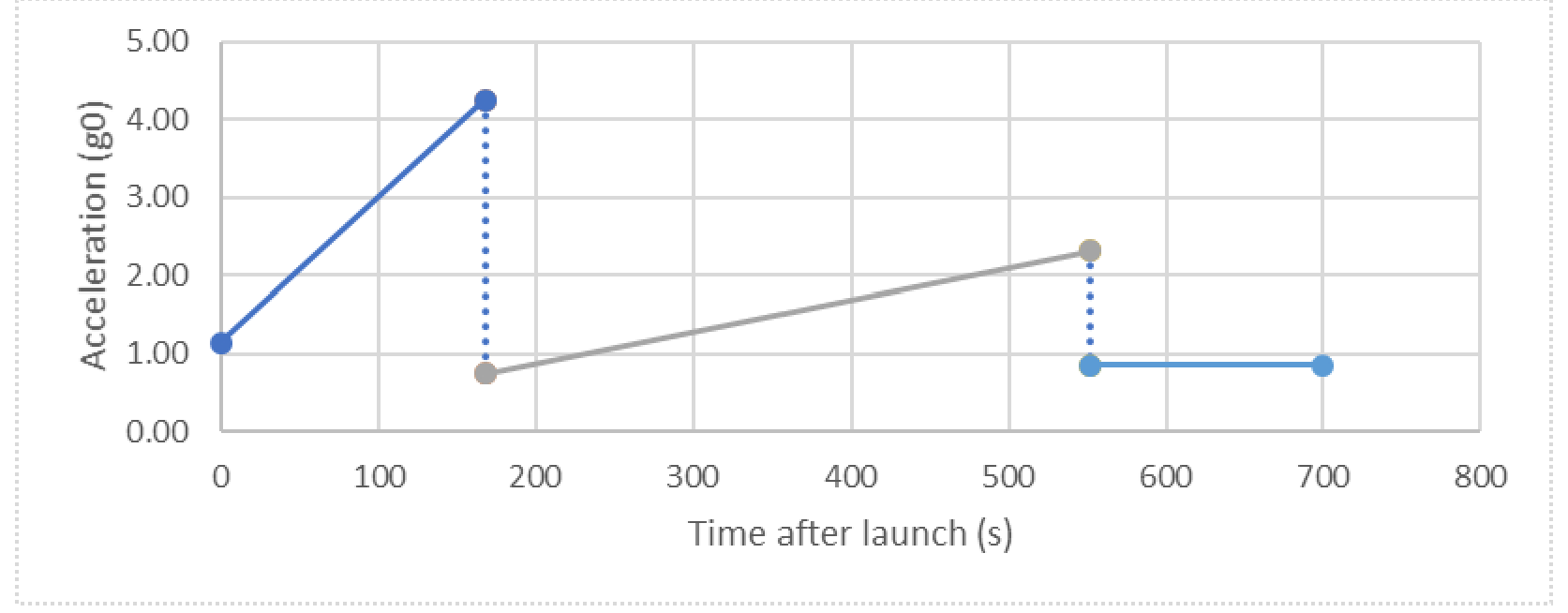
Graph has horizontal line for S-IV and only goes up to the end of first burn [1]
Graph has straight, diagonal lines for S-IC and S-II [1]
Appropriate axes labels (accel in ) [1] [5]
[The values of a (as summarised above) and t (0 s, 168 s, 552 s and 699 s) should either be listed in the working or clearly indicated in the sketch (since few students will try and do it to scale, unlike the graph above). Full ecf for incorrectly calculating the mass of the rocket gives for S-IC and , for S-II and , and for S-IV . The lines are straight since we are ignoring the changing weight]
a. (iv)
The area under the graph is the change in velocity of the rocket [1]
Working it out for each stage and adding them together,
[2] [3]
[Full ecf from the incorrect rocket masses leads to ~49250 m s]
[It is worth noting that in under 12 minutes astronauts are in Earth orbit – staggeringly quick if you think about it – and they have to train to endure several seconds at an acceleration of about 4 (deeply uncomfortable!). If you integrate this graph twice you get the total change in displacement of the rocket at 4517 km – at this height above sea level and the calculated speed the orbit would not be bound (i.e. ), meaning that the effects of air resistance and weight of the rocket make a big difference, as does the fact the rocket rapidly rotates onto its side rather than following a radial path]
b. (i)
For a circular orbit,
[1]
[1] [2]
[Must be in km for the final mark]
b. (ii)
From Kepler’s third law, [Students may just use v and the orbital circumference to find T]
[1]
[1]
revolutions [1] [3]
c.
The semi-major axis is half the total distance from A to B,
[1] [1]
From Kepler’s third law,
[1]
[1]
We will only travel half of the ellipse, so the time we want is half the period,
s = 124 hr 54 mins (9 secs) [must be in hr and min] [1] [3]
d. (i)
At point C, the gravitational forces from both bodies are equal,
[1]
[1] [2]
Using a similar approach to the previous part of the question,
[1] [1]
[1] [1]
[Allow the use of a first order binomial expansion for x giving leading to , and .]
d. (ii)
Using the vis-viva equation given at the beginning of the paper,
[1] [1]
As a percentage of the escape velocity,
[1] [1]
Similarly,
[1] [1]
[1] [1]
Since these periapsis velocities are very close to the escape velocity, the eccentricities must be very close to 1 [1] [1]
[Do not award the marks for the percentage of the escape velocity if they have calculated the escape velocity at the surface of the body, rather than at the given altitude (i.e. rather than ( + )). The use of the binomial expansion in the previous part hardly affects these values (the only one changing at 3 s.f. is )]
d. (iii)
Using a similar approach to part c. where we only want half of the full ellipse,
[1]
[1]
The best estimate is exactly half of the sum of these two durations,
s = 71 hr 33 mins (47 secs) [1] [3]
[Must be in hr and min for the final mark. Use of the binomial expansion earlier gives 73 hr 36 mins 38 s]
[The real duration of the Apollo 11 translunar coast was 73 hr 5 mins 35 secs, so our second model of patched conics has done rather well compared to the Hohmann transfer. The main reasons for the differences are that the moon is not in a perfectly circular orbit around the Earth (so its gravitational influence varies during the coast more than our model allowed for) and we are assuming that the coast and the orbit are coplanar, which is not generally true. In later Apollo missions they used a manoeuvre during the coast to change the trajectory away from a simple translunar free-return trajectory, allowing for a greater range of landing sites – this means this simple model will only get close to the real durations for the early missions and for the later missions the full (non-trivial) calculations must be done.]
Questions proposed by
END OF PAPER
Questions proposed by:
Dr Alex Calverley (Royal Grammar School, Guildford)
Alan Sun (University of Cambridge)
Navonil Neogi (University of Cambridge)
Оригинал в Архива: BAAO_2020.pdf · официални решения: BAAO_2020_solutions.pdf