BAAO 2020, Теория — Задача 2. Event Horizon Telescope and Super Massive Black Holes
British Astronomy and Astrophysics Olympiad 2019-2020 — Astronomy & Astrophysics Competition Paper — Monday 20th January 2020 · 20 януари 2020 г. · 35 т.
Указания
This question paper must not be photographed or taken out of the exam room
Time: 3 hours (approximately 60 minutes per question).
Questions: All three questions should be attempted. The last question is worth slightly fewer marks than the rest.
Solutions: Answers and calculations are to be written on loose paper. Students should ensure their name and school is clearly written on all answer sheets and pages are numbered. EACH QUESTION ANSWERED must be started on a new page. A standard formula booklet with standard physical constants should be supplied.
Instructions: To accommodate students sitting the paper at different times, please do not discuss any aspect of the paper on the internet until 8 am Saturday 25th January.
Clarity: Solutions must be written legibly, in black pen (the papers are photocopied), and working down the page. Scribble will not be marked and overall clarity is an important aspect of this exam.
Eligibility: The International Olympiad will be held during September 2020; all sixth form students are eligible to participate, even if they will be attending university from October.
Calculators: Any standard calculator may be used, but calculators cannot be programmable and must not have symbolic algebra capability.
Training Dates and the IOAA (Bogota, Columbia, 13th to 22nd September 2020)
The best students taking this paper that are eligible to represent the UK at the IOAA will be invited to attend the Training Camp to be held in the Physics Department at the University of Oxford, (Friday 27th March to Tuesday 31st March 2020). Astronomy material will be covered; problem solving skills and observational skills (telescope and naked eye observations) will be developed. At the Training Camp a data analysis exam and a short theory paper will be sat. A team of five students (plus one reserve) will be selected for further training. From April there will be mentoring by email to cover some topics and problems, followed by additional training camps in the summer.
Important Constants
| Constant | Symbol | Value |
|---|---|---|
| Speed of light | ||
| Earth’s rotation period | 1 day | 24 hours |
| Earth’s orbital period | 1 year | 365.25 days |
| parsec | pc | |
| Astronomical Unit | au | |
| Semi-major axis of the Earth’s orbit | 1 au | |
| Radius of the Sun | ||
| Radius of the Earth | ||
| Mass of the Sun | ||
| Mass of the Earth | ||
| Luminosity of the Sun | ||
| Stephan-Boltzmann constant | ||
| Gravitational constant | ||
| Boltzmann constant | ||
| Permittivity of free space | ||
| Permeability of free space | ||
| Planck’s constant | ||
| Elementary charge | ||
| Proton rest mass | ||
| Electron rest mass | ||
| Wien’s displacement law |
Basic calculus formulae:
| Chain rule | |
| Product rule | |
| Quotient rule | |
| Integration by parts | |
| Standard integral |
Important Formulae
You might find the diagram of an elliptical orbit below useful in solving some of the questions:
Elements of an elliptic orbit:
| semi-major axis | |
| semi-minor axis | |
| eccentricity | |
| F | focus |
| P | periapsis (point nearest to F) |
| A | apoapsis (point furthest from F) |
Kepler’s Third Law: For an elliptical orbit, the square of the period, , of an object about the focus is proportional to the cube of the semi-major axis, (as defined above), such that
where is the total mass of the system (typically dominated by the central object) and is the universal gravitational constant.
Vis-Viva Equation: For an elliptical orbit, the speed of an object at a distance from the focus is related to the semi-major axis, , total mass of the system, , and universal gravitational constant, , (as defined above), such that
Magnitudes: The apparent magnitudes of two objects, and , are related to their apparent brightnesses, and , via the formula
The absolute magnitude of an object, , is the same as its apparent magnitude when viewed from 10 pc, hence the relationship between apparent and absolute magnitude and distance is
where is measured in parsecs.
Note for markers
BAAO 2019/20 Solutions and Marking Guidelines
Note for markers:
- Answers to two or three significant figures are generally acceptable. The solution may give more in order to make the calculation clear. Units should be present on final answers when appropriate.
- There are multiple ways to solve some of the questions; please accept all good solutions that arrive at the correct answer. If a candidate gets the final (numerical) answer then allow them all the marks for that part of the question (as indicated in red), so long as there are no unphysical / nonsensical steps or assumptions made.
Условие
The Event Horizon Telescope (EHT) is a project to use many widely-spaced radio telescopes as a Very Long Baseline Interferometer (VBLI) to create a virtual telescope as big as the Earth. This extraordinary size allows sufficient angular resolution to be able to image the space close to the event horizon of a super massive black hole (SMBH), and provide an opportunity to test the predictions of Einstein’s theory of General Relativity (GR) in a very strong gravitational field. In April 2017 the EHT collaboration managed to co-ordinate time on all of the telescopes in the array so that they could observe the SMBH (called M87 ) at the centre of the Virgo galaxy, M87, and they plan to also image the SMBH at the centre of our galaxy (called Sgr A).
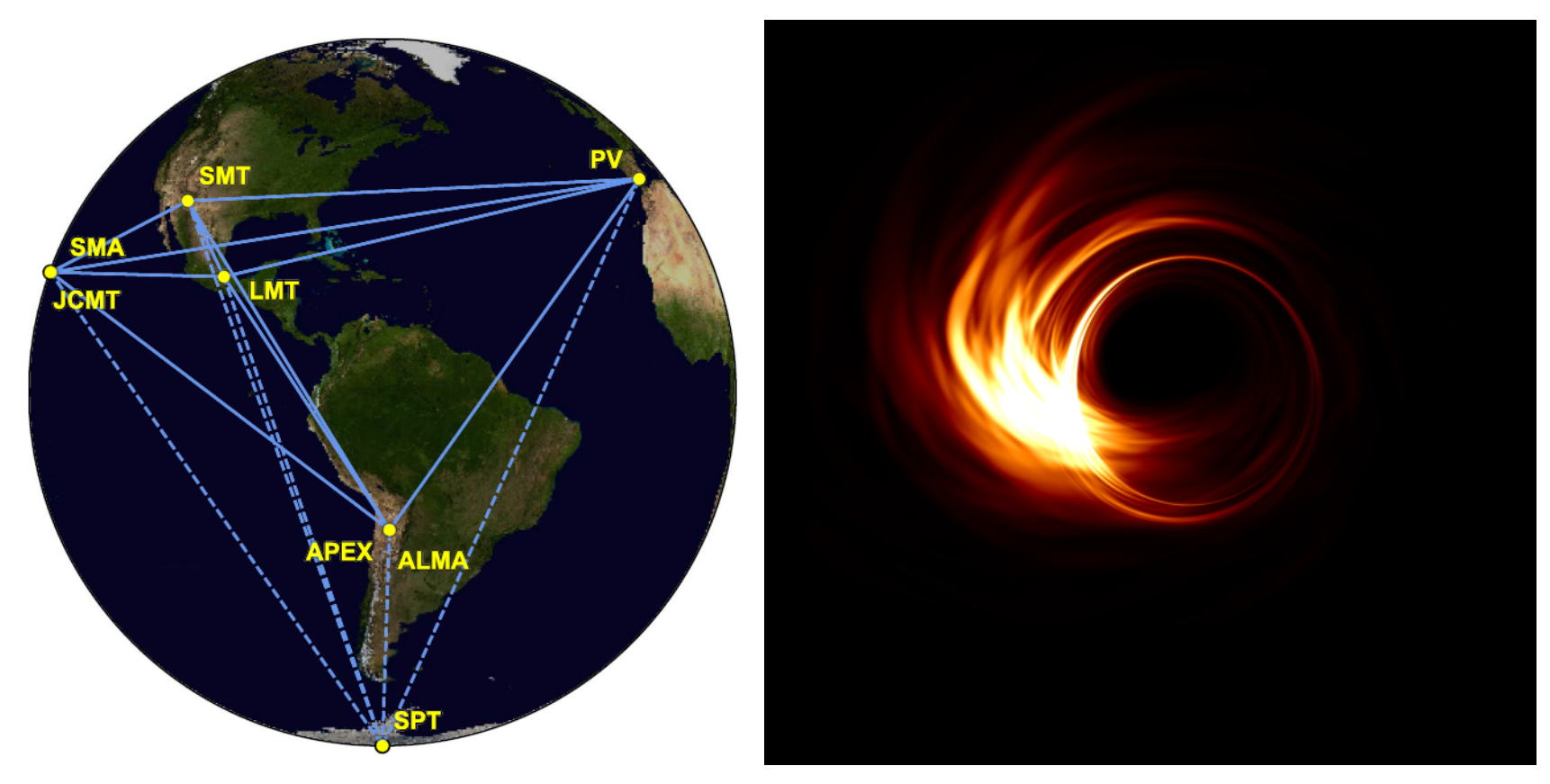
Some data about the locations of the eight telescopes in the array are given below in 3-D cartesian geocentric coordinates with pointing to the Greenwich meridian, pointing away in the equatorial plane (eastern longitudes have positive ), and positive pointing in the direction of the North Pole. This is a left-handed coordinate system.
| Facility | Location | (m) | (m) | (m) |
|---|---|---|---|---|
| ALMA | Chile | 2225061.3 | −5440061.7 | −2481681.2 |
| APEX | Chile | 2225039.5 | −5441197.6 | −2479303.4 |
| JCMT | Hawaii, USA | −5464584.7 | −2493001.2 | 2150654.0 |
| LMT | Mexico | −768715.6 | −5988507.1 | 2063354.9 |
| PV | Spain | 5088967.8 | −301681.2 | 3825012.2 |
| SMA | Hawaii, USA | −5464555.5 | −2492928.0 | 2150797.2 |
| SMT | Arizona, USA | −1828796.2 | −5054406.8 | 3427865.2 |
| SPT | Antarctica | 809.8 | −816.9 | −6359568.7 |
The minimum angle, (in radians) that can be resolved by a VLBI array is given by the equation
where is the observing wavelength and is the longest straight line distance between two telescopes used (called the baseline), assumed perpendicular to the line of sight during the observation.
a. Determine for the observations of M87 (i.e. the solid lines in Fig 3) and hence if the EHT uses radio waves of frequency 230 GHz. Give your answer for in km and in microarcseconds (1 degree = 3600 arcseconds). [4 т.]
An important length scale when discussing black holes is the gravitational radius, , where is the gravitational constant, is the mass of the black hole and is the speed of light. The familiar event horizon of a non-rotating black hole is called the Schwartzschild radius, , however this is not what the EHT is able to observe - instead the closest it can see to a black hole is called the photon sphere, where photons orbit in the black hole in unstable circular orbits. On top of this the image of the black hole is gravitationally lensed by the black hole itself magnifying the apparent radius of the photon sphere to be between and , determined by spin and inclination; the latter corresponds to a perfectly spherical non-spinning black hole. The area within this lensed image will appear almost black and is the ‘shadow’ the EHT is looking for.
b. (i) Assuming Sgr A* is a non-spinning black hole with mass and a distance from us of 8.34 kpc:
(i) Derive the (unlensed) radius of the photon sphere, , in units of , by considering a balance between the centripetal and (Newtonian) gravitational forces, but with the relativistic correction where is the classical velocity and when . [3 т.]
b. (ii) Determine the angular diameter (in microarcseconds) of the lensed photon sphere of Sgr A* and hence verify that the EHT can resolve it. [4 т.]
c. The angular diameter of M87* as determined from the images gained by the EHT (shown in Fig 4) is 42 microarcseconds, and the galaxy is 16.8 Mpc away from us. Determine the minimum and maximum possible masses of the SMBH in units of . [4 т.]
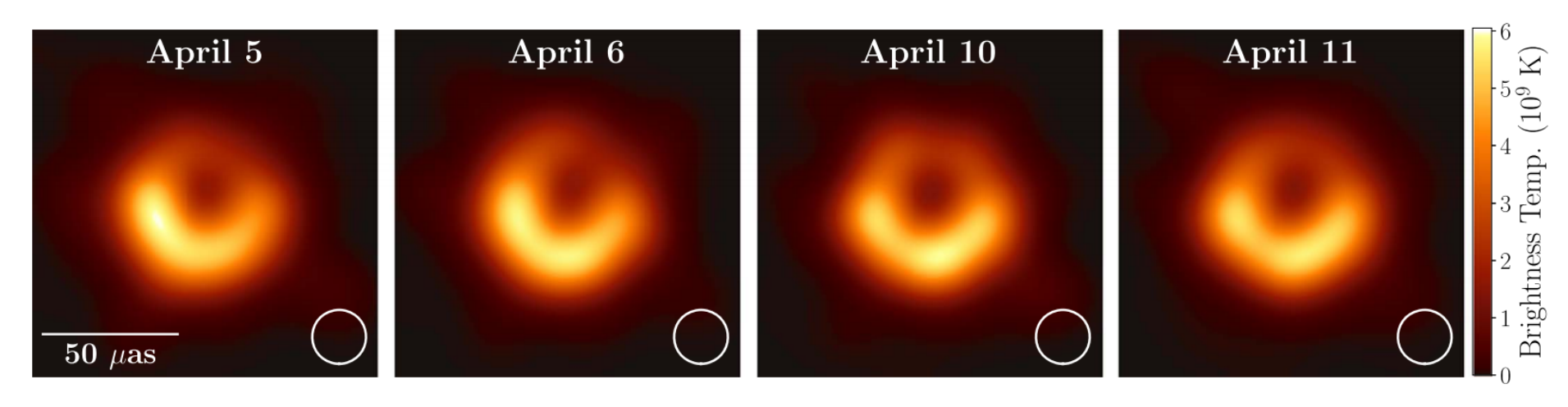
The EHT observed M87* on four separate occasions during the observing window (see Fig 4), and the team saw that some of the bright spots changed in that time, suggesting they may be associated with orbiting gas close to the black hole. The Innermost Stable Circular Orbit (ISCO) is the equivalent of the photon sphere but for particles with mass (and is also stable). The total conserved energy of a circular orbit close to a non-spinning black hole is given by
and the radius of the ISCO, , is the value of for which is minimised.
d. Determine for a non-spinning black hole. Give your answer in units of . [4 т.]
We expect that most black holes are in fact spinning (since most stars are spinning) and the spin of a black hole is quantified with the spin parameter where is the angular momentum of the black hole and is the maximum possible angular momentum it can have. The value of varies from , where negative spins correspond to the black hole rotating in the opposite direction to its accretion disk, and positive spins in the same direction. If then , whilst if then . The angular velocity of a particle in the ISCO is given by
e. (i) Taking the mass of M87* as :
(i) Determine the period of a particle in the ISCO of M87* for the , and (i.e. non-spinning) cases. Give your answer in days. [4 т.]
e. (ii) One of the bright patches in Fig 4 seemed to move a quarter of the way around the ring between April 5 and 10 (from the left hand side to the bottom). Could it be attributable to gas moving in the ISCO? If so, is the spin likely to be positive or negative? [2 т.]
e. (iii) Determine the minimum and maximum ISCO periods for Sgr A* and hence suggest a possible reason why M87 has been imaged first, even though Sgr A* has a larger angular diameter, given that each ‘exposure’ with the EHT was 7 mins long (with multiple exposures from each observing run added together for the final image from each night). [3 т.]
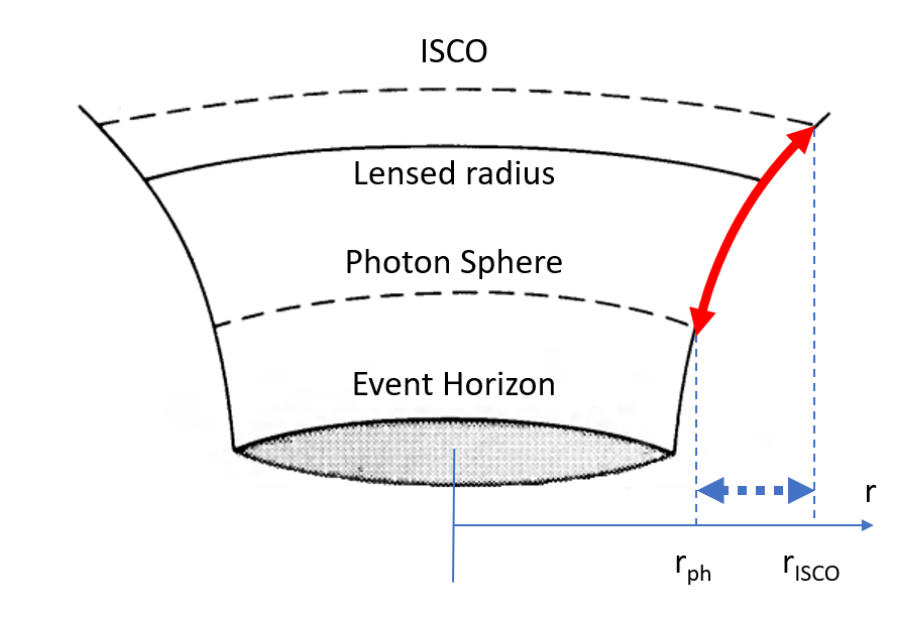
The spacetime near a black hole is curved, as described by the equations of GR. This means that the distance between two points can be substantially different to the distance you would expect if spacetime was flat. GR tells us that the proper distance travelled by a particle moving from radius to radius around a black hole of mass (with ) is given by
f. A particle close to M87* moves directly from to (and subsequently into the black hole). What is the extra distance travelled by it due to the curvature of spacetime, as described in Fig 5? Give your answer in au, and assume M87* is non-spinning. [7 т.]
Отговори
- a. dmax = 10907.93 km (JCMT–PV); θmin = 1.20 × 10⁻¹⁰ rad = 24.7 μas
- b. (i)
- b. (ii) 50.3 μas
- c. Mmin = 6.90 × 10⁹ M⊙; Mmax = 7.42 × 10⁹ M⊙
- d.
- e. (i) T(a=1) = 4.65 days; T(a=0) = 34.15 days; T(a=−1) = 60.42 days
- e. (ii) Orbital period = 20 days, within the ISCO range, so it could be gas in the ISCO; positive spin
- e. (iii) Tmin = 253 s (4.22 mins); Tmax = 3293 s (54.88 mins); bright objects / gas clouds may appear smeared out during exposures
- f. 73 au
Решение
Q2 – Event Horizon Telescope and Super Massive Black Holes [35 marks]
a.
Longest (solid) baseline from Fig. 3 is JCMT -> PV, so using 3-D Pythagoras,
[1]
[1] [2]
[Accept using SMA -> PV (giving = 10907.86 km) for full marks, and should be at least 3 s.f. and in km for the final mark. If the student uses PV -> SPT (the longest baseline, but a dashed line so not used for the M87 observation) giving = 11388.83 km then they lose the final mark only]
Wavelength being used,
[1]
[1] [2]
[Must be in microarcseconds (μas) for the final mark]
b. (i)
Balancing centripetal forces and Newtonian gravity,
[1]
Putting in the limit v = c and using the definition of (= GM/c),
[1]
[1] [3]
b. (ii)
[1]
Recognising that the lensed value we want is (3√3) ,
[1]
Determining the angular radius using trigonometry (and the small angle approximation),
[1]
Hence the angular diameter,
[1] [4]
[Must be in μas and the angular diameter (not radius) for the final mark]
[This is larger than the measured angular diameter of M87* of 42 μas, meaning that Sgr A* is the easiest SMBH to resolve, but as seen later in the question it’s not the easiest to image]
c.
The angular radius is,
The lensed physical radius is,
[1]
Looking at the minimum mass limit (i.e. the non-spinning case),
[1]
[1] [3]
Using the other lensed limit gives for the maximum mass,
[1] [1]
[The first three marks are for any correct mass (i.e. done in either order), with the fourth for the other one. Final masses must be given in ]
d.
Want given
Applying the product rule, ,
[1]
[1]
Making the expression in the square bracket equal zero (since m > 0),
[1]
(so = 6) [1] [4]
[First mark is for differentiating the expressions for u and v correctly, second mark for having the correct form of dE/dr, third mark for setting the relevant part of the expression to zero, fourth mark for the final answer. Give full credit to use of the quotient rule or other valid approaches]
e. (i)
For the a = 1 case,
[1]
days [1] [2]
Similarly,
days [Allow ecf on this one only] [1] [1]
days [All periods must be in days] [1] [1]
[First one correctly calculated is worth two marks, the rest are one mark (done in any order)]
e. (ii)
Quarter of a period in 5 days, so orbital period = 20 days
This is in the valid ISCO range (so could be gas moving in the ISCO) [1] [1]
This corresponds to a positive spin [1] [1]
[Allow full ecf on conclusions consistent with their earlier values]
e. (iii)
Minimum ISCO period when a = 1, so using a similar approach to e.(i),
[1] [1]
Maximum ISCO period when a = -1, [1] [1]
Possibility that bright objects / gas clouds appear smeared out during exposures [1] [1]
[Allow difficult to determine time evolution of the SMBH on the timescale of the ISCO / any other relevant point from identifying that the period of the ISCO might be similar to the duration of the exposure (unlike with M87*)]
f.
In flat space,
[Allow ecf] [1]
In curved space,
Using the following consecutive substitutions,
[1]
[1]
Using difference of squares followed by partial fractions,
[1]
[1]
[1]
So extra distance = [so this is a big effect!]
[1] [7]
[Accept any alternative method of integrating the function, including using numerical methods. The final answer must be in au for the final mark. To help with ecf for incorrect limits, the integral as a function of the original variable is so the irrational number should be ]
Questions proposed by
END OF PAPER
Questions proposed by:
Dr Alex Calverley (Royal Grammar School, Guildford)
Alan Sun (University of Cambridge)
Navonil Neogi (University of Cambridge)
Оригинал в Архива: BAAO_2020.pdf · официални решения: BAAO_2020_solutions.pdf