BAAO 2020, Теория — Задача 3. Inspirals of Exoplanets Near Tidal Destruction
British Astronomy and Astrophysics Olympiad 2019-2020 — Astronomy & Astrophysics Competition Paper — Monday 20th January 2020 · 20 януари 2020 г. · 30 т.
Указания
This question paper must not be photographed or taken out of the exam room
Time: 3 hours (approximately 60 minutes per question).
Questions: All three questions should be attempted. The last question is worth slightly fewer marks than the rest.
Solutions: Answers and calculations are to be written on loose paper. Students should ensure their name and school is clearly written on all answer sheets and pages are numbered. EACH QUESTION ANSWERED must be started on a new page. A standard formula booklet with standard physical constants should be supplied.
Instructions: To accommodate students sitting the paper at different times, please do not discuss any aspect of the paper on the internet until 8 am Saturday 25th January.
Clarity: Solutions must be written legibly, in black pen (the papers are photocopied), and working down the page. Scribble will not be marked and overall clarity is an important aspect of this exam.
Eligibility: The International Olympiad will be held during September 2020; all sixth form students are eligible to participate, even if they will be attending university from October.
Calculators: Any standard calculator may be used, but calculators cannot be programmable and must not have symbolic algebra capability.
Training Dates and the IOAA (Bogota, Columbia, 13th to 22nd September 2020)
The best students taking this paper that are eligible to represent the UK at the IOAA will be invited to attend the Training Camp to be held in the Physics Department at the University of Oxford, (Friday 27th March to Tuesday 31st March 2020). Astronomy material will be covered; problem solving skills and observational skills (telescope and naked eye observations) will be developed. At the Training Camp a data analysis exam and a short theory paper will be sat. A team of five students (plus one reserve) will be selected for further training. From April there will be mentoring by email to cover some topics and problems, followed by additional training camps in the summer.
Important Constants
| Constant | Symbol | Value |
|---|---|---|
| Speed of light | ||
| Earth’s rotation period | 1 day | 24 hours |
| Earth’s orbital period | 1 year | 365.25 days |
| parsec | pc | |
| Astronomical Unit | au | |
| Semi-major axis of the Earth’s orbit | 1 au | |
| Radius of the Sun | ||
| Radius of the Earth | ||
| Mass of the Sun | ||
| Mass of the Earth | ||
| Luminosity of the Sun | ||
| Stephan-Boltzmann constant | ||
| Gravitational constant | ||
| Boltzmann constant | ||
| Permittivity of free space | ||
| Permeability of free space | ||
| Planck’s constant | ||
| Elementary charge | ||
| Proton rest mass | ||
| Electron rest mass | ||
| Wien’s displacement law |
Basic calculus formulae:
| Chain rule | |
| Product rule | |
| Quotient rule | |
| Integration by parts | |
| Standard integral |
Important Formulae
You might find the diagram of an elliptical orbit below useful in solving some of the questions:
Elements of an elliptic orbit:
| semi-major axis | |
| semi-minor axis | |
| eccentricity | |
| F | focus |
| P | periapsis (point nearest to F) |
| A | apoapsis (point furthest from F) |
Kepler’s Third Law: For an elliptical orbit, the square of the period, , of an object about the focus is proportional to the cube of the semi-major axis, (as defined above), such that
where is the total mass of the system (typically dominated by the central object) and is the universal gravitational constant.
Vis-Viva Equation: For an elliptical orbit, the speed of an object at a distance from the focus is related to the semi-major axis, , total mass of the system, , and universal gravitational constant, , (as defined above), such that
Magnitudes: The apparent magnitudes of two objects, and , are related to their apparent brightnesses, and , via the formula
The absolute magnitude of an object, , is the same as its apparent magnitude when viewed from 10 pc, hence the relationship between apparent and absolute magnitude and distance is
where is measured in parsecs.
Note for markers
BAAO 2019/20 Solutions and Marking Guidelines
Note for markers:
- Answers to two or three significant figures are generally acceptable. The solution may give more in order to make the calculation clear. Units should be present on final answers when appropriate.
- There are multiple ways to solve some of the questions; please accept all good solutions that arrive at the correct answer. If a candidate gets the final (numerical) answer then allow them all the marks for that part of the question (as indicated in red), so long as there are no unphysical / nonsensical steps or assumptions made.
Условие
Some of the very first exoplanets to be discovered in large surveys were dubbed ‘hot Jupiters’ as they were similar in mass to Jupiter (i.e. a gas giant) but were much closer to their star than Mercury is to the Sun (and hence are in a very hot environment). Planetary formation models suggest that they were unlikely to have formed there, but instead formed much further out from the star and migrated inwards, due to gravitational interactions with other planets in the system. Studies of ‘hot Jupiters’ show that there is an overabundance of them with periods of days, and very few with periods shorter than that. Since large, close-in planets should be the easiest to detect in all of the main methods of finding exoplanets, this scarcity is likely to be a real effect and suggests that exoplanets which are that close to their star are in a relatively rapid (by astronomical standards) inspiral towards destruction by their star.
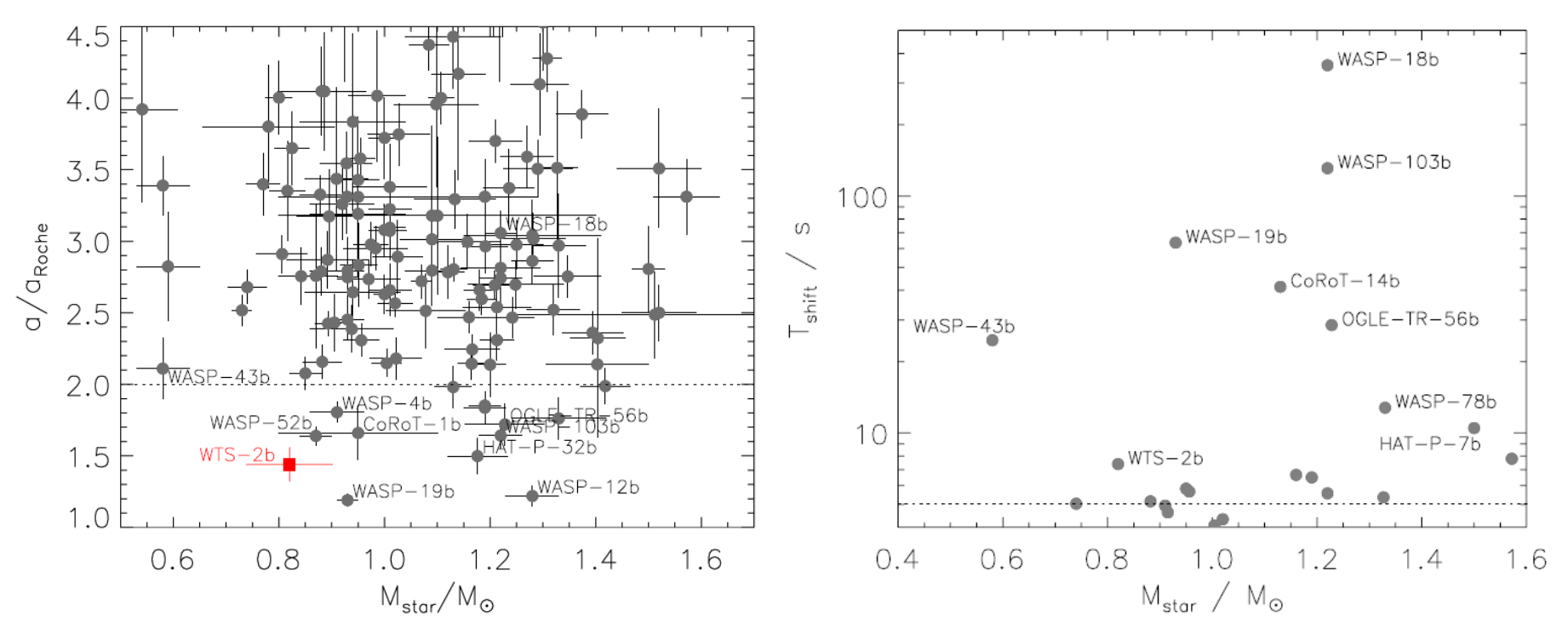
The Roche radius, where a planet will be torn apart due to the tidal forces acting on it, is defined as
where is the radius of the planet, is the mass of the planet and is the mass of the star. If a gas giant is knocked into a highly elliptical orbit (i.e. ) that has a periapsis then it will not survive. However, if the periapsis just grazes the Roche radius () then the orbit will rapidly circularise. By conserving angular momentum, it can be shown that the circular orbit will have a radius (see the left panel of Fig 6). Exoplanets observed to be in an orbit with a radius less than that will be unstable and angular momentum will be transferred from the planet to the star, causing the star to spin more rapidly and the planet’s orbital radius to decrease. Eventually this will result in the planet’s orbit crossing the Roche radius and being destroyed by the tidal forces.
The duration of this inspiral will be dependent on how well the star can dissipate the orbital energy through frictional processes within the star, and can be parameterised by the tidal dissipation quality factor, . By looking for changes in the orbital period of the planet, detectable by shifts in the timing of transits by the planet in front of the star, we can determine an estimate of , which hence tells us about the internal structure of stars. These ‘hot Jupiters’ are the best laboratory we have for this, as they are the most likely to produce a measurable shift (i.e. s) in transit times within only years (see the right panel of Fig 6). We will try and reproduce these results in this question.
The WTS-2 system consists of a star of mass , peak in its black-body spectrum at nm, and distance from us of 1.03 kpc, with an orbiting planet (called WTS-2b) with a period days, mass of 1.12 and radius 1.36 . The mass and radius of Jupiter are kg and m respectively.
a. Show that WTS-2b has an orbital radius of . [4 т.]
b. (i) Given the apparent magnitude of WTS-2 in the visible is and the absolute magnitude of the Sun in the same part of the EM spectrum is :
(i) Calculate the luminosity of the star, . Give your answer in units of . [3 т.]
b. (ii) Hence work out the radius of the star, . Give your answer in units of . [3 т.]
b. (iii) Show that the incident flux (in ) on the planet is times larger than what we receive on Earth from the Sun. [3 т.]
The change in the semi-major axis of the planet, , due to tidal forces is given by
where the dot notation is used to indicate the differential with respect to time (i.e. ), is a constant related to the density structure of the star, is the (assumed constant) time lag between where the planet is in its orbit and the location of the tidal bulge on the star, and . By separating variables and integrating this equation, an expression can be derived for the time it takes for to decrease to zero. This is known as the inspiral time, , and even though the planet will be destroyed when the time to go from to is negligible in comparison to the time to get to , so is a good estimate of the remaining lifetime of the planet.
c. Derive an equation for , showing . Hint: is a function of due to Kepler’s third law. [4 т.]
The tidal dissipation quality factor is defined as
and so absorbs some of our unknown parameters about the stellar structure. Based upon studies of binary stars it seems a value of is reasonable, although it is poorly constrained. The size of the shift in transit timings, , over an observation period of seconds is
d. (i) For the planet WTS-2b, assuming :
(i) Show that , finding the constant of proportionality (as a fraction), and hence the remaining lifetime of the planet. Give your answer in Myr. [1 Myr = years] [5 т.]
d. (ii) Show that , finding the constant of proportionality, and hence verify that is measurable (i.e. s) if years. Hint: Using the chain rule, . [8 т.]
Отговори
a. 1.44
a = 1.44 aRoche (aRoche = 1.92 × 10⁹ m, a = 2.77 × 10⁹ m)
b. (i) 0.317 L_⊙
b. (ii) 0.753 R_⊙
b. (iii) 930
bP = 930 bEarth
c.
d. (i) constant = 1/36; τ = 1.24 × 10¹⁵ s = 39.4 Myr
d. (ii) constant = 3/32; Tshift = 7.50 s (> 5 s, so measurable)
Решение
Q3 – Inspirals of Exoplanets Near Tidal Destruction [30 marks]
a.
Using the given formula for ,
[1]
Using Kepler’s third law,
[1]
[1]
[since ‘show that’ must be at least 3 s.f.] [1] [4]
b. (i)
Since the absolute magnitude is the apparent magnitude at a fixed distance of 10 pc,
and [1]
[1]
[1] [3]
[Final answer must be in for the final mark]
b. (ii)
Using Wien’s displacement law,
[1]
Using the Stephan-Boltzmann Law,
[1]
[1] [3]
[Final answer must be in for the final mark]
b. (iii)
[1]
[1]
[since ‘show that’ must be at least 2 s.f.] [1] [3]
[The consequence of such a large incident flux is that the surface of this planet is incredibly hot – given it is also tidally locked (so the same hemisphere always faces the star) it is modelled to have a maximum day-side surface temperature as high as ~2000 K]
c.
[1]
[1]
Separating variables and integrating,
[1]
[1] [4]
[We know that a is actually decreasing as time increases, so removing the modulus sign from the original given equation should give a negative sign, however the limits of the integral have been swapped around so that the value for τ evaluates to a positive number – do not penalise any student getting a negative expression for τ]
[This incredibly steep dependence on a is why we can treat the time to get from the initial value of a to zero as essentially the same as the time taken to get to (when the planet is destroyed)]
d. (i)
[1]
[1]
[so const = 1/36] [1] [3]
[First mark is for correctly substituting in the expression for Q’, the second for use of Kepler’s third law to cancel G and introduce , and the third for the value of the constant. Simply stating the constant without showing the rest of the algebraic expression cancelling into the required form loses at least the second mark.]
So we can now calculate the remaining lifetime,
[1]
s = 39.4 Myr [must be in Myr] [1] [2]
[Allow full ecf for the student’s values of a and and be generous with errors that may have arose from rounding]
[This is unsurprisingly rather short on astronomical timescales – this planet really is close to destruction!]
d. (ii)
[1]
[1]
[2]
[1]
Putting this into the given formula,
[1]
But we found so,
[so constant = 3/32] [1] [7]
Evaluating the expression for T = 10 years,
[so > 5 s therefore measurable] [1] [1]
[Allow full ecf from their value of τ. Allow use of 365.25 days in a year]
[WTS-2b is one of a number of exoplanets that could produce measurable changes in their period over the next decade (see the right panel in Fig 6 in the paper), and hence are an incredibly useful way of constraining the value of Q’, which in itself will greatly inform stellar models]
Questions proposed by
END OF PAPER
Questions proposed by:
Dr Alex Calverley (Royal Grammar School, Guildford)
Alan Sun (University of Cambridge)
Navonil Neogi (University of Cambridge)
Оригинал в Архива: BAAO_2020.pdf · официални решения: BAAO_2020_solutions.pdf