BAAO 2021, Теория — Задача 3. High Resolution Stellar Photos
British Astronomy and Astrophysics Olympiad 2020-2021 — Astronomy & Astrophysics Competition Paper — Saturday 27th February 2021 · 27 февруари 2021 г. · 40 т.
Указания
Time: 3 hours ( minutes for Q1, minutes for Q2 and minutes for Q3).
Questions: All three questions should be attempted. Each question contains independent parts so that later parts can be attempted even if earlier parts are incomplete.
Solutions: Answers and calculations are to be written on loose paper ON ONE SIDE ONLY. Students should ensure their name and school is clearly written on the first answer sheet and that all pages are numbered. EACH QUESTION ANSWERED must be started on a new page. A standard formula booklet with standard physical constants may be used if desired.
Instructions: This paper will be invigilated over Zoom with all candidates starting at 9am, however please do not discuss any aspect of the paper on the internet until 9am Saturday 6 March.
Clarity: Solutions must be written legibly, in black pen (the papers are scanned), and working down the page. Scribble will not be marked and overall clarity is an important aspect of this exam.
Eligibility: The International Olympiad will be held during November 2021; all sixth form students are eligible to participate.
Calculators: Any standard calculator may be used, but calculators cannot be programmable and must not have symbolic algebra capability.
Training Dates and the IOAA (Bogota, Colombia, November 2021)
The team will be selected from Y12 students taking this paper as well as Y12 students taking the Senior Physics Challenge paper in March. The best students that are eligible to represent the UK at the IOAA will be invited to attend the Training Camp to be held online from (Tuesday 6 April to Saturday 10 April 2021). Astronomy material will be covered; problem solving skills and observational skills (telescope and naked eye observations) will be developed. At the Training Camp a Data Analysis exam along with a Round 3 theory paper will be sat. A team of five students (plus one reserve) will be selected for further training, mostly done remotely with (hopefully) additional training camps in the summer.
Important Constants
| Constant | Symbol | Value |
|---|---|---|
| Speed of light | ||
| Earth’s rotation period | 1 day | 24 hours |
| Earth’s orbital period | 1 year | 365.25 days |
| parsec | pc | |
| Astronomical Unit | au | |
| Radius of the Sun | ||
| Radius of the Earth | ||
| Mass of the Sun | ||
| Mass of the Earth | ||
| Luminosity of the Sun | ||
| Stephan-Boltzmann constant | ||
| Gravitational constant | ||
| Boltzmann constant | ||
| Permittivity of free space | ||
| Permeability of free space | ||
| Planck’s constant | ||
| Elementary charge | ||
| Proton rest mass | ||
| Electron rest mass | ||
| Wien’s displacement law | ||
| Avagadro’s constant |
Basic calculus formulae:
Chain rule
Product rule
Quotient rule
Integration by parts
Standard integral
Important Formulae
You might find the diagram of an elliptical orbit below useful in solving some of the questions:
Elements of an elliptic orbit:
| semi-major axis | |
| semi-minor axis | |
| eccentricity | |
| focus | |
| periapsis distance (shortest distance from ) | |
| apoapsis distance (longest distance from ) |
Kepler’s Third Law: For an elliptical orbit, the square of the period, , of an object about the focus is proportional to the cube of the semi-major axis, (as defined above), such that
where is the total mass of the system (typically dominated by the central object) and is the universal gravitational constant.
Vis-Viva Equation: For an elliptical orbit, the speed of an object at a distance from the focus is related to the semi-major axis, , total mass of the system, , and universal gravitational constant, , (as defined above), such that
Magnitudes: The apparent magnitudes of two objects, and , are related to their apparent brightnesses, and , via the formula
The absolute magnitude of an object, , is the same as its apparent magnitude when viewed from 10 pc, hence the relationship between apparent and absolute magnitude and distance is
where is measured in parsecs.
BAAO 2020/21 Solutions and Marking Guidelines
Note for markers:
- Answers to two or three significant figures are generally acceptable. The solution may give more in order to make the calculation clear. Units should be present on final answers when appropriate.
- There are multiple ways to solve some of the questions; please accept all good solutions that arrive at the correct answer. Students getting the answer in a will get all the marks available for that calculation / part of the question (as indicated in red), so long as there are no unphysical / nonsensical steps or assumptions made (students may not explicitly calculate the intermediate stages and should not be penalised for this so long as their argument is clear).
Условие
The surface of the Sun has a temperature of K yet the solar corona (a very faint region of plasma normally only visible from Earth during a solar eclipse) is considerably hotter at around K. The source of coronal heating is a mystery and so understanding how this might happen is one of several key science objectives of the Solar Orbiter spacecraft. It is equipped with an array of cameras and will take photos of the Sun from distances closer than ever before (other probes will go closer, but none of those have cameras).
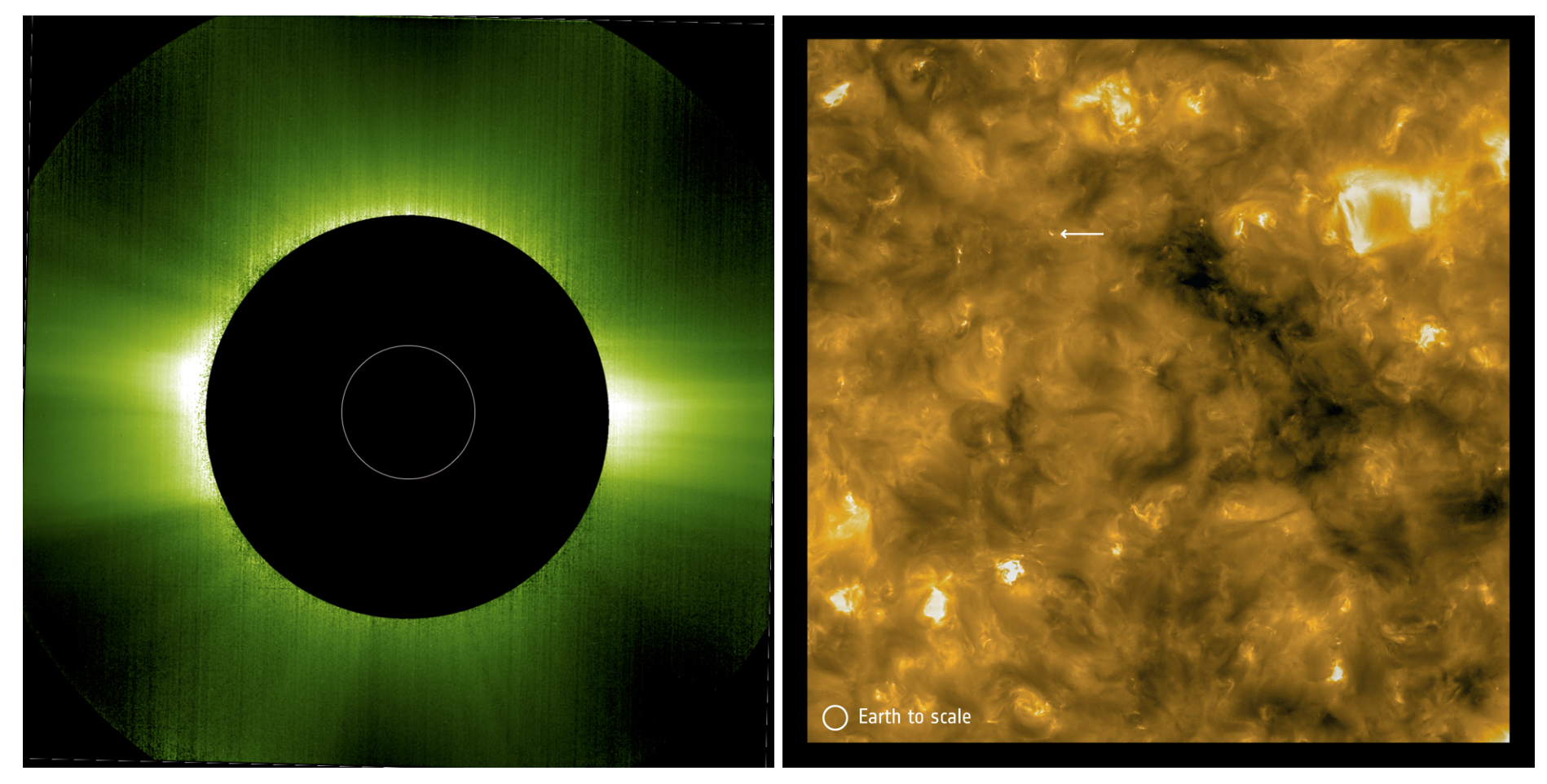
Launched in February 2020 (and taken to be at aphelion at launch), it arrived at its first perihelion on 15 June 2020 and has sent back some of the highest resolution images of the surface of the Sun (i.e. the base of the corona) we have ever seen. In them we have identified phenomena nicknamed as ‘campfires’ (see Fig 7) which are already being considered as a potential major contributor to the mechanism of coronal heating. Later on in its mission it will go in even closer, and so will take photos of the Sun in unprecedented detail.
a. (i) When it reached first perihelion, radio signals from the probe took 446.58 s to reach Earth.
Show that the spacecraft’s perihelion is au, giving your answer to 4 s.f., and hence estimate the launch date, assuming the Earth’s orbit is circular. Note that 2020 is a leap year and take year days. [Hint: You may wish to use a numerical method.] [11 т.]
a. (ii) The circumference of an ellipse, unlike for a circle, has no closed form. A good approximation from Ramanujan (1914) is
and and represent the semi-major and semi-minor axes, respectively. Use this to work out the distance travelled by the probe between launch and perihelion to 4 s.f. [4 т.]
a. (iii) The exact solution for the circumference is
where is the eccentricity and is an angle in radians. The integral has no analytical solution, but can be written as an infinite series expansion and hence the expression becomes
Find the values of and , given as fractions in their simplest terms, and hence calculate a new value for the distance travelled by the probe (also to 4 s.f.). Compare this to the approximation in the previous part and comment on your answer.
[A helpful infinite series expansion is ] [9 т.]
The highest resolution photos are taken with the Extreme Ultraviolet Imager (EUI), which consists of three separate cameras. One of them, the Extreme Ultraviolet High Resolution Imager (HRI), is designed to pick up an emission line from highly ionised atoms of iron in the corona. The iron being detected has lost 9 electrons (i.e. Fe) though is called Fe X (‘ten’) by astronomers (as Fe I is the neutral atom). Its presence can be used to work out the temperature of the part of the corona being investigated by the instrument.
b. (i) The energy density of black-body radiation, , at temperature is given as
and the number density of black-body radiation, , at temperature is given as
Here is Planck’s constant, is the frequency, is the speed of light, is Boltzmann’s constant, and is the Riemann zeta function for which .
The average energy per photon is given as . Find the numerical value of . [Standard integral: ] [5 т.]
b. (ii) Assuming the plasma of Fe ions is in thermal equilibrium with the photons, and that the average energy of the photons is equal to the ionisation energy of Fe X (which is kJ mol), calculate the temperature of the plasma. Give your answer to 4 s.f. [2 т.]
The photons detected by HRI are emitted by a rearrangement of the electrons in the Fe X ion, corresponding to a photon energy of eV (where eV J). The HRI telescope has a by field of view (FOV, where arcseconds), an entrance pupil diameter of 47.4 mm, a couple of mirrors that give an effective focal length of 4187 mm, and the image is captured by a CCD with by pixels, each of which is by µm.
Although we are viewing the emissions of Fe X ions, the vast majority of the plasma in the corona is hydrogen and helium, and the bulk motions of this determine the timescales over which visible phenomena change. In particular, the speed of sound is very important if we do not want motion blur to affect our high resolution images, as this sets the limit on exposure times.
c. (i) The Rayleigh criterion is
where is the minimum angular diameter (in radians) that can be resolved by a telescope, is the observing wavelength and is the diameter of the aperture of the telescope.
The speed of sound in a plasma is
where is the mean particle mass (, , are the mass fractions of hydrogen, helium and elements heavier than helium, respectively), is the mass of a proton, and is the adiabatic ratio.
Determine the theoretical minimum angular diameter of an element resolvable by this optical system. Give your answer in arcseconds (). [2 т.]
c. (ii) In practice, this is not achieved as the pixels are not small enough. Given that each picture element is spread across two pixels (in 1D) to allow adequate sampling, what is the actual minimum angle resolved on the CCD? Give your answer in arcseconds (). [Hint: consider the geometry of the optical system and note that the angles are small enough that the small angle approximation can be used.] [2 т.]
c. (iii) Later on in its mission, Solar Orbiter will have a perihelion of 0.284 au. Calculate the physical size on the Sun (in km) of each picture element in an image taken with HRI as well as the FOV in units of . [2 т.]
c. (iv) If the mass fractions of the surface of the Sun are , , and , and treating the plasma as an ideal monatomic gas so that , determine the speed of sound of the plasma (in km s) at the base of the corona. Hence, by comparison to your answer from the previous part, estimate the upper limit on the length of an exposure to avoid motion blur in the plasma. You should ignore any motion blur from the relative motion of the spacecraft or the rotation of the Sun. [3 т.]
Отговори
a. (i) rperi = 0.4956 au; launch date 17 February 2020
Official scheme: 0.4998 au with the simple form of Kepler’s third law also gets full marks; 18 Feb also allowed.
a. (ii) 2.281 au
a. (iii) D = 1/4, E = 3/64; distance travelled 2.281 au (same as the Ramanujan approximation to 4 s.f.)
b. (i) ≈
b. (ii) K
c. (i) 0.0929 arcsec
c. (ii) 0.985 arcsec
c. (iii) 203 km per picture element; FOV 0.297 R☉ (by 0.297 R☉)
c. (iv) vs ≈ 152 km s⁻¹; exposure ≲ 1.34 s
Решение
Q3 – High Resolution Stellar Photos [40 marks]
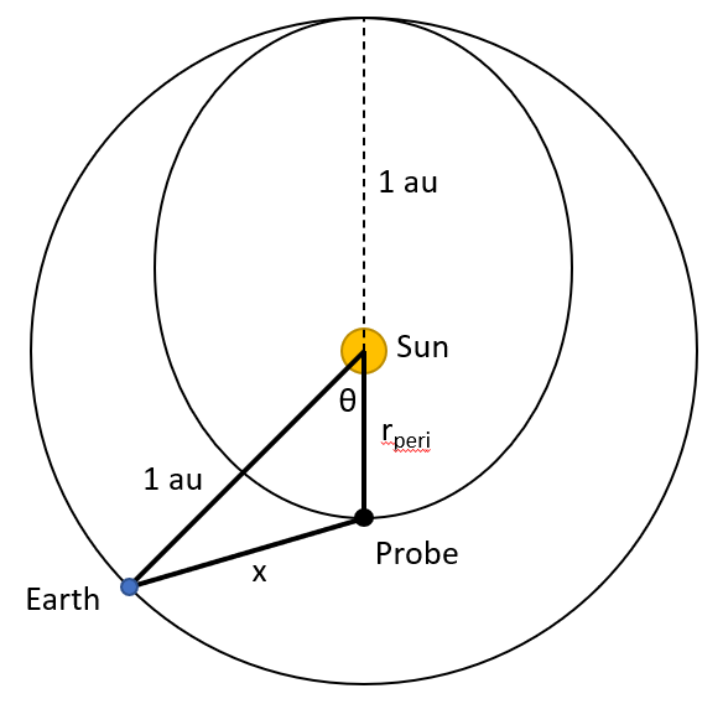
a. i. This is a diagram of the situation (note: Earth and probe are orbiting anticlockwise)
Given the light travel time,
Considering the geometry of the triangle Earth-Sun-Probe after travelling for time t:
Keeping in au, and given t is half the period of the probe’s orbit, T, we can use Kepler’s third law [= K3] to work out t in SI units:
Substituting this into our equations above to form one where is the only unknown:
Using an appropriate numerical method, [2] [7]
[Allow any valid method to find the root of the equation such as Newton-Raphson starting with r = 0.5 au, using a graphical calculator to find the roots, or even using trial and error (starting from 0.5 au). The final answer must be 4 s.f. otherwise a mark is dropped. If given in metres, a comparison must be made to 0.5 au (also in metres) to show they are approximately the same]
[If students use the ‘simple’ version of K3, , where is already in years and is already in au, then they will get so the equation to be solved is , which gives . This approach receives full marks (and is somewhat simpler to type into a calculator)]
Given we know , we can find , and therefore the launch date:
[This mark may be given in part (iii) instead if not awarded here]
So we need 15 June – 118.567 days
118.567 days = 15 in June + 31 in May + 30 in April + 31 in March + 11.567 in Feb
so will be 29 – 11.567 = 17.433 ∴ [allow 18 Feb] [1] [4]
[Using the ‘simple’ version of K3 gives a = 0.7499 au, t = 118.592 days, and the same launch date. This is effectively the same as if students use the r = 0.5 au given, although doing that with the SI version of K3 gives t = 119.090 days and so 16 Feb. Using the given r and the simple version of K3 gives t = 118.618 days. A launch date of 17 Feb corresponds to arriving at perihelion at 00:00 on 15 June, whilst 18 Feb allows for students presuming a later time of arrival (up to 23:59 on 15 June). Allow ecf on the launch date from their own values of t]
[In reality, the probe reached a perihelion distance of 0.514 au and was launched on 10 Feb. The reason for the discrepancy is that the Earth’s orbit is elliptical and reaches perihelion on 4 Jan so the probe was not actually at aphelion at launch (although it did reach it on 17 Feb), and the aphelion distance was 0.986 au]
ii. Using the equations given at the beginning of the paper,
But only half an ellipse has been covered, so distance travelled [0.5] [4]
[Must be 4 s.f. for the final mark. Carrying forward values from the ‘simple’ version of K3 gives e = 0.3335, b = 0.7070 au, j = 0.02947, C = 4.578 au and so distance travelled is 2.289 au (essentially the same as if using the given r)]
iii. Using the given formula for a binomial expansion,
The first term is very easy to evaluate (and is effectively already given),
To do the other integrals we need to use the trig identities:
The second term,
The third term,
So putting back into our original formulae,
We can now evaluate C numerically,
To 4 s.f., this is the same as the Ramanujan approximation (so very good!) [1] [1]
[Must be 4 s.f. for the final mark. If students forget the e term, they will still get the same answer to 4 s.f. – do not penalise them for that mistake. Using the ‘simple’ version of K3 gives 2.289 au, again the same as before. The real difference between the two values is , which is remarkably close]
[In reality, the distance the probe had travelled from launch to perihelion was 2.393 au, however the main reason for the discrepancy is the extra week of travel between launch and aphelion]
b. i. To get the integral to look like the standard one, we need to use a substitution:
Use [need correct dν for mark] [1]
Substituting this into the original integral,
[Third mark is for some attempt at simplification of the algebraic expression. No s.f. requirement in this question but expect at least 2 s.f. (and should really use 4 s.f. in the next part of the question). If get dν = dx and hence a value of ε that still has a value of T in it this is considered a major error and there is no ecf]
ii. Converting the ionisation energy into an energy of each photon
[Despite the considerable simplifications we have made to our model, this is remarkably close to the real value of temperature for which Fe X is the dominant fraction. In reality, it forms an equilibrium over a range of temperatures (contributing a detectable fraction from about 10 to 10 K) with various other ions in ionisation equilibrium – all you can compute is the ionic fraction at a given temperature (i.e. the plasma is never purely one ion)]
c. i. First, we can work out the wavelength given the photon energy,
[Must be in arcseconds for the final mark]
[Given the wavelength investigated is 17.5 nm, it is clearly in the extreme UV]
ii. Considering the geometry of the situation:
where s is the distance on the CCD and f is the focal length. Using the small angle approx:
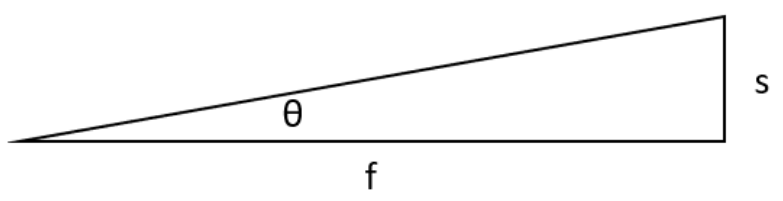
[Must be in arcseconds for the final mark. If only done for s = 1 pixel (i.e. 10 µm), lose 1 mark. Another valid approach for the first mark is to use the formula for the plate scale, ]
iii. Using similar geometry to the previous part of the question,
where d is the distance on the Sun and r is the distance to the Sun. Using the small angle approximation again,
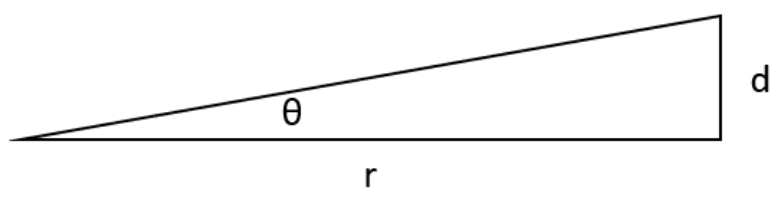
Considering the field of view (FOV) of the telescope, we need to convert 1000” into rad
[So the field of view is 0.297 R by 0.297 R. First answer must be in km and second in R for the marks]
[Originally the mission plan was to go even closer, however it was adjusted to have a minimum perihelion of au so that the solar panel technology could be reused from the BepiColombo mission, which will enter an orbit around Mercury in December 2025. Mercury’s perihelion is ≈ 0.30 au so Solar Orbiter will pass fully inside the orbit of Mercury. The minimum perihelion for Solar Orbiter will be on 7 Feb 2027]
iv. Using the given mass fractions and formulae, plus the temperature from b. (ii)
[Must be in km s for the final mark. If students did not get a value for T from part b. they should have seen in the opening paragraph of the question that typical corona temperatures are 10 K and used that – penalise those that use the temperate of the surface of the Sun]
By comparing to the physical size of each picture element,
[The HRI will take images of 1 second exposure (with shorter exposure times in subfields of the FOV) every second in the ‘Discovery’ program, however most images will have a 2 second exposure with the interval time between images varying from seconds to minutes depending on the different observation programs]
END OF PAPER
END OF PAPER
Questions proposed by:
Dr Alex Calverley (Royal Grammar School, Guildford)
Niam Vaishnav (University of Oxford)
Nick Koukoufilippas (University of Oxford)
Оригинал в Архива: BAAO_2021.pdf · официални решения: BAAO_2021_solutions.pdf