BAAO 2022, Теория — Задача 1. Sunrise in Oxford
British Astronomy and Astrophysics Olympiad 2021-2022 — Astronomy & Astrophysics Competition Paper · 24 януари 2022 г. · 30 т.
Указания
This question paper must not be photographed or taken out of the exam room
Time: 3 hours ( minutes for Q1, minutes for Q2 and minutes for Q3).
Questions: All three questions should be attempted. Each question contains independent parts so that later parts can be attempted even if earlier parts are incomplete.
Solutions: Answers and calculations are to be written on loose paper. Students should ensure their name and school is clearly written on the first answer sheet and that all pages are numbered. EACH QUESTION ANSWERED must be started on a new page. A standard formula booklet with standard physical constants may be used if desired.
Instructions: To accommodate students sitting the paper at different times, please do not discuss any aspect of the paper on the internet until 8 am Saturday 29th January.
Clarity: Solutions must be written legibly, in black pen, and working down the page. Scribble will not be marked and overall clarity is an important aspect of this exam.
Eligibility: The International Olympiad will be held in August 2022; all sixth form students are eligible to participate.
Calculators: Any standard calculator may be used, but calculators cannot be programmable and must not have symbolic algebra capability.
Training Dates and the IOAA
Training Dates and the IOAA (Kyiv, Ukraine, 12th - 22nd August 2022)
The team will be selected from students taking this paper. The best students that are eligible to represent the UK at the IOAA will be invited to attend the Training Camp to be held in Oxford from Saturday 9th to Wednesday 13th April 2022. Astronomy material will be covered; problem solving skills and observational skills (telescope and naked eye observations) will be developed. At the Training Camp a Data Analysis exam along with a Round 3 theory paper will be sat. A team of five students (plus one reserve) will be selected for further training, including additional training camps in the summer.
Important Constants
| Constant | Symbol | Value |
|---|---|---|
| Speed of light | ||
| Earth’s rotation period | 1 day | 24 hours |
| Earth’s orbital period | 1 year | 365.25 days |
| parsec | pc | |
| Astronomical Unit | au | |
| Radius of the Sun | ||
| Radius of the Earth | ||
| Mass of the Sun | ||
| Mass of the Earth | ||
| Luminosity of the Sun | ||
| Stephan-Boltzmann constant | ||
| Gravitational constant | ||
| Boltzmann constant | ||
| Permittivity of free space | ||
| Permeability of free space | ||
| Planck’s constant | ||
| Elementary charge | ||
| Proton rest mass | ||
| Electron rest mass | ||
| Wien’s displacement law | ||
| Avagadro’s constant |
Basic calculus formulae:
| Chain rule | |
| Product rule | |
| Quotient rule | |
| Integration by parts | |
| Standard integral |
Important Formulae
You might find the diagram of an elliptical orbit below useful in solving some of the questions: (the diagram is attached to Qu 3 as a figure)
Elements of an elliptic orbit:
| semi-major axis | |
| semi-minor axis | |
| eccentricity | |
| focus | |
| periapsis distance (shortest distance from ) | |
| apoapsis distance (longest distance from ) |
Kepler’s Third Law: For an elliptical orbit, the square of the period, , of an object about the focus is proportional to the cube of the semi-major axis, (as defined above), such that
where is the total mass of the system (typically dominated by the central object) and is the universal gravitational constant.
Vis-Viva Equation: For an elliptical orbit, the speed of an object at a distance from the focus is related to the semi-major axis, , total mass of the system, , and universal gravitational constant, , (as defined above), such that
Magnitudes: The apparent magnitudes of two objects, and , are related to their apparent brightnesses, and , via the formula
The absolute magnitude of an object, , is the same as its apparent magnitude when viewed from 10 pc, hence the relationship between apparent and absolute magnitude and distance is
where is measured in parsecs.
Note for markers
BAAO 2021/22 Solutions and Marking Guidelines
Note for markers:
- Answers to two or three significant figures are generally acceptable. The solution may give more in order to make the calculation clear. Units should be present on final answers when appropriate.
- There are multiple ways to solve some of the questions; please accept all good solutions that arrive at the correct answer. Students getting the answer in a box will get all the marks available for that calculation / part of the question (as indicated in red), so long as there are no unphysical / nonsensical steps or assumptions made (students may not explicitly calculate the intermediate stages and should not be penalised for this so long as their argument is clear).
Условие
It is often said that the Sun rises in the East and sets in the West, however this is only true twice a year - at the equinoxes. In the Northern hemisphere, the Sun will rise northwards of East on the June solstice, and southwards of East on the December solstice; this is directly tied in with the varying length of day too, since the Sun either has a greater or shorter distance to travel across the sky (see Figure 1).
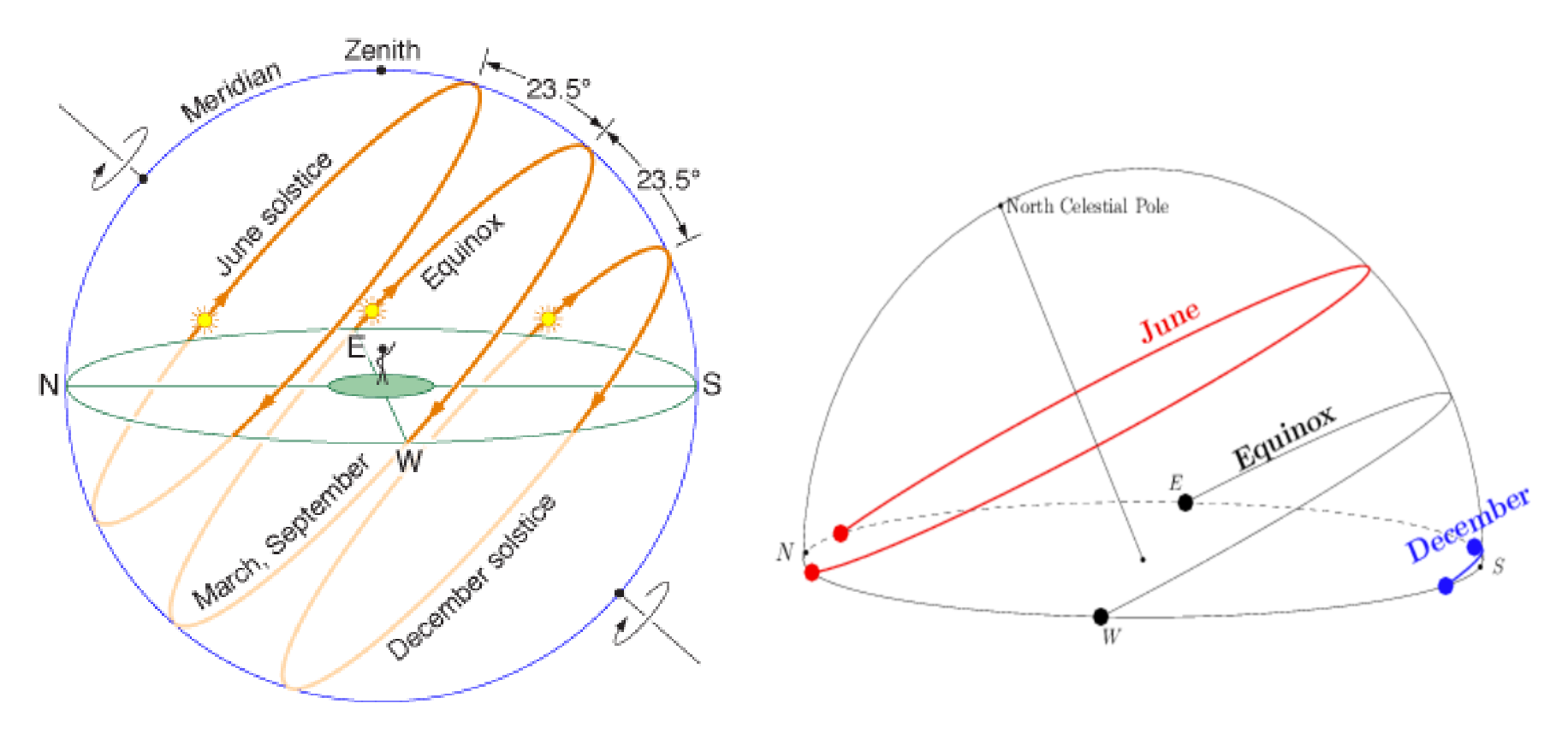
During the equinox, the Sun travels along the projection of the Earth’s equator. In this question, we will assume a circular orbit for the Earth, and all angles will be calculated in degrees.
A simple model for the vertical angle between the Sun and the horizon (known at the altitude), , as a function of the bearing on the horizon, (measured clockwise from North, also called the azimuth), the latitude of the observer, (positive in Northern hemisphere, negative in Southern hemisphere), and the vertical angle of the Sun relative to the celestial equator (known as the solar declination), , is given as:
The solar declination can be considered to vary sinusoidally over the year, going from a maximum of at the June solstice (roughly 21st June) to a minimum of on the December solstice (roughly 21st December).
a. (7 т.)
Consider an observer in Oxford () on the June solstice.
(i) Calculate the bearing of sunrise. Take the Sun to be a point source and ignore any atmospheric effects. [2 т.]
(ii) By calculating the angle the solar path makes with the horizon, , at sunrise for both the solstice and the equinox, estimate the duration of sunrise on the solstice if sunrise takes 3 mins 26 secs on the equinox. Assume the same solar angular velocity in both cases. [Hint: if is in degrees (this will give an answer in degrees per degree, rather than degrees per radian as it would be without the factor).] [5 т.]
It can be shown using spherical trigonometry that the precise model connecting , , and is:
b. (3 т.)
Considering just the bearing of sunrise, suggest (with qualitative justification only) which of the following situations the simple model will be the best approximation for the precise model:
A) a pole at solstice; B) a pole at equinox; C) the equator at solstice; or D) the equator at equinox.
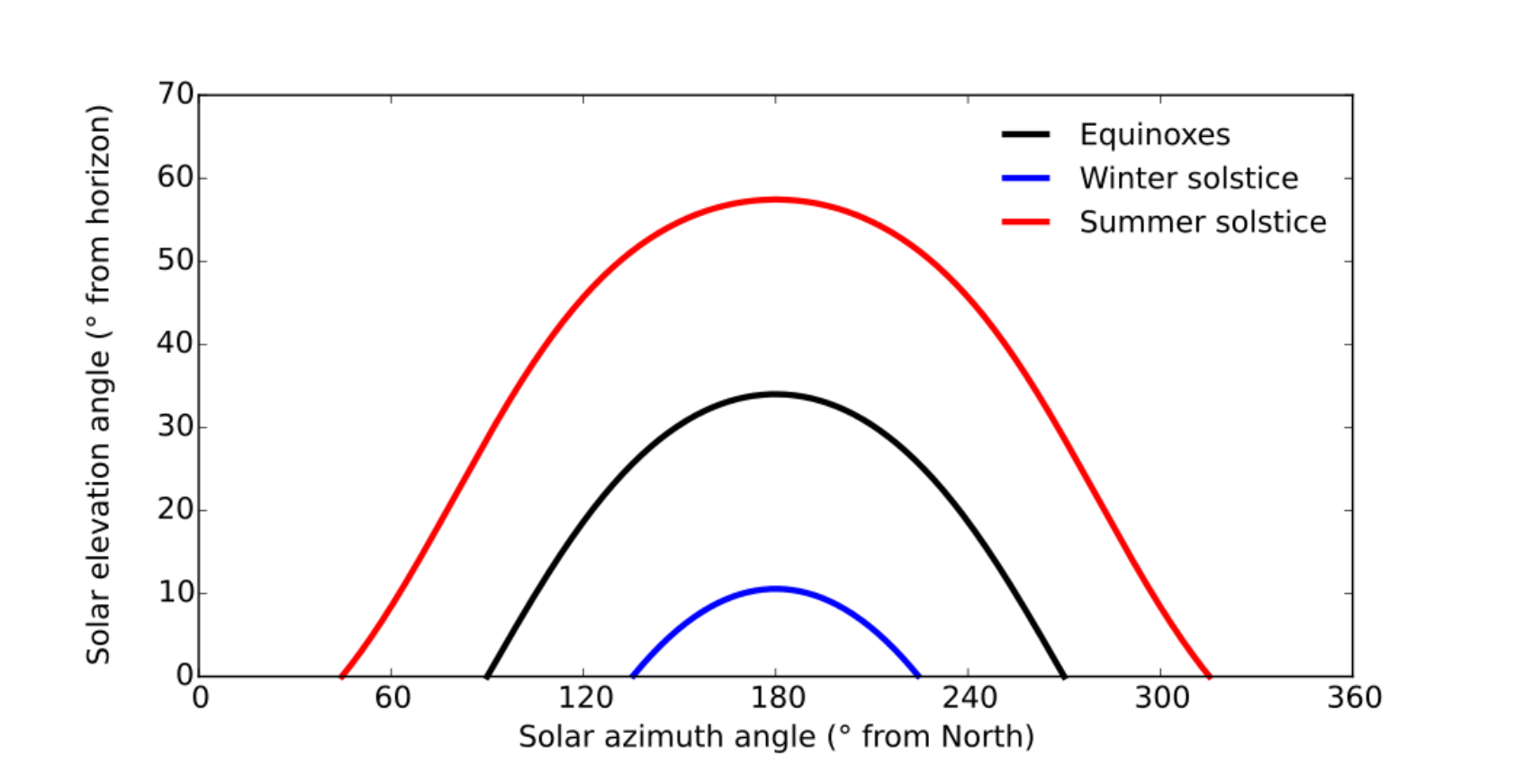
Using the precise model, the path of the Sun across the sky forms a shape that is not quite the cosine shape of the simple model, and is shown in Figure 2.
By using further spherical trigonometry, we can derive a second helpful equation in the precise model:
Here, is the solar hour angle, which measures the angle between the Sun and solar noon as measured along the projection of the Earth’s equator on the sky. Conventionally, at solar noon, is negative before solar noon, and is positive afterwards. Since the sun’s hour angle increases at an approximately constant rate due to the rotation of the Earth, we can convert this angle into a time using the conversion .
c. (10 т.)
Reconsider the Oxford observer at the June solstice, but this time use the two equations of the precise model. Ignore any atmospheric effects.
(i) Calculate the bearing of sunrise and the duration of the day (in hours and minutes), taking the Sun to be a point source. [6 т.]
(ii) Calculate the duration of sunrise (in minutes and seconds), assuming a solar angular diameter of . [4 т.]
d. (10 т.)
This exam is being taken on 24th January and is 3 hours long.
(i) Estimate the solar declination on this date. [3 т.]
(ii) Hence, calculate the latitude where today’s day length is equal to the exam length, taking the Sun to be a point source. [2 т.]
(iii) What is the latitude with the longest sunrise today? Give its duration in minutes and seconds. [5 т.]
Отговори
- a., (i) 52.1 °
- a., (ii) 4 min 5 s
- c., (i) A = 50.0°; day length 16 hr 27 min
- c., (ii) 4 min 26 s
- d., (i) -19.54 °
- d., (ii) 69 °
- d., (iii) φ = 70.2°; 55 min 3 s
Решение
Q1 – Sunrise in Oxford [30 marks]
a.
Consider an observer in Oxford (ϕ = +51.8°) on the June solstice.
i. Calculate the bearing of sunrise. Take the Sun to be a point source and ignore any atmospheric effects.
Sunrise corresponds to [1]
Putting this in the given formula:
[1] [2]
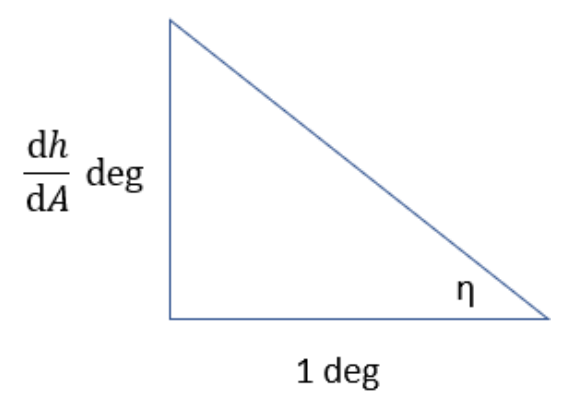
ii. By calculating the angle the solar path makes with the horizon, η, at sunrise for both the solstice and the equinox, estimate the duration of sunrise on the solstice if sunrise takes 3 mins 26 secs on the equinox. Assume the same solar angular velocity in both cases.
Using the given hint to differentiate the formula,
[1]
Considering the sunrise angle, , it is clear that
Evaluating dh/dA at A = 90° (for the equinox) and at A = 52.1° (for the June solstice) gives
[1]
[1] [3]
The Sun needs to travel vertically through some (fixed) angle Δh to set, so considering the vertical component of its angular velocity, ω
[1]
Putting in our values for the setting angles,
[1] [2]
[If the student wrongly assumes that the solstice sunset is shorter than at equinox and hence have the fraction of sin η the wrong way round (leading to 2 min 53 s) lose 4th mark but ecf on 5th; same penalty if using the ratio of dh/dA instead of the ratio of sin(tan(dh/dA)) giving 4 min 21 s. If both mistakes are made (resulting in 2 min 43 s) subtract an additional mark. Allow 1 ecf mark for if some justification given]
b.
Considering just the bearing of sunrise, suggest (with qualitative justification only) which of the following situations the simple model will be the best approximation for the precise model:
A) a pole at solstice; B) a pole at equinox; C) the equator at solstice; or D) the equator at equinox.
When , the simple model becomes
Similarly, the precise model becomes
need so need small enough to use small angle approximation equinox
and need
need to be small pole
The best option is therefore [3] [3]
[Answer without justification gets no marks. Lose 1 mark for each flaw in justification]
c.
Reconsider the Oxford observer at the June solstice, but this time use the two equations of the precise model. Ignore any atmospheric effects.
i. Calculate the bearing of sunrise and the duration of the day (in hours and minutes), taking the Sun to be a point source.
When , the precise model becomes [1]
[This mark may be awarded from working in part b. if not explicitly present here]
[1] [2]
Using the second given formula from the precise model with
[1]
[1]
The day length is the time it takes the Sun to go from to
[1]
[1] [4]
[Due to the symmetry of sunrise and sunset, do not penalise giving only a positive value of H. Must be expressed in hours and minutes for the final mark]
[This shows the simple model has done rather well for determining the bearing of sunrise with a less than 5% error. It is clear that sunrise happens in the North East, not the East, on the June solstice (and, by symmetry, in the South East on the December solstice)]
ii. Calculate the duration of sunrise (in minutes and seconds), assuming a solar angular diameter of 0.525°.
The value of now corresponds to the angle the centre of the solar disc makes with the horizon, so sunrise starts () when is 1 solar angular radius below the horizon, and finishes () when it is 1 solar angular radius above the horizon
[1]
Using the second given formula we can find out the corresponding solar hour angle,
[1]
Similarly, [Again, no penalty for positive H values] [1]
[1] [4]
[This is within 1 second of the real value (ignoring atmospheric effects), with the discrepancy coming only from not using a more precise value for the solar angular diameter. The simple model has not performed as well here as it did for the bearing, being about 8% off compared to 5% for the bearing – this extra discrepancy is mostly down to the fact that ω is slightly different at the equinox and solstice due to the elliptical shape of the Earth’s orbit]
d.
This exam is being taken on 24th January and is 3 hours long.
i. Estimate the solar declination on this date.
Given we are told that the declination varies sinusoidally from -23.44° on 21st Dec to +23.44° on 21st June, a reasonable approximation for δ (in degrees) would be
[1]
Since there are 31 days in December, 24th January is 34 days since the solstice [1]
[1] [3]
[Accept other reasonable models and use of 365.25 days for 1 year. The 2nd mark is for the number of days since the winter solstice – allow attempts based upon the number of days since / before the June solstice. No marks for use of a linear model]
[The real solar declination is -19.17°, so this is a good estimate]
ii. Hence, calculate the latitude where today’s day length is equal to the exam length, taking the Sun to be a point source.
If the day length is 3 hours, then when need [1]
Using a similar approach to c. (i) [No marks for using ]
[1] [2]
iii. What is the latitude with the longest sunrise today? Give its duration in minutes and seconds.
The longest possible sunrise will occur when it only just finishes at solar noon
when [Allow diagram or qualitative statement] [1]
Putting this into the second given equation and using a suitable trigonometric identity
[1]
[1] [3]
We can use a similar approach to c. (ii) to work out (we already know ) and hence duration of the sunrise:
[Again, no penalty for positive H values]
[1]
[1] [2]
[This means the sunrise lasts half a day, and is almost one third of the length of this exam!]
END OF PAPER
END OF PAPER
Questions proposed by:
Dr Alex Calverley (Royal Grammar School, Guildford)
Josh Brown (University of Cambridge)
Оригинал в Архива: BAAO_2022.pdf · официални решения: BAAO_2022_solutions.pdf