BAAO 2022, Теория — Задача 2. Stellar Structure
British Astronomy and Astrophysics Olympiad 2021-2022 — Astronomy & Astrophysics Competition Paper · 24 януари 2022 г. · 35 т.
Указания
This question paper must not be photographed or taken out of the exam room
Time: 3 hours ( minutes for Q1, minutes for Q2 and minutes for Q3).
Questions: All three questions should be attempted. Each question contains independent parts so that later parts can be attempted even if earlier parts are incomplete.
Solutions: Answers and calculations are to be written on loose paper. Students should ensure their name and school is clearly written on the first answer sheet and that all pages are numbered. EACH QUESTION ANSWERED must be started on a new page. A standard formula booklet with standard physical constants may be used if desired.
Instructions: To accommodate students sitting the paper at different times, please do not discuss any aspect of the paper on the internet until 8 am Saturday 29th January.
Clarity: Solutions must be written legibly, in black pen, and working down the page. Scribble will not be marked and overall clarity is an important aspect of this exam.
Eligibility: The International Olympiad will be held in August 2022; all sixth form students are eligible to participate.
Calculators: Any standard calculator may be used, but calculators cannot be programmable and must not have symbolic algebra capability.
Training Dates and the IOAA
Training Dates and the IOAA (Kyiv, Ukraine, 12th - 22nd August 2022)
The team will be selected from students taking this paper. The best students that are eligible to represent the UK at the IOAA will be invited to attend the Training Camp to be held in Oxford from Saturday 9th to Wednesday 13th April 2022. Astronomy material will be covered; problem solving skills and observational skills (telescope and naked eye observations) will be developed. At the Training Camp a Data Analysis exam along with a Round 3 theory paper will be sat. A team of five students (plus one reserve) will be selected for further training, including additional training camps in the summer.
Important Constants
| Constant | Symbol | Value |
|---|---|---|
| Speed of light | ||
| Earth’s rotation period | 1 day | 24 hours |
| Earth’s orbital period | 1 year | 365.25 days |
| parsec | pc | |
| Astronomical Unit | au | |
| Radius of the Sun | ||
| Radius of the Earth | ||
| Mass of the Sun | ||
| Mass of the Earth | ||
| Luminosity of the Sun | ||
| Stephan-Boltzmann constant | ||
| Gravitational constant | ||
| Boltzmann constant | ||
| Permittivity of free space | ||
| Permeability of free space | ||
| Planck’s constant | ||
| Elementary charge | ||
| Proton rest mass | ||
| Electron rest mass | ||
| Wien’s displacement law | ||
| Avagadro’s constant |
Basic calculus formulae:
| Chain rule | |
| Product rule | |
| Quotient rule | |
| Integration by parts | |
| Standard integral |
Important Formulae
You might find the diagram of an elliptical orbit below useful in solving some of the questions: (the diagram is attached to Qu 3 as a figure)
Elements of an elliptic orbit:
| semi-major axis | |
| semi-minor axis | |
| eccentricity | |
| focus | |
| periapsis distance (shortest distance from ) | |
| apoapsis distance (longest distance from ) |
Kepler’s Third Law: For an elliptical orbit, the square of the period, , of an object about the focus is proportional to the cube of the semi-major axis, (as defined above), such that
where is the total mass of the system (typically dominated by the central object) and is the universal gravitational constant.
Vis-Viva Equation: For an elliptical orbit, the speed of an object at a distance from the focus is related to the semi-major axis, , total mass of the system, , and universal gravitational constant, , (as defined above), such that
Magnitudes: The apparent magnitudes of two objects, and , are related to their apparent brightnesses, and , via the formula
The absolute magnitude of an object, , is the same as its apparent magnitude when viewed from 10 pc, hence the relationship between apparent and absolute magnitude and distance is
where is measured in parsecs.
Note for markers
BAAO 2021/22 Solutions and Marking Guidelines
Note for markers:
- Answers to two or three significant figures are generally acceptable. The solution may give more in order to make the calculation clear. Units should be present on final answers when appropriate.
- There are multiple ways to solve some of the questions; please accept all good solutions that arrive at the correct answer. Students getting the answer in a box will get all the marks available for that calculation / part of the question (as indicated in red), so long as there are no unphysical / nonsensical steps or assumptions made (students may not explicitly calculate the intermediate stages and should not be penalised for this so long as their argument is clear).
Условие
The Sun is our closest star so it is arguably the most studied. Results from detailed observations of how sound waves propagate through the plasma of the Sun allow us to get a sense of the general structure of the Sun, with an upper layer of convecting plasma (leading to the ‘bubbling’ we see with granulation on the surface) and radiative heat transfer below, including a central core region where the pressure and temperature are large enough for nuclear fusion to occur (see Figure 3).
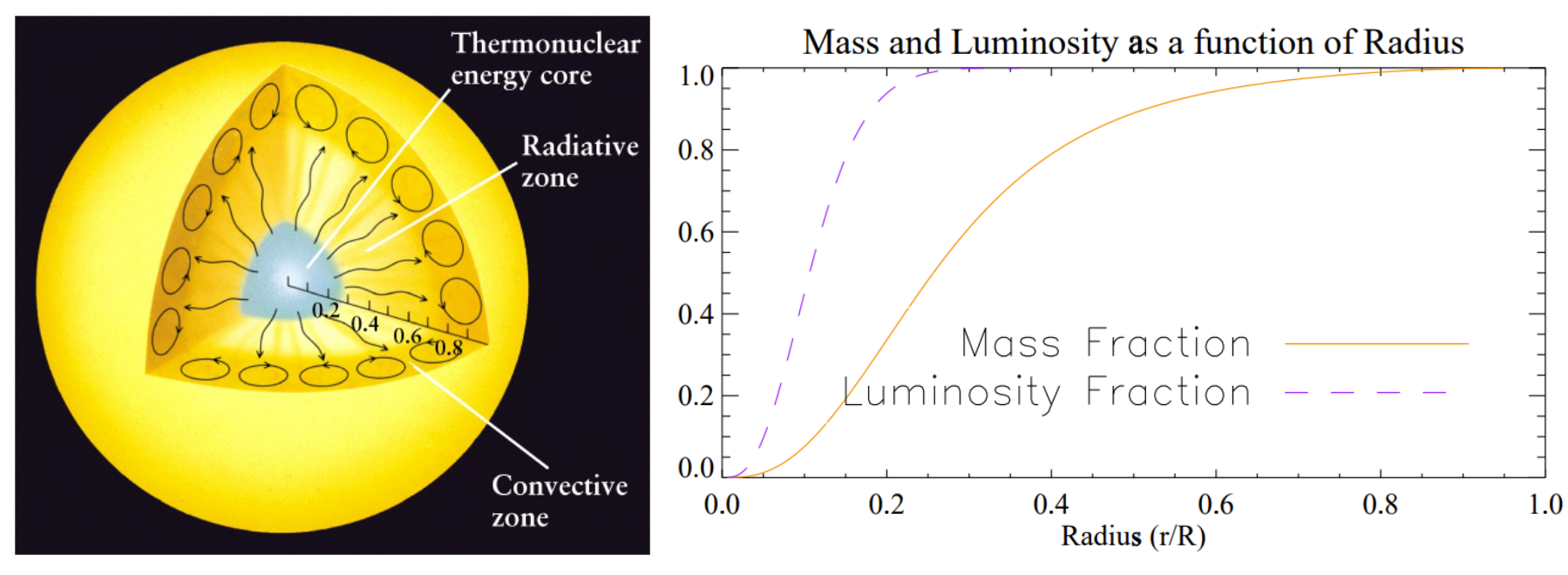
Estimating the conditions in the cores of stars is an important aspect of constructing stellar models. This question explores some of the equations governing stellar structure and estimates the central temperature and pressure of the Sun.
a. (7 т.)
Let denote distance from the centre of a star. We define the variables , and to be the density, pressure and temperature at radius respectively, and to be the mass enclosed within radius . We will now try and derive an estimate for the pressure at the centre of the Sun.
(i) By considering forces on a box of height at radius , show that
[This is known as the equation of hydrostatic equilibrium.] [2 т.]
(ii) We can get a good estimate of the central pressure if we use as our independent variable rather than . Derive an expression for in terms of and , and hence express in terms of and . [2 т.]
(iii) Assuming that the pressure at the surface, , is negligible compared to the pressure at the centre of the Sun, , the edge of the core is at and encloses a mass of , and that is constant throughout the star and equal to the value at the edge of the core, calculate a value for . [3 т.]
b. (7 т.)
The Sun is composed predominantly of ionized hydrogen and helium, with approximate mass fractions and respectively (taken to be constant throughout the Sun). These ionized nuclei and electrons may be treated as an ideal monatomic gas, obeying the equation of state
where is the number of particles contained within volume and is the Boltzmann constant. They also have an average kinetic energy per particle
(i) Show that the kinetic energy per unit mass of the solar plasma is given by:
where is the mass of a proton (treated to be the same as the mass of a neutron). [4 т.]
(ii) The Virial Theorem states that for a stable, gravitationally bound system of particles the total kinetic energy in the system, and the total gravitational potential energy in the system, , are related as
In the context of the plasma in the Sun, this becomes
Using the Virial Theorem, and given , estimate the Sun’s mean temperature
[This is our initial lower bound for the central temperature] [3 т.]
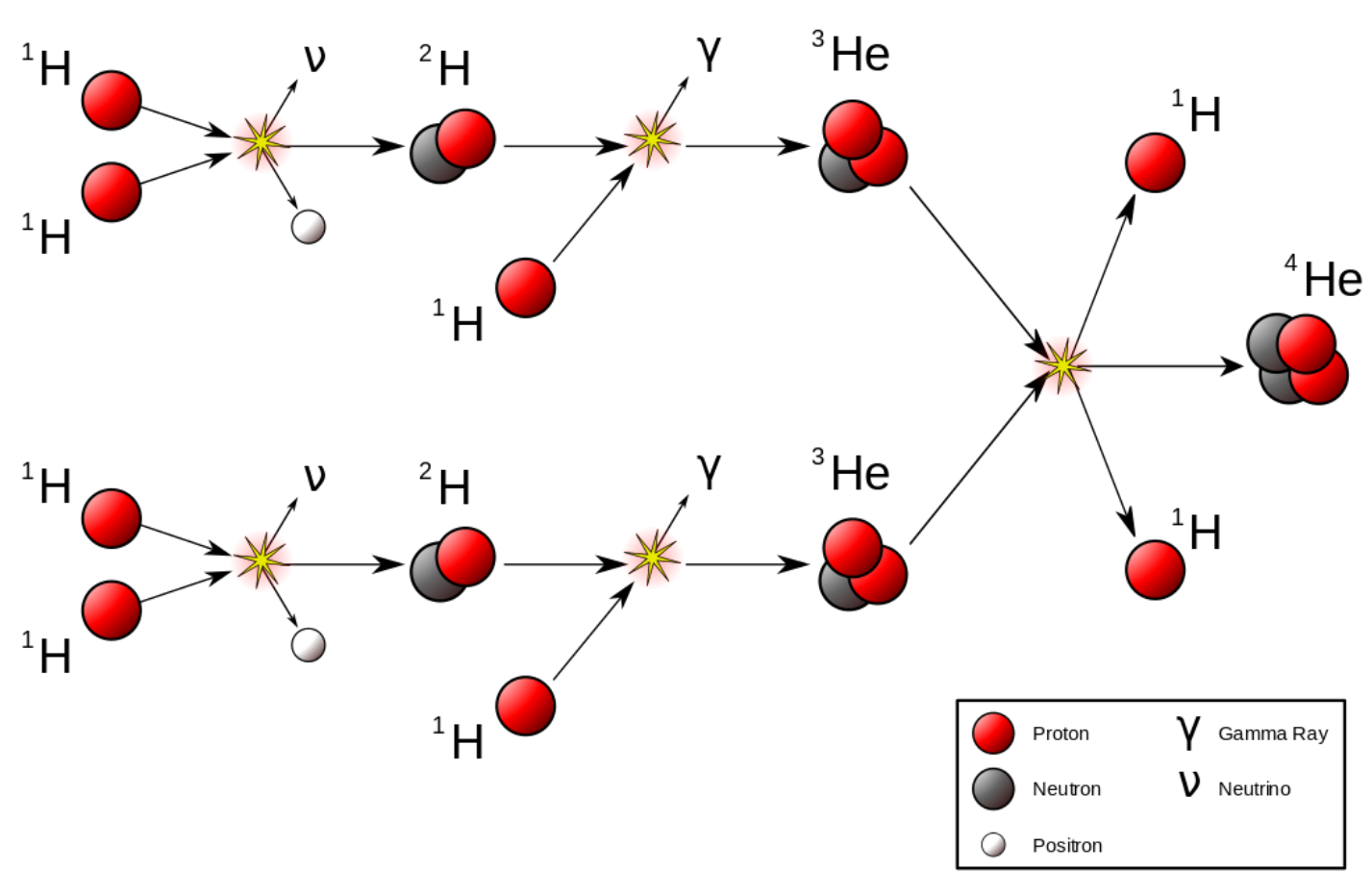
The primary nuclear fusion pathway responsible for much of the Sun’s luminous output is called the proton-proton chain (p-p chain). All of the most common steps are shown in Figure 4.
The net reaction of the p-p chain is
The rate-limiting step is the first one () as the probability of interaction is so low, since it requires the decay of a proton into a neutron and so involves the weak nuclear force.
Nuclear physics allow us to calculate the reaction rate coefficient, , energy produced per reaction, , and hence the energy generation rate, . The reaction rate is related to the number of particles that have enough energy to undergo quantum tunnelling, and the distribution as a function of energy is known as the Gamow peak, with the top of the curve at energy . For two nuclei, and , with mass fractions and , then to first order and ignoring electron screening,
and measures the probability of interaction at the maximum of the Gamow peak whilst is a characteristic width of the Gamow peak,
Here is Planck’s constant, is the permittivity of free space and is the elementary charge (the charge on a proton). Finally, the energy generation rate per unit mass is
where is the Kronecker delta, so equals 1 when and 0 otherwise.
Evaluating the fundamental constants and defining gives
whilst for the proton-proton interaction MeV (half the overall energy of the p-p chain), , and is keV m (Adelberger et al. 2011), so
c. (21 т.)
Considering the evaluated equations for , , and we can use this with the measured luminosity of the Sun to get a new estimate for the central temperature.
(i) Considering the simplified equation for and assuming that the core has a mass of , throughout which and are constant, and that the Sun’s luminosity is equal to the power produced by the p-p chain fusion processes occurring within its core, estimate the central temperature. [Hint: you are also given that where is the central density, and you may need to use a numerical method with as an initial guess.] [7 т.]
(ii) Using this new central temperature, and considering and the central number density of protons, , estimate the typical amount of time a proton needs to wait to undergo fusion, giving your answer in years.
[This is an estimate for the length of time the Sun spends on the main sequence.] [4 т.]
(iii) Since and , it can be approximated at a given temperature as , quantifying the sensitivity of the fusion reaction to temperature. By considering give an expression for as a function of and calculate it at your central temperature. [6 т.]
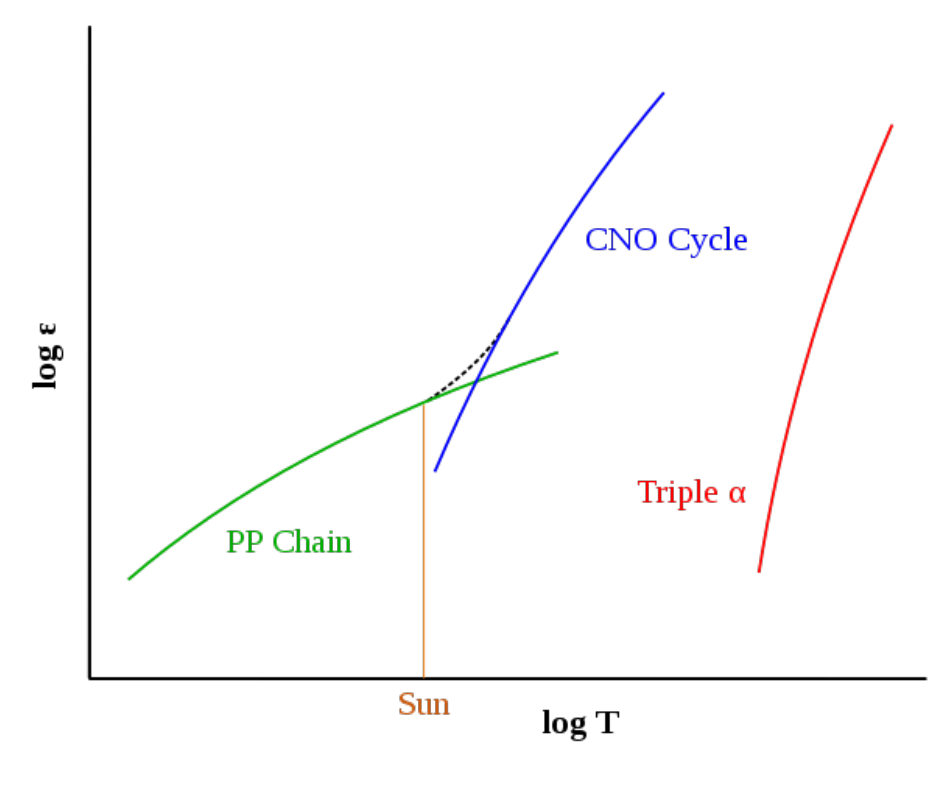
(iv) The carbon-nitrogen-oxygen (CNO) cycle is an alternative pathway that becomes important at higher temperatures, where heavier elements catalyse the process of turning hydrogen into helium. There the rate limiting step is between and . Compare the temperature dependence of the CNO cycle to the p-p chain at the Sun’s central temperature. [4 т.]
Отговори
- a., (ii)
- a., (iii) Pa
- b., (ii) K
- c., (i) K
- c., (ii) yr
- c., (iii)
- c., (iv) α = 23.06 for the CNO cycle — a much steeper temperature dependence than the p-p chain
Решение
Q2 – Stellar Structure [35 marks]
a.
Let r denote distance from the centre of a star. We define the variables ρ(r), p(r) and T(r) to be the density, pressure and temperature at radius r respectively, and m(r) to be the mass enclosed within radius r. We will now try and derive an estimate for the pressure at the centre of the Sun.
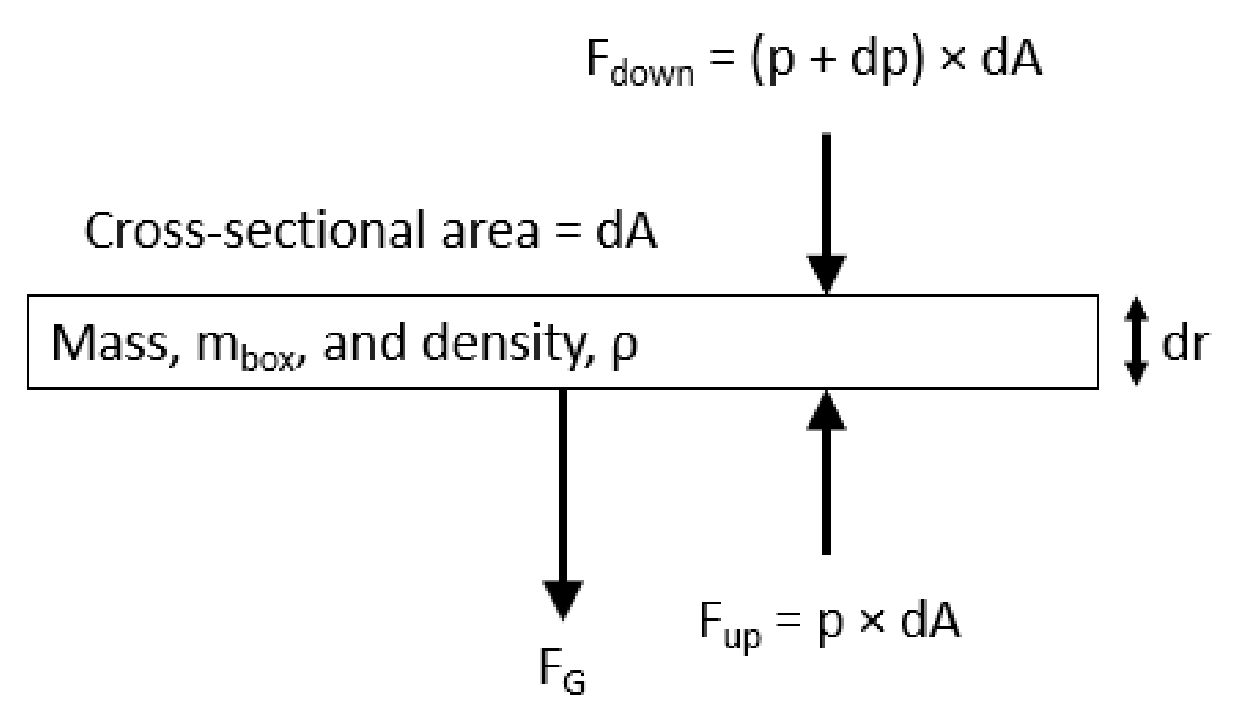
i. By considering forces on a box of height dr at radius r, show that dp/dr = -ρGm/r.
Suitable diagram (e.g. side on, as below) showing all the relevant forces [1]
By balancing forces
[1] [2]
The dA and p on both sides cancel, leaving
(as required)
[Since it was a ‘show that’ question, there is no credit for the final formula, just the working]
ii. We can get a good estimate of the central pressure if we use m as our independent variable rather than r. Derive an expression for dm/dr in terms of r and ρ, and hence express dp/dm in terms of m and r.
Considering a single spherical shell of density ρ and thickness dr, its mass is given as
[1] [1]
Applying the chain rule with this result
[1] [1]
iii. Assuming that the pressure at the surface, p, is negligible compared to the pressure at the centre of the Sun, p, the edge of the core is at r = 0.20 R and encloses a mass of m = 0.35 M, and that dp/dm is constant throughout the star and equal to the value at the edge of the core, calculate a value for p.
Evaluating dp/dm at the edge of the core
[1]
Since dp/dm is a constant
[1]
[1] [3]
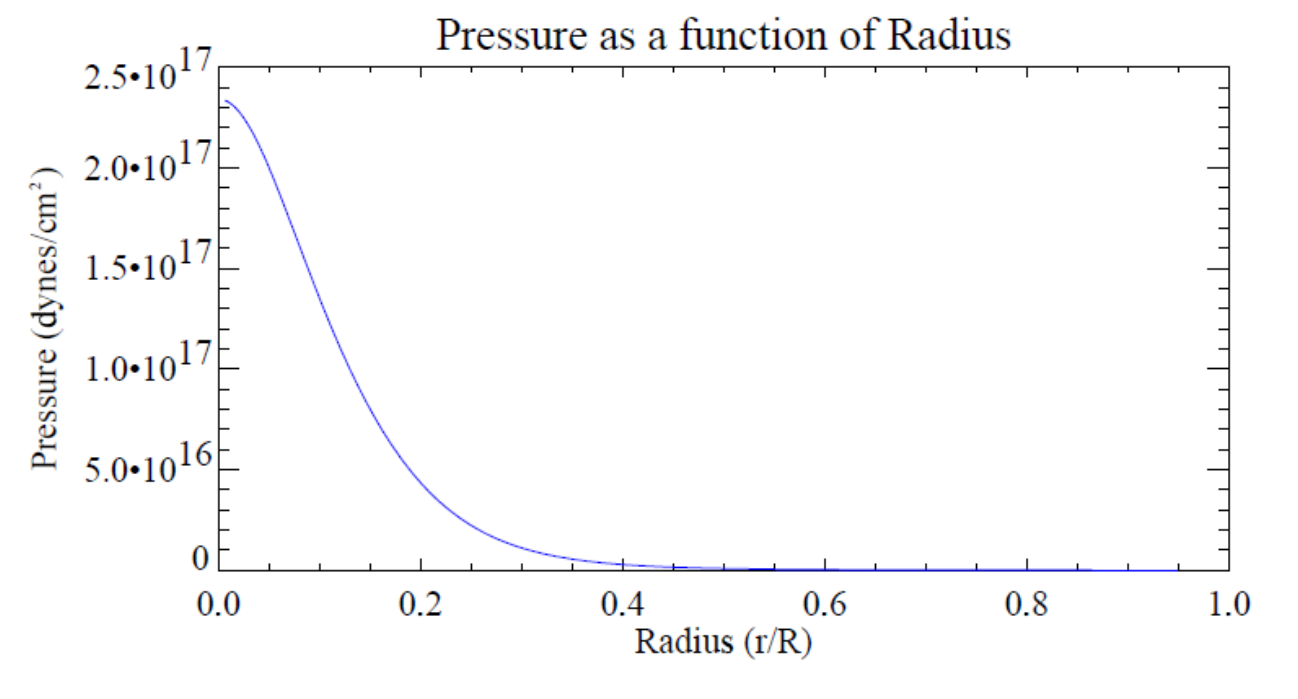
[This is rather close to the real value of 2.34 × 10 Pa, which is very large compared to values we are used to e.g. it is about the same as 10 atmospheres! The graph below shows how it varies as a function of radius (where 1 dyne/cm = 10 Pa) justifying p ≈ 0]
b.
The Sun is composed predominantly of ionized hydrogen and helium, with approximate mass fractions X = 0.70 and Y = 0.30 respectively (taken to be constant throughout the Sun).
i. Show that the kinetic energy per unit mass of the solar plasma is the formula given.
Expressing the mass fractions in terms of the number of each atom, N, and the mass of each atom (ignoring electrons)
[1]
In a fully ionised plasma, each hydrogen atom contributes two particles (1 nucleus and 1 electron) whilst each helium atom contributes three particles (1 nucleus and 2 electrons) so the total number of particles is
[1]
In thermodynamic equilibrium, all the particles will have the same average KE, so to get the KE per unit mass we need to divide the average KE by the average mass of a particle
[1]
[1] [4]
The M cancel to leave (as required)
[Since it was a ‘show that’ question, there is no credit for the final formula, just the working]
ii. Using the Virial Theorem, and given , estimate the Sun’s mean temperature.
Combining the integral form for the LHS and the given expression for E with the non-integral form of the RHS, our expression for the Virial Theorem becomes
[ignore any minus sign on RHS] [1]
Comparing to the form we are aiming for
[1]
[1] [3]
c.
Considering the evaluated equations for τ, R, and q we can use this with the measured luminosity of the Sun to get a new estimate for the central temperature.
i. Considering the simplified equation for q and assuming that the core has a mass of 0.35 M, throughout which T and ρ are constant, and that the Sun’s luminosity is equal to the power produced by the p-p chain fusion processes occurring within its core, estimate the central temperature. [You are given that u = 3p/2ρ.]
Combining the given expression for u = 3p/2ρ with the one from b. (i)
[1]
Assuming all of the power output of the Sun comes from the reaction in the core
[1]
Equating the given expression for q with this gives
[1]
[1]
[1]
Using an appropriate iterative method with T = 4.73 as the starting point [1]
This gives [1] [7]
[Accept any valid numerical method to solve the equation, although several students may have a ‘solve’ button on their calculator or plot the graph and so not show much working. An evaluated value for ρ is not of use here as it would obscure its dependence on T, however if calculated then there is a mark in the next part that can be awarded here instead]
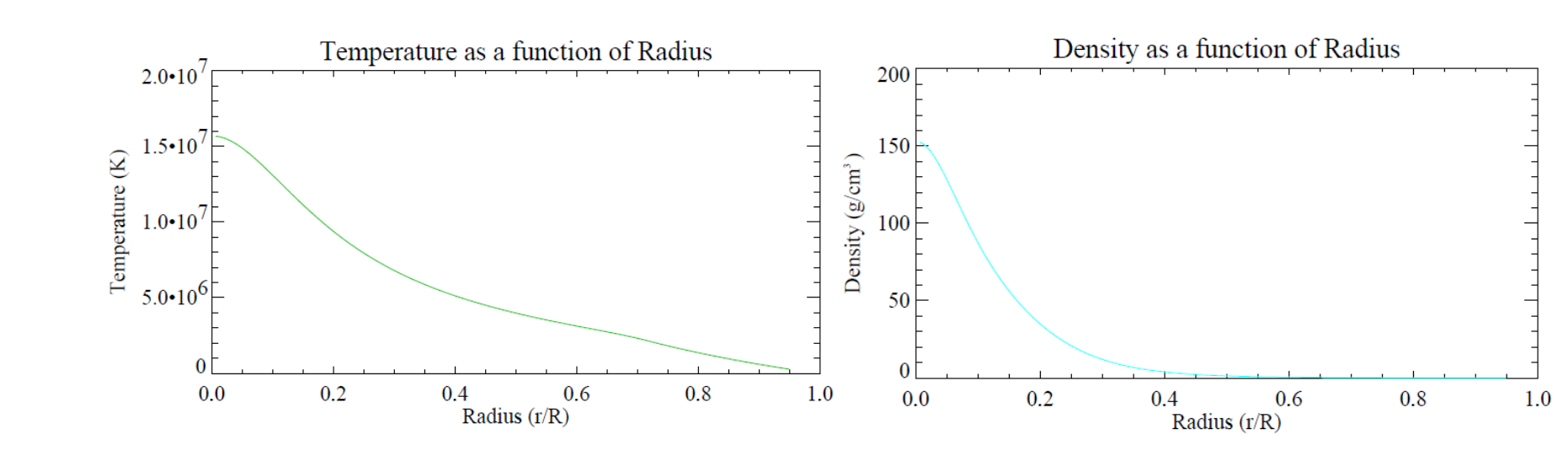
[The real value is 15.7 × 10 K, so our model has underestimated it by about a third – this is because we have assumed the density and the temperature are constant within the core, whilst in practice this is a poor approximation as shown in the graphs below. Interestingly, we could get closer to the real value by using our value of and scaling it assuming that the plasma outside the core is much cooler than that within it, such that
]
ii. Using this new central temperature, and considering R and the central number density of protons, n, estimate the typical amount of time a proton needs to wait to undergo fusion, giving your answer in years.
Evaluating the central density
[1]
[This mark may be awarded from working in part c. (i) if not explicitly present here. Since we have stated a constant density in the core, accept ]
Using the evaluated expression for R with T = 9.80
[1]
The number density of protons in the centre of the core is
[1]
Since is the number of protons undergoing fusion every second, the reciprocal should give the expected time a proton has to wait to undergo fusion
[1] [4]
[Final answer should be in years for the final mark. Watch out for students forgetting the factor of X in the expression for n and so losing the 3rd mark, but allow ecf for 4th mark (they get 1.80 × 10 yrs). Using the alternative core density, they get 6.21 × 10 yrs]
[The value for R really emphasises how little fusion is actually going on inside a cubic metre of the core of the Sun every second – it is simply the sheer size of the core that means enough pressure is produced to balance gravitational forces. Our value of ρ is very close to the real one of 1.52 × 10 kg m, which is approximately 80 times denser than gold! Using the correct central temperature and pressure gives a main sequence lifetime of a little under 10 years – the slowness of this reaction is the reason stars like the Sun stay on the main sequence for so long]
iii. Since and , it can be approximated at a given temperature as , quantifying the sensitivity of the fusion reaction to temperature. By considering d(ln q)/d(ln T) give an expression for α as a function of τ and calculate it at your central temperature.
Inserting constants of proportionality into the expressions for q and τ
Differentiating both with respect to T (and using the product rule for q)
[1]
[1]
Using the standard result that then
[1]
[must be simplified] [1] [4]
[This is only one route – allow any valid method to get here, although the final expression must be as a function of τ and not a function of T (indicating the question was misread)]
By comparison with the evaluated expression for q and putting in the calculated value of T
[1]
[1] [2]
[For the real central temperature , showing the reasonable temperature dependence of the reaction – this is why very little fusion happens outside the core]
iv. The carbon-nitrogen-oxygen (CNO) cycle is an alternative pathway that becomes important at higher temperatures, where heavier elements catalyse the process of turning hydrogen into helium. There the rate limiting step is between nitrogen-14 and hydrogen-1. Compare the temperature dependence of the CNO cycle to the p-p chain at the Sun’s central temperature.
For the reaction between nitrogen-14 and hydrogen-1
[1]
[1]
[1] [3]
This is a much steeper temperature dependence than the p-p chain [1] [1]
[This value of α is why the CNO cycle dominates at higher temperatures yet is almost irrelevant in the Sun. At even higher temperatures the triple alpha process (a way of fusing helium nuclei into carbon) dominates with an even steeper temperature dependence of – as you use nucleosynthesis to move along the periodic table the value of α tends to increase. This is the reason why the regions of different nucleosynthesis occur in well-defined shells in the star after it leaves the main sequence.]
END OF PAPER
END OF PAPER
Questions proposed by:
Dr Alex Calverley (Royal Grammar School, Guildford)
Josh Brown (University of Cambridge)
Оригинал в Архива: BAAO_2022.pdf · официални решения: BAAO_2022_solutions.pdf