BAAO 2022, Теория — Задача 3. James Webb Space Telescope
British Astronomy and Astrophysics Olympiad 2021-2022 — Astronomy & Astrophysics Competition Paper · 24 януари 2022 г. · 35 т.
Указания
This question paper must not be photographed or taken out of the exam room
Time: 3 hours ( minutes for Q1, minutes for Q2 and minutes for Q3).
Questions: All three questions should be attempted. Each question contains independent parts so that later parts can be attempted even if earlier parts are incomplete.
Solutions: Answers and calculations are to be written on loose paper. Students should ensure their name and school is clearly written on the first answer sheet and that all pages are numbered. EACH QUESTION ANSWERED must be started on a new page. A standard formula booklet with standard physical constants may be used if desired.
Instructions: To accommodate students sitting the paper at different times, please do not discuss any aspect of the paper on the internet until 8 am Saturday 29th January.
Clarity: Solutions must be written legibly, in black pen, and working down the page. Scribble will not be marked and overall clarity is an important aspect of this exam.
Eligibility: The International Olympiad will be held in August 2022; all sixth form students are eligible to participate.
Calculators: Any standard calculator may be used, but calculators cannot be programmable and must not have symbolic algebra capability.
Training Dates and the IOAA
Training Dates and the IOAA (Kyiv, Ukraine, 12th - 22nd August 2022)
The team will be selected from students taking this paper. The best students that are eligible to represent the UK at the IOAA will be invited to attend the Training Camp to be held in Oxford from Saturday 9th to Wednesday 13th April 2022. Astronomy material will be covered; problem solving skills and observational skills (telescope and naked eye observations) will be developed. At the Training Camp a Data Analysis exam along with a Round 3 theory paper will be sat. A team of five students (plus one reserve) will be selected for further training, including additional training camps in the summer.
Important Constants
| Constant | Symbol | Value |
|---|---|---|
| Speed of light | ||
| Earth’s rotation period | 1 day | 24 hours |
| Earth’s orbital period | 1 year | 365.25 days |
| parsec | pc | |
| Astronomical Unit | au | |
| Radius of the Sun | ||
| Radius of the Earth | ||
| Mass of the Sun | ||
| Mass of the Earth | ||
| Luminosity of the Sun | ||
| Stephan-Boltzmann constant | ||
| Gravitational constant | ||
| Boltzmann constant | ||
| Permittivity of free space | ||
| Permeability of free space | ||
| Planck’s constant | ||
| Elementary charge | ||
| Proton rest mass | ||
| Electron rest mass | ||
| Wien’s displacement law | ||
| Avagadro’s constant |
Basic calculus formulae:
| Chain rule | |
| Product rule | |
| Quotient rule | |
| Integration by parts | |
| Standard integral |
Important Formulae
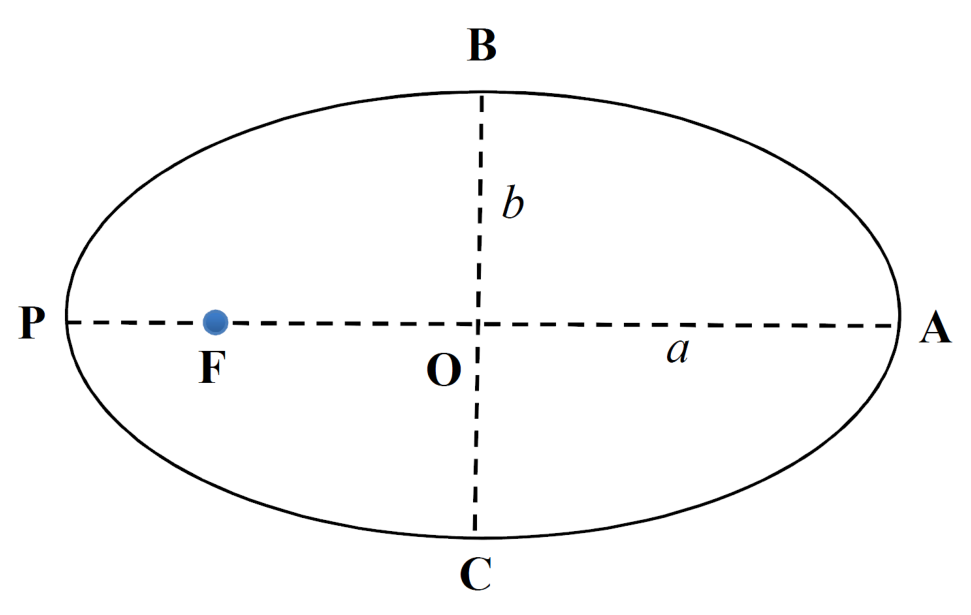
You might find the diagram of an elliptical orbit below useful in solving some of the questions: (the diagram is attached to Qu 3 as a figure)
Elements of an elliptic orbit:
| semi-major axis | |
| semi-minor axis | |
| eccentricity | |
| focus | |
| periapsis distance (shortest distance from ) | |
| apoapsis distance (longest distance from ) |
Kepler’s Third Law: For an elliptical orbit, the square of the period, , of an object about the focus is proportional to the cube of the semi-major axis, (as defined above), such that
where is the total mass of the system (typically dominated by the central object) and is the universal gravitational constant.
Vis-Viva Equation: For an elliptical orbit, the speed of an object at a distance from the focus is related to the semi-major axis, , total mass of the system, , and universal gravitational constant, , (as defined above), such that
Magnitudes: The apparent magnitudes of two objects, and , are related to their apparent brightnesses, and , via the formula
The absolute magnitude of an object, , is the same as its apparent magnitude when viewed from 10 pc, hence the relationship between apparent and absolute magnitude and distance is
where is measured in parsecs.
Note for markers
BAAO 2021/22 Solutions and Marking Guidelines
Note for markers:
- Answers to two or three significant figures are generally acceptable. The solution may give more in order to make the calculation clear. Units should be present on final answers when appropriate.
- There are multiple ways to solve some of the questions; please accept all good solutions that arrive at the correct answer. Students getting the answer in a box will get all the marks available for that calculation / part of the question (as indicated in red), so long as there are no unphysical / nonsensical steps or assumptions made (students may not explicitly calculate the intermediate stages and should not be penalised for this so long as their argument is clear).
Условие
The James Webb Space Telescope (JWST) is an incredibly exciting next generation telescope that was successfully launched on 25th December 2021. Its mirror is approximately 6.5 m in diameter, much larger than the 2.4 m mirror of the Hubble Space Telescope (HST), and so it has far greater resolution and sensitivity. Whilst HST largely imaged in the visible, JWST will do most of its work in the near- and mid-infrared (NIR and MIR respectively). This will allow it to pick up heavily redshifted light, such as that from the first generation of stars in the very first galaxies.
a. (8 т.)
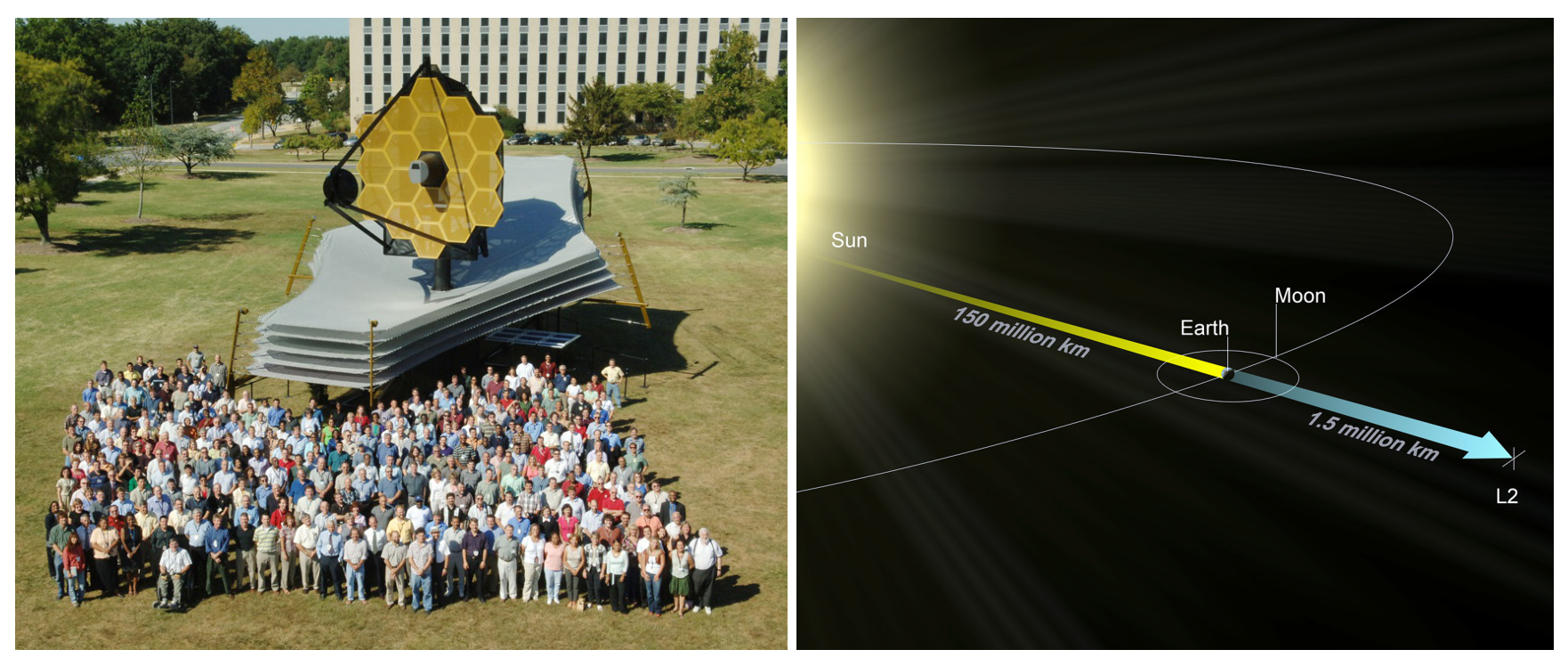
The telescope will spend its expected 10-20 year mission in a halo orbit about the second Lagrangian point, (see Figure 5). This is one of five special points in the Sun-Earth system where the gravitational forces from the two bodies provide the centripetal force required to have a (small mass) object there have an orbital period identical the the Earth. At the point, this means it orbits quicker than you would expect for an object that distance from the Sun.
(i) Taking 1 year as 365.25 days and 1 au as m, using numerical methods show that the distance between the Earth and is km. Give your answer to 4 s.f. [5 т.]
(ii) Rather than go to directly, the JWST is on an orbit that will take it to within 200 000 km of , where it will then do a final large burn of the rockets to insert it into the halo orbit around . Assuming it is on a simple elliptical transfer orbit ignoring the influence of the Sun, and had a perigee at an altitude of 2100 km above the surface of the Earth, how long will it take JWST to get to the L2 orbital insertion phase of its mission? Give your answer in days. [3 т.]
The resolution limit of a telescope is set by the amount of diffraction light rays experience as they enter the system, and is related to the diameter of a telescope, , and the wavelength being observed, . The resolution limit of a CCD is set by the size of the pixels.
Three of the imaging cameras on JWST are tabulated with some properties below:
| Instrument | Wavelength range (µm) | CCD plate scale (arcseconds / pixel) |
|---|---|---|
| NIRCam (short wave) | 0.031 | |
| NIRCam (long wave) | 0.065 | |
| MIRI | 0.11 |
An arcsecond is a measure of angle where arcseconds.
The familiar variation in intensity on a screen, , due to diffraction through an infinitely tall single slit is given as
and is the initial intensity. For a circular aperture, the formula is slightly different and is given as
Here is the Bessel function of the first kind and is calculated as
The -axis intercepts and shape of the maxima are quite different, as shown in Figure 6. The position of the first minimum of is at meaning that , whilst for it is at so . This is one way of defining the minimum angular resolution, although since the flux drops off so steeply away from the central maximum a more convenient one for use with CCDs is the angle corresponding to the full width half maximum (FWHM).
b. (13 т.)
To achieve suitable sampling, an image will be considered diffraction limited when it has pixels per . The diameter of the JWST primary mirror is 6.5 m, however since it is composed of hexagons and hexagonal in shape, it is not straightforward to work out the equivalent circular mirror diameter. To a good approximation it can be taken to be 6.0 m.
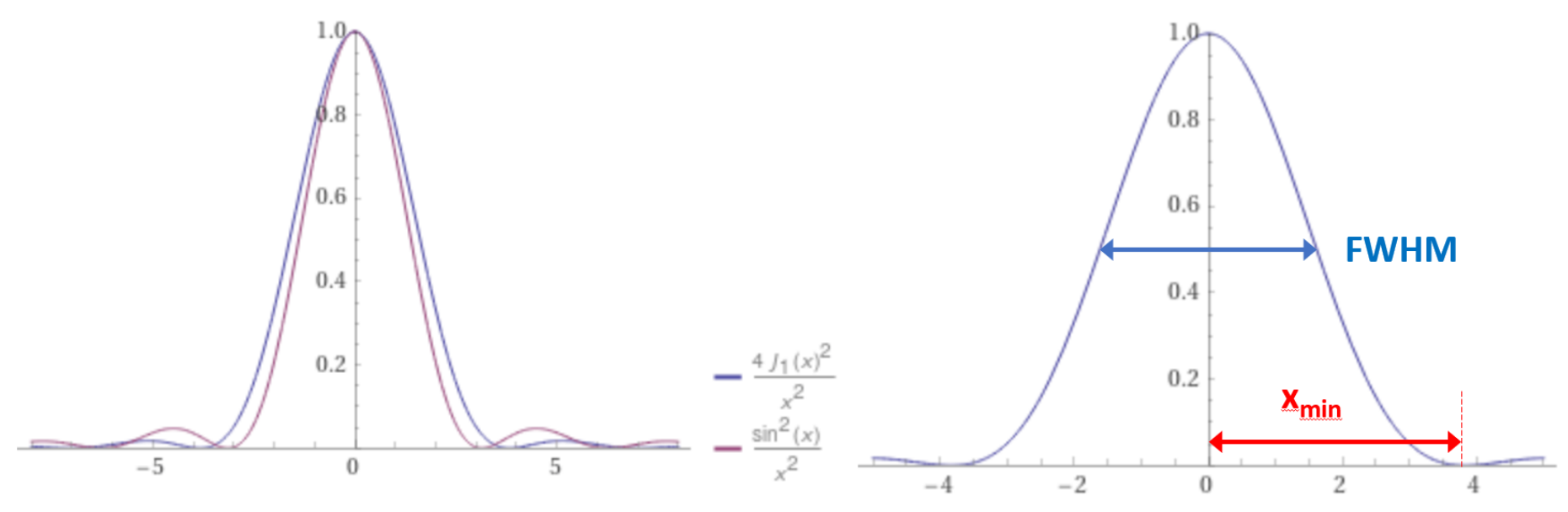
(i) Given , find for , giving your answer to 3 s.f. [7 т.]
(ii) Hence, determine which of the three imaging instruments is diffraction limited for the greatest fraction of its wavelength range. [6 т.]
As well as having the largest mirror of any space telescope ever launched, it is also one of the most sensitive, with its greatest sensitivity in the NIRCam F200W filter (centred on a wavelength of 1.989 µm) where after seconds it can detect a flux of 9.1 nJy (1 Jy = W m Hz) with a signal-to-noise ratio (S/N) of 10, corresponding to an apparent magnitude of . This extraordinary sensitivity can be used to pick up light from the earliest galaxies in the Universe.
The scale factor, , parameterises the expansion of the Universe since the Big Bang, and is related to the redshift, , as
with the observed wavelength and the rest frame wavelength. The current rate of expansion of the Universe is given by the Hubble constant, , and this is related to the current Hubble time, , and current Hubble distance, , as
Here the subscript 0 indicates the values are measured today. The Hubble constant is more appropriately known as the Hubble parameter as it is a function of time, and the evolution of as a function of is
where is the normalised density parameter, and the subscript , , and indicate the contribution to from matter, radiation, and dark energy, respectively. The proper age of the Universe at redshift is best evaluated in terms of as
If and (corresponding to what it known as a flat Universe), then via the standard integral this integral can be evaluated analytically to give
Finally, the luminosity distance, , corresponding to the distance away that an object appears to be due to its measured flux given its intrinsic luminosity (i.e. ) is given as
where is the redshift of interest and is the equivalent scale factor. Even for the flat Universe case with this integral cannot be be done analytically so must be evaluated numerically.
c. (14 т.)
Computer models suggest the first galaxies formed around . One of the best ways to look for high-redshift galaxies is to try and detect the emission from the Lyman alpha (Ly) emission line at nm as it is a relatively bright line. Some of the brightest galaxies in that initial era of galaxy formation would have an absolute magnitude of . In this question, you are given that , , and km s Mpc.
(i) Calculate the redshift at which the Ly line is detected in the centre of the F200W filter. [1 т.]
(ii) How long after the Big Bang does this correspond to? Give you answer in years. [3 т.]
(iii) Calculate the luminosity distance to the galaxy and hence its apparent magnitude. Assume all emitted flux is picked up by the telescope. [7 т.]
(iv) If the minimum flux detectable decreases proportionally to where is the length of the exposure, estimate the minimum exposure time necessary for JWST to image this galaxy with S/N = 10. Give your answer in hours. [3 т.]
Отговори
a., (i) m
a., (ii) 30.6 days
The marking scheme also accepts 45.6 days if the probe is taken to be 200 000 km beyond L2.
b., (i) 1.03
b., (ii) MIRI
c., (i) 15.4
c., (ii) yr
c., (iii) DL = 168 Gpc (±5 Gpc accepted); m = 31.1
c., (iv) 141 h
Решение
Q3 – James Webb Space Telescope [35 marks]
a.
The telescope will spend its expected 10-20 year mission in a halo orbit about the second Lagrangian point, L2 (see Figure 5). This is one of five special points in the Sun-Earth system where the gravitational forces from the two bodies provide the centripetal force required to have a (small mass) object there have an orbital period identical to the Earth. At the L2 point, this means it orbits quicker than you would expect for an object that distance from the Sun.
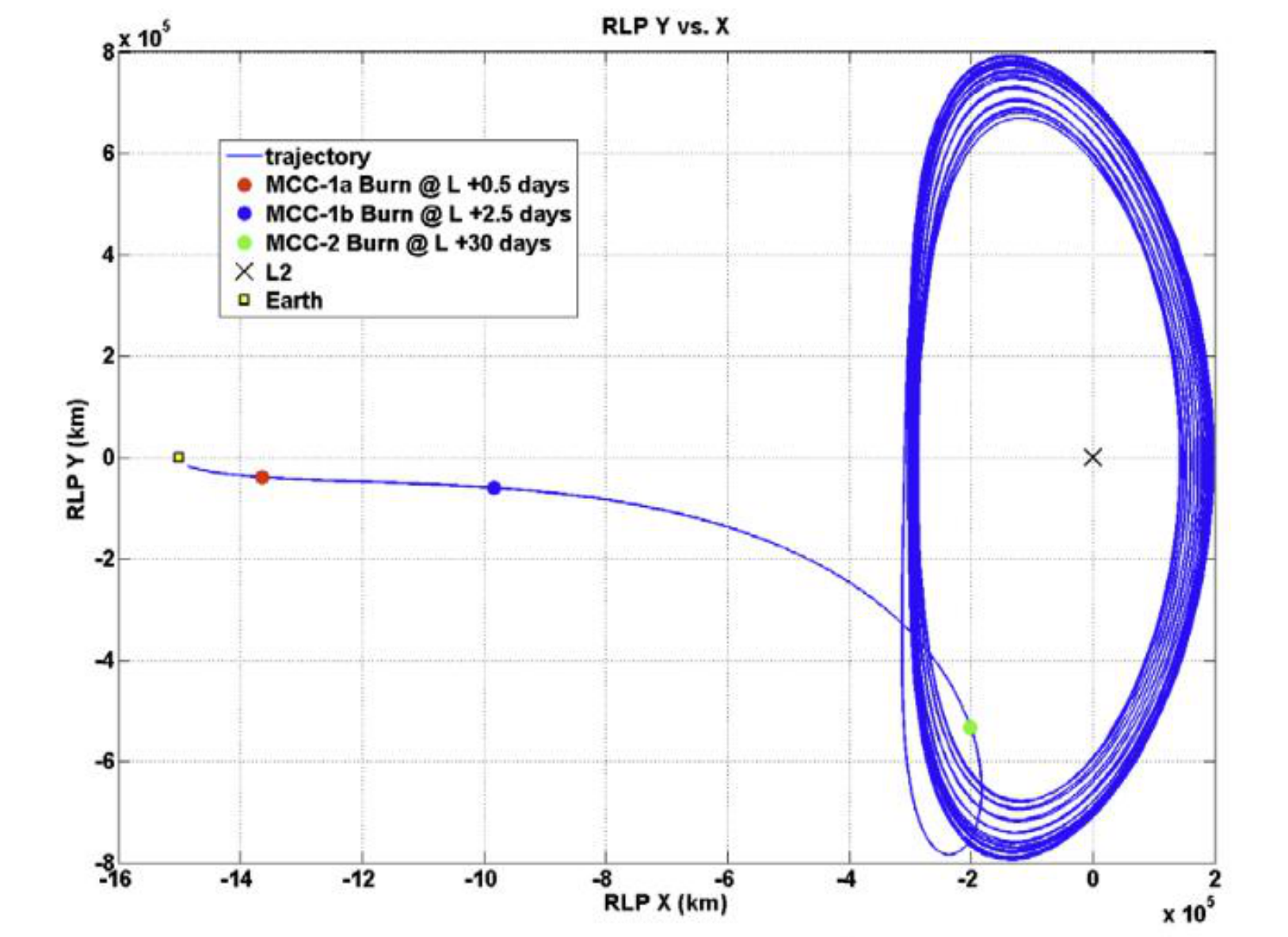
i. Taking 1 year as 365.25 days and 1 au as 1.496 × 10 m, using numerical methods show that the distance between the Earth and L2 is ~ 1.5 × 10 km. Give your answer to 4 s.f.
At the L2 point the gravitational forces from the Sun and Earth balance the centripetal force
[can be implied by 2nd mark] [1]
Defining to be the distance between the Earth and L2 and to be mass of the probe
[1]
[1]
Using any reasonable root-finding numerical method with m [1]
(so roughly km, as expected) [1] [5]
[The 3rd mark is for creating a suitable quintic and setting it equal to zero. In expanded form it is . For the 4th mark the Newton-Raphson method works well with the expanded form, although, since the starting value is so close to the root, interval bisection or decimal search methods are much quicker to do and don’t require the expanded form – this is the recommended approach for this sort of problem. Since the required root is the only non-complex root of the quintic, even methods that are slow to converge will get there. The final answer must be 4 s.f. for the final mark.]
[Several other spacecraft has been sent to L2, such as the WMAP and Planck probes which looked at the cosmic microwave background. L2 is about 4 times further away than the Moon and is roughly a million miles away (which brings context to the common saying!)]
ii. The JWST is on an orbit that will take it to within 200 000 km of L2, where it will then do a final large burn of the rockets to insert it into the halo orbit around L2. Assuming it is on a simple elliptical transfer orbit ignoring the influence of the Sun, and had a perigee at an altitude of 2100 km above the surface of the Earth, how long will it take JWST to get to the L2 orbital insertion phase of its mission? Give your answer in days.
Finding the semi-major axis of the elliptical orbit
[1]
Using Kepler’s 3rd Law
[allow ecf with their a] [1]
We want only half the period to get the time to go from apogee to perigee
[must be in days for final mark] [1] [3]
[The question intended for the probe to be 200 000 km shy of L2, however it is ambiguous from the phrasing so accept if the student treats it as 200 000 km beyond L2 (getting , s and so a final mission time of )]
[The expected time to get to L2 was about a month, so our elliptical transfer approximation has not done too badly – the real orbital shape is much more complex. Due to the time taken to get there, it would be impossible for any human mission to be launched to fix any faults with the telescope (as needed to happen with the Hubble Space Telescope)]
b.
To achieve suitable sampling, an image will be considered diffraction limited when it has ≥ 2 pixels per θ. The diameter of the JWST primary mirror is 6.5 m, however since it is composed of hexagons and hexagonal in shape, it is not straightforward to work out the equivalent circular mirror diameter. To a good approximation it can be taken to be 6.0 m.
i. Given θ = αλ/D, find α for I, giving your answer to 3 s.f.
Substituting in the given expansion of
[1]
At FWHM,
[1]
Any reasonable method to solve this quartic [1]
[Expected approach is to use the substitution and solve the resulting quadratic to give or ]
[Don’t penalise if missing ±] [1]
Considering only the positive roots of the quartic , and since
[1]
[1]
From Fig 6 it is clear that [1] [7]
[Assuming means only lose 6th mark – allow ecf on correct root choice for 7th. Must be 3 s.f. for final mark. Expanding the bracket on the second line and only going up to the x term leads to α = 1.07 – this approach only loses the second mark and has ecf for the rest]
ii. Hence, determine which of the three imaging instruments is diffraction limited for the greatest fraction of its wavelength range.
At the critical wavelength, [1]
For each instrument
[1]
[1]
[1]
Images will be diffraction limited when [1]
Diffraction limited wavelength range for each instrument
| NIRCam-SW | (33% of range) | |
| NIRCam-LW | (51% of range) | |
| MIRI | (97% of range) |
[1] [6]
[A bald statement of MIRI without working receives only the final mark. The first mark is for some understanding of how to use the given plate scale (either as a statement or in a formula). The percentage of each range is not required for the final mark. No ecf on final mark if 5th mark is not achieved (e.g. student incorrectly looks at ). Full ecf on their value of α]
[This is why JWST is not quite considered to be the direct successor of the Hubble Space Telescope (HST), as in the orange / red regions of the visible that it can image in it will not be diffraction limited (unlike the Hubble Space Telescope which was diffraction limited throughout almost the whole visible range) – its specialism is much more in the infrared]
c.
Computer models suggest the first galaxies formed around . One of the best ways to look for high-redshift galaxies is to try and detect the emission from the Lyman alpha (Lyα) emission line at λ = 121.6 nm as it is a relatively bright line. Some of the brightest galaxies in that initial era of galaxy formation would have an absolute magnitude of . In this question, you are given that Ω = 0.3, Ω= 0.7, Ω = 0 and H = 70 km s Mpc.
i. Calculate the redshift at which the Lyα line is detected in the centre of the F200W filter.
Given that Lyα = 121.6 nm and the F200W filter is centred at 1.989 μm
[1] [1]
ii. How long after the Big Bang does this correspond to? Give you answer in years.
Calculating the Hubble time (after converting the units of ) [Accept formula sheet ]
[1]
Substituting in the values of , , and into the given formula
[1]
[must be in years] [1] [3]
[This shows that JWST is probing a period in the Universe’s history when it is less than 2% of its current age!]
iii. Calculate the luminosity distance to the galaxy and hence its apparent magnitude. Assume all emitted flux is picked up by the telescope.
Calculating the Hubble distance
[1]
Finding the scale factor corresponding to
[1]
This means the integral that needs to be done is
[1]
[This mark could also be awarded for correct substitution into the integral with ]
Any reasonable method to numerically integrate this expression [1]
Integral = 2.40225 … [1]
[Trapezium rule with 10 steps gives 2.34, Simpson’s rule with 10 steps gives 2.41, most calculator’s inbuilt functions will give 2.40 – in general accept 2.40 ± 0.06]
Hence the luminosity distance is
[Accept ±5 Gpc] [1] [6]
Consequently, the apparent magnitude is
[1] [1]
[This is as faint as any object detected by HST in the Extreme Deep Field (XDF). In practice, the filter only picks up part of the emitted spectrum and so we need to take into account broadening of the Lyα line due to the redshift and an assumed spectral slope to convert between the detected and emitted flux – this is a much more involved calculation. Supernovae from the deaths of the very first stars would have a similar apparent magnitude so JWST will be able to investigate the physics of the earliest stellar populations too]
iv. If the minimum flux detectable decreases proportionally to where t is the length of the exposure, estimate the minimum exposure time necessary for JWST to image this galaxy with S/N = 10. Give your answer in hours.
Calculating the ratio of the flux from the galaxy to the given limit after 10 s
[1]
We are told
[1]
[1] [3]
[The 1st mark can also be given for . Needs to be in hours for final mark]
[In practice, S/N = 5 (as used by the HST XDF) would be sufficient for most discovery purposes which would be about half the time. JWST was designed to be at its most sensitive at 2 μm where it also has the best angular resolution of the diffraction limited range of any of its cameras – this should give an amazing opportunity to explore the high redshift Universe in unprecedented detail in reasonable timescales]
END OF PAPER
END OF PAPER
Questions proposed by:
Dr Alex Calverley (Royal Grammar School, Guildford)
Josh Brown (University of Cambridge)
Оригинал в Архива: BAAO_2022.pdf · официални решения: BAAO_2022_solutions.pdf