BAAO 2023, Теория — Задача 2. Wolf-Rayet Dust Shells
British Astronomy and Astrophysics Olympiad 2022-2023 — Astronomy & Astrophysics Competition Paper — Monday 6th February 2023 · 6 февруари 2023 г. · 40 т.
Указания
This question paper must not be photographed or taken out of the exam room
Time: 3 hours ( minutes for Q1, minutes for Q2 and minutes for Q3).
Questions: All three questions should be attempted. Each question contains independent parts so that later parts can be attempted even if earlier parts are incomplete.
Solutions: Answers and calculations are to be written on loose paper. YOU WILL NEED GRAPH PAPER. Students should ensure their name and school is clearly written on the first answer sheet and that all pages are numbered. EACH QUESTION ANSWERED must be started on a new page. A standard formula booklet with standard physical constants may be used if desired.
Instructions: To accommodate students sitting the paper at different times, please do not discuss any aspect of the paper on the internet until 8 am Saturday 11th February.
Clarity: Solutions must be written legibly, in black pen, and working down the page. Scribble will not be marked and overall clarity is an important aspect of this exam.
Eligibility: The International Olympiad will be held in August 2023; all sixth form students are eligible to participate.
Calculators: Any standard calculator may be used, but calculators cannot be programmable and must not have symbolic algebra capability.
Training Dates and the IOAA (Chorzów, Poland, 10th - 20th August 2023)
The team will be selected from students taking this paper. The best students that are eligible to represent the UK at the IOAA will be invited to attend the Training Camp to be held in Oxford from Saturday 1st to Wednesday 5th April 2023. Astronomy material will be covered; problem solving skills and observational skills (telescope and naked eye observations) will be developed. At the Training Camp a Data Analysis exam along with a Round 3 theory paper will be sat. A team of five students (plus one reserve) will be selected for further training, including additional training camps in the summer.
Important Constants
| Constant | Symbol | Value |
|---|---|---|
| Speed of light | ||
| Earth’s rotation period | 1 day | 24 hours |
| Earth’s orbital period | 1 year | 365.25 days |
| parsec | pc | |
| Astronomical Unit | au | |
| Radius of the Sun | ||
| Radius of the Earth | ||
| Mass of the Sun | ||
| Mass of the Earth | ||
| Luminosity of the Sun | ||
| Stephan-Boltzmann constant | ||
| Gravitational constant | ||
| Boltzmann constant | ||
| Permittivity of free space | ||
| Permeability of free space | ||
| Planck’s constant | ||
| Elementary charge | ||
| Proton rest mass | ||
| Electron rest mass | ||
| Wien’s displacement law | ||
| Avagadro’s constant |
Basic calculus formulae:
| Chain rule | |
| Product rule | |
| Quotient rule | |
| Integration by parts | |
| Standard integral |
Important Formulae
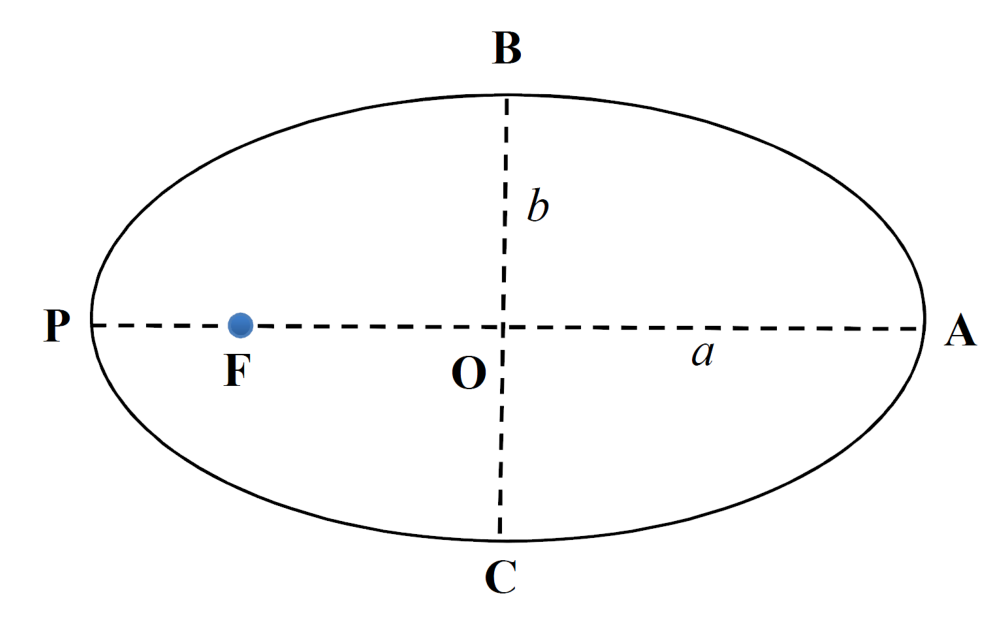
You might find the diagram of an elliptical orbit below useful in solving some of the questions:
Elements of an elliptic orbit:
| semi-major axis | |
| semi-minor axis | |
| eccentricity | |
| focus | |
| periapsis distance (shortest distance from ) | |
| apoapsis distance (longest distance from ) |
Kepler’s Third Law: For an elliptical orbit, the square of the period, , of an object about the focus is proportional to the cube of the semi-major axis, (as defined above), such that
where is the total mass of the system (typically dominated by the central object) and is the universal gravitational constant.
Vis-Viva Equation: For an elliptical orbit, the speed of an object at a distance from the focus is related to the semi-major axis, , total mass of the system, , and universal gravitational constant, , (as defined above), such that
Magnitudes: The apparent magnitudes of two objects, and , are related to their apparent brightnesses, and , via the formula
The absolute magnitude of an object, , is the same as its apparent magnitude when viewed from 10 pc, hence the relationship between apparent and absolute magnitude and distance is
where is measured in parsecs.
Note for markers
BAAO 2022/23 Solutions and Marking Guidelines
Note for markers:
- Answers to two or three significant figures are generally acceptable. The solution may give more in order to make the calculation clear. Units should be present on final answers when appropriate.
- There are multiple ways to solve some of the questions; please accept all good solutions that arrive at the correct answer. Students getting the answer in a box will get all the marks available for that calculation / part of the question (as indicated in red), so long as there are no unphysical / nonsensical steps or assumptions made (students may not explicitly calculate the intermediate stages and should not be penalised for this so long as their argument is clear).
Условие
Wolf-Rayet (WR) stars are some of the hottest stars known, with very strong stellar winds causing considerable mass to the be lost to the interstellar medium (ISM). In binary systems between a WR star and a very large O or B spectral class star, where their strong stellar winds collide can create the conditions for the formation of dust which goes on to enrich the ISM.
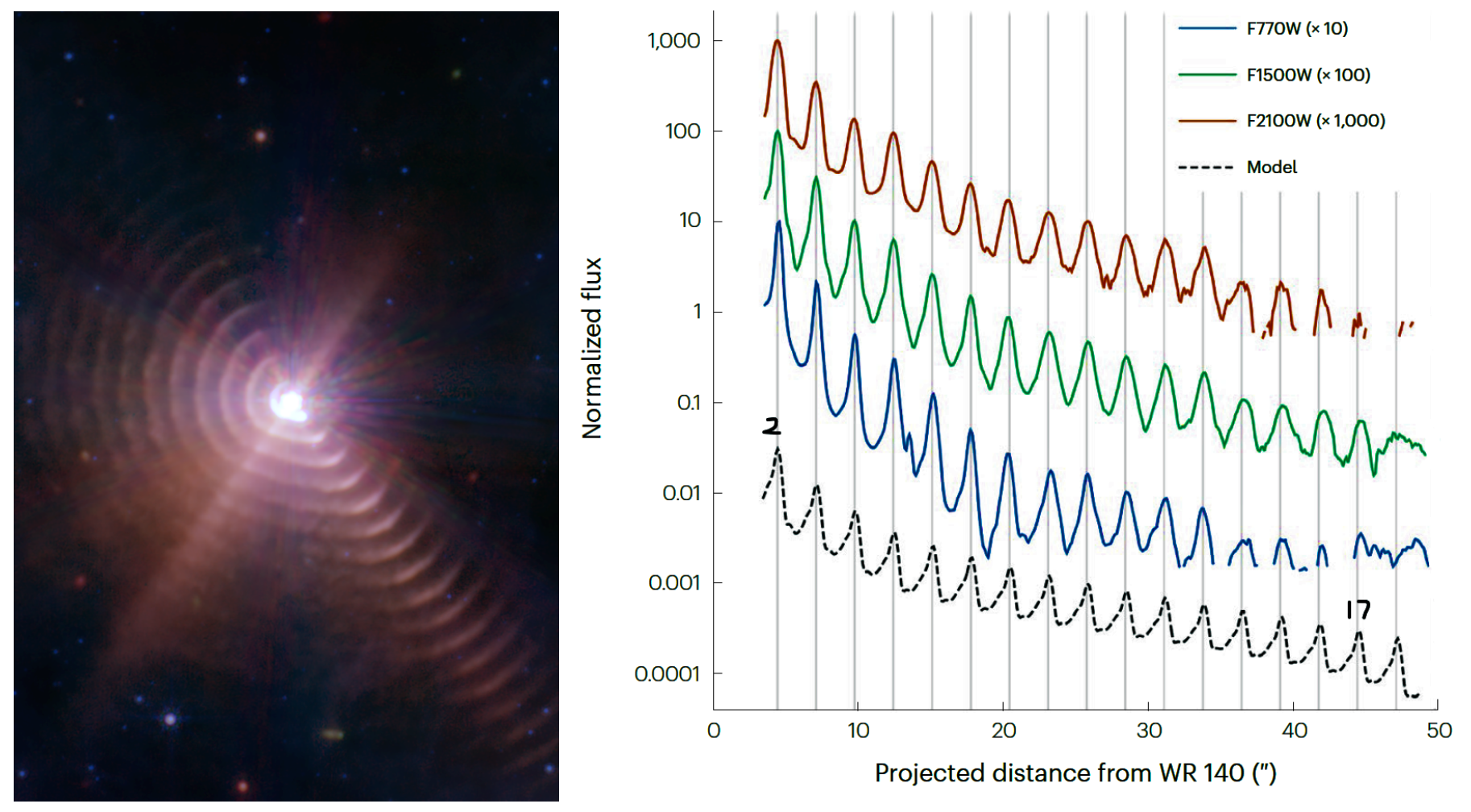
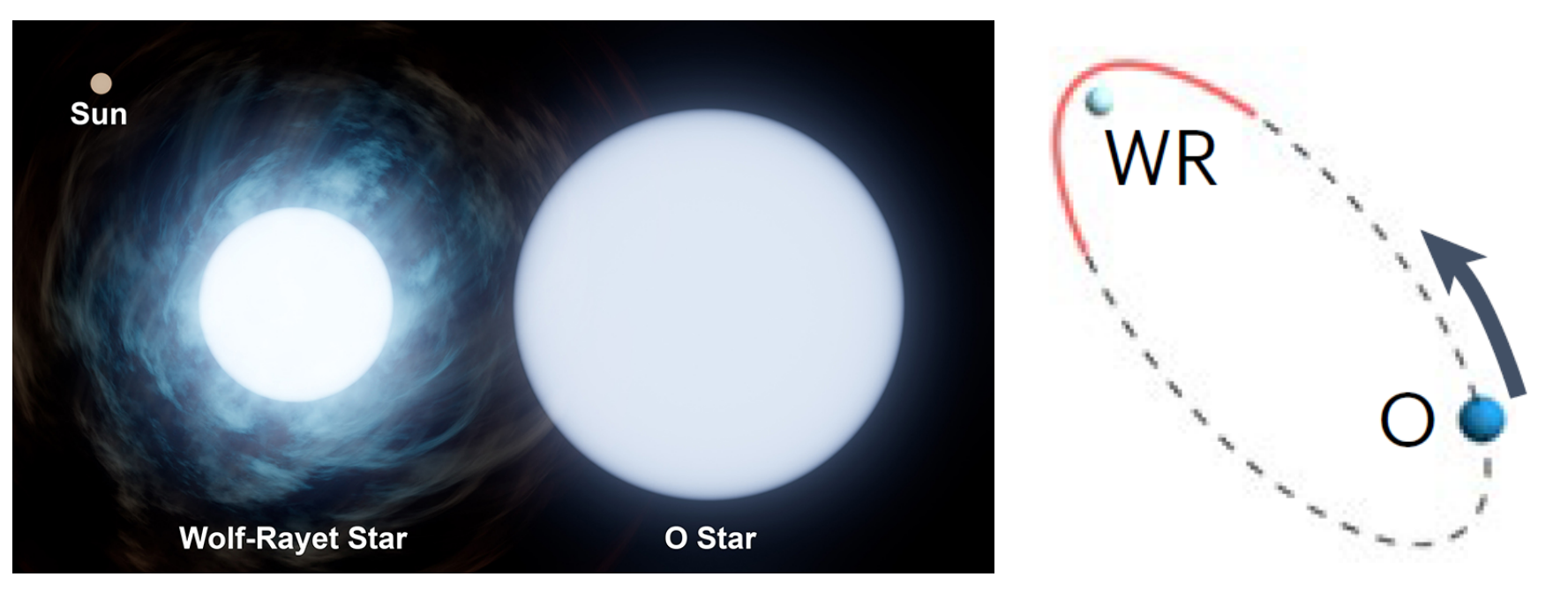
The WR140 system consists of a WR and an O star which produce dust very regularly when the two stars are close together, around periastron. They are in a highly elliptical orbit () with a period of days. Once far from the stars, these dust shells move through space at a remarkably constant speed as indicated by the regularity of the shells in the recent image taken with the James Webb Space Telescope (JWST), shown above in Figure 3. An artist’s impression of the two stars in the system and the orbit (in the reference frame of the WR star) is shown in Figure 4 below.
a. (i) Take the distance to the system to be kpc.
By taking measurements from Figure 3, show that the average radial expansion velocity between shells 2 to 17 is km s. [1 arcsecond is a measurement of angle, where .] [3 т.]
a. (ii) Shell 1 was observed by JWST on 27th July 2022 to be away from the central stars. It was formed during the last periastron passage of the O star, which (as viewed from Earth) took place in December 2016. Taking light travel time into account, in what year was the periastron passage responsible for shell 17? [3 т.]
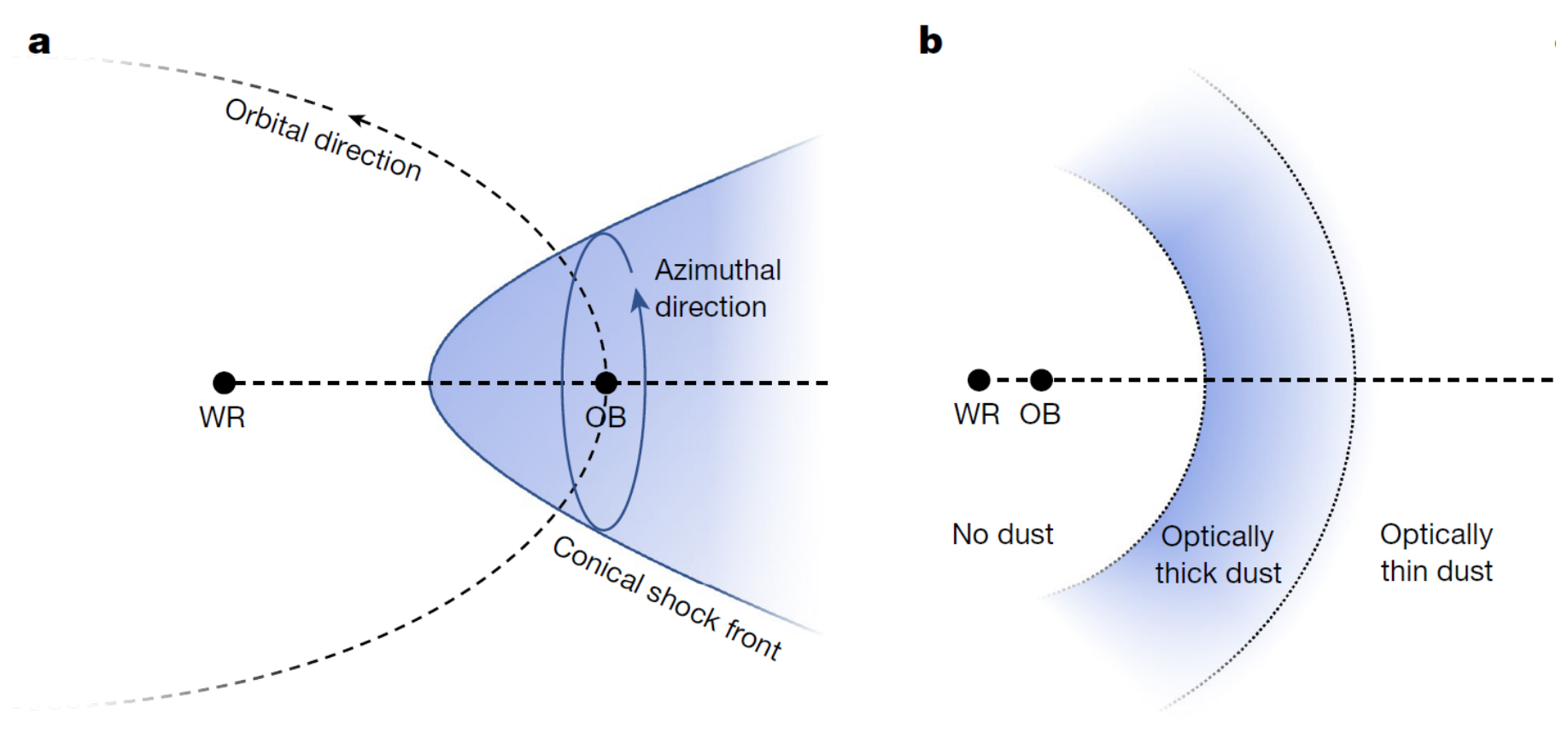
The average radial expansion velocity of shell 1 is less than that seen for shells 2 to 17, suggesting a mechanism accelerates the dust up to that speed from some lower speed resultant from the bow shock between the two colliding stellar winds. A prime candidate is radiation pressure, where photons deposit all of their momentum onto an optically thick dust cloud, before it moves too far from the original stars and becomes optically thin (so the transfer of momentum becomes less and less efficient) as shown in the right panel of Figure 5.
The radiation force, , experienced by a single dust grain at a distance is given as
where is the cross-sectional area of the dust grain, is the speed of light and is the combined luminosity of the binary system. Han et al. (2022) suggest the following acceleration model to match the observations:
Here, is the inner radius of the optically thick dust shell and is the distance at which it becomes optically thin. is the constant acceleration experienced by the dust whilst optically thick, and is equal to the acceleration of a dust grain by radiation pressure at .
b. (i) In the Han et al. (2022) model they use au, au, and assume spherical dust grains with a radius of nm and density g cm, as well as a dust-to-gas ratio of . Take the apparent magnitude of the system (after correcting for substantial extinction by the dust shells and the general ISM) as , and you are given the absolute magnitude of the Sun is .
Show that is km s yr. [5 т.]
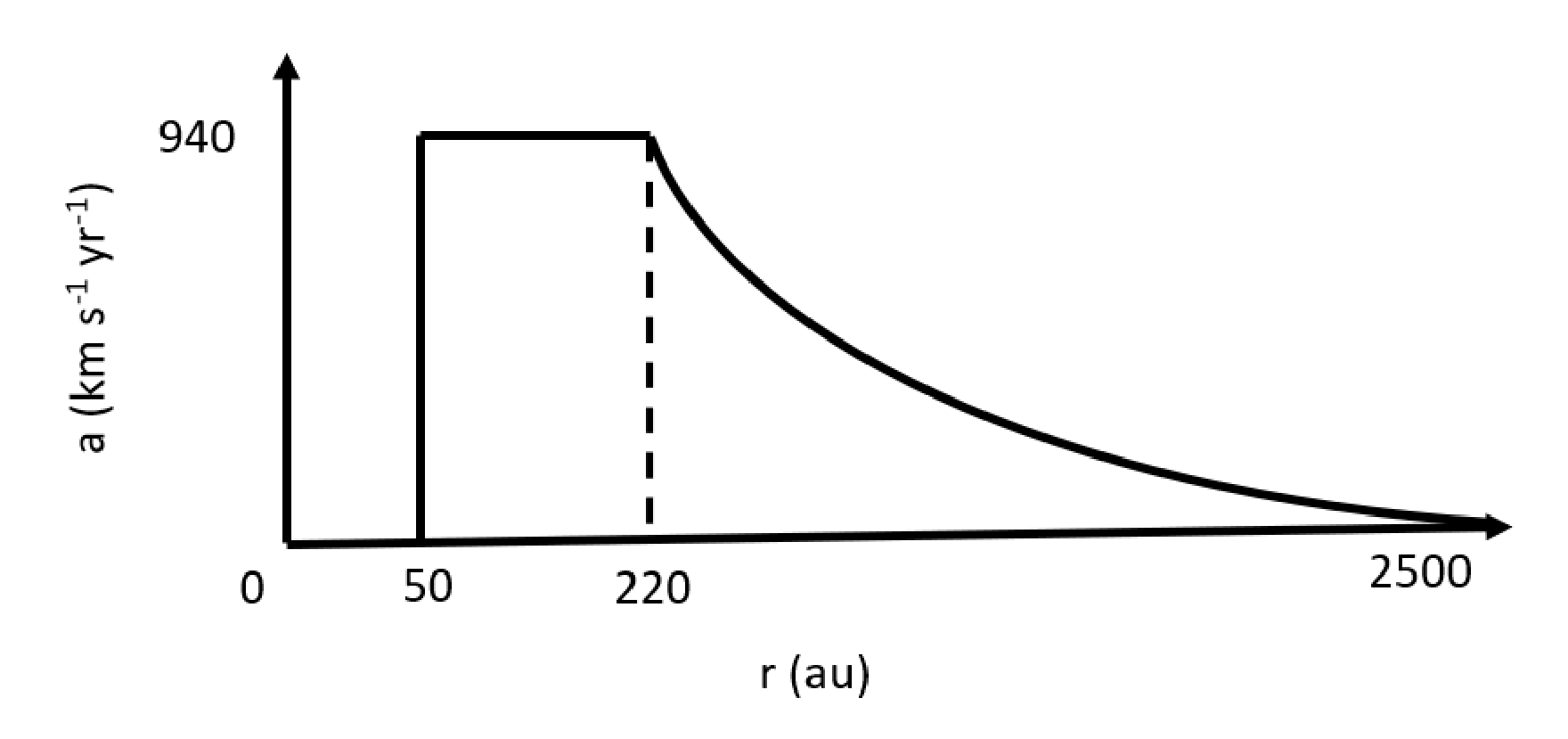
b. (ii) Hence, sketch from au. [2 т.]
b. (iii) Given shell 1 is measured to be moving at km s, calculate the initial speed of the gas streaming away from the stars in the conical shock front, , before it experiences the acceleration due to radiation pressure. [5 т.]
The stellar winds from each star are initially thermally accelerated up to a terminal velocity, , following the relationship , where is the radius of the star. The shape of the conical shock front is well approximated as a hyperbolic cross-section so long as the speed of each star’s wind at the shock front is where they meet. This is true for much of the orbit and the cone, however due to the extreme eccentricity of the WR140 system at periapsis it may not hold close to the stagnation point (the closest the cone gets to the WR star, as seen in Figure 5).
c. (i) The measured semi-major axis of the WR140 system from radio interferometry is milliarcseconds. Investigation of spectral lines shows that for the O star km s and for the WR star km s, and measurements of X-ray absorption lead to suggested mass loss rates of and respectively for each star. In the shock front, the pressure from each stellar wind is balanced. Considering the system at periapsis:
Show that the distance from the O star to the stagnation point is
where is the ratio of the momenta of the two stellar winds, and is the separation between the stars at periapsis. [2 т.]
c. (ii) Hence, calculate in au. [4 т.]
c. (iii) Taking the WR star to be approximately 2 times more luminous than the O star, and the effective surface temperatures of the stars to be kK and kK, calculate the radius of each star in solar units. [3 т.]
c. (iv) Hence, determine for which star(s) the assumption of at the stagnation point is reasonable, and suggest (if any) the change in the position of the stagnation point taking in the real values of at . [3 т.]
d. The conditions for dust production turn on when the stars get within au of each other, corresponding to the solid red region in the right panel of Figure 4. A line from the WR star to the start of dust production region makes an angle of with the semi-major axis. By using Kepler’s second law, or otherwise, estimate the rough duration of dust production during each orbit. Give your answer in years to 2 decimal places, making any simplifying assumptions clear. [Hint: Kepler’s second law states that the area swept out by one object orbiting another is equal in the same amount of time, such that where is the period] [10 т.]
Отговори
a. (i) 2620 km s⁻¹
a. (ii) 3467 BC
b. (i) 941 km s⁻¹ yr⁻¹
Using the exact factor mdust/mtot = 0.01865 gives 924 km s⁻¹ yr⁻¹, also accepted.
b. (iii) 1770 km s⁻¹
c. (ii) 0.195 au
c. (iii) RWR = 9.06 R_⊙, RO = 18.82 R_⊙
c. (iv) Only for the WR star (v ≈ 0.97 v∞,WR, while the O-star wind has only 0.55 v∞,O); the stagnation point will be even closer to the O star.
d. 0.66 yr
The marking scheme accepts any justified method giving 0.60–0.70 years.
Решение
Q2 – Wolf-Rayet Dust Shells [40 marks]
a. (i)
Measuring from the graph, the average spacing between shells is 2.67” [1]
[Expect to see candidates realise that 40” covers the 15 intervals from shell 2 to 17, and hence the average separation is 40”/15 = 2.67”. Allow ±0.03” and ecf on all subsequent parts of the question accordingly]
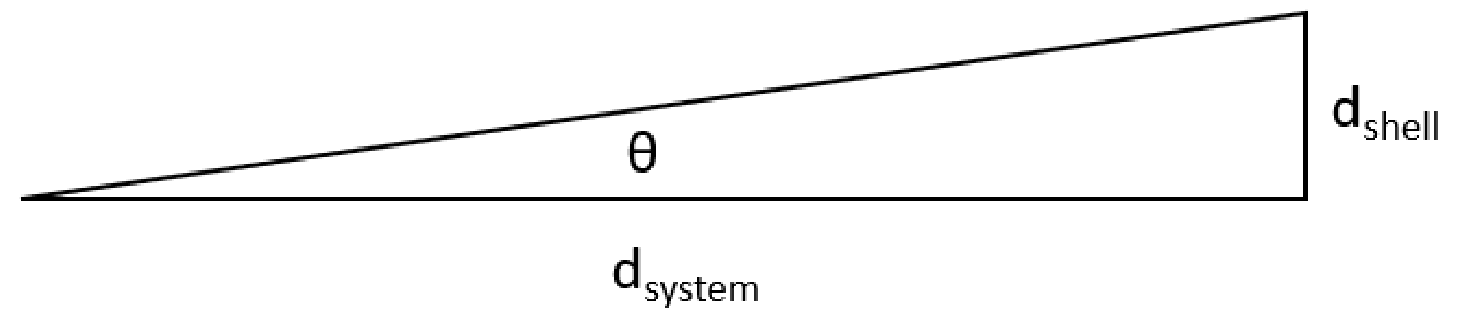
Using the small angle approximation (with the angle converted into radians), the distance between shells implied by their average angular spacing is
[1]
Given the period is 2895 days and converting it to seconds,
[1] [3]
[Given it is a ‘show that’, it must have 3 s.f. in final answer]
a. (ii)
From shell 1 to shell 17 is 16 intervals, so in years
[1]
[Accept use of 365.25 days in a year]
The light travel time from the system is
[1]
Given that December 2016 is approximately decimalised as 2016.9, and that 1 BC goes to 1 AD with no year zero, then the year it was created is
[1] [3]
[Accept use of 2016 instead of 2016.9, and not skipping year 0, giving an allowance of ±2 years on the final answer]
b. (i)
First we can find the absolute magnitude of the system
[1]
By comparison with the Sun we can turn this into a luminosity
[1]
From Newton’s 2nd Law
[1]
[1]
[1] [5]
[Given it is a ‘show that’, it must have 3 s.f. in final answer. Final mark is for correct unit conversion. Give full credit for the use of the exact corrective factor , leading to . Forgetting about the use of the dust-to-gas ratio gives and scores 4 marks max. If no attempt at the algebraic simplification, the third mark can be gained for either a correct (= kg) or (= )]
b. (ii)
Zero from au
and flat section at ~940 km s yr from au [1]
Following 1/r shape from au [1] [2]
[Lose 1 mark if the axes are not labelled, or a scale on either axis is missing. The horizontal axis does not need to be to scale, so long as key values indicated. Expect to see a (not to scale) sketch like the one below]
b. (iii)
The work done by the radiative force on the dust is equal to its change in KE
[1]
[This formula could also be arrived at by generalising the SUVAT equation into ]
In a. ii we were told the angular separation of shell 1 from the star, so
[1]
[This corresponds to 2670 au. If they use = 2500 au in the subsequent integration lose only this mark (so get max 4 marks)]
Evaluating the integral with everything in SI units
[1]
[1]
[0.5 marks for either correctly evaluated integral (flat section or curved section)]
We can now evaluate
[1] [5]
[Accept answer in m s or km s for final mark. Allow ecf from their ]
c. (i)
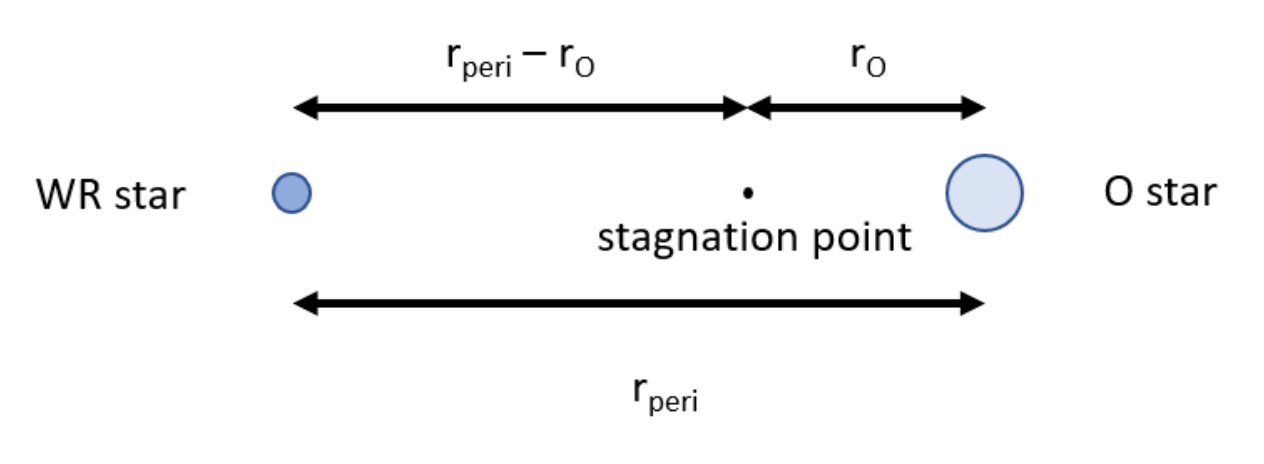
The ram pressure is where is the rate of change of momentum, so at the stagnation point (assuming spherically symmetric stellar winds)
[1]
But since then [1] [2]
This can then be rearranged to give the required formula
[The first mark is for setting up the problem algebraically or for a helpful diagram. The second mark is for correctly introducing and having convincing algebra to the final answer (since it was given, no standalone mark for the final expression)]
c. (ii)
First, we can calculate
[1]
We can also calculate the semi-major axis, and then use the given eccentricity to get the periapsis distance
[1]
[1]
Putting it all into the formula of the previous part
[1] [4]
[Must be in au for the final mark, although a and might be given in metres ( m and m respectively)]
c. (iii)
We can split up the luminosity calculated earlier in b. i.
[0.5]
[0.5]
Using the Stephan-Boltzmann law
[1] [1.5]
[1] [1.5]
[Score max 2 out of 3 if their final answer is not in .
Give full credit if they assume and so use for calculations]
[This matches up well with the scale of the stars in Figure 4 in the paper, showing these are both large, very hot stars.]
c. (iv)
Using the given formula:
[1]
[1]
So is only a reasonable assumption for the WR star (at periapsis) [0.5]
This means the stagnation point will be even closer to the O star [0.5] [3]
[Do not allow bald statement that it is a reasonable assumption for the WR star without evidence of calculation]
d.
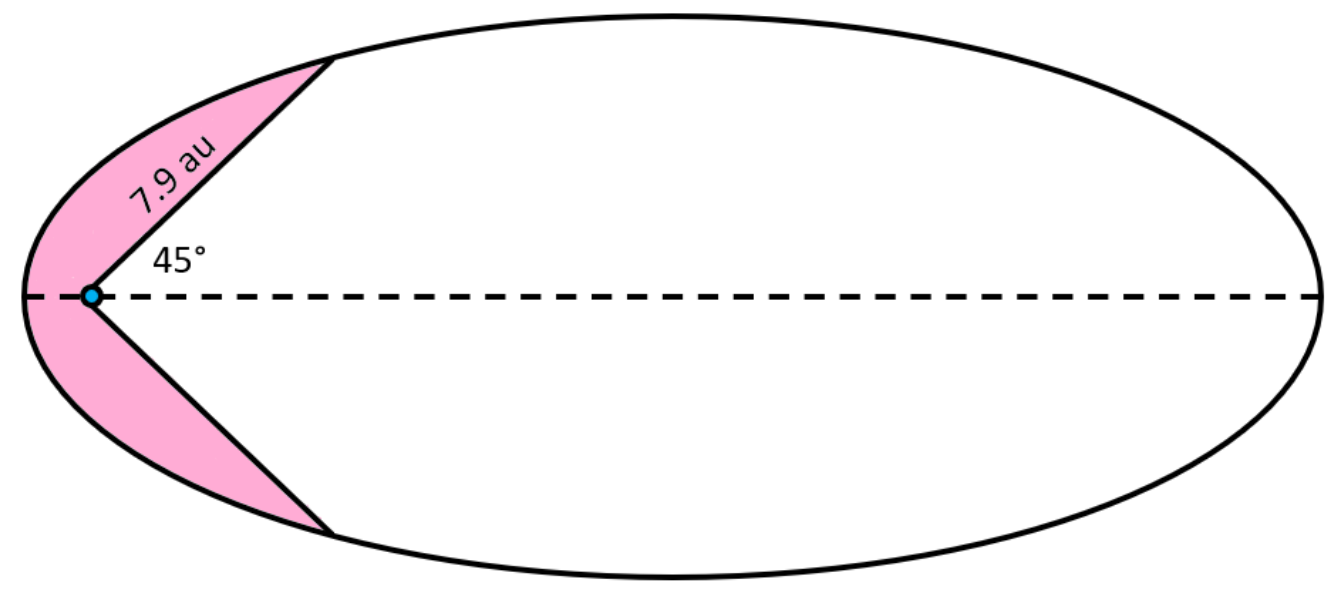
From Kepler’s 2nd law, [1]
We can use approximate geometry to calculate this area e.g. breaking the non-shaded section up into a triangle (ABS) and trapezium (ABDC) sat within a half-ellipse: [1]
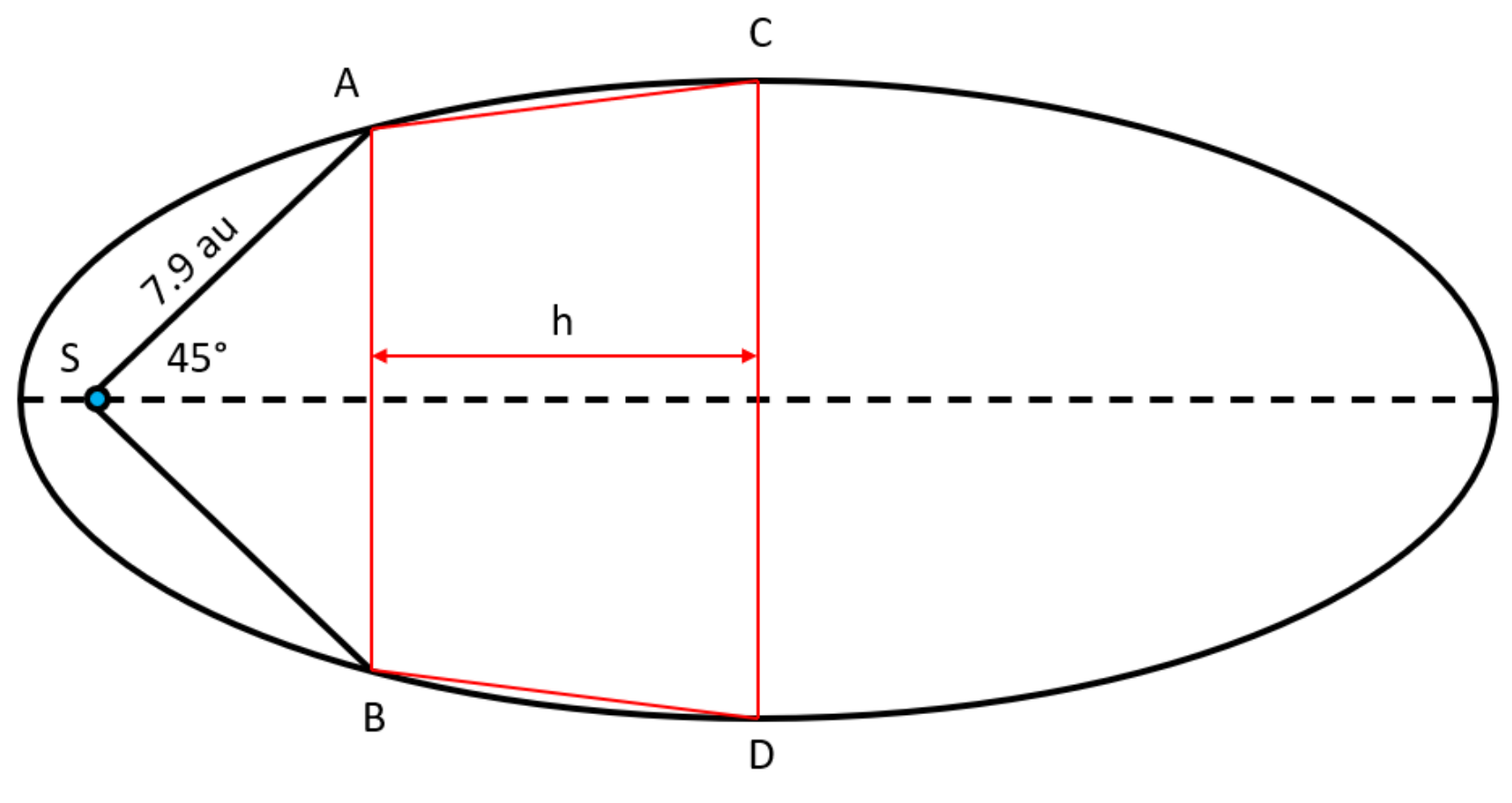
Given the symmetry, angle
[1]
We can also use Pythagoras’ theorem to get the length AB
[1]
The height of the trapezium
[1]
The length of CD is the minor axis (= 2b), which can be calculated from rearranging the formula given at the beginning of the paper
[1]
Hence, the area of the trapezium
[1]
Finally, the area of the half-ellipse (to the left of CD)
[1]
The area of the shaded section is therefore
[1]
Finally, applying Kepler’s 2nd law
[1] [10]
[Must be in years and to 2 d.p. for the final mark. A wide variety of approaches are possible, so award marks based upon sensible choices of shapes to evaluate the area of. The first mark is for realising how to apply Kepler’s 2nd law in this context, the second mark is for a clear approach to break the ellipse up into shapes (ideally with a diagram – and not necessarily the triangle and trapezium used here), and the final mark is for the final answer – all other marks are available for sensible areas and lengths relevant to their method. Accept any method that gives a value of 0.60-0.70 years so long as the justification is clear]
[The more exact way to work this out is using our knowledge of anomalies, although some approximations were made to simplify the geometric case in terms of the given length and angle. Assuming the angle to be correct, leads to a true anomaly . Given this and the quoted eccentricity and semi-major axis, the real length AS is 7.6 au, and utilising Kepler’s equation to get the time for gives 0.633 years. Alternatively, assuming the length AS = 7.9 au to be correct, leads to a real true anomaly of 136.3°, and when looking at the time to travel from gives 0.671 years. Students using this approach (rather than areas of shapes) get full credit. However the problem is approached, it is clear that dust is only produced on a relatively short time frame, which is why each shell has such contrast.]
Questions proposed by
END OF PAPER
Questions proposed by:
Dr Alex Calverley (Surbiton High School)
Josh Brown (University of Cambridge)
Оригинал в Архива: BAAO_2023.pdf · официални решения: BAAO_2023_solutions.pdf