BAAO 2023, Теория — Задача 3. Planetary Migration in Protoplanetary Discs
British Astronomy and Astrophysics Olympiad 2022-2023 — Astronomy & Astrophysics Competition Paper — Monday 6th February 2023 · 6 февруари 2023 г. · 25 т.
Указания
This question paper must not be photographed or taken out of the exam room
Time: 3 hours ( minutes for Q1, minutes for Q2 and minutes for Q3).
Questions: All three questions should be attempted. Each question contains independent parts so that later parts can be attempted even if earlier parts are incomplete.
Solutions: Answers and calculations are to be written on loose paper. YOU WILL NEED GRAPH PAPER. Students should ensure their name and school is clearly written on the first answer sheet and that all pages are numbered. EACH QUESTION ANSWERED must be started on a new page. A standard formula booklet with standard physical constants may be used if desired.
Instructions: To accommodate students sitting the paper at different times, please do not discuss any aspect of the paper on the internet until 8 am Saturday 11th February.
Clarity: Solutions must be written legibly, in black pen, and working down the page. Scribble will not be marked and overall clarity is an important aspect of this exam.
Eligibility: The International Olympiad will be held in August 2023; all sixth form students are eligible to participate.
Calculators: Any standard calculator may be used, but calculators cannot be programmable and must not have symbolic algebra capability.
Training Dates and the IOAA (Chorzów, Poland, 10th - 20th August 2023)
The team will be selected from students taking this paper. The best students that are eligible to represent the UK at the IOAA will be invited to attend the Training Camp to be held in Oxford from Saturday 1st to Wednesday 5th April 2023. Astronomy material will be covered; problem solving skills and observational skills (telescope and naked eye observations) will be developed. At the Training Camp a Data Analysis exam along with a Round 3 theory paper will be sat. A team of five students (plus one reserve) will be selected for further training, including additional training camps in the summer.
Important Constants
| Constant | Symbol | Value |
|---|---|---|
| Speed of light | ||
| Earth’s rotation period | 1 day | 24 hours |
| Earth’s orbital period | 1 year | 365.25 days |
| parsec | pc | |
| Astronomical Unit | au | |
| Radius of the Sun | ||
| Radius of the Earth | ||
| Mass of the Sun | ||
| Mass of the Earth | ||
| Luminosity of the Sun | ||
| Stephan-Boltzmann constant | ||
| Gravitational constant | ||
| Boltzmann constant | ||
| Permittivity of free space | ||
| Permeability of free space | ||
| Planck’s constant | ||
| Elementary charge | ||
| Proton rest mass | ||
| Electron rest mass | ||
| Wien’s displacement law | ||
| Avagadro’s constant |
Basic calculus formulae:
| Chain rule | |
| Product rule | |
| Quotient rule | |
| Integration by parts | |
| Standard integral |
Important Formulae
You might find the diagram of an elliptical orbit below useful in solving some of the questions:
Elements of an elliptic orbit:
| semi-major axis | |
| semi-minor axis | |
| eccentricity | |
| focus | |
| periapsis distance (shortest distance from ) | |
| apoapsis distance (longest distance from ) |
Kepler’s Third Law: For an elliptical orbit, the square of the period, , of an object about the focus is proportional to the cube of the semi-major axis, (as defined above), such that
where is the total mass of the system (typically dominated by the central object) and is the universal gravitational constant.
Vis-Viva Equation: For an elliptical orbit, the speed of an object at a distance from the focus is related to the semi-major axis, , total mass of the system, , and universal gravitational constant, , (as defined above), such that
Magnitudes: The apparent magnitudes of two objects, and , are related to their apparent brightnesses, and , via the formula
The absolute magnitude of an object, , is the same as its apparent magnitude when viewed from 10 pc, hence the relationship between apparent and absolute magnitude and distance is
where is measured in parsecs.
Note for markers
BAAO 2022/23 Solutions and Marking Guidelines
Note for markers:
- Answers to two or three significant figures are generally acceptable. The solution may give more in order to make the calculation clear. Units should be present on final answers when appropriate.
- There are multiple ways to solve some of the questions; please accept all good solutions that arrive at the correct answer. Students getting the answer in a box will get all the marks available for that calculation / part of the question (as indicated in red), so long as there are no unphysical / nonsensical steps or assumptions made (students may not explicitly calculate the intermediate stages and should not be penalised for this so long as their argument is clear).
Условие
Young, Earth-like planets interact with the protoplanetary discs in which they form, and as a result migrate to different orbital radii. The aim of this question is to quantify this migration in a simple model. We shall think of protoplanetary discs as consisting of nested circular orbits of gas and dust around a central star. For a thin disc (with small vertical extent), we assign to the disc a surface density (or mass per unit area) , and semi-thickness , which in general vary over the disc’s extent. The disc’s ‘aspect ratio’ at radius from the central star is denoted . This question is concerned with the migration of ‘small’ planets, such that .
a. Consider a planet of mass in a circular orbit of radius about a star of mass , with . Show that it has angular velocity and angular momentum about the central star given by:
[2 т.]
b. Consider now a rotationally symmetric disc with surface density profile , and outer radius . Find the mass of the disc in terms of and assuming its inner radius . [4 т.]
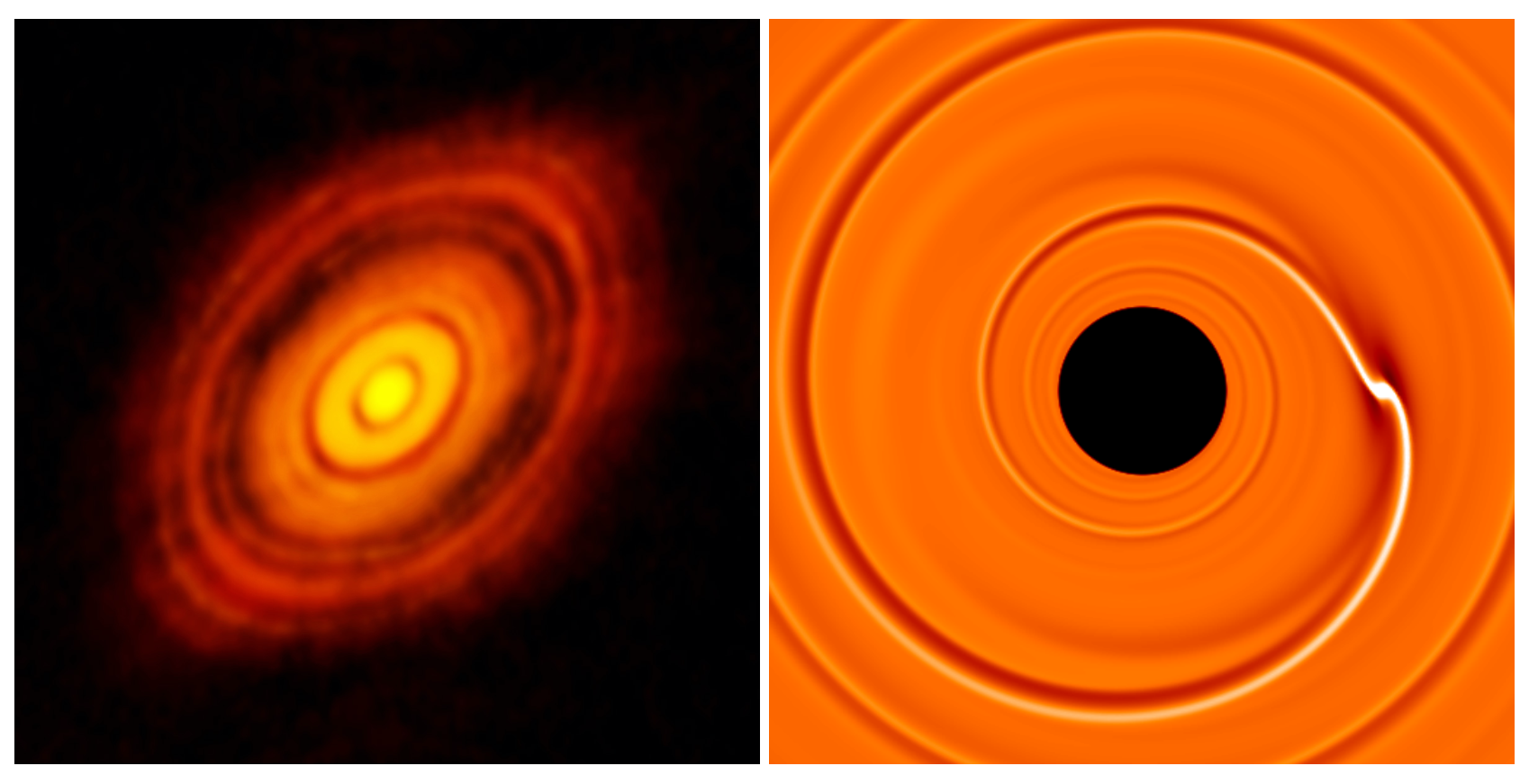
Since the planet is assumed small (), its interaction with the gas in the disc constitutes the excitation of a spiral density wave, and redistribution of matter in the co-orbital region (that is, matter orbiting at radii ), as shown in Figure 6. The resulting non-uniform density distribution induced in the disc exerts a net gravitational force, and hence a torque on the planet, which has been estimated using analytical methods. This torque, , acts to change the planet’s angular momentum, and hence its orbital radius, causing it to ‘migrate’, via:
It is convenient to write the torque in terms of the reference value
c. From 2-dimensional steady fluid-dynamical disc models, it is predicted that the total torque has two main contributions: from the spiral wave, the ‘Lindblad torque’, , and from the co-orbital region, the ‘Corotation torque’, . For a disc of uniform entropy (), and with surface density profile , and pressure profile , Tanaka et al. (2002) and Paardekooper & Papaloizou (2009) find these torques are given by:
We assume the gas in the disc obeys the ideal gas law, so that:
where is the absolute temperature and is the adiabatic index (the ratio of the heat capacity at constant pressure to the heat capacity at constant volume). Show that for a disc of uniform entropy,
[Hint: if , then .] [5 т.]
d. Assume the disc model from part b. with . Find the time taken for the orbital radius of the planet to halve from initial radius . Take , and give your answer in terms of the migration timescale,
where is the orbital period at radius . [9 т.]
e. If the disc has mass and aspect ratio , and if and years, find the elapsed time in years for the migration described in part d. to occur. Is this a feasible mechanism for planetary migration given the lifetime of the disc is roughly Myr? [2 т.]
f. Whilst the planet excites a spiral density wave over the whole disc, in fact the dominant contribution to the torque from the spiral is from only a small neighbourhood around the planet, so that may be replaced by
Near the inner radius of the disc, the surface density departs from the above power-law behaviour and smoothly decreases to . Does the migration stop before the planet reaches the disc’s inner radius? [3 т.]
Helpful equations:
The moment of inertia, , of a point mass moving in a circle of radius is .
The angular momentum, , of a spinning object with an angular velocity of is , where is the linear momentum of a point particle a distance from the axis of rotation.
Отговори
b.
d.
e. 110000 yr
Yes — this is well within the 10 Myr disc lifetime, so it is a feasible mechanism.
f. Yes — the migration does halt before the inner edge of the disc (α changes from 1.5 to negative values, so it passes through αcrit where Γ = 0).
Решение
Q3 – Planetary Migration in Protoplanetary Discs [25 marks]
a.
Balancing the centripetal force with the gravitational force [accept balancing accelerations]
[1] [1]
Cancelling and rearranging gives as required
[This was a ‘show that’, so the mark is for the algebraic route to the answer, not the final answer]
Using the equations for the hint at the end of the question
[1] [1]
Substituting the expression for gives as required
[This was a ‘show that’, so the mark is for the algebraic route to the answer, not the final answer]
b.
We will need to integrate the surface density (mass per unit area) over the total area of the disc
[1]
Given and our lower integral limit is ≈ 0, and so
[1]
[1]
[1] [4]
[If the first mark is not already given, it can be scored for either a correct approximation of 0 for the lower integral limit, or for converting from dA to dr. Students that do get a maximum of 1 mark (for the lower integral limit), since the negative total mass is non-physical]
c.
The final expression does not include , so we need to find it as a function of and so we can combine the given expressions. Given and ,
① [1]
We are told it is a disc of uniform entropy (so ds = 0)
[1]
Using the hint given
[1]
But given from earlier
② [1]
Comparing ① and ②
[1] [5]
Substituting this into the given expressions for and gives the required expression
[‘Show that’ so mark for route not answer]
d.
Using our earlier expression for L and assuming only the orbital radius changes with time
[1]
In the model of part b., so by comparison with part c. , and we are told
Using the expression from part c. for and inputting with the earlier expression for
[1]
[1]
Equating these two expressions for and rearranging for
[1]
However, we recognise that
[1]
All of the parameters on the right hand side are constant , so if in time t the radius of the planet has halved, [negative since is decreasing] [1]
Substituting it in and rearranging for t
[1]
From Kepler’s 3rd law, we can derive an expression for the initial orbital period,
[1]
As found in part b., and remembering that
[1] [9]
[Must be in terms of the migration timescale, , for the final mark. The numerical factor may be left as 1/4.53 or equivalent rather than evaluated]
e.
Substituting the numbers into the equation we just derived
[1] [1]
Since Myr then , it is a feasible mechanism [1] [1]
[Award 0.5 marks for calculating (= 0.5 Myr). Second mark can only be gained with a sensible comparison between their t (allowing ecf) and 10 Myr, not for a bald statement. Allow use of the more precise formula for from c. leading to 110 246 years rather than 110 327 years]
f.
The migration will stop when = 0, which we can use to define a critical value of
[1]
Since this means
Far from the inner edge (as used previously in the question),
We are told that decreases to zero at the inner edge, so the variation of as a function of increasing r must be that it starts from zero at , increases smoothly to some maximum, and then decreases again following .
Since then following the behaviour described above there must be a region near where is positive (since in that region is increasing with increasing r) and so (since and are also positive) is negative [1]
[This mark is for any reasoning that to match the described behaviour then there must be a change in the sign of as you approach ]
This means far from the inner edge
and close to the inner edge
so there must be a place in the disc between and where
hence before the inner edge of the disc [1] [3]
[No mark for a bald statement without some attempt at mathematical justification]
[This is the reason planets are able to form and survive to be detected in mature star systems, otherwise planets would only be a feature of young systems (before spiralling into their star) and life on Earth would not have had enough time to evolve]
Questions proposed by
END OF PAPER
Questions proposed by:
Dr Alex Calverley (Surbiton High School)
Josh Brown (University of Cambridge)
Оригинал в Архива: BAAO_2023.pdf · официални решения: BAAO_2023_solutions.pdf