BAAO 2025, II кръг — Задача 1. Gravity Train
British Astronomy and Astrophysics Olympiad 2024-2025 — Astro Round 2 — Tuesday 25th February 2025 · 25 февруари 2025 г. · 30 т.
Указания
This question paper must not be photographed or taken out of the exam room
Time: 3 hours ( minutes for Q1, minutes for Q2 and minutes for Q3).
Questions: All three questions should be attempted. Each question contains independent parts so that later parts can be attempted even if earlier parts are incomplete. The questions build in difficulty.
Solutions: Answers and calculations are to be written on loose paper. Students should ensure their name and school is clearly written on the first answer sheet and that all pages are numbered. A standard formula booklet may be used. START EACH QUESTION ON A NEW PAGE.
Clarity: Solutions must be written legibly, in black or blue pen, and working down the page. Scribble will not be marked and overall clarity is an important aspect of this exam.
Instructions: To accommodate students sitting the paper at different times, please do not discuss any aspect of the paper on the internet until 8 am Thursday 6th March.
Calculators: Any standard calculator may be used, but calculators cannot be programmable and must not have symbolic algebra capability.
Training Dates and the IOAA
Training Dates and the IOAA (Mumbai, India, 11th - 21st August 2025)
The best students taking this paper eligible to represent the UK at the IOAA will be invited to attend the Selection Camp to be held in Oxford from Monday 7th to Friday 11th April 2025. At the camp, problem solving skills and observational skills (including with telescopes) will be developed, and students will sit a Data Analysis exam along with the Round 3 paper. From this, a team of five students (plus one reserve) will be selected for further training, including additional camps in the summer.
The BAAO are very proud to be sponsored by G-Research
Important Constants
| Constant | Symbol | Value |
|---|---|---|
| Speed of light | ||
| Earth’s rotation period | 1 day | 24 hours |
| Earth’s orbital period | 1 year | 365.25 days |
| parsec | pc | |
| Astronomical Unit | au | |
| Radius of the Sun | ||
| Radius of the Earth | ||
| Mass of the Sun | ||
| Mass of the Earth | ||
| Luminosity of the Sun | ||
| Absolute magnitude of the Sun | ||
| Hubble constant | ||
| Stephan-Boltzmann constant | ||
| Gravitational constant | ||
| Boltzmann constant | ||
| Permittivity of free space | ||
| Permeability of free space | ||
| Planck’s constant | ||
| Elementary charge | ||
| Proton rest mass | ||
| Electron rest mass | ||
| Wien’s displacement law | ||
| Avagadro’s constant |
Basic calculus formulae:
Chain rule
Product rule
Quotient rule
Integration by parts
Standard integral
Important Formulae
You might find the diagram of an elliptical orbit below useful in solving some of the questions:
Elements of an elliptic orbit:
- semi-major axis
- semi-minor axis
- eccentricity
- focus
- periapsis distance (shortest distance from )
- apoapsis distance (longest distance from )
Kepler’s Third Law:
Vis-Viva Equation:
Wien’s Displacement Law:
Stephan-Boltzmann Law:
Brightness (Intensity):
Magnitudes:
Distance-Parallax Relation:
Rayleigh Criterion:
Redshift:
Hubble’s Law:
Note for markers
Astro Round 2 2025 Paper Solutions and Marking Guidelines
Note for markers:
- Answers to two or three significant figures are generally acceptable. The solution may give more in order to make the calculation clear. Units should be present on final answers when appropriate.
- There are multiple ways to solve some of the questions; please accept all good solutions that arrive at the correct answer. Students getting the answer in a will get all the marks available for that calculation / part of the question (as indicated in red), so long as there are no unphysical / nonsensical steps or assumptions made (students may not explicitly calculate the intermediate stages and should not be penalised for this so long as their argument is clear).
In these solutions a plain [1] is a marking point and a bold [n] is the total for that calculation or part (printed in red in the source).
Условие
First proposed by Robert Hooke in a conversation with Isaac Newton, and later explored mathematically by Paul Cooper in the s and several science fiction authors thereafter, a ‘gravity train’ involves drilling a tunnel through the Earth to connect two locations that are often far apart and using only gravitational forces to accelerate and decelerate the train on its journey. In this question we will investigate the physics of this novel form of transportation.
You may wish to make use of Newton’s Shell Theorem, which states that if an object is at a distance from the centre of mass of a sphere of radius , the gravitational force it experiences is identical to that from a point mass at the location of the centre of mass with a mass equal to the mass enclosed by a shell of radius .
Throughout this question we will assume that the Earth is a solid sphere of uniform density, , and that all tunnels are maintained in vacuum.
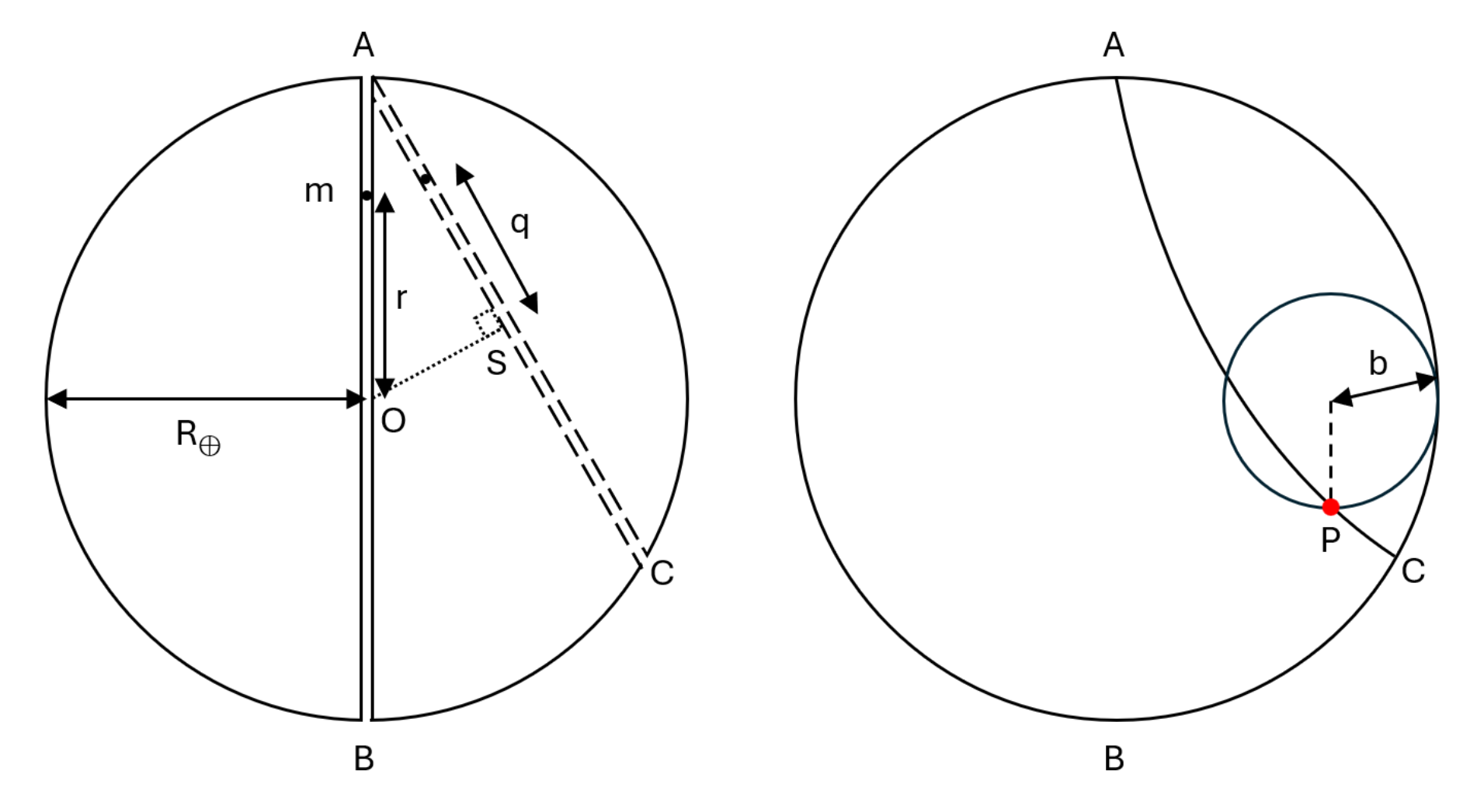
Figure 1 shows possible routes for the gravity train as explored by Paul Cooper. The simplest case is between two points, and , that are on completely opposite sides of the planet, and so line is a diameter of the Earth, with at the centre of the Earth. A more convenient case is along an arbitrary chord to point , with as the midpoint, and Cooper showed that the quickest route between two arbitrary points on the Earth’s surface is along the hypocycloid curve connecting the two - this is a special type of curve, generated by the trace of a fixed point on a small circle of radius that rolls within the larger circle.
a. (10 т.)
In this part of the question you should ignore any effects of the Earth’s rotation. Assume the gravity train always starts from rest at point .
(i) Show that the gravity train using the route would undergo simple harmonic motion (SHM) and hence that the time to get from to is a function of and , where is the gravitational field strength at the surface of the Earth. Hence show is about minutes. [3 т.]
(ii) Compare this to the time taken by a satellite to go from to when orbiting in a circular orbit of radius . [1 т.]
(iii) What is the largest speed achieved by the gravity train? What is this the same as? [2 т.]
(iv) Gravity trains could potentially be used in the future to mine the asteroid belt, as a way to haul raw material to a central refining point or port for launch back to Earth. The dwarf planet Ceres has an average density of . What would be on Ceres? [2 т.]
(v) The route is an arbitrary chord through the planet. Given the gravity train is constrained to travel along frictionless rails, determine the time to go along this route. Compare your answer to . You may wish to make use of the notation in Figure 1. [2 т.]
b. (9 т.)
Cooper showed that the time taken to travel along a hypocycloid made by a circle of radius is
For all points and , . Again, ignore the Earth’s rotation and assume the gravity train starts from rest at point .
(i) When , what is the value of ? What situation does this correspond to? [2 т.]
(ii) Consider a chord between and with a maximum depth below the Earth’s surface of , and the hypocycloid has a maximum depth of where . If is chosen such that , find the latitude, , of if is the North Pole (for which ) and hence find . [7 т.]
So far we have ignored the Earth’s rotation, and this would be fine for a tunnel travelling from the North Pole to the South Pole, however if we had instead tried to go between two points anywhere else (whether a diameter or a chord), other forces would have to be taken into account. Moving into a rotating co-ordinate system (of constant angular velocity) means that in order for Newton’s laws of motion to hold, we have to introduce two ‘fictitious forces’: a centrifugal force, , that acts radially and a Coriolis force, that acts tangentially (perpendicular to both the particle’s velocity and to the Earth’s axis of rotation).
The magnitude of the centrifugal force is equal to that of the centripetal force, but pointed away from the rotational axis. The magnitude of the Coriolis force is given by
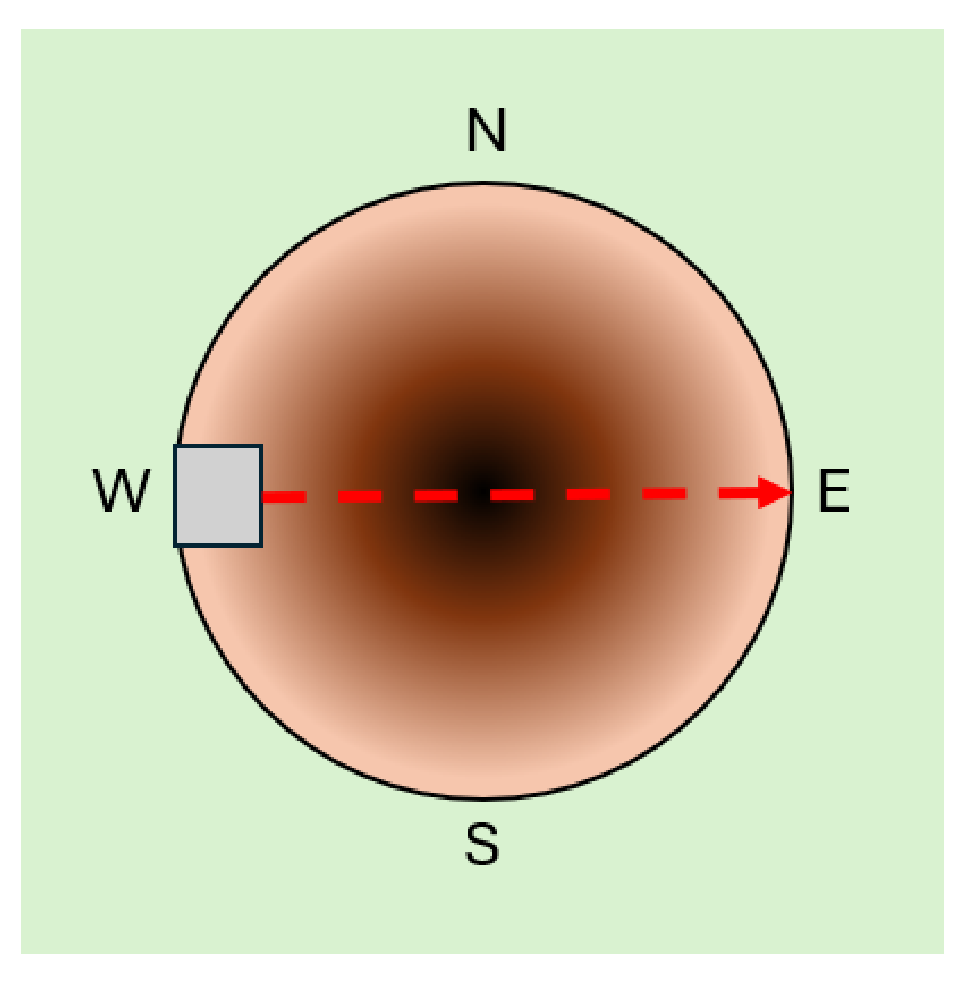
where is the particle’s mass, is its velocity component perpendicular to the Earth’s axis of rotation, and is the Earth’s angular velocity. A consequence of the Coriolis force is that the gravity train, unless constrained on rails, will drift eastwards and crash into the side. For a tunnel starting at the equator with the train on the West wall, this is movement to the right (see Figure 2).
c. (11 т.)
Suppose the tunnel along the diameter is now in the plane of the Earth’s equator, and so rotational effects will have to be considered.
(i) The centrifugal acceleration is greatest at the surface of the Earth. Show that it is of , and so we are justified in ignoring it. [1 т.]
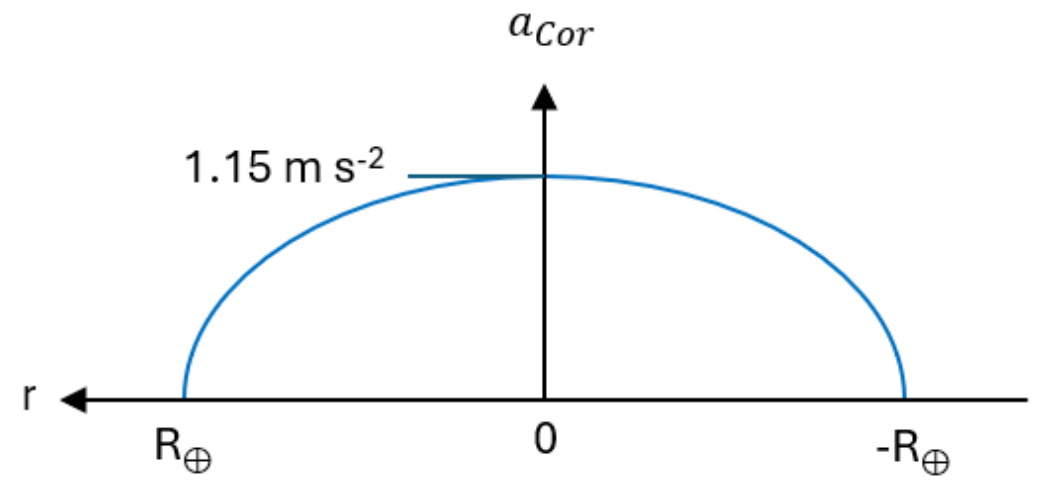
(ii) Sketch how the Coriolis acceleration experienced by the gravity train varies as a function of (as defined in Figure 1 as the distance from ) indicating numerical values on the -axes that confirm we cannot treat it as negligible. You may find it easiest to reverse your axis so it goes from (at A) to to (at B). Treat eastwards as positive. [3 т.]
(iii) If the train was originally on the West side of the tunnel (as shown in Figure 2) and became detached from its rails the moment the journey started, find an expression for the West-East displacement as a function of time. [3 т.]
(iv) If the distance between the top of the gravity train and the other side of the tunnel is (it’s a very wide tunnel!), how much time will elapse before it crashes into the wall?
(You may wish to use the small angle approximation for that ) [2 т.]
(v) How far below the surface did the train crash? Give your answer as a percentage of . [2 т.]
Отговори
a., (i) 42.2 min
tAB = π√(R⊕/g0) = 2532 s = 42.2 mins (= 42 mins 12 secs).
a., (ii) t is the same (t = π√(R⊕³/GM⊕) = 42.2 minutes)
a., (iii) 7.91 km s⁻¹
vmax = √(g0 R⊕); the same as the circular orbital velocity for an orbit with radius R⊕.
a., (iv) 4044 s
tAB = π√(3/(4Gπρ)) = 4044 s (= 67.4 mins = 1.12 hours).
a., (v) tAC = tAB (SHM with the same ω as for the route AB)
b., (i)
The path is along a diameter (i.e. AC = AB).
b., (ii) φ = 65.9° N; α = 6.07
c., (i) 0.34 %
aCent/g0 = 3.43 × 10⁻³ = 0.34%.
c., (ii) 1.15 m s⁻²
aCor = 2Ωω√(R⊕² − r²); maximum 1.15 m s⁻² at r = 0; the sketch is the upper half of an ellipse.
c., (iii)
c., (iv) 128 s
c., (v) 1.26 %
Решение
Q1 – Gravity Train [30 marks]
a.
i. Given a uniform density Earth, the mass enclosed by a sphere of radius (with )
Applying Newton’s shell theorem to get that the acceleration experienced is
[1] [1]
[Expect some comparison to the general SHM equation () or written argument with the SHM definition to get this mark. Do not penalise students for dropping the symbol. Allow or expressed in any valid combination of constants]
We know that the period of SHM will be and hence since A→B is just one-way
[1] [1]
[Must be as a function of and for this mark. If they leave it as or in the form needed for part iv. () then award 0.5 marks]
Substituting in the numbers
[1] [1]
[Must be in minutes (or mins and seconds) for this mark and s.f (in mins). Accept answers that use an alternative expression for or round to 42.2 minutes or have a remainder that rounds to 11-12 seconds. If left in seconds award 0.5 marks]
ii. Using the speed of an object in a circular orbit and half the circumference of the Earth
[1] [1]
[Do not penalise them for finding a few seconds discrepancy, depending on the values of constants they are using, and so simply stating the times are very close / very similar. Allow use of Kepler’s 3rd Law as an alternative route to get . Allow ecf on this question if their is right but is different to their from part i.]
iii. Given it follows SHM
[1] [1]
[Accept answers that round to 7.90 km s or 7.91 km s, based upon the values of constants being used. Allow use of energy conservation where and so (following the method of Astro R1 2024 Q2 for the GPE) you have the expression which you evaluate at . An alternative energy conservation route is that the work done by gravitational forces is equal to the change in KE of the gravity train, and so (using that inside a uniform density planet) the work done is etc.]
This is the same as [1] [1]
[Allow ecf with this mark e.g. if a student finds , and correctly identifies it as the escape velocity, give this mark]
iv. Since we can express as a function of
[1]
Substituting in the numbers using that 2.16 g cm = 2160 kg m
[1] [2]
[Since unit not specified in the question, accept answer in seconds, minutes or hours. Accept students showing that and then using and their earlier answer in a scaling relationship]
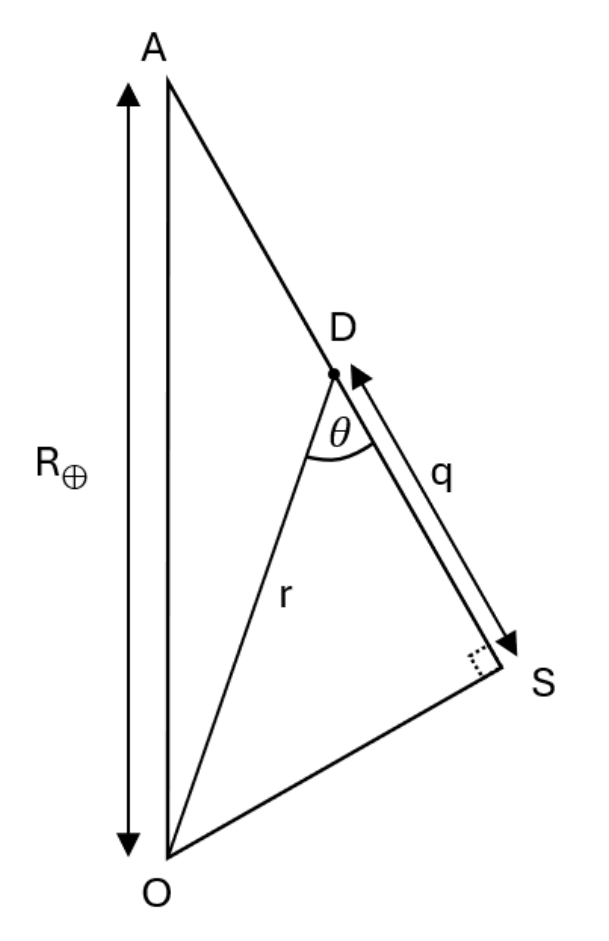
v. Consider when the gravity train is at point D, which is a distance r from O and q from S (using the Figure 1 notation)
The gravitational acceleration the gravity train experiences is the component of in the direction of S
[1]
But since
This is SHM with the same as for the route AB
[1] [2]
[Allow any valid method that demonstrates this equivalence, or if a student uses numerical comparisons. Don’t penalise if they just keep the algebraic expressions to magnitudes]
The article by Cooper was called “To Everywhere in 42 Minutes” and celebrated this fact that the smaller acceleration exactly balanced the shorter distance to travel. This only holds on the assumption of a uniform density Earth – using a realistic model for the density distribution of the Earth the time becomes minutes and the position of C matters such that (with shorter chords having the longer times). Coincidentally, this shorter time for is very similar to what you would get if you assumed throughout and applied simple SUVAT to get .
b.
i. Given that we are looking at the situation
[1] [1]
This means that the chord will have to pass through the centre
[1] [1]
ii. Modifying what we did in the previous part to work out the new
Cancelling the and and rearranging gets the quadratic
[1]
The solutions are
[0.5]
We know that and so we need the negative solution
[0.5]
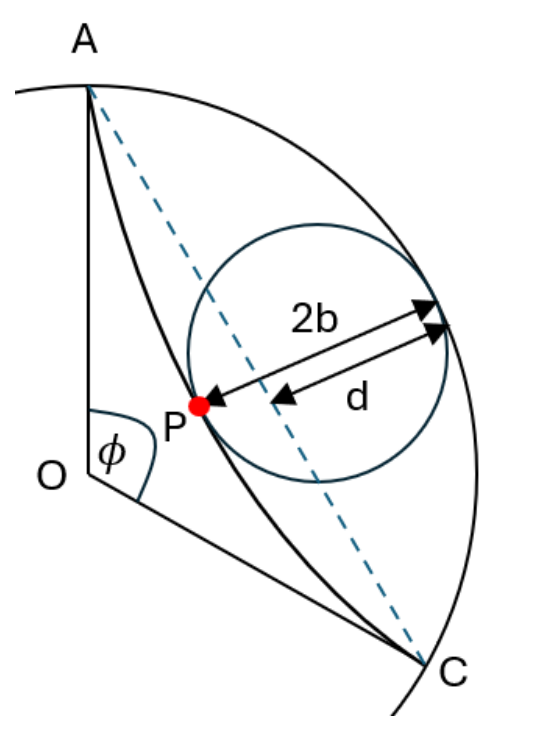
It is clear that the arc length AC is equal to the circumference of the small circle
[1]
[0.5]
[0.5] [4]
[No penalty if they exclude the N so long as their value is positive]
The deepest part of both routes occurs at the midway point
[1]
[Accept equivalent expressions e.g. ]
Considering the geometry
[1]
[If they forget that is the radius not the diameter and so use then award 0.5 marks]
[1] [3]
[Allow ecf from their chosen geometry e.g. if they get due to confusing diameter and radius in MP6]
c.
i. We can evaluate at the Earth’s surface and compare it to
[1] [1]
[If they only calculate or if they forget to convert from fraction to percentage (i.e. leave their answer as ) then award only 0.5 marks. Expect to see a clear comparison made with 1%, whether by stating that or that (i.e. 1% of ), but no penalty if absent]
ii. Using the given formula for the Coriolis force and that varies with following SHM
[1] [1]
[Accept any equivalent form using or alternatives from a) i.]
[1] [1]
[This is about 12% of so we need to take it into consideration]
Sketch is of the upper half of an ellipse [Accept semicircle] [1] [1]
[No penalty if they decide not to reverse the axis. If their sketch is two quarter ellipses with a discontinuity at , or is the bottom half of an ellipse, award 0.5 marks]
iii. Again, taking advantage of the properties of SHM
[1]
[1]
[1] [3]
[Accept any algebraically equivalent expressions]
iv. Using the given hint for the small angle approximation for
[1]
[1] [2]
[The first marking point is for a correctly rearranged equation for OR for a successful usage of the small angle approximation]
v. Finding the fraction of the distance travelled
[1]
[1] [2]
[If they forget to put their calculator into radians they will get 0.000385% - in this case give only 1.5 marks total]
Questions proposed by
END OF PAPER
Questions proposed by:
James Kennedy (University of Oxford)
Charlotte Stevenson (University of Oxford)
Ben Woodrow (University of Oxford)
Dr Alex Calverley (Surbiton High School)
Оригинал в Архива: BAAO_R2_2025.pdf · официални решения: BAAO_R2_2025_solutions.pdf