BAAO 2025, II кръг — Задача 2. The Fate of the Earth
British Astronomy and Astrophysics Olympiad 2024-2025 — Astro Round 2 — Tuesday 25th February 2025 · 25 февруари 2025 г. · 35 т.
Указания
This question paper must not be photographed or taken out of the exam room
Time: 3 hours ( minutes for Q1, minutes for Q2 and minutes for Q3).
Questions: All three questions should be attempted. Each question contains independent parts so that later parts can be attempted even if earlier parts are incomplete. The questions build in difficulty.
Solutions: Answers and calculations are to be written on loose paper. Students should ensure their name and school is clearly written on the first answer sheet and that all pages are numbered. A standard formula booklet may be used. START EACH QUESTION ON A NEW PAGE.
Clarity: Solutions must be written legibly, in black or blue pen, and working down the page. Scribble will not be marked and overall clarity is an important aspect of this exam.
Instructions: To accommodate students sitting the paper at different times, please do not discuss any aspect of the paper on the internet until 8 am Thursday 6th March.
Calculators: Any standard calculator may be used, but calculators cannot be programmable and must not have symbolic algebra capability.
Training Dates and the IOAA
Training Dates and the IOAA (Mumbai, India, 11th - 21st August 2025)
The best students taking this paper eligible to represent the UK at the IOAA will be invited to attend the Selection Camp to be held in Oxford from Monday 7th to Friday 11th April 2025. At the camp, problem solving skills and observational skills (including with telescopes) will be developed, and students will sit a Data Analysis exam along with the Round 3 paper. From this, a team of five students (plus one reserve) will be selected for further training, including additional camps in the summer.
The BAAO are very proud to be sponsored by G-Research
Important Constants
| Constant | Symbol | Value |
|---|---|---|
| Speed of light | ||
| Earth’s rotation period | 1 day | 24 hours |
| Earth’s orbital period | 1 year | 365.25 days |
| parsec | pc | |
| Astronomical Unit | au | |
| Radius of the Sun | ||
| Radius of the Earth | ||
| Mass of the Sun | ||
| Mass of the Earth | ||
| Luminosity of the Sun | ||
| Absolute magnitude of the Sun | ||
| Hubble constant | ||
| Stephan-Boltzmann constant | ||
| Gravitational constant | ||
| Boltzmann constant | ||
| Permittivity of free space | ||
| Permeability of free space | ||
| Planck’s constant | ||
| Elementary charge | ||
| Proton rest mass | ||
| Electron rest mass | ||
| Wien’s displacement law | ||
| Avagadro’s constant |
Basic calculus formulae:
Chain rule
Product rule
Quotient rule
Integration by parts
Standard integral
Important Formulae
You might find the diagram of an elliptical orbit below useful in solving some of the questions:
Elements of an elliptic orbit:
- semi-major axis
- semi-minor axis
- eccentricity
- focus
- periapsis distance (shortest distance from )
- apoapsis distance (longest distance from )
Kepler’s Third Law:
Vis-Viva Equation:
Wien’s Displacement Law:
Stephan-Boltzmann Law:
Brightness (Intensity):
Magnitudes:
Distance-Parallax Relation:
Rayleigh Criterion:
Redshift:
Hubble’s Law:
Note for markers
Astro Round 2 2025 Paper Solutions and Marking Guidelines
Note for markers:
- Answers to two or three significant figures are generally acceptable. The solution may give more in order to make the calculation clear. Units should be present on final answers when appropriate.
- There are multiple ways to solve some of the questions; please accept all good solutions that arrive at the correct answer. Students getting the answer in a will get all the marks available for that calculation / part of the question (as indicated in red), so long as there are no unphysical / nonsensical steps or assumptions made (students may not explicitly calculate the intermediate stages and should not be penalised for this so long as their argument is clear).
In these solutions a plain [1] is a marking point and a bold [n] is the total for that calculation or part (printed in red in the source).
Условие
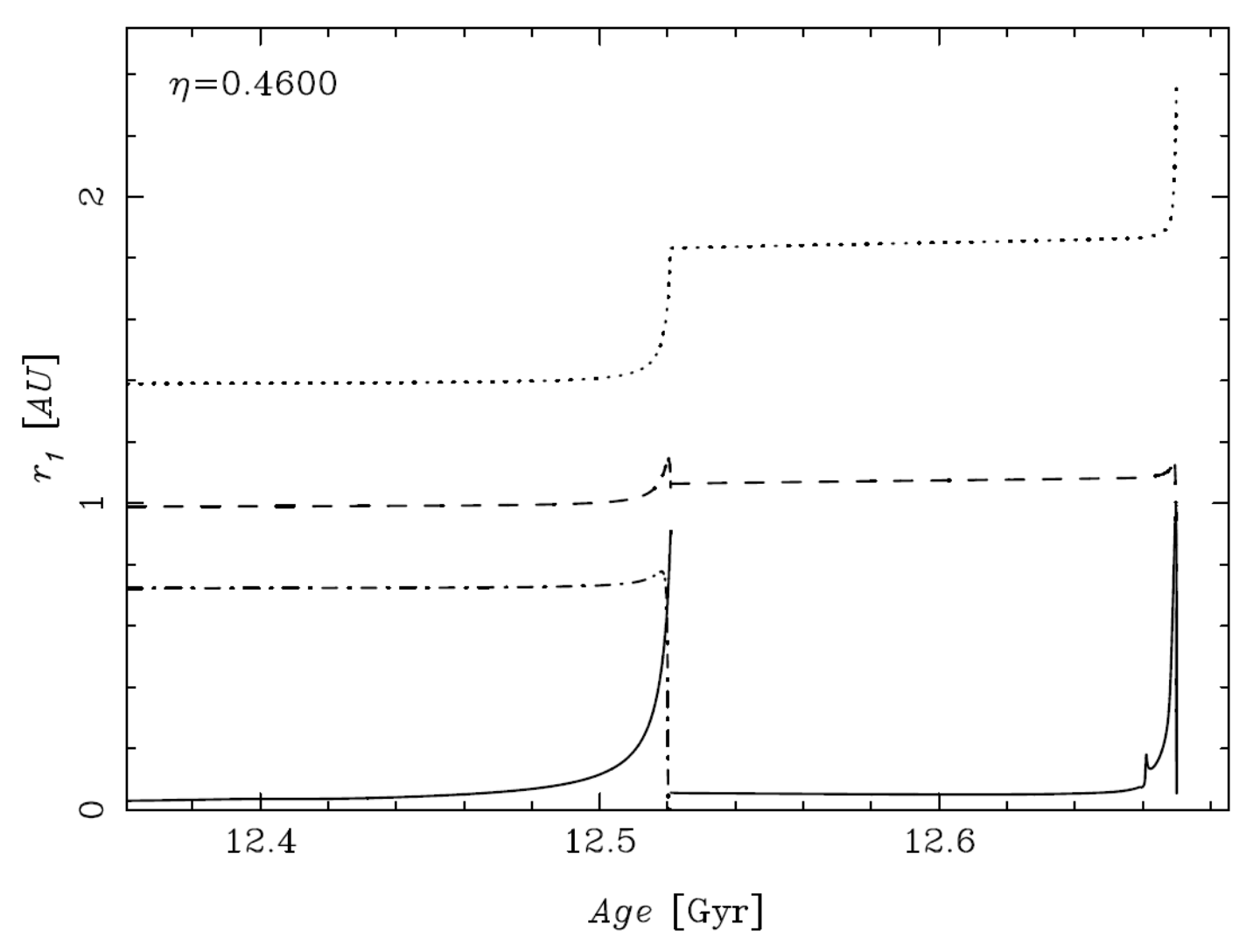
When the Sun finishes its time on the main sequence it will expand into a red giant. As a result, both its radius and luminosity will increase dramatically, while its mass will decrease. It has been a subject of debate for decades whether the planet Earth will survive the expansion of the Sun’s radius, or become engulfed by it. A classic paper on the topic is Sackmann, Boothroyd & Kraemer (1993) where they looked at the fate of the inner planets for two different scenarios, shown in Figure 3 below.
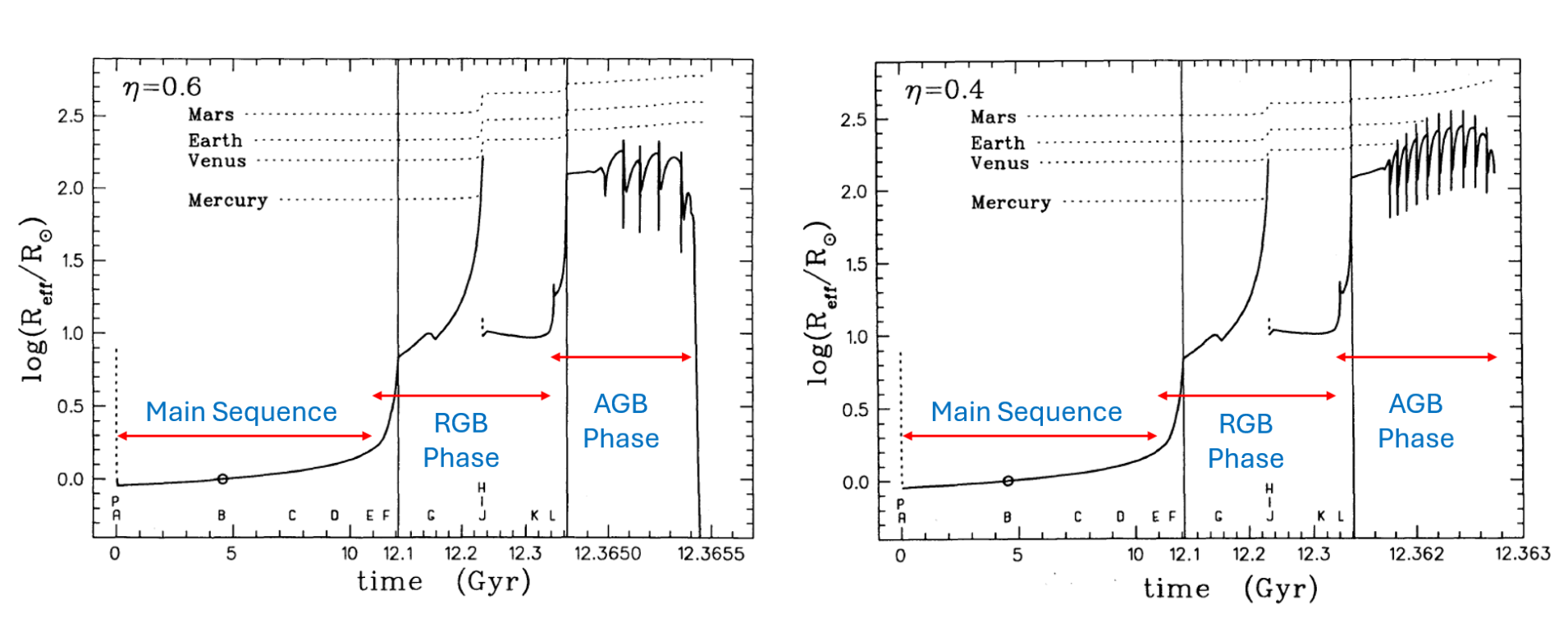
The key factor that is unknown is the amount of mass lost by the star towards the end of its life. This can be modelled by the Reimers’ (1975) parameter, , which is related to the efficiency of the mass-loss mechanism (larger values of mean higher mass loss, whilst means no mass loss). In the graphs, three key areas are indicated: the Main Sequence, when we have hydrogen fusion in the core; the Red Giant Branch (RGB) phase, when we have helium fusion in the core and hydrogen fusion in a shell around it; and the Asymptotic Giant Branch (AGB) phase, when we have an inert core, helium fusion in a shell around the core, and hydrogen fusion in a second shell around the helium shell. During the RGB and AGB phases, the radius of the Sun is of order au, and the largest value reached in each phase is called the ‘tip’ (i.e. the RGB tip and AGB tip).
In this question, we will investigate how the Earth’s orbital radius is affected by changes in the Sun’s mass and radius, closely following the method of Guo et al. (2016).
Due to the conservation of angular momentum, the orbital radii of the planets increase following the relation where and are the new orbital radius and stellar mass and and are the original values - i.e. as the Sun loses mass the planets move further away, and so the Earth may survive.
a. (2 т.)
Show that
where and denote the time derivatives of the orbital radius, , and the stellar mass, , respectively.
As the Sun expands, its rotation about its own axis slows drastically and the stellar surface draws much closer to the planets - this means that tidal effects begin to become important. In this section we will consider the tidal effects in a general solar system containing a star (with radius and mass ) and a single orbiting planet (with orbital radius and mass ). You may assume that throughout: although this will become less reasonable in the later stages of the star’s expansion, it will provide a good (and much more mathematically feasible!) approximation for the system’s initial behaviour. You may also assume that the planet’s orbit is circular at each moment, although the radius will change slowly over time.
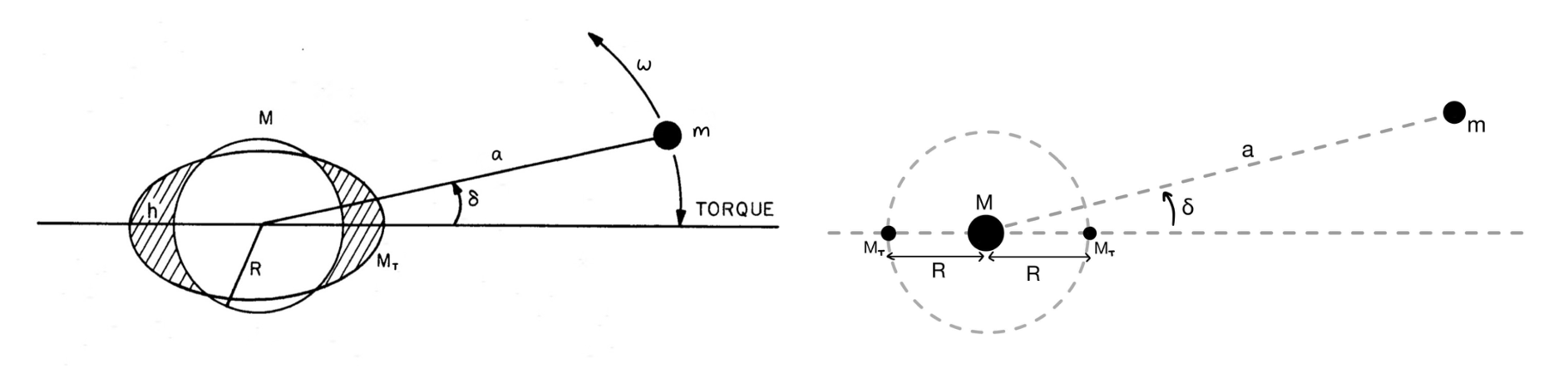
Tides are caused by a difference in the strength of the gravitational force of the planet across each part of the star; this creates two bulges (tides) on either side of the star, as seen in Figure 4. We will model the tides as two point masses positioned on the surface of the star, a distance from its centre, each with a mass
where is the apsidal motion constant.
Due to the inelasticity within the star, the tides actually ‘lag behind’ the planet by an angle . This creates a torque, , on the planet which ultimately causes its orbital radius to decrease, and thus somewhat counteracts the effect of the Sun’s mass loss. Torque is the angular counterpart to force, and has magnitude , where denotes the radius from the centre of rotation (in this case ), denotes force on the planet, and denotes the angle between the radius and force vectors.
b. (17 т.)
(i) Find an expression for the difference in the gravitational field strength of the gravitational field of the planet at the star’s centre and the closest point on the (spherical) star’s surface to the planet. Simplify this using the fact that . You may wish to use the fact that for . [3 т.]
(ii) How would the structure of the star differ between smaller and larger values of ? [1 т.]
(iii) Calculate the resultant torque on the planet in terms of , assuming again that . [8 т.]
(iv) Torque can also be defined as the rate of change of angular momentum L with , where is the angle between the radius vector and the planet’s momentum vector . Assuming to be small and constant, the star’s mass constant, and the planet’s orbit to be circular at each instant, show that
where (the eddy turnover time), and is the instantaneous angular velocity. [5 т.]
One factor we have not considered so far is solar wind. When the central star loses mass, this mass can be considered to fly out radially and isotropically. This creates a ‘wind’, some of which collides with the planet and pushes it away from the star.
c. (16 т.)
(i) Assuming that the mass reaches the planet at speed , travels in straight lines, and is perfectly and elastically reflected from the planet’s surface upon collision, calculate the force of the wind on the planet in terms of . Compare this to the force if the collisions were perfectly inelastic. Use to denote the planet’s radius. (Hint: split up the surface of the planet into thin rings and integrate over the momentum transfer rate for each.) [8 т.]
(ii) Since the solar wind force is proportional to , we can consider the combined effect of the star’s mass and solar wind as one combined gravitational force with a reduced solar effective mass . Using the equation you derived in part a., find an expression for which takes into account solar mass loss and solar wind effects in terms of and its derivatives (you may ignore tidal effects, and assume that can be approximated as constant). [3 т.]
(iii) Suppose the mass of the Sun as a function of time throughout the RGB phase can be approximated by
where denotes the mass of the Sun at the start of the RGB phase, denotes the time since the start of the RGB phase, and is the approximate total length of the RGB phase ( years). Using this expression, find a rough order of magnitude estimate for the percentage difference in the value of for the Earth when the Sun is at the RGB tip, for the value obtained if one does account for solar wind compared to the value if they do not. You may once again ignore tidal effects, and assume that . Is the effect of solar wind significant? [5 т.]
Отговори
b., (i)
As printed in the official (handwritten) solution, which writes M for the mass producing the field.
b., (ii) More mass at edges of star OR larger bulges/more elliptical shape (for larger k)
b., (iii)
c., (i)
The same force as for perfectly inelastic collisions.
c., (ii)
c., (iii) change ≈ 10⁻¹⁶ (10⁻¹⁴ percent)
The official solution gives only the size of the change; it is negligible.
Решение
The official solution to this question is handwritten (numbers in circles give the marks for each part; the marking notes are written in red).
a.
(a) [2]
1 for recognising = constant.
1 for differentiating + rearranging
(2 for other convincing methods)
1 for semi-convincing arguments
b.
b) i) [3]
(1 for correct set-up; 1 for correct expansion; 0.5 for )
(1 for simplification; 2 for ; for force ())
b) ii) [1] More mass at edges of star OR larger bulges/more elliptical shape
b) iii) [8]
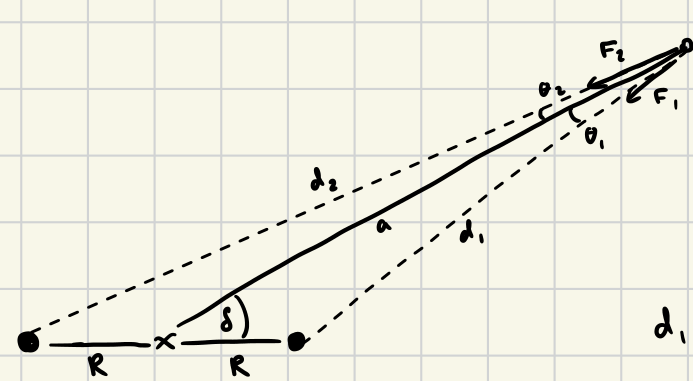
(1 for correct eq (WITH CORRECT , ))
(1 for correct expression)
(1 for correct expression)
(1 for getting rid of term (some attempt to simplify); 1 for Taylor expansion)
(1 for )
(1 for this)
(1 for final answer (equivalent forms okay); for with )
LENIENCE FOR OTHER EXPRESSIONS SHOULD BE GIVEN!
↳ but dock marks if wrong dimensions, or not simplified
MAX 4 IF CORRECT FOR PLANET ON STAR:
b) iv) [5]
(1 for realising (ie. ))
(1 for use of this to get rid of )
(1 for correct )
(1 for correct (or any small angle approx))
(1 for correct insertion of )
c.
c) i) [8]
(1 for right limits; 1: correct incoming momentum rate per area; 1: correct ‘area’ of ring; 1: correct projection factor; 1: correct momentum)
(1 for trig rearrangement that can be integrated in 1 step)
(1 for final answer (IF DIM. CORRECT); FOR WRONG SIGN)
If the collisions were inelastic, , so the same. (1)
2 for case.
c) ii) [3]
(1 for getting what is)
(1 for ; for using inelastic case.)
(1 for final answer.)
c) iii) [5]
(1)
(0.5; → 1)
(0.5; → 1)
change or percent → 1
Questions proposed by
END OF PAPER
Questions proposed by:
James Kennedy (University of Oxford)
Charlotte Stevenson (University of Oxford)
Ben Woodrow (University of Oxford)
Dr Alex Calverley (Surbiton High School)
Оригинал в Архива: BAAO_R2_2025.pdf · официални решения: BAAO_R2_2025_solutions.pdf