BAAO 2025, II кръг — Задача 3. Gravitational Microlensing
British Astronomy and Astrophysics Olympiad 2024-2025 — Astro Round 2 — Tuesday 25th February 2025 · 25 февруари 2025 г. · 40 т.
Указания
This question paper must not be photographed or taken out of the exam room
Time: 3 hours ( minutes for Q1, minutes for Q2 and minutes for Q3).
Questions: All three questions should be attempted. Each question contains independent parts so that later parts can be attempted even if earlier parts are incomplete. The questions build in difficulty.
Solutions: Answers and calculations are to be written on loose paper. Students should ensure their name and school is clearly written on the first answer sheet and that all pages are numbered. A standard formula booklet may be used. START EACH QUESTION ON A NEW PAGE.
Clarity: Solutions must be written legibly, in black or blue pen, and working down the page. Scribble will not be marked and overall clarity is an important aspect of this exam.
Instructions: To accommodate students sitting the paper at different times, please do not discuss any aspect of the paper on the internet until 8 am Thursday 6th March.
Calculators: Any standard calculator may be used, but calculators cannot be programmable and must not have symbolic algebra capability.
Training Dates and the IOAA
Training Dates and the IOAA (Mumbai, India, 11th - 21st August 2025)
The best students taking this paper eligible to represent the UK at the IOAA will be invited to attend the Selection Camp to be held in Oxford from Monday 7th to Friday 11th April 2025. At the camp, problem solving skills and observational skills (including with telescopes) will be developed, and students will sit a Data Analysis exam along with the Round 3 paper. From this, a team of five students (plus one reserve) will be selected for further training, including additional camps in the summer.
The BAAO are very proud to be sponsored by G-Research
Important Constants
| Constant | Symbol | Value |
|---|---|---|
| Speed of light | ||
| Earth’s rotation period | 1 day | 24 hours |
| Earth’s orbital period | 1 year | 365.25 days |
| parsec | pc | |
| Astronomical Unit | au | |
| Radius of the Sun | ||
| Radius of the Earth | ||
| Mass of the Sun | ||
| Mass of the Earth | ||
| Luminosity of the Sun | ||
| Absolute magnitude of the Sun | ||
| Hubble constant | ||
| Stephan-Boltzmann constant | ||
| Gravitational constant | ||
| Boltzmann constant | ||
| Permittivity of free space | ||
| Permeability of free space | ||
| Planck’s constant | ||
| Elementary charge | ||
| Proton rest mass | ||
| Electron rest mass | ||
| Wien’s displacement law | ||
| Avagadro’s constant |
Basic calculus formulae:
Chain rule
Product rule
Quotient rule
Integration by parts
Standard integral
Important Formulae
You might find the diagram of an elliptical orbit below useful in solving some of the questions:
Elements of an elliptic orbit:
- semi-major axis
- semi-minor axis
- eccentricity
- focus
- periapsis distance (shortest distance from )
- apoapsis distance (longest distance from )
Kepler’s Third Law:
Vis-Viva Equation:
Wien’s Displacement Law:
Stephan-Boltzmann Law:
Brightness (Intensity):
Magnitudes:
Distance-Parallax Relation:
Rayleigh Criterion:
Redshift:
Hubble’s Law:
Note for markers
Astro Round 2 2025 Paper Solutions and Marking Guidelines
Note for markers:
- Answers to two or three significant figures are generally acceptable. The solution may give more in order to make the calculation clear. Units should be present on final answers when appropriate.
- There are multiple ways to solve some of the questions; please accept all good solutions that arrive at the correct answer. Students getting the answer in a will get all the marks available for that calculation / part of the question (as indicated in red), so long as there are no unphysical / nonsensical steps or assumptions made (students may not explicitly calculate the intermediate stages and should not be penalised for this so long as their argument is clear).
In these solutions a plain [1] is a marking point and a bold [n] is the total for that calculation or part (printed in red in the source).
Условие
When a ray of light passes near to a massive body, the ray is deflected towards it by a very small angle due to the body’s gravity. This effect is known as gravitational lensing. The angle of deflection is given by the formula
where is the impact parameter, defined as the distance of closest approach between the ray’s original trajectory and the lensing mass.
One particularly interesting example of this phenomenon is Gravitational Microlensing, where the body causing the deflection is a relatively small mass such as a star or planet. This allows us to detect objects which are too dim to observe directly, such as exoplanets and brown dwarfs. In this question, we will examine how microlensing can be used to discover exoplanets by studying the gravitational interaction of light with the planet and its host star.
a. (7 т.)
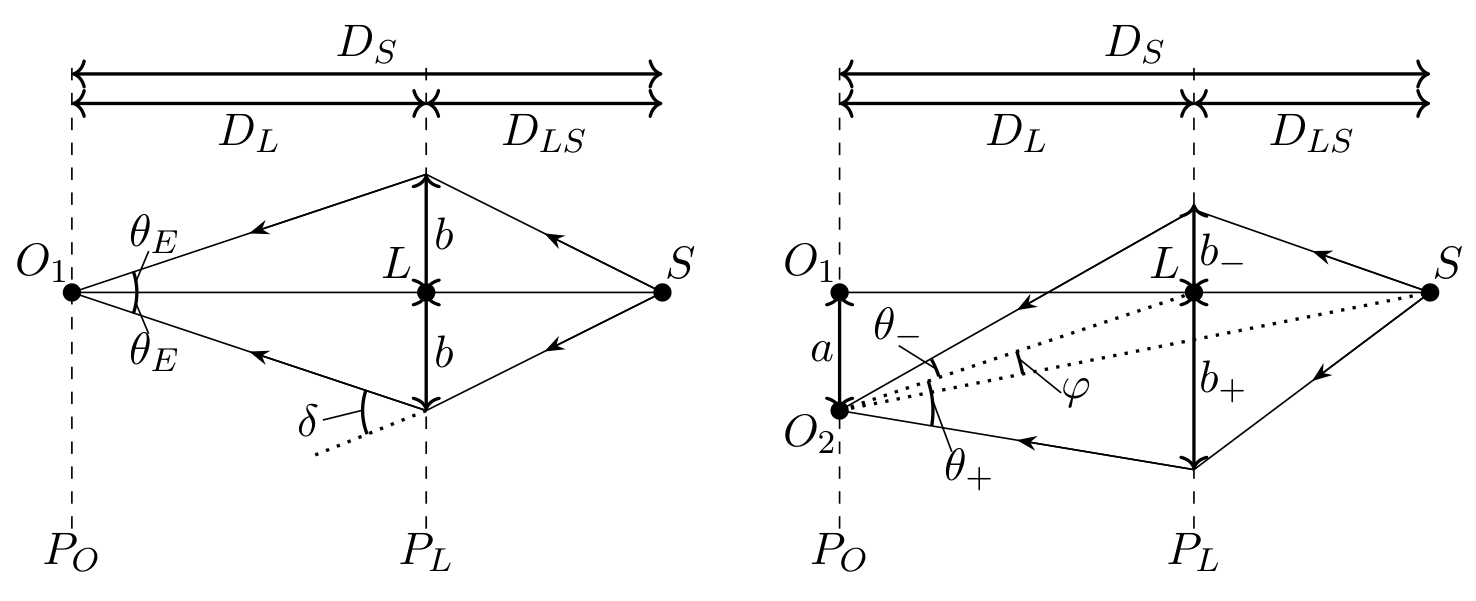
First, we will consider the scenario where the source , the lensing mass , and the observer are directly aligned, as shown in the left of Figure 6. This is an especially interesting case, as light from the source is able to reach the observer by passing around the source in any direction, creating a circular image known as an Einstein Ring, with angular radius . We will assume that the lensing deflection occurs instantaneously at the point where the light passes though the lensing plane . Since all the angles involved are extremely small, the impact parameter is simply the distance between this point and .
(i) Show that the Einstein radius is given by the formula
[4 т.]
(ii) Calculate the Einstein radius for a hypothetical Jupiter-sized exoplanet in a system with parallax milliarcseconds (mas), lensing light from a source star with parallax mas. Jupiter has a mass of . [3 т.]
b. (11 т.)
We will now consider how the lensed source will appear to an observer , still situated in the plane , but now at a distance from . In this case, instead of seeing the full Einstein Ring around the lens, the observer will see two point images at angles and , one each side of the lens. The situation is shown in the right panel of Figure 6. This a much more typical scenario, as perfect alignments like the one in the previous part are extremely rare.
(i) Find an equation which must be satisfied by each of the angles . Hence, find show that in terms of and the Source-Observer-Lens angle is given by
and find an equivalent formula for . [6 т.]
(ii) Determine the maximum value of the angular displacement of the image at from the unlensed position of the source as varies, and the corresponding value of . [4 т.]
(iii) What is the smallest diameter of telescope which would be able to resolve this maximal displacement for the hypothetical exoplanet mentioned earlier? [1 т.]
As you have just seen, the deflection caused by typically sized exoplanets is typically not directly observable by conventional optical means. Fortunately, the lensing also has a secondary effect of magnifying the brightness of the source, which is much more easily detected.
c. (15 т.)
We will now attempt to calculate the size of the amplification effect caused by the lensing.
(i) Find expressions for and the impact parameters in terms of , and the various . [3 т.]
(ii) Consider changing by a small increment . Determine the corresponding changes and . [3 т.]
(iii) By considering the total power incident on the annulus of points in between and with and without the lensing effect, determine the brightness of each of the two images compared to the unlensed brightness of the source. Give your answer in terms of the ratio . [6 т.]
(iv) Assuming that the observer cannot resolve the two images, show that the total amplification factor is given by
[1 т.]
(v) For the same hypothetical exoplanet considered earlier, calculate the percentage increase in source brightness due to the lensing effect given mas. [2 т.]
This increase in brightness is much more easily detected than the change in image position angle found earlier, and so is the focus of many astronomical surveys.
d. (7 т.)
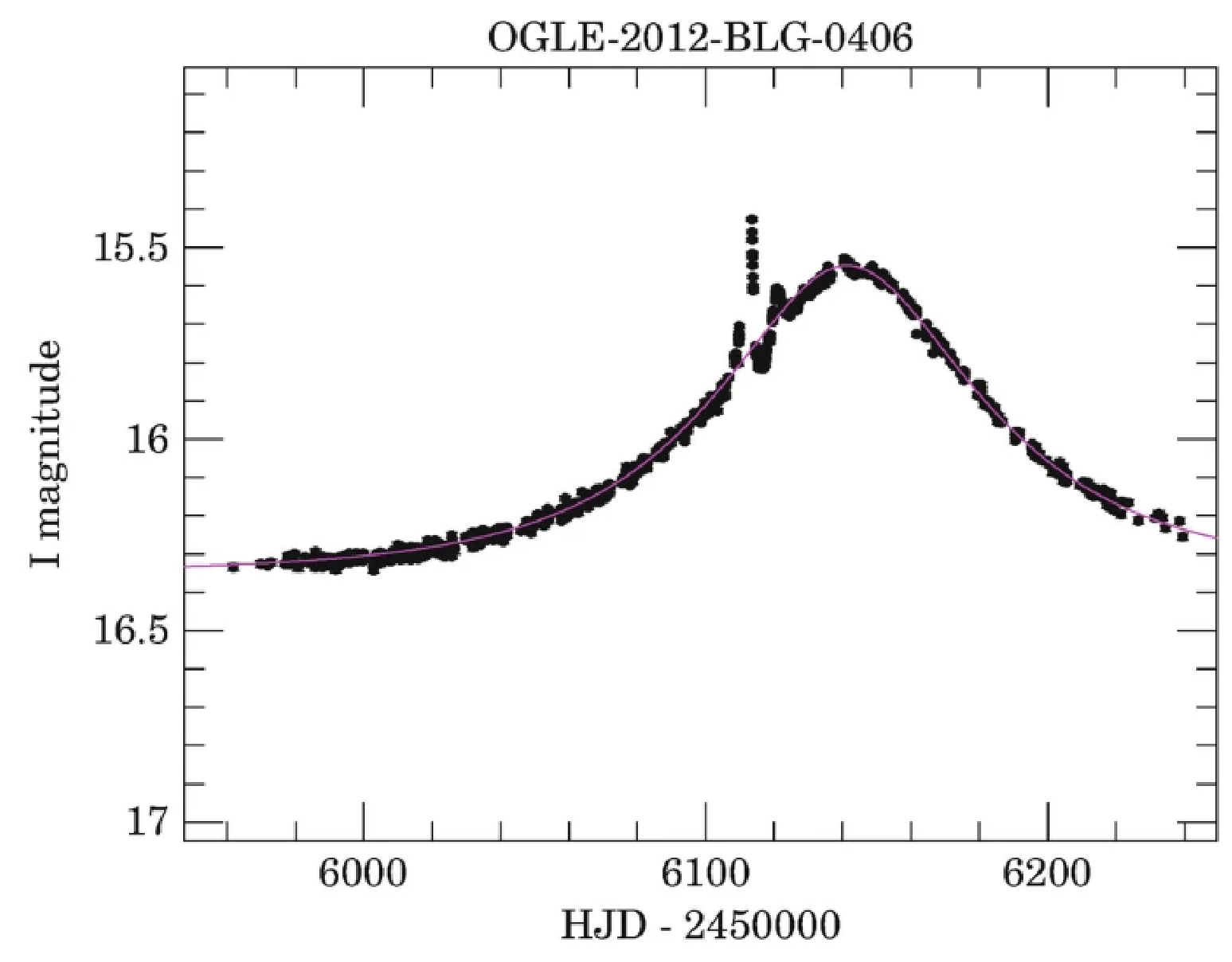
In 2012, researchers at the Optical Gravitational Lensing Experiment (OGLE) studied a microlensing event caused by a star and its exoplanet lensing the light from a more distant star. The light curve is shown in Figure 7. Most of the curve is a typical single source microlensing event with the star as the lens, as we considered in b. earlier. The anomaly at around is due to interaction with the exoplanet. As the source and lens move across the sky relative to each other, the value of changes, causing the variation in the brightness of the source. We will assume that the source and lens are moving with a constant relative angular velocity.
(i) Using values taken from Figure 7, a suitable numerical method and the formula given above for , determine the minimum value of over the course of this lensing interaction. [4 т.]
(ii) Determine the Einstein crossing time , defined as the time taken for the source and lens to move relative to each other by an angle . [3 т.]
These parameters describing the geometry of the microlensing event make it possible to fit a suitable model for a binary lens to match the anomaly seen in the data and determine the position and mass of the exoplanet.
Отговори
a., (ii) rad
= 0.0291 mas; DS = 11.5 kpc, DL = 5.1 kpc, DLS = 6.1 kpc.
b., (i)
Both angles are the roots of θ² − θφ − θE² = 0.
b., (ii) θ₊ − φ = θE, at φ = 0
b., (iii) 4300 m
For an example wavelength of 500 nm.
c., (i)
c., (ii)
c., (iii)
c., (v) 3.5 %
u = 2.4, A = 1.035.
d., (i) 0.527
From .
d., (ii) 70 days
The marking scheme accepts 70 ± 15 days.
Решение
1 Gravitational Microlensing (Model Solution)
The marks for each step are given in round brackets; the total for each part in square brackets.
a.
(i) [4]
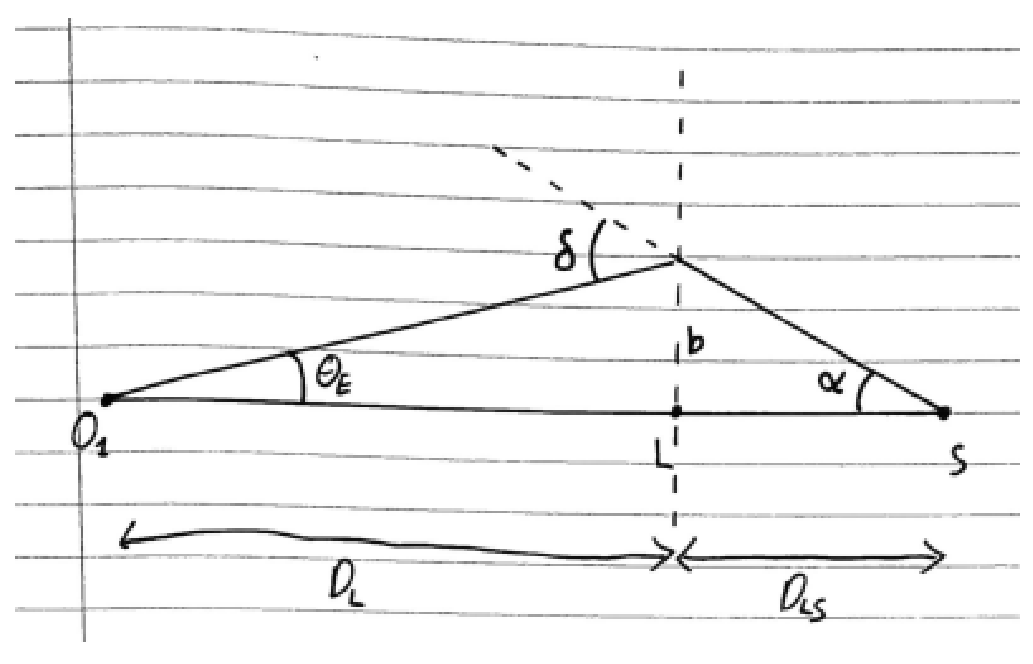
By geometry and the small angle approximation for , we have:
By considering the angle shown in Figure 1, we also have:
Hence:
(ii) [3]
Using the definition of parallax, we have:
Marking scheme
(a) (i) [1] Deduces
[1] Considers the angle and finds one of the corresponding equations or finds another similarly useful geometric construction and a corresponding equation
[1] Makes all necessary small angle approximations for their method
[1] Makes all necessary substitutions for their method
(If none of marks 2-4 scored, award 1 mark for substitution of expression for b or δ into any correct geometric equation. Award 3 marks for any solution only missing approximations. Must be rearranged into the final form to score full marks)
(ii) [1] Finds kpc or kpc
[1] Finds all 3 ’s
[1] Calculates rad mas
(Award one of the first 2 marks if the same error is made for both parallax calculations and is correct for their values)
b.
(i) [6]
By small angles:
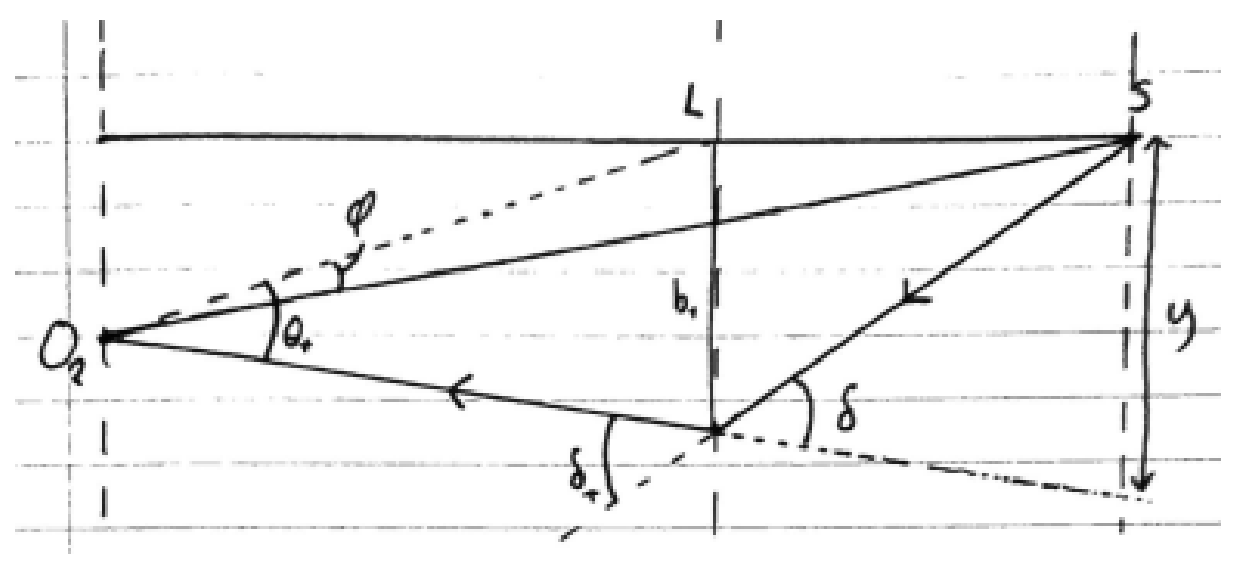
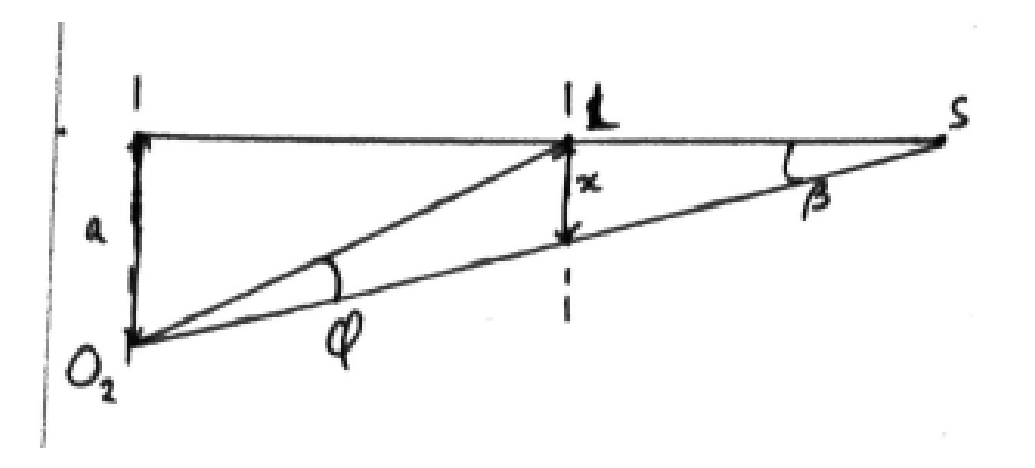
Extending the ray’s trajectory and considering the distance , as shown in Figure 2, by small angle approximations:
Since we can do exactly the same construction with (using a sign convention where is negative), it satisfies the same equation. Thus the are the 2 roots of this equation, and from the quadratic formula, we have:
(ii) [4]
The displacement of the source from its unlensed position is given by the expression . Differentiating, we have: (1)
Thus, the displacement is decreasing with , and so for minimal displacement we pick , corresponding to . (2)
(iii) [1]
By the Rayleigh criterion for an example wavelength of 500 nm (any wavelength corresponding to visible light is fine):
We remark that this is an absurd size for an optical telescope, so the deflection cannot be detected by conventional means (although it may be observed using interferometry).
Marking scheme
(b) (i) [1] Deduces
[1] Helpful geometric observation which could be used to find and a corresponding expression
[1] Finds any equation which would reduce to the correct quadratic upon substitutions of and the formulae for and or )
[1] Correctly makes any 2 of the above substitutions
[1] Obtains
[1] Deduces (Ignore sign)
(ii) (Allow full marks for all parts from (b-ii) to (c-iii) considering only , in place of , )
[1] Considers the angle
[1] Differentiates correctly (Award this mark for correctly differentiating if the first mark has been lost)
[1] Deduces decreasing with and hence minimised when
[1] Deduces
(iii) [1] Correct Rayleigh criterion calculation for a sensible wavelength. 500 nm gives 4300 m.
c.
(i) [3]
By small angles:
By considering Figure 3:
(ii) [3]
By differentiating:
(iii) [6]
Let be the annulus described above, and the corresponding annulus of points in between and . Let be the luminosity of the source. Without the lensing effect:
Since is a narrow strip with length and width , it has area . Hence:
When the lensing effect is present, the rays passing through which contribute to the image we are considering are exactly the ones which are incident on . Thus:
Therefore, the ratio of powers on the annuli, which is the same as the ratio of brightnesses (since the power is constant over the annulus for small enough ), is given by:
(iv) [1]
(v) [2]
So the % increase in brightness is 3.5% (1)
Marking scheme
(c) (i) [1] Finds
[1] Helpful geometric observation which could be used to find and a corresponding expression (e.g. considering the length given by and and finding either one of those expressions)
[1] Finds
(ii) [1] Correctly finds (ECF their )
[1] Attempts to differentiate their and uses any one differentiation rule correctly
[1] Correctly finds (ECF their b)
(iii) [1] Formula for area of annulus (in terms of or )
[1] Correct brightness on either plane (allow unnecessary terms accounting for extra distance due to or as long as they are correct)
[1] Determines power on any relevant annulus (ECF the above)
[1] Determines power on the other annulus (does not need to be simplified)
[1] Finds an expression for the ratio of powers in terms of only
[1] Correctly simplifies their expression
(iv) [1] Sums brightnesses from both images to obtain
(v) [1] Determines
[1] Determines % increase (= 3.5%)
d.
i) [4]
Reading values from Figure 6, we see that the baseline magnitude of the source is , and the peak magnitude is . Thus: (1)
We therefore need to solve for in the equation:
This could be done with Newton-Raphson iteration, or even by by rearranging into a quadratic in to solve exactly, but it is easiest to use the following fixed-point iteration scheme:
Applying the scheme, with (any sensible value will work fine), it converges in relatively few iterations to (1)
ii) [3]
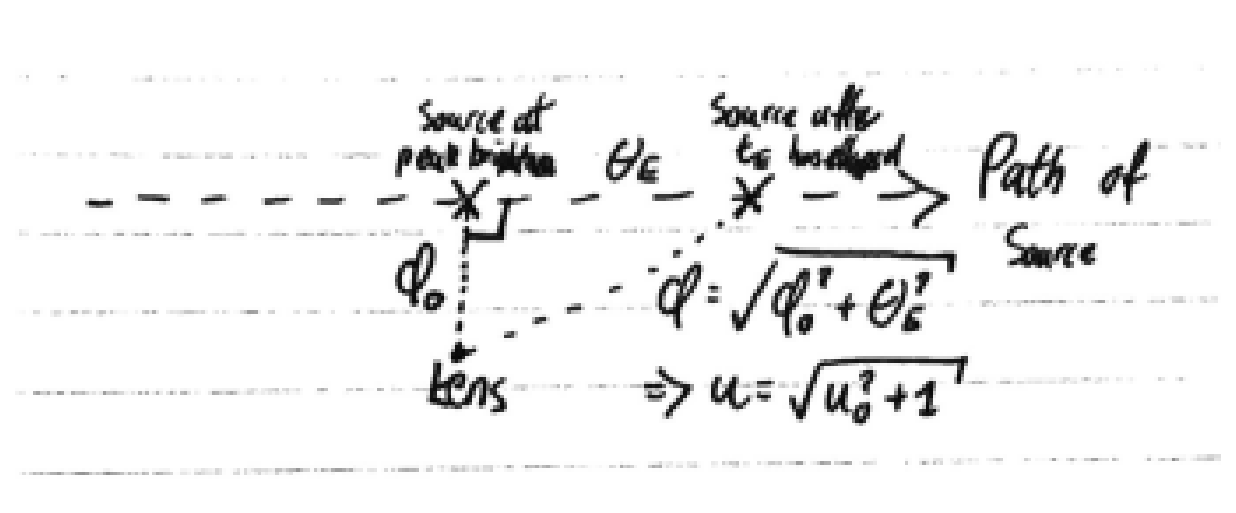
Figure 4 shows the movement of the source relative to the lens, as it would be seen by the observer without the lensing effect. Therefore, at a time of from the peak brightness, the source will have traversed a distance of from the point of closest approach, and will therefore be at a value of . Therefore: (1)
From the graph, this happens at , while the peak occurs at . Thus, days. (1)
Marking scheme
(d) (i) [1] Reads or from figure 6
[1] Determines (ECF any sensible values for read from the graph)
[1] Sets up an appropriate numerical method to solve for or rearranges to a quadratic in
[1] Finds (ECF their A)
(ii) [1] Deduces that 1 Einstein time away from the peak,
[1] Deduces at away
[1] Uses the graph to see that this is days away from the peak
Questions proposed by
END OF PAPER
Questions proposed by:
James Kennedy (University of Oxford)
Charlotte Stevenson (University of Oxford)
Ben Woodrow (University of Oxford)
Dr Alex Calverley (Surbiton High School)
Оригинал в Архива: BAAO_R2_2025.pdf · официални решения: BAAO_R2_2025_solutions.pdf