BPO 2022, Теория — Задача 2. The descent of a skier
Problem 1: Resistor circuit · Problem 2: The descent of a skier · Problem 3: “The bead on the spring” · Problem 4: Galileo Galilei – “The minimum descent time” · 25 т.
Условие
A skier descent a steep hill. The angle between the inclined surface of the hill and a horizontal plane is . The acceleration of gravity is . The mass of the skier is . The coefficient of friction of the skies in the snow is unknown. The drag force with which the air acts on the skier, is , where is an unknown number, the so called drag coefficient, depending on the shape of the skier, is the density of the air, is the projected frontal area (cross section) of the skier perpendicular to his velocity, and is his speed relative to the air. The air does not move (there is no wind). The skier's descent is recorded. Analyzing the video, some of his positions (measured on the slope from the starting point of descent) in different moments after the start of his descent are measured. The data are shown on the table below.
| 1 | 2,00 | 7,21 | |||||
| 2 | 2,50 | 11,22 | |||||
| 3 | 3,00 | 16,08 | |||||
| 4 | 3,50 | 21,76 | |||||
| 5 | 4,00 | 28,24 | |||||
| 6 | 4,50 | 35,49 | |||||
| 7 | 5,00 | 43,47 | |||||
| 8 | 5,50 | 52,14 | |||||
| 9 | 6,00 | 61,49 | |||||
| 10 | 6,50 | 71,46 |
Using the above data, one can calculate the values of the coefficient of friction , the coefficient of the drag force C, the maximum attainable speed , of the skier (assuming that he starts his descent from a sufficient high altitude).
A. Using suitable new variables, present the dependence of the skier motion on the experimental results in a way that can be studied graphically and the information on the parameters describing the motion to be extracted from the graph, such as the drag coefficient C, the coefficient of the frictional force and the maximum attainable speed, . Give the expressions for the new variables and for the parameters of the used functional dependence as functions of the given parameters . [7 т.]
B. Calculate the values of the new variables for each measurement based on the given data and fill the empty columns of the table. [4 т.]
C. Draw the dependence in the graph paper provided. [4 т.]
D. Using the graph, calculate the values of the coefficient of friction , the drag coefficient and the maximal attainable speed of the skier (if the hill is sufficiently high). [10 т.]
Отговори
A.
The official solution writes for the friction coefficient in .
D. μ ≈ 0,15; C ≈ 0,62; υmax ≈ 34,9 m/s ≈ 126 km/h
From the official graph: b = 3,62 m/s², d = 2,97×10⁻³ m⁻¹.
Решение
A. (7 points)
The friction force , acting on the skier when he slides on the snow, is , where is the force of the reaction. As , then . (0,5 p)
The projection of the gravity force on the hill surface is . As the drag force is , the equation of motion is , (0,5 p) where and are the velocity and acceleration of the skier, respectively.
Therefore, , i.e. depends on linearly, , where the coefficients of the linear dependence are and . (1 p)
As from the experimental data only average velocity can be calculated, the instantaneous velocity can be evaluated as . (1 p)
Therefore, as from the experimental data only average acceleration can be calculated, the instantaneous acceleration can be evaluated as . (1 p)
So, the graph is straight line . The coefficients and defined above can be calculated from the graph. After that the unknown values can be calculated: the friction coefficient is , (1 p)
the drag coefficient is , (1 p)
and maximal attainable speed of the skier is . (1 p)
B. (4 points)
The empty columns in the table can be filled with the calculated values of averaged velocity , (0,8 p) instantaneous velocity , (0,8 p) average acceleration , (0,8 p) instantaneous acceleration , (0,8 p) and the square of instantaneous velocity , (0,8 p) respectively (see the table below).
| m/s | m/s | m/s² | m/s² | (m/s)² | |||
|---|---|---|---|---|---|---|---|
| 1 | 2,00 | 7,21 | |||||
| 2 | 2,50 | 11,22 | 8,02 | 8,87 | |||
| 3 | 3,00 | 16,08 | 9,72 | 10,54 | 3,34 | 3,29 | 111.09 |
| 4 | 3,50 | 21,76 | 11,36 | 12,16 | 3,24 | 3,19 | 147,87 |
| 5 | 4,00 | 28,24 | 12,96 | 13,73 | 3,14 | 3,07 | 188,51 |
| 6 | 4,50 | 35,49 | 14,50 | 15,23 | 3,00 | 2,92 | 231,95 |
| 7 | 5,00 | 43,47 | 15,96 | 16,65 | 2,84 | 2,79 | 277,22 |
| 8 | 5,50 | 52,14 | 17,34 | 18,02 | 2,74 | 2,67 | 324,72 |
| 9 | 6,00 | 61,49 | 18,70 | 19,32 | 2,60 | ||
| 10 | 6,50 | 71,46 | 19,94 |
C. (4 points)
The dependence is drawn on the graph below.
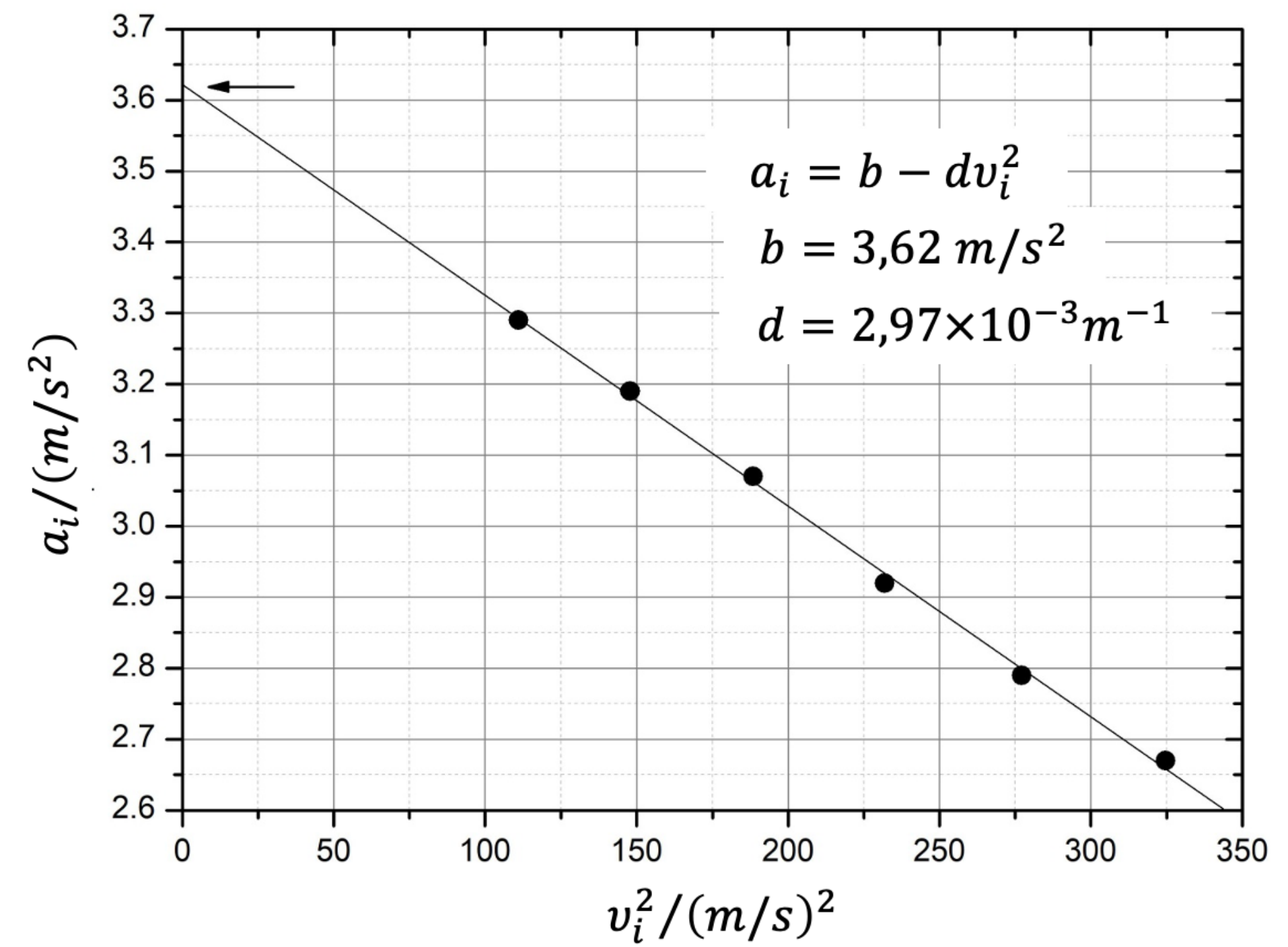
D. (10 points)
Using the obtained graph, the calculated values are:
the friction coefficient is ; (3,5p)
the drag coefficient is ; (3,5 p)
maximum attainable speed of the skier is . (3 p)
Оригинал в Архива: problems.pdf · официални решения: solutions.pdf