BPO 2022, Теория — Задача 3. “The bead on the spring”
Problem 1: Resistor circuit · Problem 2: The descent of a skier · Problem 3: “The bead on the spring” · Problem 4: Galileo Galilei – “The minimum descent time” · 25 т.
Условие
Assume there is a setup such as the one shown in the next figure. A bead with mass m is constrained to move along a rail which is connected with another rail at an angle . The rail has friction and the coefficient of the kinetic friction with the bead is . The bead is connected with a spring of spring constant k. The other end of the spring is constraint to move on a frictionless rail. The spring is always perpendicular to the rail due to the fact the rail is frictionless and the spring does not have a mass. The relaxed length of the spring is zero. Assume also that the system is not affected by gravitational effects.
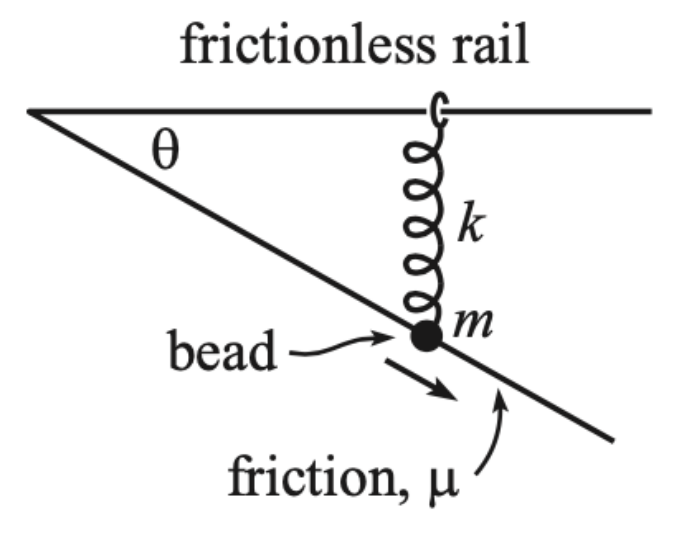
The bead starts to move at the vertex of the rails and the spring is at its relaxed length of zero. An impulse is given to the system so it starts to move with velocity along its rail. The figure shows the configuration of the system at a time .
A. Draw the free body diagram for the bead at an arbitrary moment and give the mathematical expressions for the forces you draw. If x is the distance the bead has travelled along its rail, determine all the forces and express them in terms of this distance x and the other constants. [6 т.]
B. Derive the expression for the distance the bead is covering before it comes to a stop for the first time. [8 т.]
C. Determine the condition for the bead to start moving again. Specify the direction the bead is going to move. Assume that the coefficient of static friction is also . [5 т.]
D. Assume that the bead really does move towards the vertex of the rails. Determine its speed when it arrives back to the vertex. [6 т.]
Отговори
A.
B.
C.
The bead then moves back towards the vertex, all the way to it.
D.
Решение
A. (6 points)
The forces acting on the bead are the friction, the force due to spring and the normal force from the rail to the bead. The force of friction points to the opposite direction when the bead moves back towards the vertex of the two rails. If we assume the bead has travelled a distance x then the forces acting on it will be: (3p)
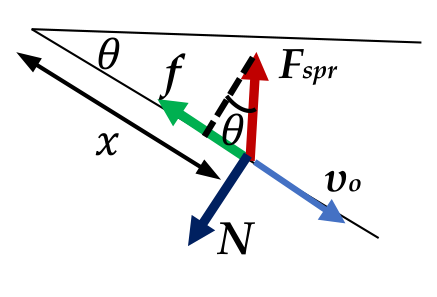
When the bead is at position then:
Spring Force is (1,25p)
The component of the spring force perpendicular to the rail is: and this force is opposite to the normal force N from the rail to the bead. Its magnitude will be:
(1,25p)
The magnitude of the frictional force will be (0,5p)
B. (8 points)
The component of the spring force along the rail, points towards the vertex. Its magnitude is
(1p)
When the bead reaches the point further away from the vertex, it stops momentarily.
Using the work-kinetic energy theorem we obtain: where is the work done by the component of the spring force and is the work of the frictional force. (1p)
The forces are of the proportional to the distance travel and their work will becoming either from the integral calculation or considering the graph of force vs displacement and estimating the area of the triangle. The work will be:
(2p)
The work of the friction will be: (2p)
Substitution to the work-kinetic energy formula gives
Solving for x, the bead comes to a stop when it traveled a distance x given by: (2p)
C. (5 points)
The bead will accelerate back towards the vertex if the component of the spring force along the rail is larger than the static frictional force. So the condition to accelerate back is:
(3p)
This result is independent of x. If the bead accelerates in one place will accelerate in any other place. So, if it starts accelerating back it will make it all the way back to the vertex. (2p)
D. (6 points)
Using the work—kinetic energy theorem, as in part B., for the trip back, we will obtain (the work of the spring force is positive and the work of the frictional force is negative):
(4p)
Solving for the speed after substituting the gives: (2p)
Оригинал в Архива: problems.pdf · официални решения: solutions.pdf