BPO 2022, Теория — Задача 4. Galileo Galilei – “The minimum descent time”
Problem 1: Resistor circuit · Problem 2: The descent of a skier · Problem 3: “The bead on the spring” · Problem 4: Galileo Galilei – “The minimum descent time” · 25 т.
Условие
This year the world of Physics commemorates 380 years since Galileo Galilei (1564-1642), one of the founders of modern science, passed away. During the final years of his life, Galileo approached an interesting problem dedicated to the ”minimum descent time”, or, what is today called the ”Galilei’s problem”.
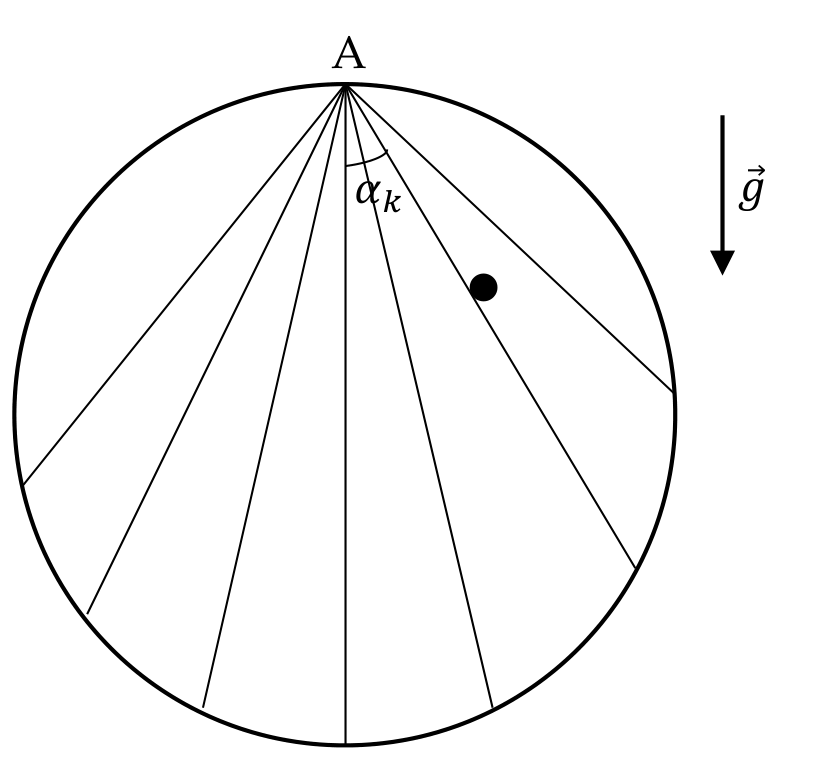
A. (5 points) From a point A, with zero initial speed, a big number of identical material points move in a vertical plane, in a uniform gravitational field (the gravitational acceleration, g, is known), sliding without friction along ramps, inclined at different angles to the vertical (see the adjacent figure). If the point A lies at the highest point of a vertical circle of radius R, determine:
A1. on which of the ramps the material points reach back to the circle in the shortest time; [2 т.]
A2. the geometric locus of the points occupied by all the material points at any given time during their motion on the ramps (i.e., the geometrical figure described by the moving material points, at any given moment of time, if a snapshot is taken). [3 т.]
B. (9 points) An inclined plane makes the angle with the horizontal plane (see the figure below). A point A is situated above the inclined plane, at the height , measured along the vertical direction, above the inclined plane.
B1. Find the position of a point B on the inclined plane (i.e., the mathematical expression for the length of the segment BC), such that a material point, leaving A with zero initial speed, and sliding without friction along the rectilinear ramp AB, to arrive in B in the shortest time. The gravitational acceleration is and has the same value in all the points. Calculate the numerical value for the length of the segment BC.
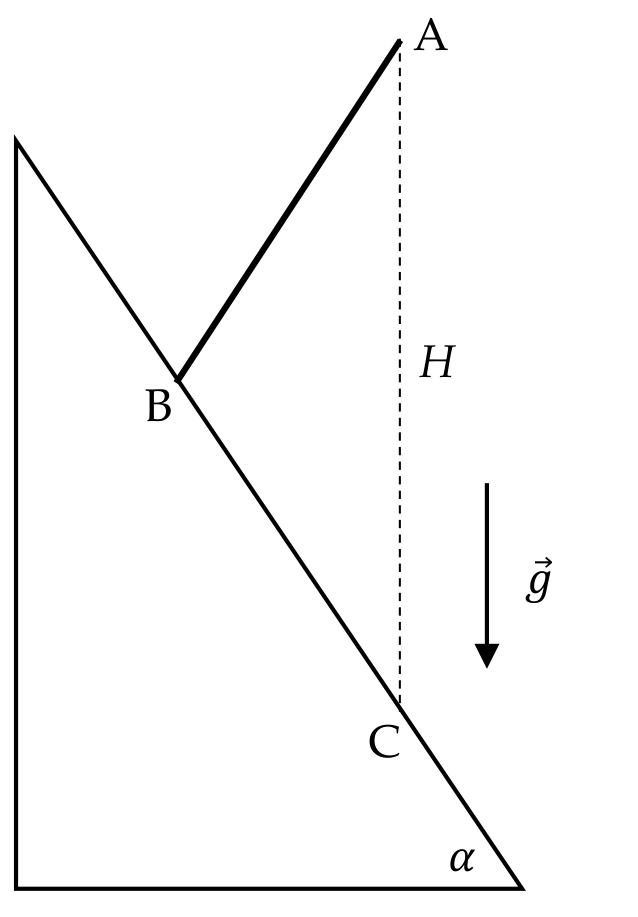
B2. Determine the mathematical expression for the minimum descent time on the ramp AB and calculate its numerical value.
C. (11 points) In his last book¹, in which motion is treated mathematically for the first time in history, Galileo analyzes the problem of the fastest descent in uniform gravitational field without friction and concludes that the arc of a circle is faster than any number of its chords. Although it was later proved that the circle is not the path of fastest descent, Galilei admits that any possible error will be removed after future advances in Mathematics. The problem of fastest descent (also called the brachistochrone problem) – formulated in 1696 by Johann Bernoulli and correctly solved by his older brother Jakob Bernoulli – actually shows that the curve is different from a circle and is called cycloid, a name given by Galilei himself.
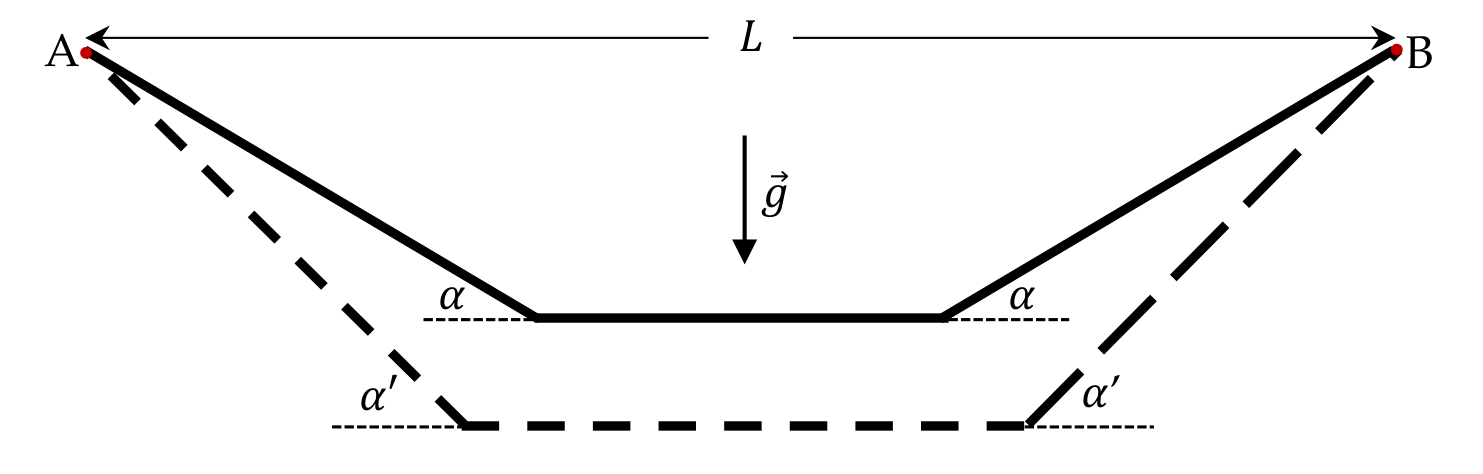
Since the brachistochrone problem is complicated, it can be simply modeled by three connected rectilinear ramps, the descent time surpassing the cycloidal one with just a few percent. To further simplify the model, a symmetric arrangement will be considered, as illustrated in the figure above. A material point is released in A, with zero initial speed and slides on the ramps without friction from A to B. The middle ramp is horizontal and the transition from one ramp to the next is smooth. The horizontal distance between the fixed points A and B is .
Note: By modifying the angle , while keeping the points A and B fixed, the lengths of all the ramps will change. For an angle , the new configuration is represented with dashed lines on the above figure.
¹ Galileo Galilei, Discourses and Mathematical Demonstrations Relating to Two New Sciences, 1638, Leiden, South Holland.
C1. Determine the angle of the inclined ramps such that the transition time from A to B to be minimum. [8 т.]
C2. Derive the expression for the length of the entire path of the material point, , when the transition time is minimal and calculate its numerical value. [2 т.]
C3. Derive the mathematical expression for the minimum transition time and calculate its numerical value. [1 т.]
Отговори
A1.
The time is the same on every ramp: all the material points reach the circle at the same time.
A2. a vertical circle passing through A (its uppermost point) with radius r = gt²/4
B1. ≈ m
B2.
C1. 60 °
C2. ≈ m
C3.
Решение
A1.
Solution: For any given ramp, inclined with an angle with respect to the vertical diameter of the circle, the acceleration of the material point is
which is constant.
The length of that ramp is
On the other hand,
so
or
which means that all the material points will reach the circle at the same time.
A2.
Solution: After a time , the material point falling vertically will reach the point , the length of the segment being
while the material point sliding along the ramp inclined with an angle with respect to the vertical diameter, will reach the point , the length being
drawing: 0.5 p
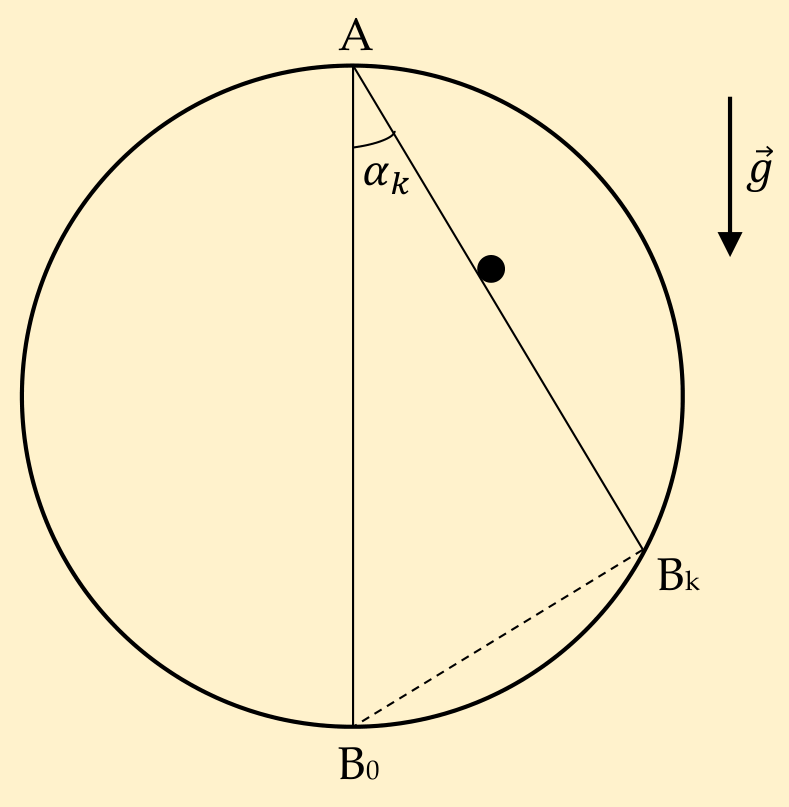
Hence
which means that, for any angle ,
This means that, at any instant , all the material points are on the vertical circle passing through A (the uppermost point of the circle), having the radius
B1.
Solution 1 (geometrical): 4.5p
We saw above that, for any inclination of the ramp AB, after a time , the material point is on the circle having the radius
which means that the sliding time on the ramp AB is minimum when the circle radius is minimum. 0.25 p
For the material point to reach the inclined plane, the circle should intersect the plane (the circle can be tangent or secant to the inclined plane). The circle with the minimal value of its radius, satisfying this condition, is the circle tangent to the plane, so B is the tangency point of the circle with the inclined plane (see the figure below). 0.5 p
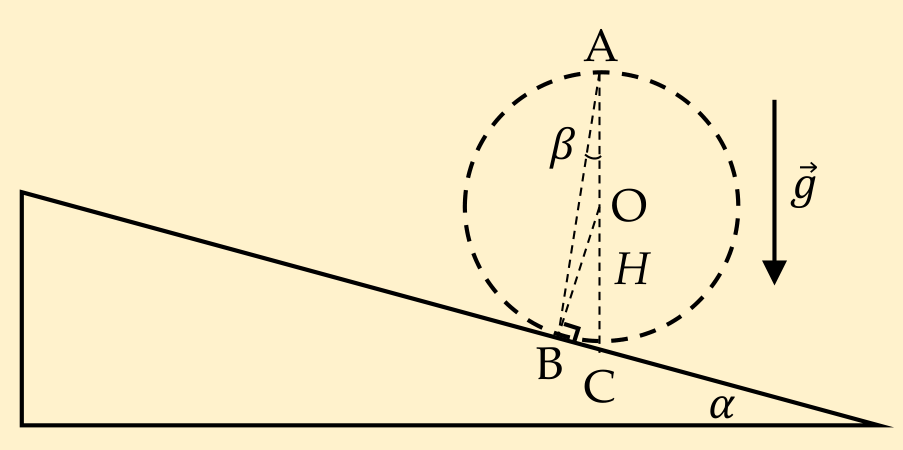
Drawing: 0.75 p
The problem is solved if we can derive the expression of the angle which gives the inclination of the ramp AB with respect to the vertical.
In , the angle has the measure
so
The length of the segment BC is
The radius of the circle follows from
hence
So,
The numerical value for the length of this segment is
Solution 2 (algebraical): 7.5p
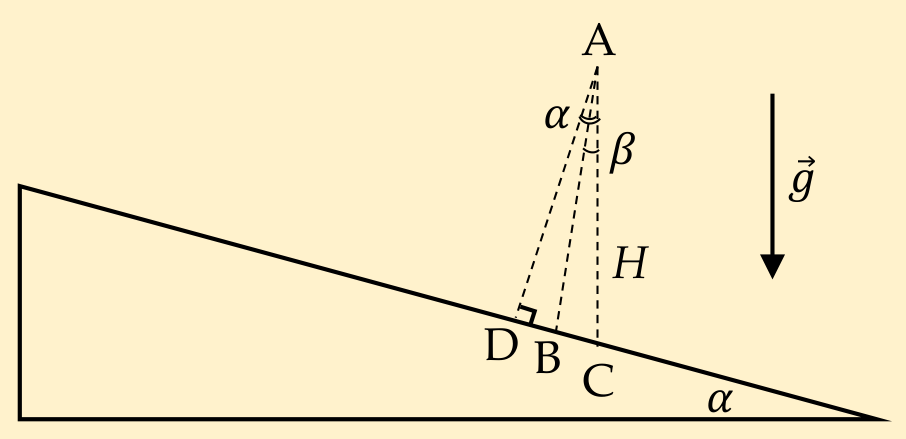
Drawing: 0.75 p
The length of the ramp AB is
and the acceleration of the material point is
so
This means that is minimum when . But 0.25 p
while
Hence
Since , when the function
This function can be rewritten as
This function is maximum when , which means that 0.25 p
meaning that AB is the bisector of the angle .
Then
Since
then
Because
then
The numerical value for the length of this segment is
B2.
(For solution 1): 4.5p
The length of the ramp AB is
and the acceleration of the material point is
so
where
while
Hence
so
The minimum descent time is ()
which gives
The numerical value of the minimum descent time is
(For Solution 2): 1.5p
Since
The minimum descent time is ()
which gives
The numerical value of the minimum descent time is
C1.
Solution: Due to the symmetry of the path, the total transition time is
If the length of one of the inclined ramps is denoted by , the descending time on the first inclined ramp is
where
The transition time on the horizontal ramp is
where the speed of the material point on the horizontal path is 2 x 0.5 p
Hence, the total transit time is
For optimal values of and , the transit time will be minimal. Let’s consider that already has that optimal value and that the only variable is . Under these circumstances, we can write
This expression has the form
where
It can be written as
From here we can see that is minimal when the binomial is zero, or
Which gives
In our case, the optimal value for is
For this result the transit time will be
Now, since is fixed, we can find the optimal value of which minimizes the value of . This will happen when the ratio
is minimal. From here, by eliminating the denominator and squaring the equation, it follows that
or
Rearranging the terms, we get
The solutions of this quadratic equation are
The minimal value for to obtain real solutions is
For this value of , the optimal value of is given by
which gives the value
C2.
Solution: The optimal value for is
Since the horizontal path has the length
then
having the expression
and the numerical value
C3.
Solution: Since
then
The numerical value of this time is
Оригинал в Архива: problems.pdf · официални решения: solutions.pdf