BPO 2024, Теория — Задача 4
BPO6 Problems 20-24 June 2024. Montenegro · 20 юни 2024 г. · 25 т.
Условие
1. Description of the experiment
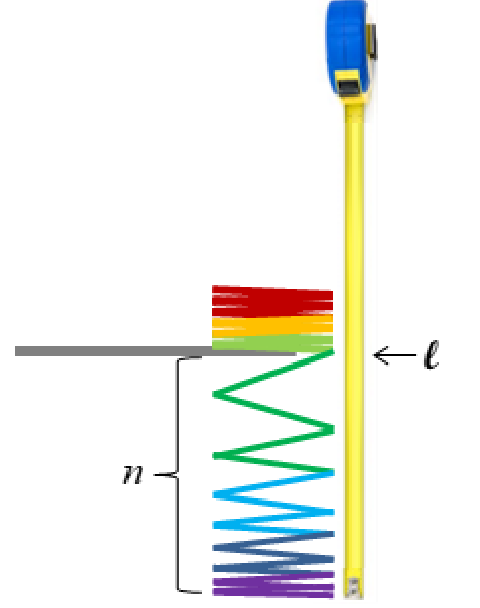
A long plastic spring, the so called “slinky”, of mass , is composed of identical circular turns. The slinky is positioned on a horizontal support, so that part of it is hanging freely, as depicted in Figure 1. After the spring oscillations damp completely, the length of the suspended part is measured as a function of the number of hanging turns (; see the figure). The experimental data for at different are recorded in the Table at the end of the text.
2. Tasks
A. From a theoretical viewpoint, the dependence of on is given by a quadratic function:
where and are constants characterizing the spring. Define a set of variables and , which linearize equation (1), i.e. transform it to a linear dependence. [2 т.]
B. Determine constants and in equation (1) by means of a graphical analysis. Any auxiliary data, necessary for plotting the graph, must be recorded in the empty cells of Table 1. Use the graph paper to draw your graph. Attach the last page of the text (containing the table) to your solution! [10 т.]
C. Equation (1) can be derived under the assumptions that each single turn of the slinky is equivalent to a spring of stiffness (known also as “spring constant” or “coefficient of elasticity”) and length in the undeformed state. Perform a theoretical analysis and express constants and in equation (1) in terms of and . Neglect the deformation of a given single turn by its own weight. [5 т.]
D. Calculate and . [3 т.]
E. Calculate the length of whole slinky in the undeformed state, and its stiffness . [5 т.]
Useful information:
- The acceleration due to gravity is .
- Depending on the methodology of your solution, the following relation may be of use:
Attach this page to your solutions!
Table
| 5 | 1.5 | ||
| 10 | 3.9 | ||
| 15 | 7.6 | ||
| 20 | 12.9 | ||
| 25 | 18.3 | ||
| 30 | 25.0 | ||
| 35 | 33.4 | ||
| 40 | 42.8 | ||
| 45 | 53.2 | ||
| 50 | 64.6 |
Отговори
A. y = ℓ/n; x = n, so that y = A + Bx (alternatively y = ℓ/n²; x = 1/n, y = Ax + B).
B. A ≈ 0.18 cm; B ≈ 0.022 cm
C.
The official solution writes the single-turn stiffness and length as , (the statement uses , ).
D. ks ≈ 15 N/m; ℓs ≈ 0.20 cm (2.0 mm)
E. L ≈ 22 cm; K ≈ 0.14 N/m
Решение
A. The simplest choice of variables is:
In this case:
Alternatively, the student may choose to work with:
and:
though calculations in this case are more time consuming and the results are less accurate.
Marking scheme for A
| Element of solution | Points |
|---|---|
| Defines a set of variables as in equation (1) or (3) | 1.0 |
| Writes explicitly the linear dependence (2) or (4) for the given choice of variables | 1.0 |
| Totally on A | 2.0 |
B. We will present the solution corresponding to the choice of variables in equations (1) and (2). In this case students must calculate values of y only, as shown in Table 1, since x coincides with n. The final marking scheme for the choice (3)–(4) will follow similar criteria.
Table 1
| (cm) | (cm) | ||
|---|---|---|---|
| 5 | 1.5 | 0.30 | |
| 10 | 3.9 | 0.39 | |
| 15 | 7.6 | 0.51 | |
| 20 | 12.9 | 0.65 | |
| 25 | 18.3 | 0.73 | |
| 30 | 25.0 | 0.83 | |
| 35 | 33.4 | 0.95 | |
| 40 | 42.8 | 1.07 | |
| 45 | 53.2 | 1.18 | |
| 50 | 64.6 | 1.29 |
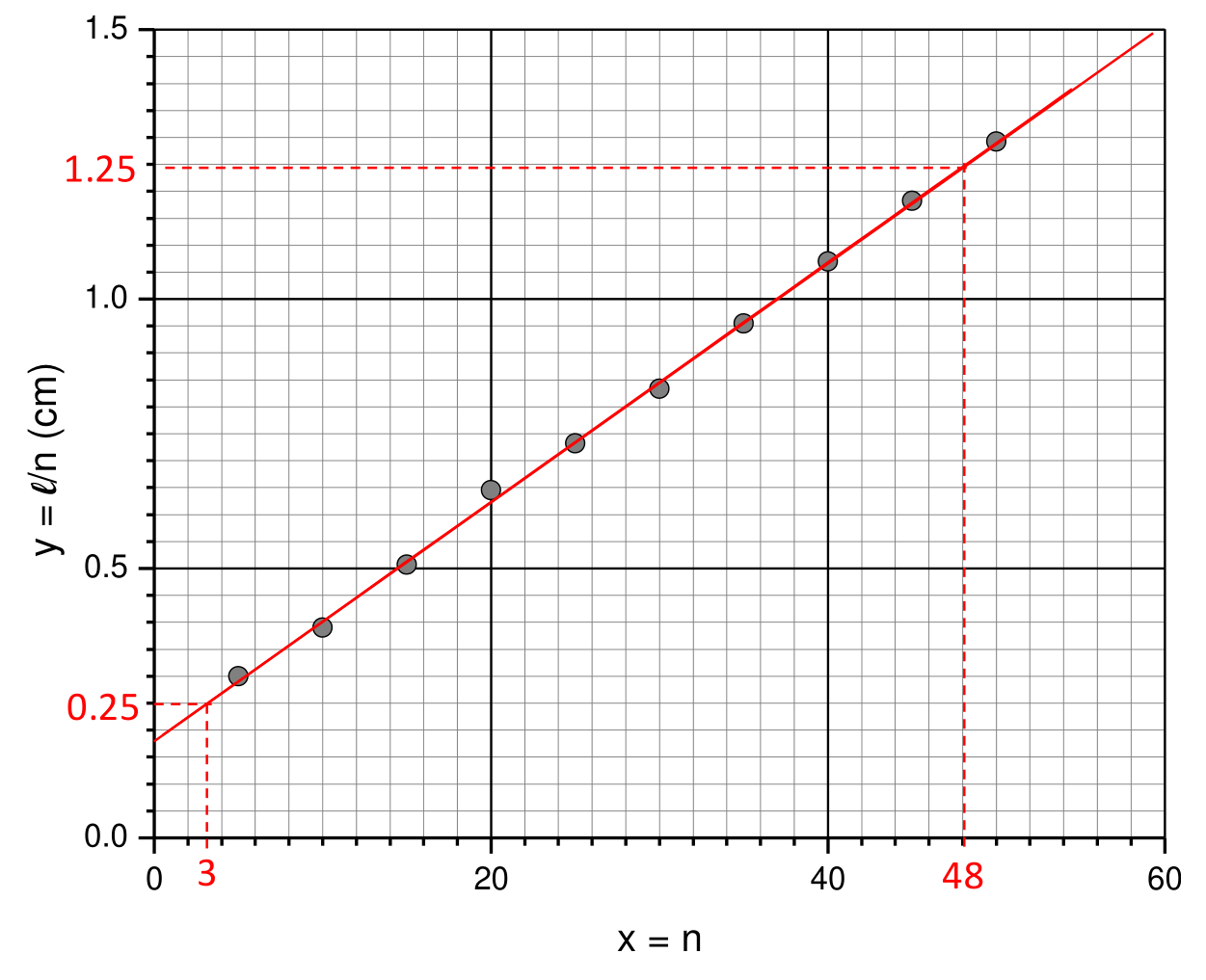
Figure 1 shows data points on a x-y graph and the line, approximating the data. If we measure coordinates of two pints of the fitting line, (,) and (,), then:
and the coefficients A and B could be calculated as:
For the choice shown in Fig. 1, and . Therefore:
Alternatively A could be determined as the y-coordinate of the intersection between the fitting line and the vertical axis. In this case, however, A is much less accurate and values between 0.15 mm and 0.20 mm could be reported by the students.
Marking scheme for B
| Element of solution | Points |
|---|---|
| Writes calculated y-values (variable choice in eqs. 1–2) or x and y (variable choice in eqs. 3–4) in the empty cells of Table 1. - Values are calculated correctly and are written with as many significant digits as the original data: 0.2 pts./row, maximum 9×0.2 = | 1.8 |
| - Additional table column(s) is (are) annotated with title(s) and unit(s) | 0.2 |
| Axes of the graph are annotated with titles and unit(s) | 0.2 |
| Grid labels on X | 0.5 |
| Grid labels on Y | 0.5 |
| Data points are positioned correctly: 0.2 pts./data point, maximum 9×0.2 = | 1.8 |
| Approximating (fitting) line is drown (Deduce 0.5 if number of points below and above the fitting line differ by 2 or more) | 1.0 |
| Coefficients A and B are calculated from measurements performed on two points of the fitting line (eqs. 5-6 or equivalent). Coefficient A could be determined directly from the intersection between fitting line and y-axis, as well. | 1.0 |
| Calculated value of A is within interval [0.16 cm ; 0.20 cm] | 0.5 |
| Additional points if A is within interval [0.17 cm ; 0.19 cm] | 0.5 |
| Additional points if value of A, presented with two significant digits, is 0.18 cm | 0.5 |
| Calculated value of B is within interval [0.024 cm ; 0.020 cm] | 0.5 |
| Additional points if A is within interval [0.023 cm ; 0.021 cm] | 0.5 |
| Additional points if value of A, presented with two significant digits, is 0.022 cm (No points are given for numerical values of A or B, if the units are not specified) | 0.5 |
| Totally on B | 10.0 |
C. We will enumerate the hanging turns from 1 to n starting from the lowest free end toward the upper turn attached to the holder. The mass of one single turn is:
The deformation of i-th turn is due to the total weight of all i–1 turns underneath. From the Hook’s law:
The total deformation of the hanging part is a sum of the deformation of individual turns:
The measured length is a sum of the undeformed length of the hanging part and the deformation:
By comparing with equation 1, we identify:
and
Marking scheme for C
| Element of solution | Points |
|---|---|
| Writes down eq. 7 or equivalent | 0.2 |
| Uses the Hook’s law to express the deformation of a single turn – eq. 8 or equivalent | 0.5 |
| Finds out expression for the total deformation of the hanging part –eq. 9 or equivalent | 1.0 |
| Adds up the undeformed length of hanging part to the deformation to obtain the total length – eq. 10 or equivalent | 0.5 |
| Writes down an explicit expression for A – eq. 11 | 1.4 |
| Writes down an explicit expression for A – eq. 12 | 1.4 |
| Totally on C | 5.0 |
D. From the theoretical expressions for A and B, and by using their experimental values:
and
Marking scheme for D
| Element of solution | Points |
|---|---|
| Writes down eq. 13 or equivalent - explicit expression for in terms of B | 0.5 |
| - input numeric data are transformed to basic SI units – kg and m | 0.5 |
| - numeric value of is calculated correctly and is written with corresponding SI unit | 1.0 |
| Writes down eq. 14 or equivalent - explicit expression for in terms of A and B | 0.5 |
| - numeric value of is calculated correctly and is written with corresponding SI unit | 0.5 |
| Totally on D | 3.0 |
E. The total length of the spring in undeformed state is:
If forces with opposite direction and the same magnitude F are applied to both ends of slinky, each single turn will be stretched by:
The total deformation of the spring will be:
Therefore, the stiffness of the whole slinky is:
Marking scheme for E
| Element of solution | Points |
|---|---|
| Writes down eq. 15 or equivalent - explicit expression for L | 1.0 |
| - numeric value for L with appropriate number of significant digits and SI units. Calculated value of L must be consistent with the value of obtained by the student in part D and thus may deviate from that in eq. 15. | 0.5 |
| Realizes that the same force F is stretching all the turns | 0.5 |
| Uses Hook’s law to express the deformation of one single turn – eq. 16 | 1.0 |
| Writes down expression for the total deformation of slinky – eq. 17 | 0.5 |
| Derives analytic expression for K in terms of and N – eq. 18 | 1.0 |
| Calculates K numerically with the appropriate number of significant digits and SI units. Calculated value of K must be consistent with the value of obtained by the student in part D and thus may deviate from that in eq. 18. | 0.5 |
| Totally on E | 5.0 |
Оригинал в Архива: problems.pdf · официални решения: solutions.pdf