BPO 2026, Теория — Задача 3. Istanbul Bosphorus Cross-Continental Swim and current correction
EIGHTH BALKAN PHYSICS OLYMPIAD (BPO-8) · 29 юни 2026 г. · 25 т.
Условие
The Istanbul Bosphorus Cross-Continental Swimming Race is an international open-water event in which swimmers cross from the Asian side of Istanbul to the European side. In this problem, the Bosphorus current is not neglected.
A simplified race course is modeled as a straight crossing of width
from point on the Asian shore to point on the European shore. The current flows parallel to the shores, from north to south, with constant speed . A swimmer swims with the constant speed relative to the water.
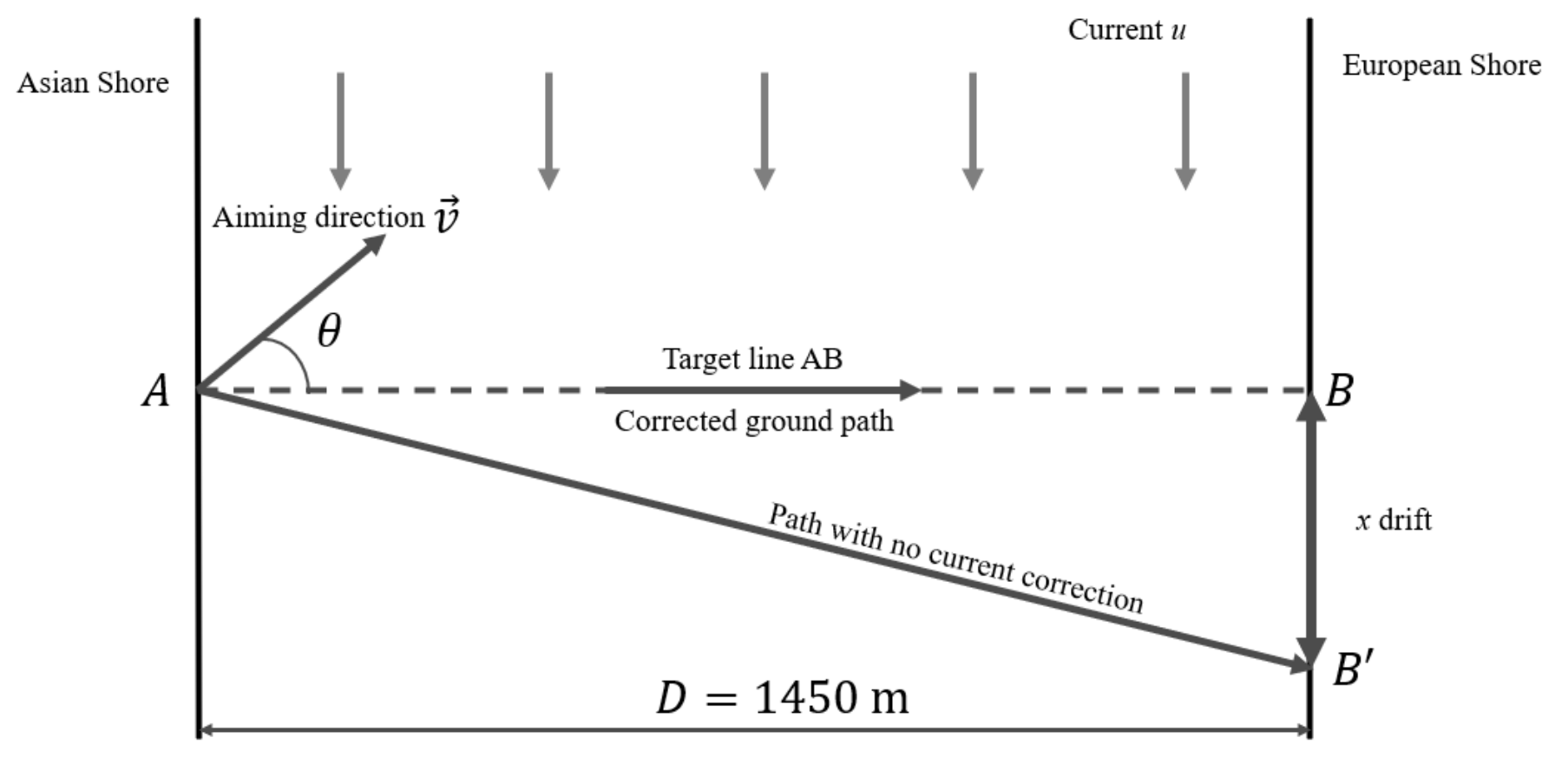
The swimmer wants to reach exactly point , directly opposite to point . Therefore, the swimmer must aim upstream at an angle with respect to the straight line .
A) Find the angle at which the swimmer must aim relative to the line in order to arrive exactly at point . [6 т.]
B) Determine the time required for the swimmer to cross the Bosphorus and reach point . [6 т.]
C) A second swimmer ignores the current and swims directly toward point . Determine the time needed to reach the European shore, as well as the downstream displacement from point . [6 т.]
D) During a training session, three swimmers cross the same route. Their measured crossing times and downstream displacements are given below.
| Swimmer | Crossing time (s) | Downstream displacement (m) |
|---|---|---|
| S1 | 1320 | 0 |
| S2 | 1160 | 270 |
| S3 | 1450 | -110 |
Here positive means downstream from , and negative means upstream from .
For each swimmer, determine the average ground-velocity components
and decide which swimmer made the best current correction. [7 т.]
Отговори
A) 31.3 °
B) 1358 s
≈ 22.6 min
C) t2 = 1160 s; 754 m downstream from point B
D) S1
Решение
Choose the positive -direction along the straight crossing from the Asian shore toward the European shore. Choose the positive -direction upstream. Therefore the water current is
The swimmer’s speed relative to the water is constant:
The width of the crossing is
(a) Angle required to land exactly at point (6 points)
To land exactly at , the swimmer must aim upstream so that the upstream component of his velocity relative to the water cancels the downstream current.
If the swimmer aims at angle above the line , the velocity components relative to the water are
(1.5p)
The ground-velocity component in the -direction is therefore
For exact arrival at ,
(1.5p)
Thus
(1.5p)
(0.5p)
Therefore
(1.0p)
Hence the swimmer must aim approximately
(b) Time required to cross the Bosphorus (6 points)
The forward speed across the Bosphorus is the -component of the ground velocity:
(2.0p)
Since
(1.0p)
we get
The crossing time is
(2.0p)
Thus
(1.0p)
(c) Second swimmer who aims directly toward
Now the swimmer does not correct for the current. Therefore the swimmer’s velocity relative to the water is completely in the -direction:
The current gives the whole -component of the ground velocity:
Time to reach the European shore. Since the -component is 1.25 ms, the crossing time is
(2.0p)
Thus
(1.0p)
Downstream displacement. The downstream drift is
(2.0p)
Therefore the swimmer lands
(1.0p)
downstream from point .
(d) Analysis of the GPS checkpoint data
For each swimmer, the average velocity components are obtained from
where is the final displacement parallel to the current direction relative to point .
Swimmer S1
Hence
(1.0p)
(1.0p)
So
Swimmer S2
Thus
(1.0p)
(1.0p)
Therefore
Swimmer S3
Thus
(1.0p)
(1.0p)
Therefore
The best current correction corresponds to the swimmer who lands closest to the target line through . This means the swimmer with the smallest value of .
The displacements are
Therefore the best current correction is achieved by
(1.0p)
Оригинал в Архива: problems.pdf · официални решения: solutions.pdf