Балкански 2006, Теория — Задача 1. The human sight.
Concours Général de Physiques “Minko Balkanski” 20 mai 2006 · 20 май 2006 г.
Указания
The two problems are completely independent and can be treated in any order.
The clearness, the quality and the precision of the work, which must be written in English, will form a very significant share of the final note.
The duration of the composition is 4 hours.
Условие
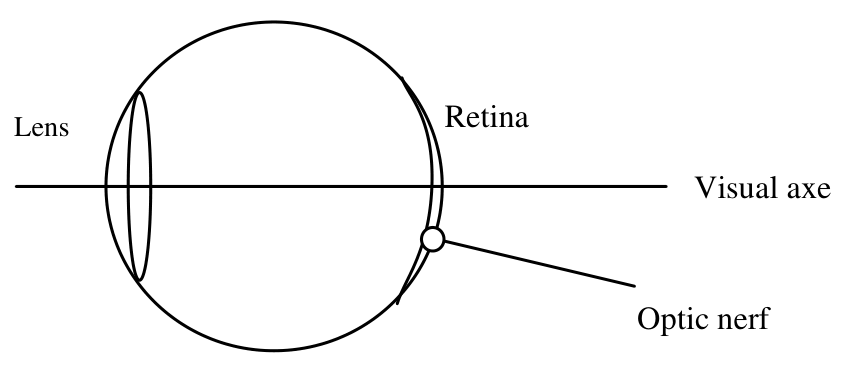
The human eye is composed in a first approximation of a lens and a detector (retina) as shown on figure 1. The size of the human eye is approximately D=24mm of diameter.
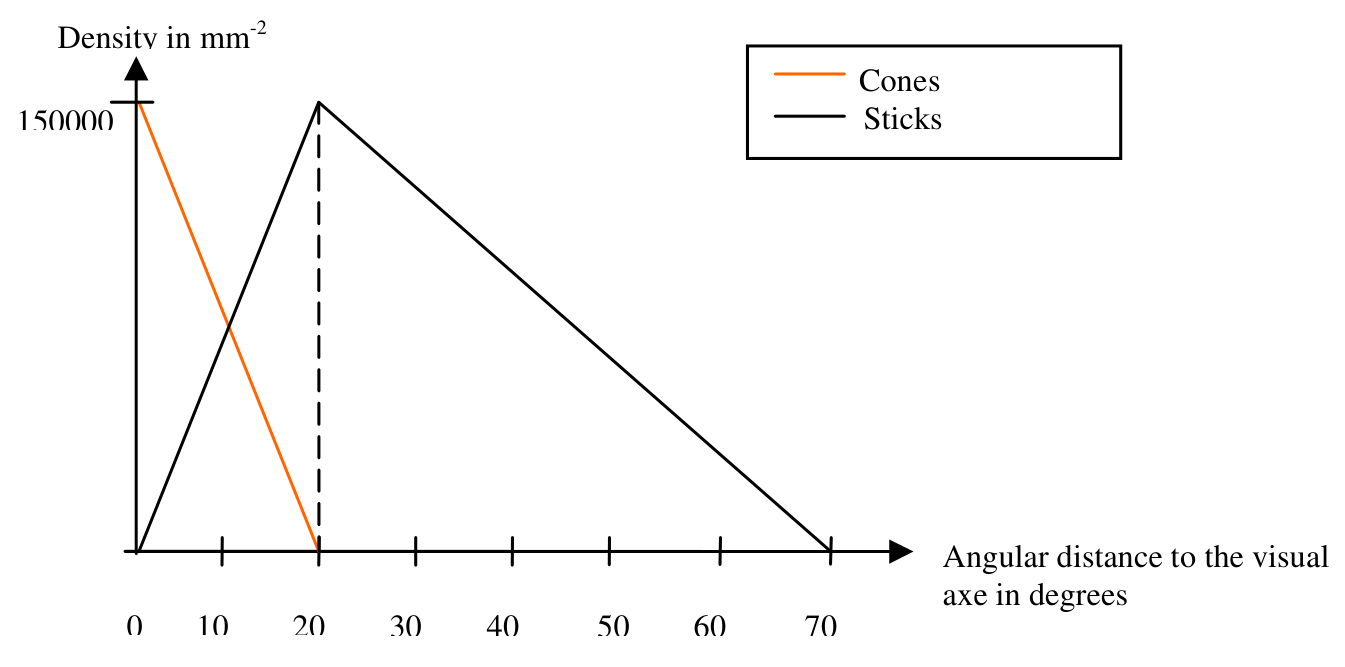
The detector is made of two types of small cells called cones and sticks. The cones are present especially in the centre of the visual axis while the sticks are present in a broader zone and their concentration is maximum at about 20° optical axis. Figure 2 shows the distribution of the cones and the sticks on the retina.
First part : In this part only the cones are considered. It is also supposed that the retina is plane and that it is located at a distance D behind the lens.
1. What must be the focal power of the lens so that an object located ad infinitum is focused on the retina.
2. a. An object is placed at a distance of 1m. from the eye.
a. What must be the focal distance of the lens so that the object is clearly seen?
2. b. What is the minimal size of the object so that it could be clearly seen?
3. a. The retina of a short-sighted person focuses an object located at 3m of the eye 1 mm in front of the retina.
a. This defect is corrected by wearing eye-glasses. If the distance between the eye and the glasses is 1 cm, what must be the focal distance of the lens of the glasses?
3. b. If contact lenses are worn, what must be the focal distance of the lens of contacts?
4. a. The density of the cones is supposed equal to the average density of the cones in the zone of clear vision.
a. What is the average size of one cone?
4. b. What is the minimal visible size of an object?
4. c. What is the minimal distance between two points located at 1m of a normal eye so that they would be seen separately?
4. d. What is the angular resolution of a healthy eye?
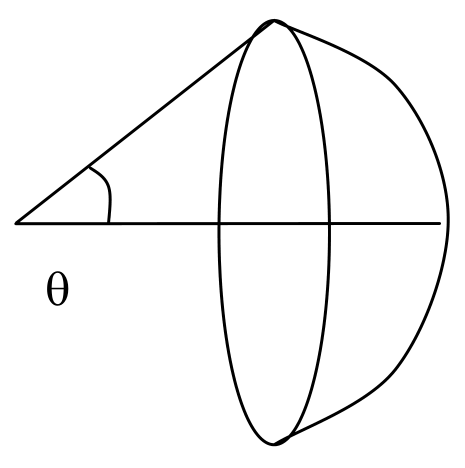
Second part : In this part the retina is no longer approximated to a plane and a spherical retina is considered. Moreover one takes into account the response of the cones and the sticks. It is pointed out that the surface of a portion of sphere is given by the formula with where Ω is the solid angle and θ is the angle shown on figure 3. Furthermore, it is supposed that during daytime two sticks are necessary to have the same sensitivity as one cone.
Second part 1. Give the angular resolution of the eye in the zone of clear vision in function of the angle of incidence of the light.
Second part 2. Calculate the angular resolution of the eye on the entire retina as a function of the angle of incidence of the light. What happens when an object moves away from the visual axis?
Решение
Внимание: Непълно решение
В архива няма официално решение на тази задача.
Оригинал в Архива: CGP_2006_en.pdf