Балкански 2020, Теория — Задача 1. Problème 1 / Problem I
Concours Général de Physique «Minko Balkanski» — 17 août 2020 (Français / English) · 17 август 2020 г. · 6 т.
Прочетете внимателно!
Част първа и част втора съдържат условията на задачите съответно на френски и английски език. Единствените външни документи, на които имате право, са френски и английски речници. Ако желаете, можете да ползвате калкулатори.
При оценяването на задачите голяма тежест ще имат яснотата и стилът на изложените решения и аргументация. Не използвайте излишна проза в аргументите си, бъдете точни и кратки. Използването на схеми за онагледяване на разсъжденията Ви е желателно. Пишете само на езика, който сте избрали (френски или английски).
Задачите носят еднакъв брой точки.
Ако намерите грешка в условията на задачите, отбележете я в работата си и продължете без да повдигате въпроси към квесторите.
Разполагате с 4 часа. Успех!
Éditions linguistiques / Language editions
Les quatre problèmes sont imprimés en français (pages 3–6) et en anglais (pages 7–10); les deux versions sont conservées sous chaque problème. Les instructions sont en bulgare et la page 2 est blanche. Les numéros anglais imprimés sont I, II, III et IV. Les problèmes valent respectivement 6, 5, 2.5 et 6.5 points, malgré la phrase des instructions annonçant des valeurs égales.
The four problems are printed in French and English; both source versions appear below. In Problem 2, question 8, French prints , whereas English prints . Both printed forms are retained. No matching official solution or marking scheme was found in the archive catalogue or the competition’s Phys directory.
Условие
Première partie — Français
Un bloc de glace de masse et de centre d'inertie est lancé sur un tremplin composé d'une part, d'une rampe rectiligne inclinée d'un angle par rapport à l'horizontale, et d'autre part d'une portion circulaire , de rayon et d'angle (cf figure ci-contre). Le tremplin est conçu de sorte que le triangle est rectangle en (donc la rampe est tangente au cercle en ). À l'instant , le glaçon est lancé depuis avec la vitesse , puis il glisse sans frottement sur le tremplin. On admet que le mouvement a lieu dans le plan et on définit la base cartésienne associée . On désigne par l'intensité du champ de pesanteur. Le référentiel d'étude est terrestre et considéré galiléen.
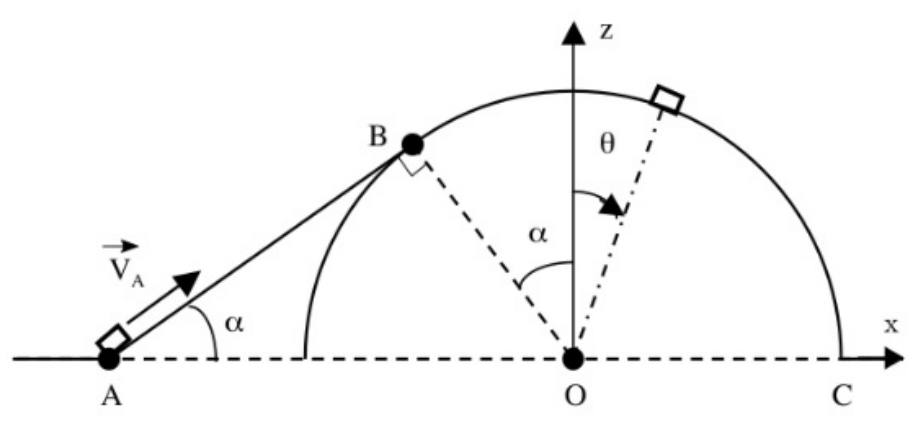
1. Déterminer l'expression de la vitesse à l'instant sur la rampe, en fonction des données, dans la base .
2. Montrer que le point est atteint seulement si la norme de est supérieure à une valeur . Exprimer puis calculer sa valeur numérique.
Pour les questions suivantes, on suppose la condition précédente vérifiée.
3. Exprimer la date à laquelle le glaçon atteint le point .
4. Exprimer la norme de la vitesse au point .
On s'intéresse maintenant à la phase du mouvement sur l'arc . La position de est repérée par l'angle . On travaille dans la base polaire définie par et dirigé vers les croissants (sens positif horaire).
5. Faire un schéma des forces appliquées au glaçon, puis projeter le théorème de la résultante cinétique sur les vecteurs et .
6. Montre que l'expression de la vitesse angulaire suivant satisfait les équations de mouvement établies lors de la question précédente . Exprimer la constante en termes des paramètres du problème.
7. En déduire l'expression de la réaction normale du support en fonction de et et .
8. A quelle condition sur , puis sur , n'y aura-t-il pas de décollage avant le sommet ? Que donne la valeur numérique ?
9. Déterminer finalement l'expression de la position , valeur de pour laquelle le glaçon quitte la piste.
10. Application numérique : que se passe-t-il si ?
Part II — English
A block of ice of mass and center of mass is launched on a track consisting of, firstly, a rectangular ramp tilted at an angle with respect to the horizontal, and secondly, a circular part of radius and angle (see the figure). The trampoline is designed so that the triangle has right angle at (so the ramp is tangent to the circle at ). At moment , the ice is launched from with velocity , then it slides without friction on the track. Assume that the movement happens in the plane and we define the associated cartesian system . We denote the gravitational acceleration. The reference frame is the one of the laboratory and it is considered to be Galilean (inertial).
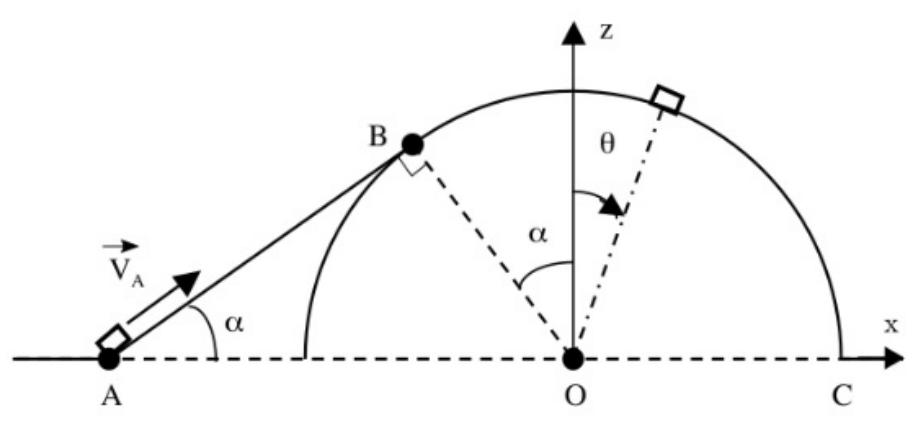
1. Determine the expression of the velocity at moment on the ramp as a function of the given data, in the basis .
2. Show that the point is reached only if the norm of is larger than a given value . Express and calculate its numerical value.
For the next questions, we assume that the previous condition is verified.
3. Express the moment when the ice reaches the point .
4. Express the norm of the velocity at point .
We are now interested in the phase of movement on the arc . The position of is defined by the angle . We work in the polar basis given by the vectors and directed along increasing values of (i.e. clockwise).
5. Make a diagram with the forces acting on the ice, then project them along the vectors and so as to obtain two scalar equations.
6. Show that the following expression of the angular velocity satisfies the equations of motion already established in the previous question . Express the constant in terms of known parameters.
7. Deduce the expression of the normal reaction of the support as a function of and .
8. Under what condition on , and then on , there won’t be a take-off before the summit of the track? Calculate the respective numerical values.
9. Determine the expression of the position , the value of for which the ice leaves the track.
10. Numerical application: what happens if ?
Решение
Внимание: Непълно решение
В архива няма официално решение на тази задача.
Оригинал в Архива: CGP_2020.pdf