Балкански 2020, Теория — Задача 4. Problème 4 / Problem IV
Concours Général de Physique «Minko Balkanski» — 17 août 2020 (Français / English) · 17 август 2020 г. · 6,5 т.
Прочетете внимателно!
Част първа и част втора съдържат условията на задачите съответно на френски и английски език. Единствените външни документи, на които имате право, са френски и английски речници. Ако желаете, можете да ползвате калкулатори.
При оценяването на задачите голяма тежест ще имат яснотата и стилът на изложените решения и аргументация. Не използвайте излишна проза в аргументите си, бъдете точни и кратки. Използването на схеми за онагледяване на разсъжденията Ви е желателно. Пишете само на езика, който сте избрали (френски или английски).
Задачите носят еднакъв брой точки.
Ако намерите грешка в условията на задачите, отбележете я в работата си и продължете без да повдигате въпроси към квесторите.
Разполагате с 4 часа. Успех!
Éditions linguistiques / Language editions
Les quatre problèmes sont imprimés en français (pages 3–6) et en anglais (pages 7–10); les deux versions sont conservées sous chaque problème. Les instructions sont en bulgare et la page 2 est blanche. Les numéros anglais imprimés sont I, II, III et IV. Les problèmes valent respectivement 6, 5, 2.5 et 6.5 points, malgré la phrase des instructions annonçant des valeurs égales.
The four problems are printed in French and English; both source versions appear below. In Problem 2, question 8, French prints , whereas English prints . Both printed forms are retained. No matching official solution or marking scheme was found in the archive catalogue or the competition’s Phys directory.
Условие
Première partie — Français: Propagation d'un signal le long d'une corde
Un signal progressif (perturbation) se propage le long d'une corde d'axe (Ox), tendue.
À la date le signal part du point O, origine de l'axe et se propage selon les x croissants. Le graphique ci-contre représente le déplacement au cours du temps d'un point M de la corde d'abscisse , déplacement noté
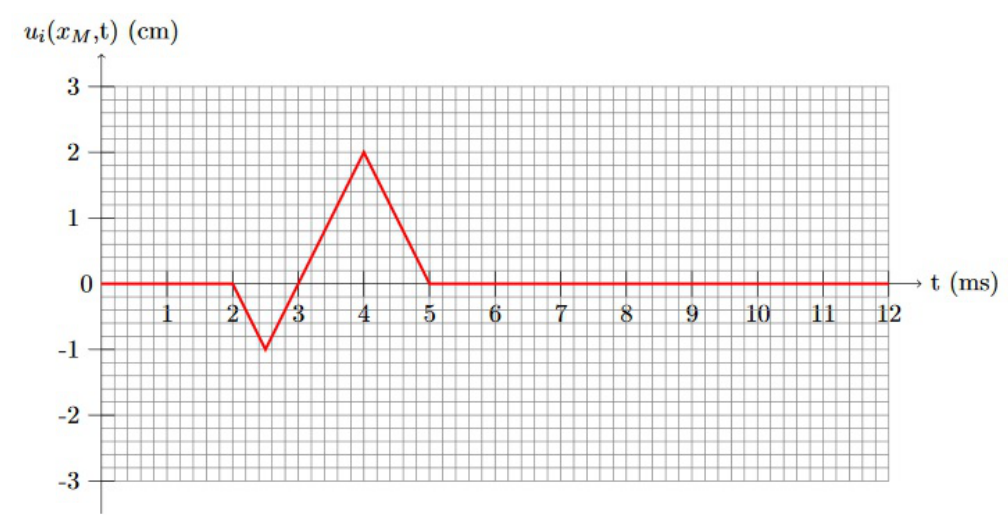
1. À quelle date la perturbation arrive-t-elle en M ?
Calculer la célérité de l'onde le long de la corde.
2. La célérité des ondes sur une corde tendue dépend de la tension T de cette corde (force avec laquelle elle est tendue) et de sa masse linéique (masse par unité de longueur). Par analyse dimensionnelle, donner l'expression de en fonction de et , à un facteur multiplicatif sans dimension près.
3. Pour augmenter cette célérité, pourrait-on tendre la corde plus fortement ? Choisir une corde de masse plus grande (pour une même longueur) ? Produire une perturbation d'amplitude différente ? Justifier les réponses.
4. Pendant quelle durée le point M est-il affecté par le passage de l'onde ? Quelle est la longueur de la perturbation ?
5. On considère un point N d'abscisse . À quelle date la perturbation arrive-t-elle en N ? Représenter l'évolution temporelle du signal au point N sur une figure.
6. Exprimer l'allure de la corde à la date . La représenter sur une figure. On placera les points M et N sur la corde.
7. La corde est en fait fixée à un support à l'abscisse . Justifier qu'il existe une onde réfléchie . Établir son expression en fonction de l'onde incidente en . Représenter l'allure de à la date sur une figure.
Positionnement des frettes d'une guitare
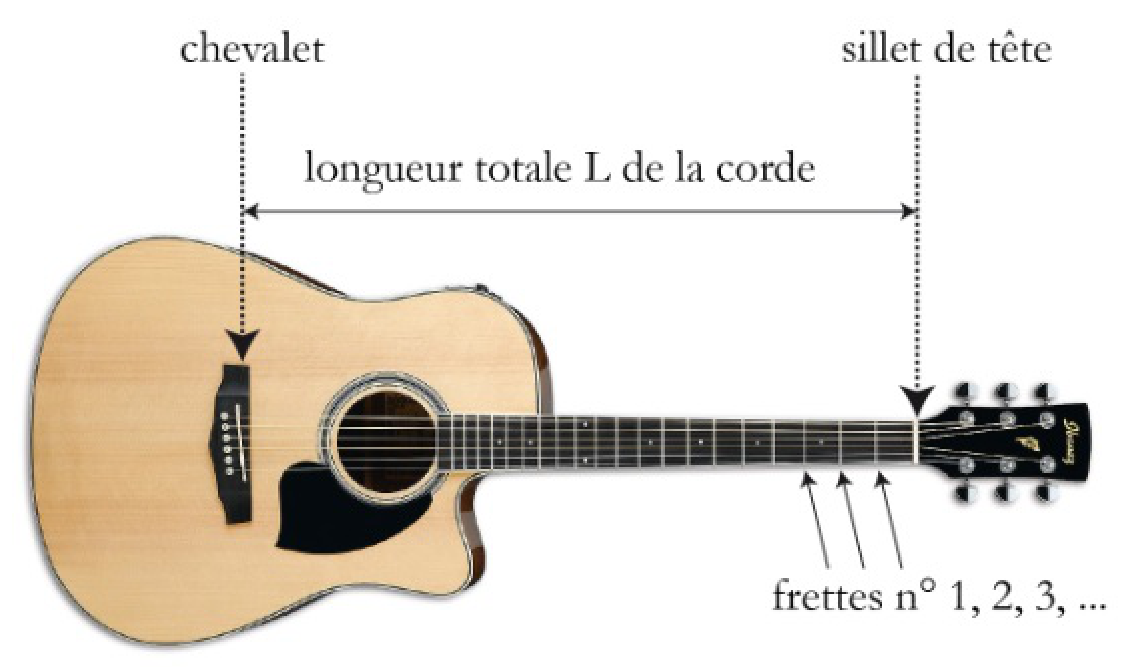
On considère la corde de «La» d'une guitare, corde homogène, quasi-inextensible, de masse linéique (masse par unité de longueur) et de longueur L, tendue entre ses deux extrémités fixes O et A avec une tension constante T. Les points O (au niveau du chevalet, cf. figure ci-dessous) et A (au niveau du sillet) sont solidaires de la guitare. À l'équilibre, la corde est rectiligne.
Pour le guitariste, les notes accessibles sont quantifiées par des barrettes (frettes), placées sur le manche. Ces frettes permettent de réduire momentanément la longueur de la corde, la tension T (et donc la célérité des ondes) restant constante. En bloquant la corde avec le doigt contre la frette, le guitariste diminue la longueur de la corde libre de vibrer (longueur de vibration allant alors de la frette jusqu'au chevalet) et obtient la note voulue. On cherche à déterminer les emplacements à donner aux frettes lors de la construction du manche de la guitare.
8. Donner la définition d'un mode propre sinusoïdal de vibration de la corde. Indiquer le lien entre la longueur L de la corde et la longueur d'onde du n-ième mode propre. En déduire les expressions des fréquences correspondantes, en fonction de et L, et l'expression mathématique du n-ième mode
9. Dessiner l'allure de la déformation associée au mode de vibration fondamental (n= 1) à deux instants différents. Faire de même pour les trois harmoniques suivants (n= 2, 3 et 4)
10. La corde de « La » a une longueur , et correspond à la fréquence . En déduire la célérité des ondes dans cette corde.
11. Justifier où il faut placer la frette permettant de «monter» la note d'une octave, c'est-à-dire pour doubler la fréquence fondamentale et donc obtenir la fréquence ?
12. La guitare s'appuie sur la gamme «dodécaphonique» (12 sons) : do - do# - ré - ré# - mi - fa - fa# - sol - sol# - la - la# - si - do (note de l'octave supérieure). L'intervalle entre deux notes consécutives de cette gamme s'appelle le demi-ton. Le signe #, ou «dièse», signifie qu'un demi-ton est ajouté à la note. On passe d'une note de la gamme à la suivante en multipliant la fréquence toujours par la même constante K. En répétant 12 fois l'opération, on retrouve l'intervalle d'une octave. Calculer la valeur de la constante K.
13. Déterminer,en fonction uniquement de K et de , la distance sur le manche de la guitare entre le sillet et la première frette permettant de passer du La au La# . Calculer la valeur numérique de .
14. Le fait d'effleurer la corde, sans la presser complètement, permet de la laisser vibrer sur toute sa longueur tout en imposant un nœud de vibration à l'endroit où l'on pose le doigt : ceci a pour effet de supprimer une partie des harmoniques. Dans le cas de la corde «La», de fréquence fondamentale , en effleurant la corde soit au quart soit aux trois quarts de sa longueur , un son plus aigu est émis, avec seulement quelques harmoniques. Évaluer la fréquence de vibration du son émis.
Part II — English: Propagation of signal along a string
A progressive wave (perturbation) is propagating along a stretched string, coinciding with the axis .
At time the perturbation is at point O, the origin of the axis , and propagates in the direction of increasing x. The attached graph shows the displacement as a function of time, of a point on the string, denoted M. It is located at , its displacement is known and denoted .
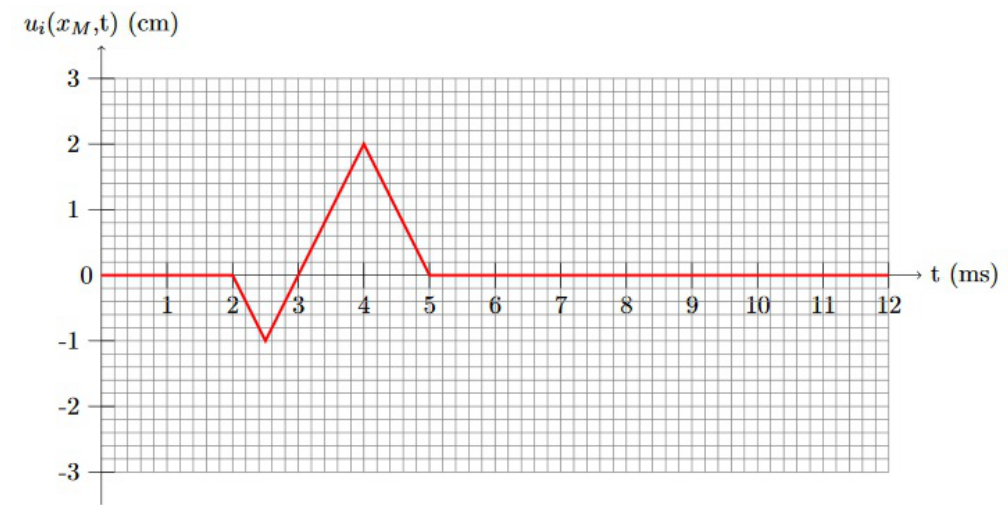
1. Determine the moment of time , when the perturbation arrives at point M. Calculate the speed of propagation of the perturbation along the string.
2. The speed of propagation of progressive waves on a stretched string depends on its tension (force which is applied on the string to keep it stretched) and its mass per unit length . By the means of a dimensional analysis, give the expression of as a function of and and a dimensionless multiplicative factor.
3. On order to increase this speed , can we increase the tension ? Or choose a string with higher mass per unit length? Or create a perturbation with bigger amplitude? Justify your answers.
4. For what duration the point M is affected by the passage of the perturbation? What is the length of that perturbation?
5. We consider a point N situated at . At which moment of time the perturbation will arrive at N? Represent the temporal evolution of the signal received at point N on a graph.
6. Express , where . Draw it on a graph and place the points M and N.
7. The string is fixed to a mount at . Justify the existence of a reflected wave. Establish its expression as a function of the incident wave at . Draw on a graph , where .
Positioning of the guitar frets
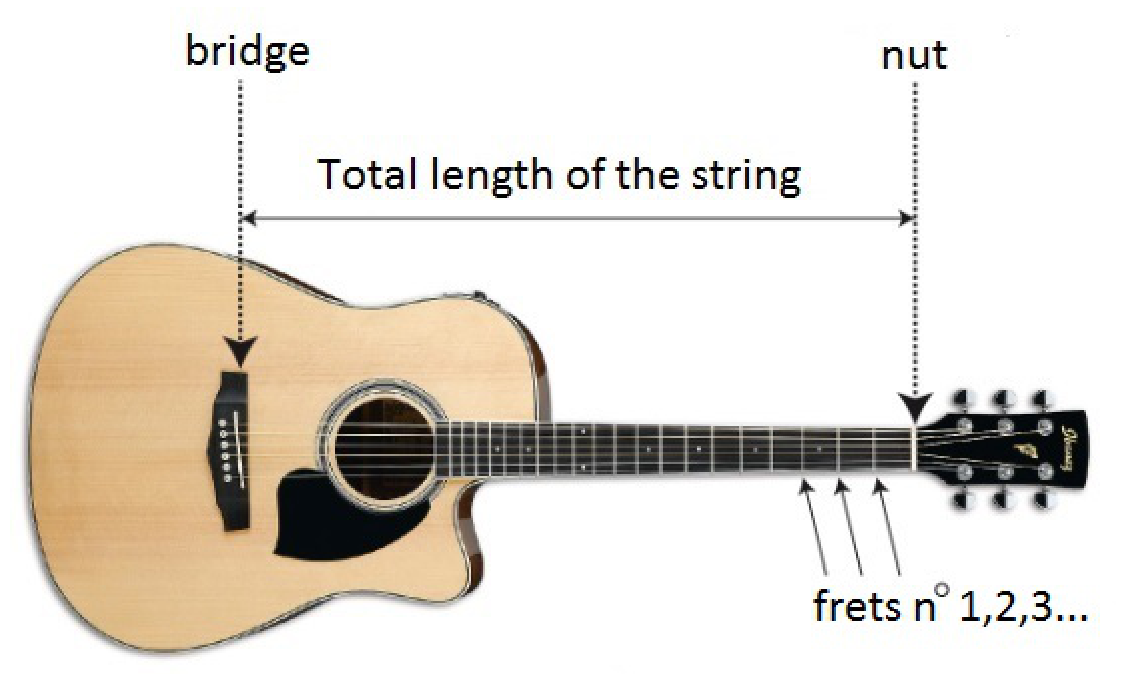
We consider the A ("La") string of a guitar, it is homogeneous, quasi-inextensible, of mass per unit length and length , stretched between two points O and A with a constant tension . The points O (at the bridge, cf. the adjacent figure) and A (at the nut) are fixed with respect to the guitar. At equilibrium the string is straight.
The guitar player can access different notes by the use of bars (called frets), placed on the fretboard of the guitar neck. Those frets let the guitar player temporally reduce the length of the string, while keeping the tension (and as so the speed of propagation of waves ) constant. This effect is accomplished by pressing the string against the fret with finger thus reducing the length of freely vibrating string (the part of the string able to freely vibrate is then fixed at the bridge and at the fret) and obtaining the desired note. We will try to find where the constructor of a guitar should place the frets on the guitar neck.
8. Give the definition of a sinusoidal normal mode of vibration of string. What is the relation between the length of the string and the wavelength of the n-th normal mode ? Write down the expressions of the corresponding frequencies and of the modes themselves as a function of and .
9. Sketch the deformation of the string associated with the fundamental mode (n=1) at two different moments of time. Do the same for the 3 following modes (n=2, 3 and 4).
10. The A ("La") string is long and the corresponding frequency of the note is . Find the speed of propagation of waves for this string.
11. Justify where should the manufacturer place the fret that permits the guitar player to go one octave higher, meaning to double the fundamental frequency and thus obtain .
12. The guitar is based on the «dodécaphonic» (12 sons) scale: C - C# - D - D# - E - F - F# - G - G# - A - A# - B - C (resp. do - do# - ré - ré# - mi - fa - fa# - sol - sol# - la - la# - si - do), the last C being one octave higher compared to the first C. The interval between two adjacent notes of this scale is called a semitone. The sign # ,read here as "sharp", means a semitone is added to the note. We go from one note of the scale to the next one by multiplying its frequency by the same constant factor . By repeating this procedure 12 times, we have effectively went over 1 whole octave. Calculate the numerical value of .
13. Determine the distance on the fretboard between the nut and the first fret, which corresponds to the note A# (up from A), as a function of and . Calculate the numerical value of .
14. Lightly touching the string over a fret, without pressing it, lets the string vibrate over its whole length (from bridge to nut), while imposing a node where the guitar player has placed his finger: the effect of this technique is to suppress some of the harmonics. In the case of the A ("La") string, of fundamental frequency , we press lightly the string at 1/4 or at 3/4 of its length , the pitch of the sound goes up and it contains only a handful of harmonics. Find the frequency of the emitted sound.
Решение
Внимание: Непълно решение
В архива няма официално решение на тази задача.
Оригинал в Архива: CGP_2020.pdf