EuPhO 2017, Теория — Задача 1. Oscillating rope
10 т.
Условие
A heavy uniform rope of length is suspended vertically from the ceiling. The rope may oscillate around its equilibrium position with different natural frequencies, which will be denoted by in an ascending order. The figure below presents the shape of the rope in the first three natural vibrations, as obtained by a computer simulation. Note that the horizontal and vertical scales in the figures are not equal. You may assume that the actual lateral displacement of the rope is much smaller than its length (small-amplitude approximation).
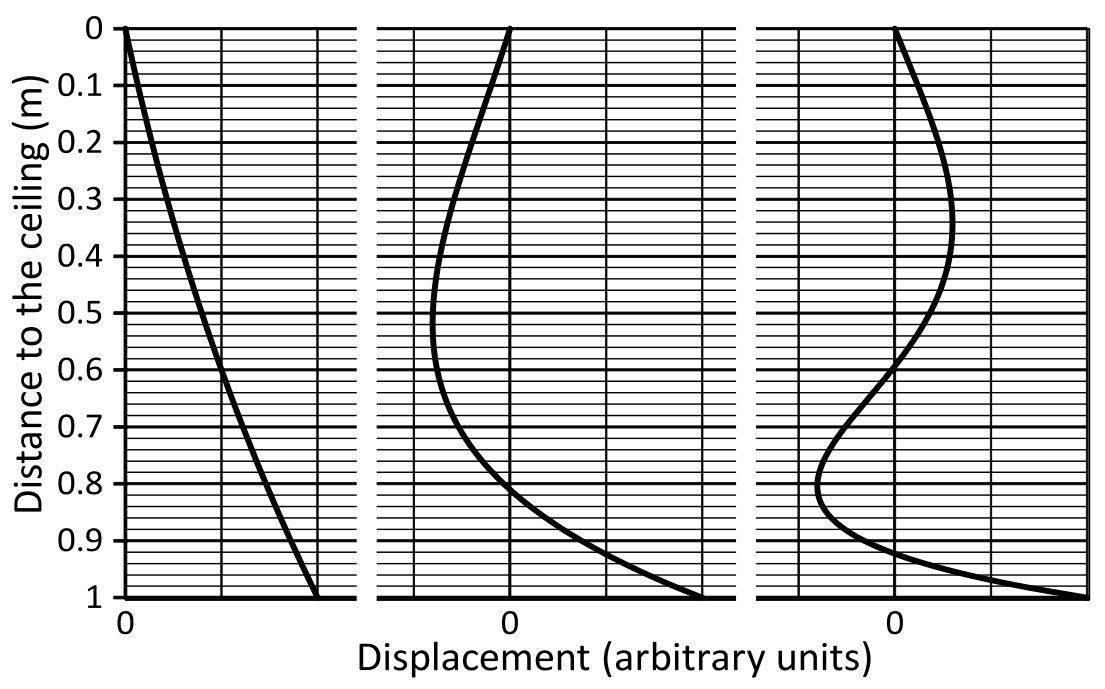
A) Develop a simplified model, which will allow you to estimate the frequency of the first (fundamental) vibration of the rope. Hence, calculate approximately for a rope of length m. Assume that . [4 т.]
B) Take necessary readings from the figure to estimate the frequency ratio . [6 т.]
Отговори
A) 0.61 Hz
Hz (physical-pendulum model of a rigid rod); period s.
B)
Решение
A) It is evident from the figure that the curvature of the rope in the fundamental vibration is very small. It infers for a possibility to model the fundamental vibration as a swinging of a rigid uniform rod of length about a pivot point at its end. The moment of inertia of the rod is:
and the distance from the center-of-mass to the pivot point is:
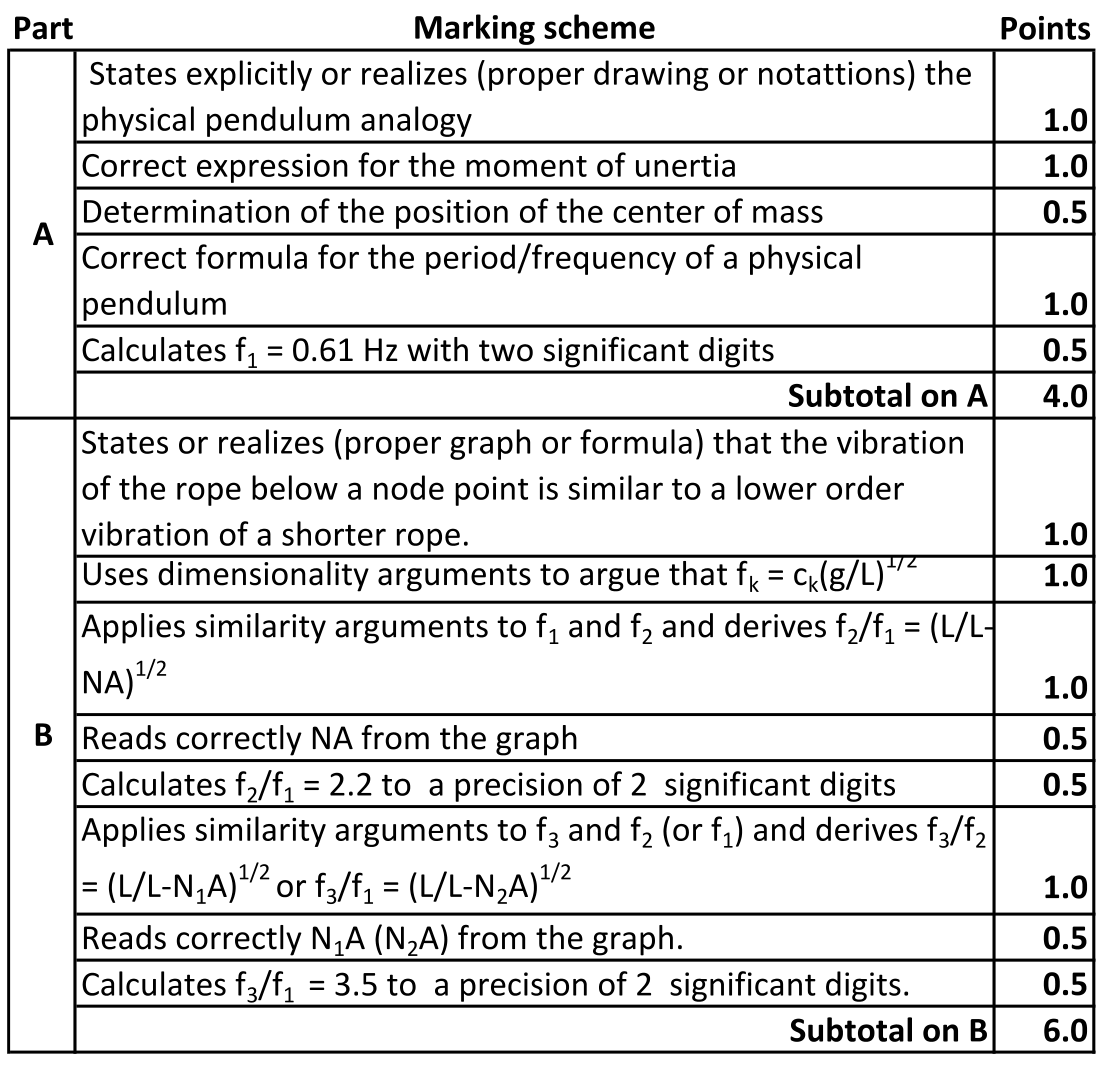
Therefore, the frequency of the fundamental vibration is approximated as:
Correspondingly, the period of the fundamental vibration is:
B) Whatever model for estimating of is being used, one may deduce on the basis of dimensionality arguments that the k-th natural frequency of the rope is:
where is a dimensionless numeric coefficient depending on the consecutive mode number only. Let and be the suspension point and the free end of the rope respectively, and be the node on the rope for the second natural vibration (see the figure).
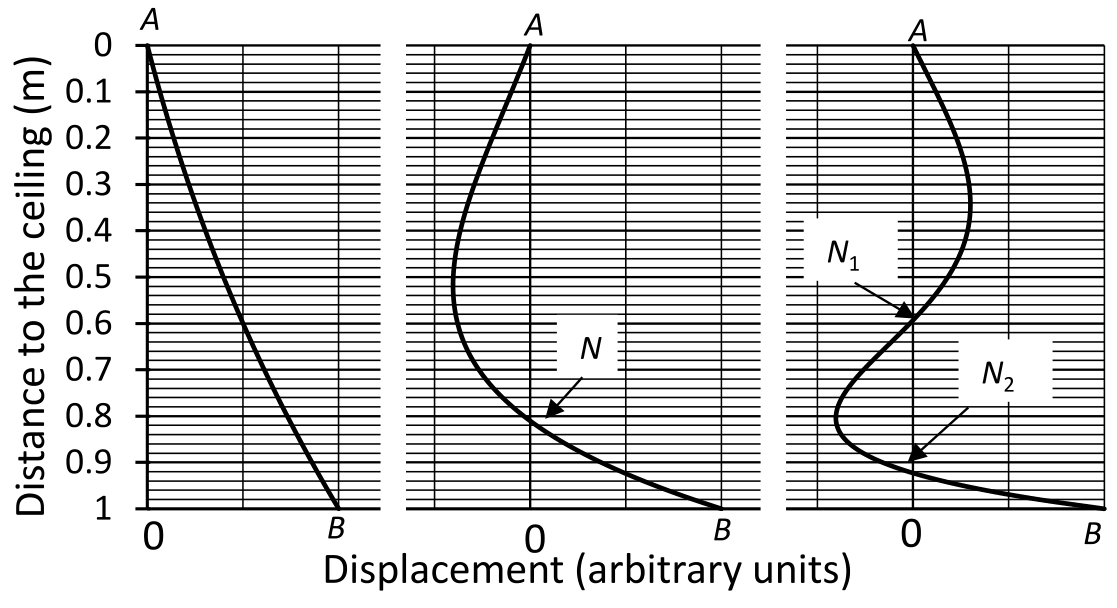
Since the node point is at rest (in the small-amplitude approximation), the vibration of the part could be considered as a fundamental vibration of a rope of length about a suspension point . Therefore:
Hence one may write:
Since the absolute displacement is much smaller than the length of the rope, the distances could be measured in a vertical direction, to the ceiling, instead along the rope. Therefore, by taking m, and m, we obtain:
Similarly, the vibration of the part in the third eigenmode is equivalent to the second natural vibration of a rope of length m. In analogy to the first case:
and
Therefore:
Finally:
Оригинал в Архива: th_pr.pdf · официални решения: th_sol.pdf