EuPhO 2021, Теория — Задача 2. Thread around a cylinder
EuPhO-2021 Theoretical Problems. Language: English
Условие
One end of a thread is tied into a loop of length , and a cylinder of radius is put through the loop. The coefficient of friction between the thread and the cylinder is . The free end of the thread is being pulled parallel to the axis of the cylinder (as shown by arrow in the photo) while keeping the cylinder at rest. If the length of the loop is longer than a critical value, , the loop can slide along the cylinder without changing its shape, otherwise the friction “locks” it into a place and increasing the pulling force would eventually just break the thread. Find this critical value . The weight of the thread is to be neglected; the thread will not twist when being pulled.
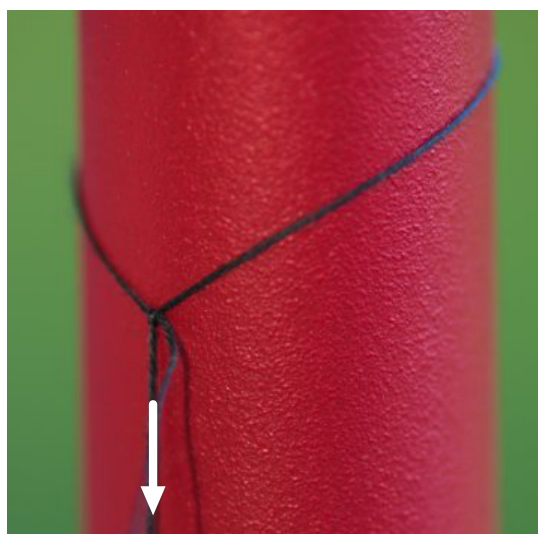
It might be useful to know that
where .
Отговори
Решение
Fig. 1 shows the cylinder and the loop from three different angles; denotes the pulled point of the loop, while is the top point of the thread.
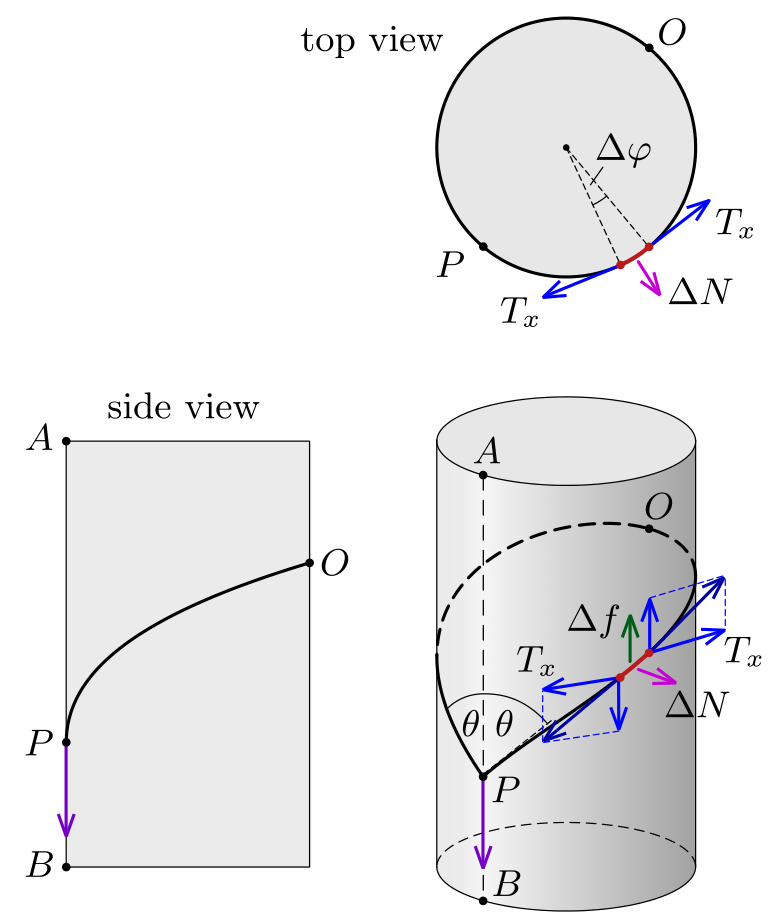
Imagine that the side of the cylinder is cut along the generatrix passing through point , and then the side (including the loop) is unfolded as shown in Fig. 2. In this figure points and , and , and are equivalent, respectively. Let us introduce a Cartesian coordinate system on this unfolded plane so that point is the origin, axis is parallel with the axis of cylinder and directed downwards, axis is perpendicular to (i.e. horizontal).
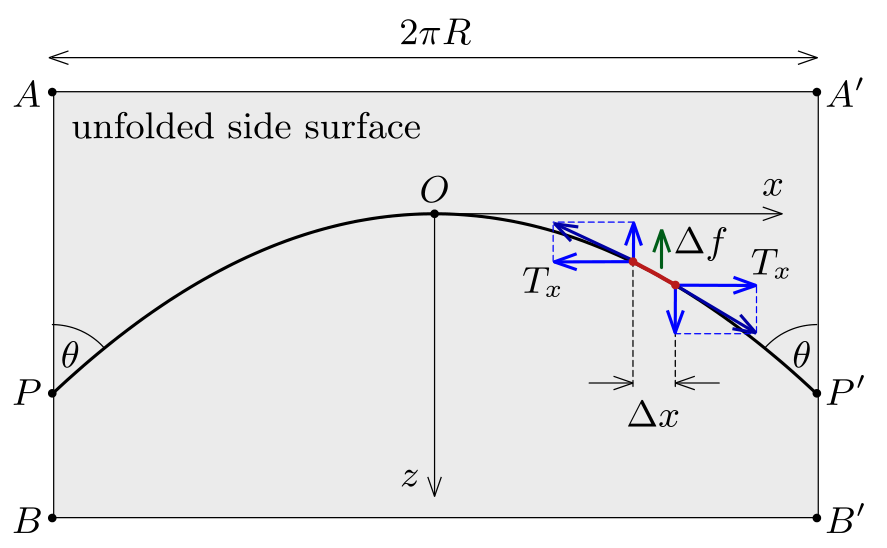
Consider the forces acting on a small piece of the thread (with horizontal projection ) indicated with red line in both figures. These are the tensions at both ends of the small piece exerted by neighbouring parts of the thread, the normal force and the friction force exerted by the cylinder. On the verge of slipping, the direction of is parallel to the -axis. Since the small piece of thread is in equilibrium, the -component of the tension is the same everywhere:
The normal force can be determined by looking at the top view of the loop in Fig. 1. The polar angle corresponding to small piece of thread is , so the force balance in the radial direction can be written as
The frictional force on the verge of slipping is given by
Thus, the force balance on the small piece of thread in the direction (see Fig. 2):
where we expressed the -component of the tension forces with and the tangent . Using the three equations above and taking the limit , we get the differential equation
where we used the fact that . By direct integration and taking into account the boundary conditions and we get
so the shape of the thread on the unfolded side surface (Fig. 2) can be described by a parabola.
The thread needs to span over the entire cylinder, so its length can be calculated as
Substituting the function we get:
where we introduced the notation . Using the integral given in the text of the problem:
If the length of the thread is shorter than the length calculated here, then there is no solution satisfying the thread length constraint, i.e. the thread cannot slip.
Note. In the limit the loop slips even if , which should be reproduced by our final formula. Using the relation for the inverse hyperbolic function given in the problem text, then expanding the logarithm in Taylor series in linear order around we get:
so for small values of we get
| Grading scheme: T2 | |
|---|---|
| 2-i. A figure or figures reflecting the correct geometry such as: the loop is a non-planar curve in all figures (0.5 p), existence of exactly one cusp (0.5 p, if the „back” is hidden, 0 p). | 0.5 p + 0.5 p |
| 2-ii. Realizing that on the verge of slipping the frictional force is parallel with the axis of the cylinder for every small piece of the thread and . (If any of the two is missing, then 0.2 p) | 0.5 p |
| 2-iii. Correct equation for the force balance in direction involving frictional force or the load (which is pulling down the loop) and the components of the tension. | 0.5 p |
| 2-iv. + correct explanation based on the balance in direction. If the physics is incompatible with the geometrical assumptions (e.g. planar curve for the loop and the existence of a frictional force acting on small pieces), no points are given | 0.5 p + 1.5 p |
| 2-v. Expressing the normal force acting on a small segment with and (or ). If the relation or is not used here or anywhere else, 1.5 p is given. If the expression is wrong but is proportional to the curvature (), 1.0 p is given. | 2.0 p |
| 2-vi. Deriving the correct differential equation for (if the diff. equation is wrong due to any reason, 0 p) | 1.5 p |
| 2-vii. Solving the diff. equation for correctly (including boundary conditions). If only one integral is evaluated correctly, 0.3 p are given. For stating only the boundary conditions (both and ) 0.2 p. | 1.0 p |
| 2-viii. Writing down the length of the thread in terms of an integral of , i.e. writing down the length constraint | 0.5 p |
| 2-ix. Evaluating the integral correctly (factor mistake in calculation 0.5 p, wrong units 0.2 p) | 1.0 p |
| Total T2: | 10.0 p |
General guidelines for marking:
- Granularity for marks is 0.1 p.
- A simple numerical error resulting from a typo is punished by 0.2 p unless the grading scheme explicitly says otherwise.
- Errors which cause dimensionally wrong results are punished by at least 50 % of the marks unless the grading scheme explicitly says otherwise.
- Propagating errors are not punished repeatedly unless they either lead to considerable simplifications or wrong results whose validity can easily be checked later.
Оригинал в Архива: EuPhO_2021-theory.pdf · официални решения: EuPhO_2021_Solutions-2.pdf