EuPhO 2021, Теория — Задача 3. Glass ball
EuPhO-2021 Theoretical Problems. Language: English
Условие
The first photo here is taken with a digital camera and shows a glass ball, backlit with diffuse dichromatic light which has only two narrow spectral lines (red 630 nm and violet 400 nm). This diffuse light comes from the white floor (marked with ‘1’ in the figure) and the white walls (marked with ‘2’), both illuminated with violet and red LED lamps. The sensor of the camera has only red, blue and green sensors so that violet light appears in the photo as blue. The photo is taken from a distance much greater than the radius of the ball. On the back side of the ball, a very narrow opaque thread is glued to the glass surface, forming an arc of a great circle on the ball. In the photo, the thread is obstructed by the ball and cannot be seen directly. However, hugely deformed images of a very short segment of the thread are seen as blue (marked with ‘b’) and red (‘r’) ellipses. The letter ‘p’ indicates purple-coloured areas in the photo.
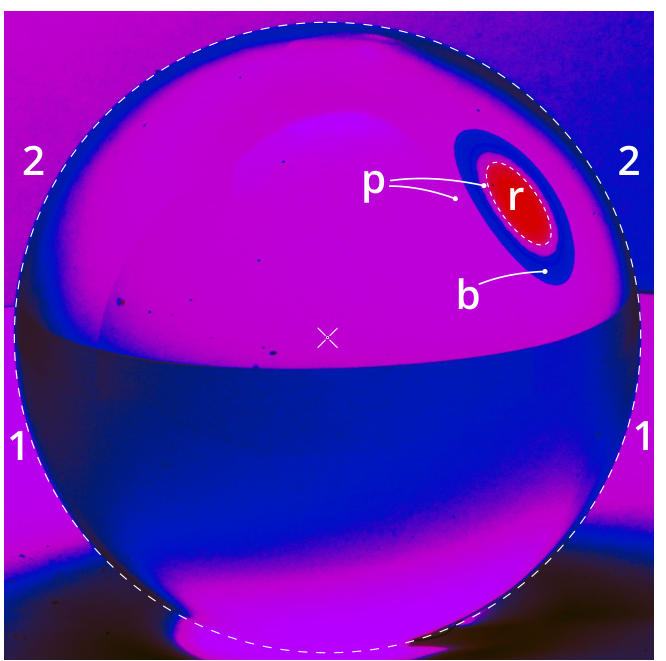
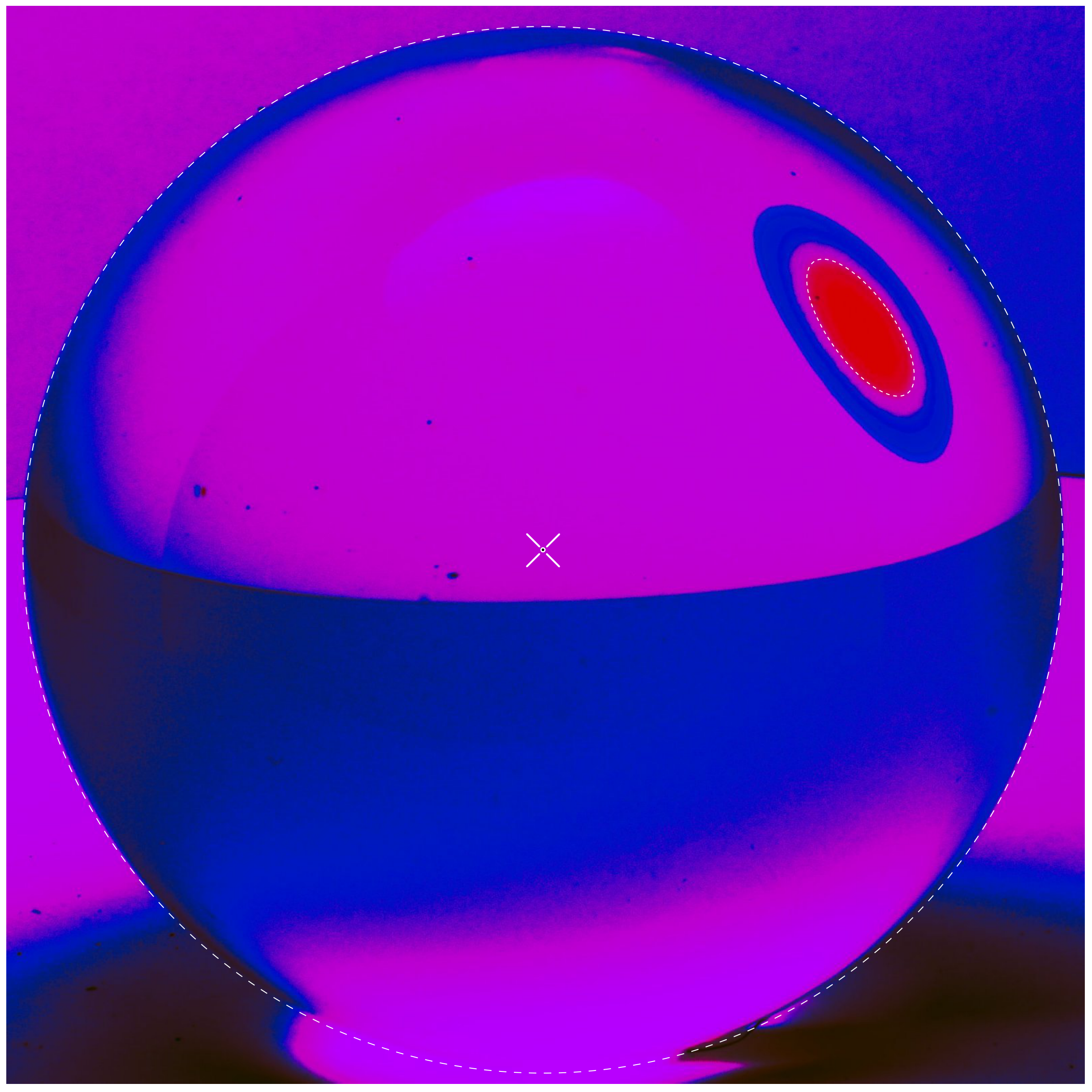
In the first photo, the centre of the ball is marked with a cross, and the perimeter of the ball is traced with a dashed line. You can find a larger version of the first photo on a separate sheet. You may take distance measurements there. In the larger photo, the boundary between the red and purple regions is also traced with a dashed line.
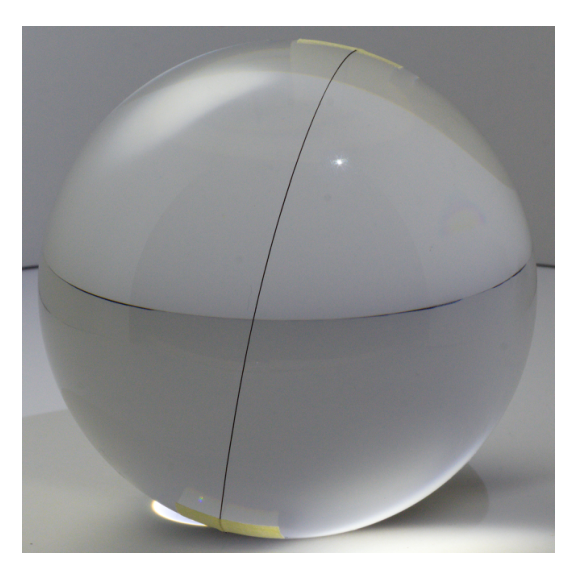
The second photo is taken while illuminating with a white LED with the ball turned so that the thread can be seen directly.
a. Explain qualitatively using a ray diagram why a segment of the thread is seen as a closed loop in the first photo.
b. Determine the coefficient of refraction for the red light.
c. Determine the difference of the coefficients of refraction for the red and violet light (with denoting the coefficient of refraction for the violet light).
Отговори
b. 1.5
Solution 1 gives n ≈ 1.498 ≈ 1.50; Solution 2 gives nR ≈ 1.51; the grading scheme accepts answers within ±0.03.
c. 0.013
Solution 1 gives Δn ≈ 0.0132 ≈ 0.013; Solution 2 gives nV − nR ≈ 0.0145; the grading scheme accepts answers within ±0.003.
Решение
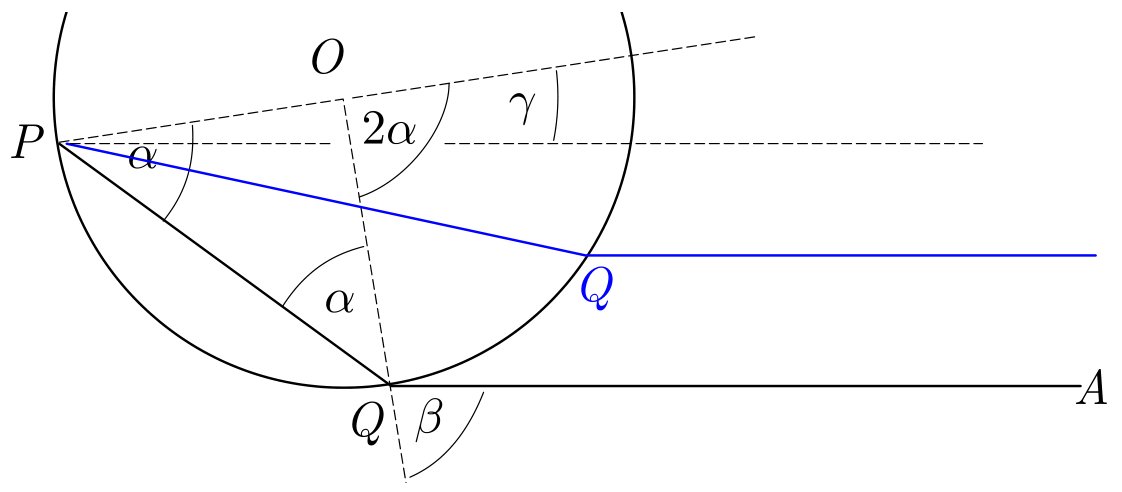
To begin with, let us notice that if a ray coming from a point on the stripe is refracted at point at the surface of the ball towards a very distant point (which denotes the aperture of the camera lens), the ray will remain in the plane where is the centre of the sphere. This means that those rays which arrive from to must lay in the plane , and the rays can be conveniently depicted in the -plane.
The angle between vectors and is given by
and is a non-monotonous function of which achieves its maximum by a certain . This means that for a fixed and , if , there are two such angles and, hence, two such positions and for the point that the ray will reach the point (here we have assumed that the point is at a very big distance). So, when viewed from the point , the image of the point is split into two points and . On the other hand, if , rays from cannot reach , and such points on the stripe cannot be seen in the photo. If , the two images and merge into a single point bridging the two images of a piece of stripe into a closed loop.
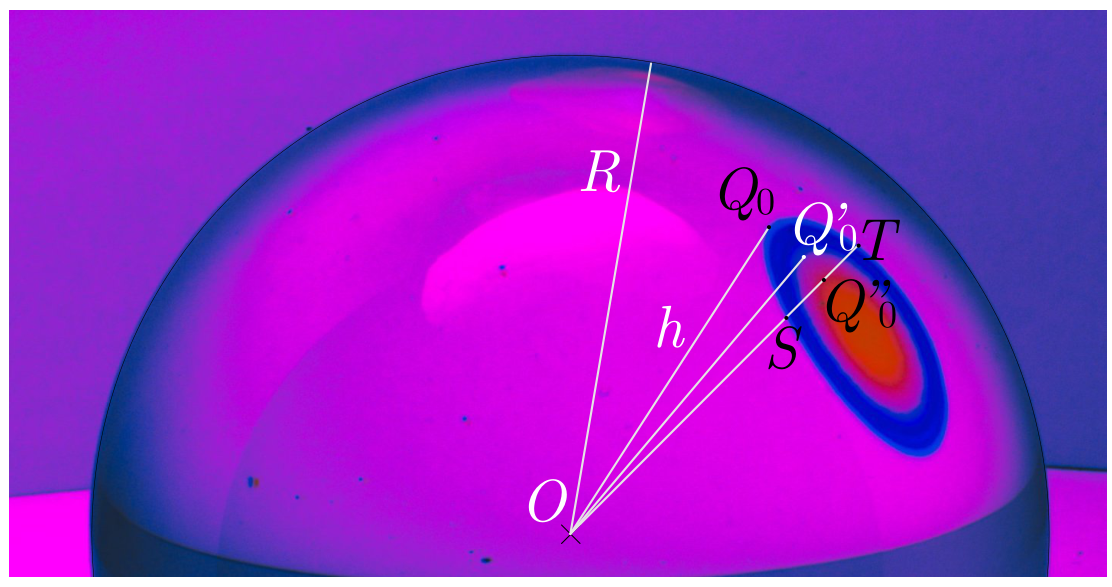
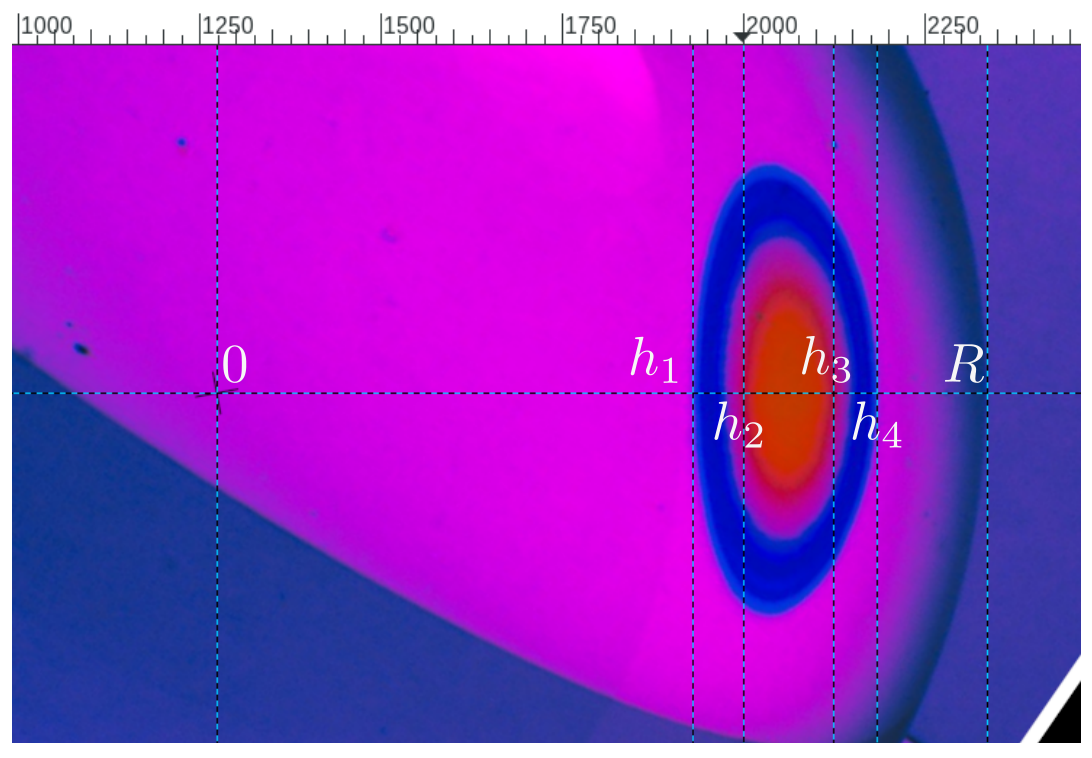
Now it becomes clear that the place where images and merge into a single image is the key to finding the coefficient of refraction. Indeed, the point can be found in the photo as the point where the blue ellipse (the images of a segment of the stripe in red light as the blue shadow is where the red light is missing) is touching a radius of the ball, see the figure below (we need to find tangent point with the radius because we need to consider plane which projects into a line through the ball’s centre). There is no difference between taking the tangent to the outer edge of the elliptical stripe and taking the tangent to the inner edge of it (point in the photo below). Then, can be determined from the photo as the ratio of the lengths and , , where denotes the distance of the ball’s centre from the line , measurable in the photo as the length (when looking from the distant point , we can see only the perpendicular-to- component of the segment , and is the ball’s radius.
Since we look for an extremum of , upon taking differentials from Eqns. (7,8), we obtain
from where
In order to find , we could find in a similar way (, ), but the result would have a huge relative uncertainty as and have very similar lengths. A much more precise result will be obtained if we base our calculations on the segment length , see the figure below. is where the blue rays have an extremum for while and are two red rays originating from the same point on the stripe. From the photo we can measure , hence we can use the small parameter .
Rays from , , and arrive to the lens aperture, so all these rays (which originate from the same point on the stripe) have the same value of . So, we have a set of equations
and we would like to get an expression relating to , where the indices 1 and 2 relate to the two different solutions. Expressing we obtain from Eq. (10) that . Now, if we expand Eq. (12) into Taylor series, neglect the smallest term with , and keep in mind Eq. (11), we obtain
Here the two linear-in- terms cancel out due to Eq. (13) so that with we obtain
On the other hand, , hence
Grading scheme
A-i
- Proving that we can see a loop because for a range of points on the thread, a single point of thread creates two images: 0.7 pts
- The endpoints of that thread create one image forming thereby a closed loop: 0.3 pts
Else if only the fact that rays coming to A must be in the PQO plane is stated: 0.3 pts
A-ii Drawing a ray diagram where we can see that two rays originating from a single point arrive both to the lens while crossing the ball’s surface at different points and following the Snell’s law: 1.0 pt
Else if such idea is demonstrated by words or by a rough sketch (which does not obey Snell’s law): 0.5 pts
B-i Relating angle to the measurable distance in the photo (any point on the blue or red ellipse will earn the mark): 1pt
B-ii Measuring ratio of to : 0.5 pts
B-iii The idea of using point : 1 pt (using will earn only 0.5 pts as this corresponds to the violet light)
B-iv Obtaining a correct expression of as a function of (or equivalent calculations in different parametrisation): 1 pt
B-v Finding extremum and hence, the final expression of as a function of or : 1pt. If an incorrect expression is obtained from reasonable physics because of mistakes in algebraic manipulation: 0.5 pts
B-vi If the numerical answer is correct within and is found using reasonable physics: 0.5 pts. Else if the numerical answer is correct within and is found using reasonable physics: 0.3 pts. No point if the answer is guessed or is found using completely wrong or irrelevant physics.
C-i The idea of using the width or length of the blue ellipse: 1 pt (red ellipse cannot be used as we don’t know if the center of the red ellipse corresponds to the edge of the thread, or to a point at its middle)
C-ii Obtaining Eq (14) or something equivalent based on considering neighbouring red and violet rays: 1 pt. If an incorrect expression is obtained from reasonable physics because of mistakes in algebraic manipulation: 0.5 pts
C-iii Expressing correctly in terms of measurable quantities: 0.5 pts
C-iv Finding numerical answer correct within : 0.5 pts. (0 pts if this answer is obtained without considering the width or height of the blue ellipse.)
Solution 2
One may alternatively prefer to consider a plane, perpendicular to the thread and containing the ball centre and the camera . This is the plane of symmetry for the system and corresponds to the maximum width of the ovals. The same arguments as in the first Solution lead to
For this function is not monotonous and may give the same result for two different values of (that is why the mapping of an arc is a closed oval).
To get the refraction index for red we solve the equation
which gives .
One could repeat the previous argument to find . One could also compare the images of the same thread elements in different colours. This gives 4 equations
where means we can replace it with the value of or . Similar rule applies for . From each equation, we can solve for one value of and then take their average. This results in .
Grading scheme
A-i
- Proving that we can see a loop because for a range of points on the thread, a single point of thread creates two images: 0.7 pts
- The endpoints of that thread create one image forming thereby a closed loop: 0.3 pts
Else if only the fact that rays coming to A must be in the PQO plane is stated: 0.3 pts
A-ii Drawing a ray diagram where we can see that two rays originating from a single point arrive both to the lens while crossing the ball’s surface at different points and following the Snell’s law: 1.0 pt
Else if such idea is demonstrated by words or by a rough sketch (which does not obey Snell’s law): 0.5 pts
B-i Relating angle to the measurable distance in the photo (any point on the blue or red ellipse will earn the mark): 1pt
B-ii Measuring ratio of to : 0.5 pts
B-iii The idea of using points on the blue ellipse lying on the same radius of the sphere: 1 pt
B-iv Obtaining the correct equation to solve for numerically: 2 pts. If an incorrect equation is obtained from reasonable physics because of mistakes in algebraic manipulation: 1 pt
B-v If the numerical answer is correct within and is found using reasonable physics: 0.5 pts. Else if the numerical answer is correct within and is found using reasonable physics: 0.3 pts. No point if the answer is guessed or is found using completely wrong or irrelevant physics.
C-i The idea of using points on the red (or both) ellipse(s) lying on the same radius of the sphere: 1 pt
C-ii Obtaining at least one correct equation to solve for numerically: 1.5 pts. If an incorrect equation is obtained from reasonable physics because of mistakes in algebraic manipulation: 1 pt
C-iii Finding numerical answer correct within : 0.5 pts.
Оригинал в Архива: EuPhO_2021-theory.pdf · официални решения: EuPhO_2021_Solutions-2.pdf