EuPhO 2024, Експеримент — Задача 1. Task E.1 — Elasticity of the ball
"EuPhO 2024, Kutaisi, Georgia — Experimental Problems" · 2 т.
Условие
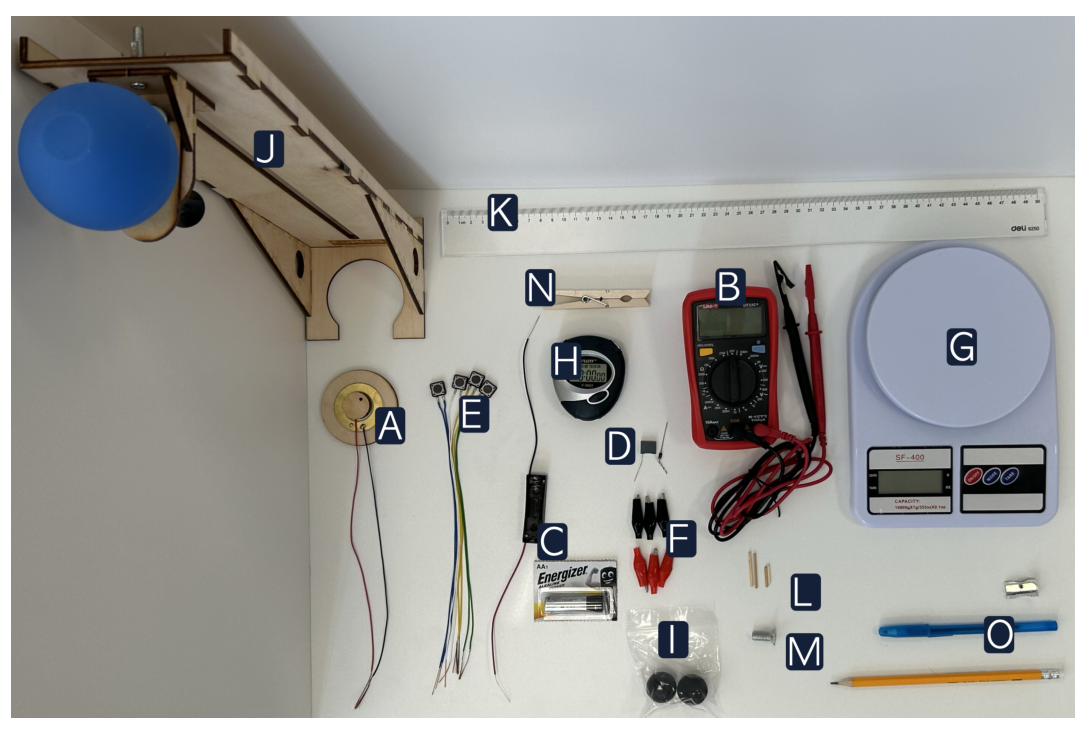
Of the two rubber balls you are provided with, one is more elastic than the other.
For the more elastic rubber ball, determine the fraction of kinetic energy which is lost during a collision with a solid surface. Determine this fraction for three different values of the initial kinetic energy.
Решение
Task E.1 - Elasticity of the ball
The elasticity can be computed as the ratio of the kinetic energy immediately before and after the bounce. Since the air drag is small, these energies are directly proportional to the dropping height , or to the bouncing height . In order to measure or as precisely as possible, it is necessary to devise a method to minimise parallax errors and take into the fact that the rule's zero is offset from its endpoint. Below is described one of the ways to do this.
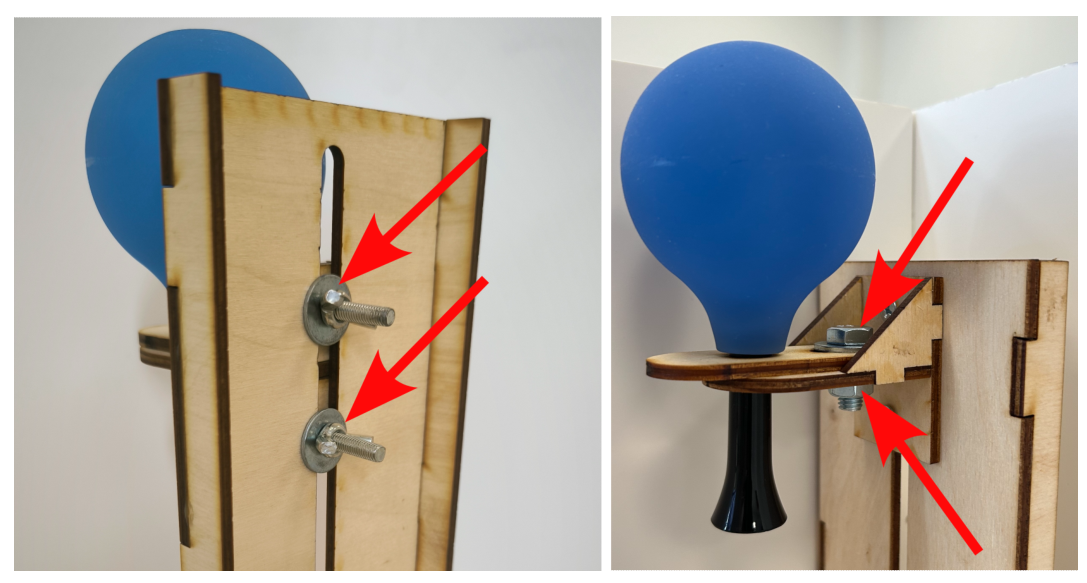
We attach the ruler with the help of a peg onto one of the wings of the stand, fix (by sucking) a ball to the the black pipe of the release mechanism, and take the reading of the ruler at the lowest point of the hanging ball. We call this measured quantity and it relates to via the thickness of the wood on the bottom (), and the starting height of the scale on the ruler () so that .
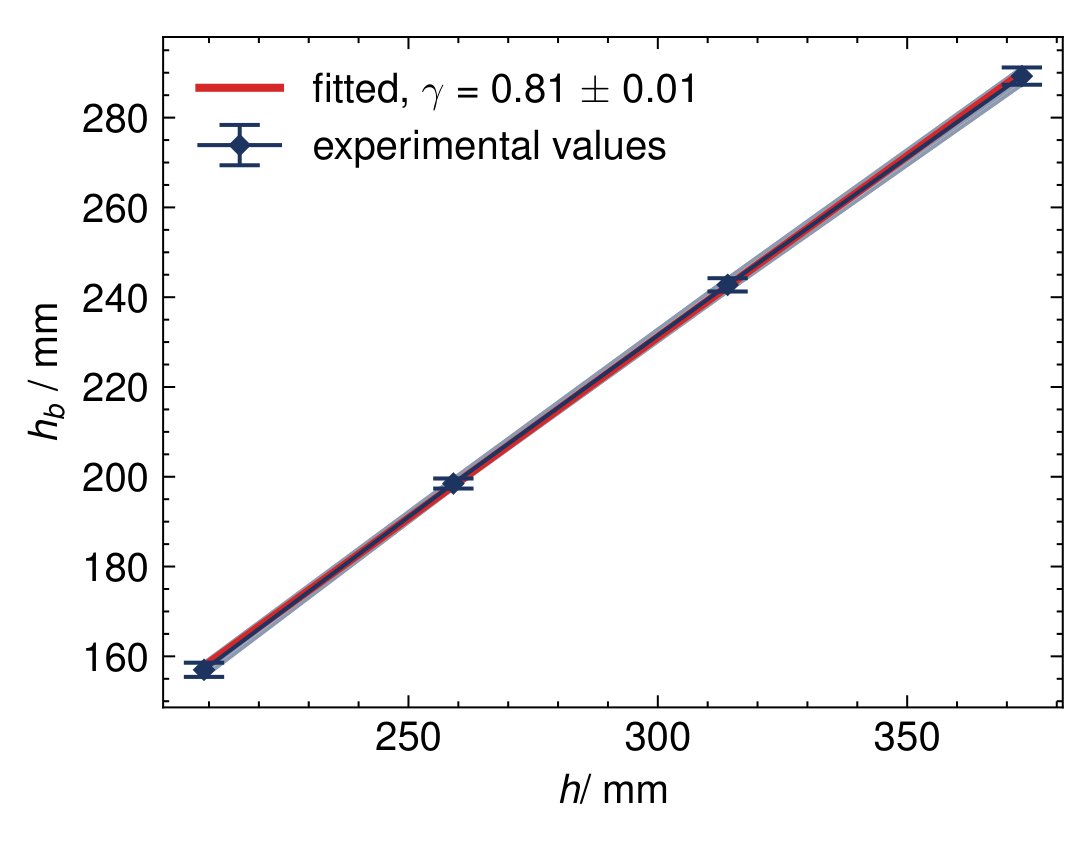
We record the dropping and bouncing height for 4 different heights, and for each height, we repeat the experiment 5 times. With a linear fit (Fig. 1), we obtain a slope of ; therefore, the energy loss fraction is expressed as
In the framework of this task, it would also be a valid, yet less precise method and therefore, awarded partial marks only, for each height to compute the ratio and take the average of these 4 ratios.
E.1 - Elasticity of the ball
| Points | ||
|---|---|---|
| a | Approach and Measurement | 0.9 |
| Idea that the fraction of kinetic energy after bounce can be found as | 0.3 | |
| 0.1 per each three measured pairs of heights ( and ), up to 9 pairs of heights, possibly with the same | 0.3 | |
| 0.1 per each different value used, up to 3 values | 0.3 | |
| b | Evaluation and result | 1.1 |
| Graphical evaluation, or fit via calculator | 0.5 | |
| Alternatively: evaluation via point-wise average | or 0.3 | |
| value of * inside OR value of inside | 0.6 or 0.3 | |
| Total on E.1 | 2.0 |
Special cases and penalties
- If a student computes instead of , full marks will still be given according to the table above.
- Special case: multiple bounces It is a valid approach to measure the time it takes for the ball to make several bounces for different heights or the total time it takes for the ball to stop bouncing. The theory behind that must be demonstrated to evaluate to a correctly linearized form of which can be extracted but in that case one can receive full marks with that approach. If the approach is chosen without correct linearization, the first 0.3 points are deducted, the rest is graded normally, so a total 1.7 points would still be possible.
Оригинал в Архива: eupho2024_experiment_problems.pdf · официални решения: eupho2024_experiment_solutions.pdf