EuPhO 2024, Експеримент — Задача 4. Task E.4 - Deformation of the ball
"EuPhO 2024, Kutaisi, Georgia — Experimental Problems" · 4,5 т.
Условие
In this part you will be dropping the more elastic rubber ball on the piezo element. During the collision between the ball and the piezo, the ball experiences deformations. You can assume that the force acting on the ball depends on the ball's elastic deformation as a power law:
Find the exponent and the material constant .
Отговори
Results from Eqs. (18)–(20) of the official solution.
Решение
Task E.4 - Deformation of the ball
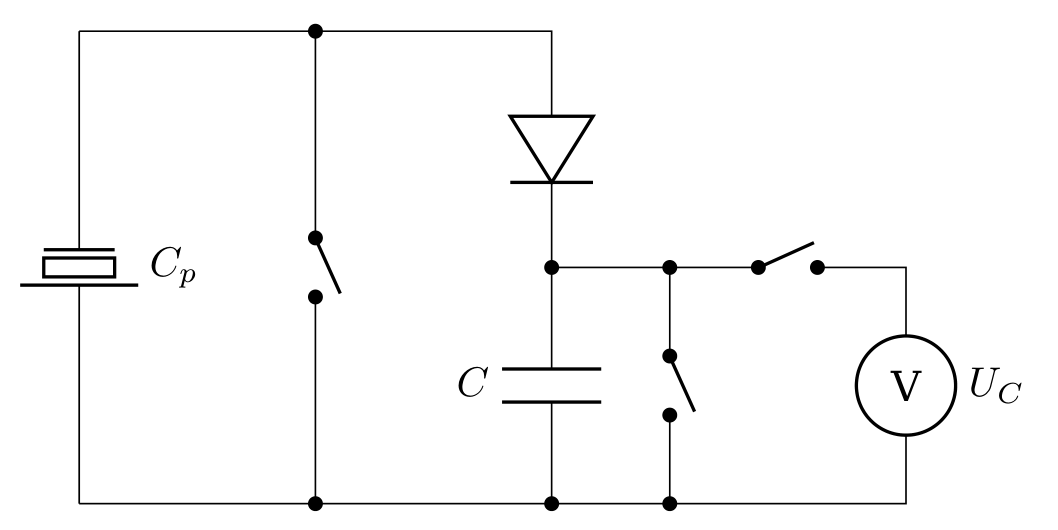
When the ball is dropped onto the piezo element, the kinetic energy just before the collision is partially converted into elastic deformation and the remainder dissipated as heat and sound. At the point of maximal deformation, the kinetic energy is zero and the force on the ball and piezo is also at its maximum. By using the diode that is soldered to the capacitor, we can prevent charges from flowing backwards and therefore store the maximum voltage during the measurement. You can see the corresponding circuit diagram in Fig. 9.
If we drop the ball onto the piezo element from different heights, we will provide different kinetic energies before the impact. Each time, we read the maximum voltage from the capacitor and convert it into piezo voltage by multiplying with . Multiplying again with the linear slope found in task E.2c, we get the maximum force during the impact . With that, we can, for each initial kinetic energy, compute the maximum deformation .
We integrate the force and find the maximum elastic energy the ball reaches during the collision.
From task E.1, we can express the elastic energy of the ball, when dropped from height :
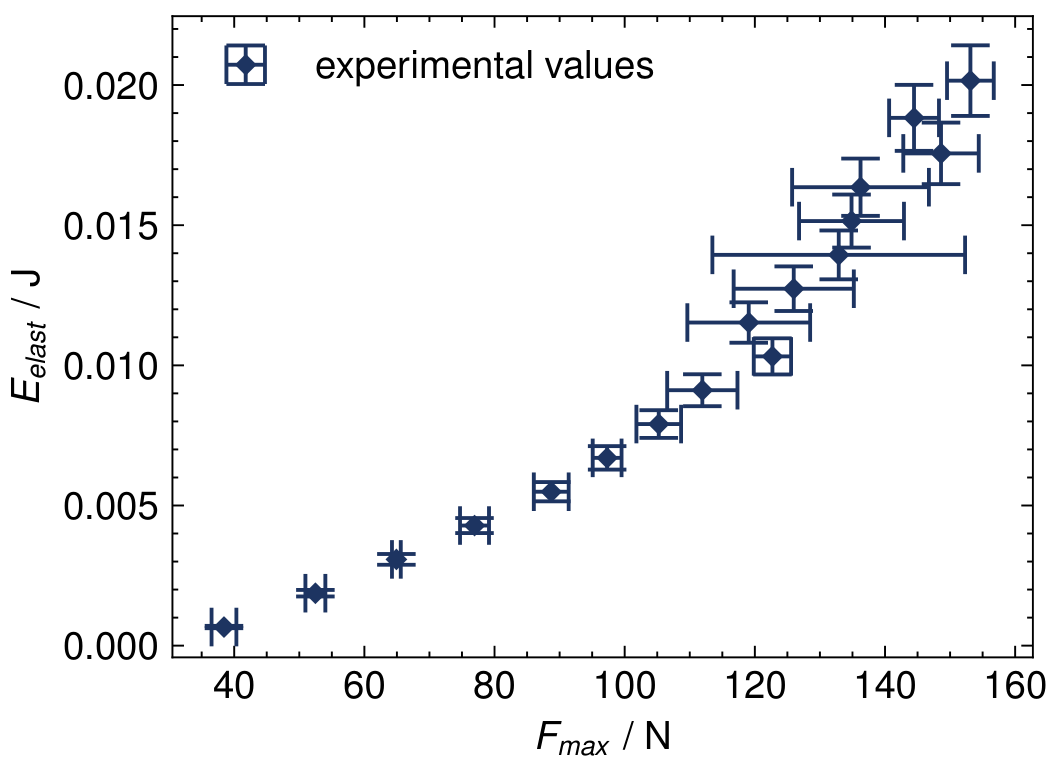
where can be measured using the scales. Using that, we can plot the elastic energy as a function of the maximum force. However, this linear plot (Fig. 10) was not required from the students, we only show it here for illustration.
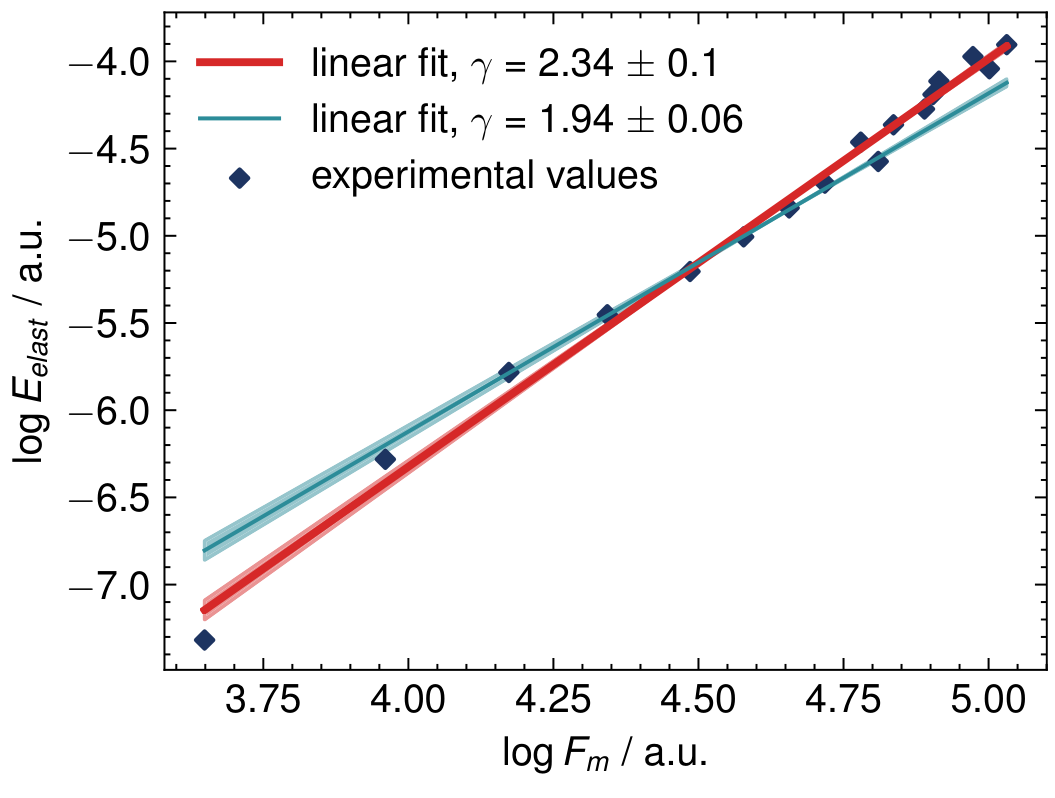
Taking the logarithm of both and , we arrive at a linear function, which we can plot (Fig. 11).
Extracting the slope , we arrive at a value of of:
A more correct way is to take into account only the nicely linear region in the center of the range. The reason for dropping the leftmost datapoint is that the relative uncertainty of the underlying height measurement is very low. The reason for dropping the rightmost datapoints lies in the force-voltage curve: we are already starting to approach the saturation region.
Note: This result is actually surprising, since, according to the Hertz theory, we would have expected an exponent of 3/2. This is again something related to the piezo element being glued to the plates: while the crystal tries to take a bowl-like shape, plate moves slightly towards the ball, hence the deformation of the ball does no longer strictly correspond to its displacement during the impact.
With Eq. 17, we can compute from the interception of the fit (), so:
E.4 - Deformation of the ball
| Points | ||
|---|---|---|
| a | Aproach | 1.5 |
| Idea to use the diode in combination with the capacitor for extracting the maximum piezo voltage during a drop | 0.5 | |
| using switch to discharge piezo (documented via circuit diagram or detailed description!) | 0.5 | |
| Approach that the elastic kinetic energy part from dropping is the same as deformation energy | 0.5 | |
| b | Measurement | 1.0 or 0.5 |
| If the piezo has not been discharged before each individual measurement, the points are halved (it is assumed that the piezo has not been discharged if the voltage readings of the datapoints fluctuate significantly around the expected values) | ||
| 0.1 per measured 2 height values, up to 8 different height values | 0.4 | |
| 0.1 per measured 10 cm of height range | 0.3 | |
| 0.1 per repetition per data point, up to 3 repetitions | 0.3 | |
| c | Evaluation and result | 2.0 |
| Linearisation equivalent to Eq. 17 | 0.8 | |
| Graphical evaluation for and , or fit via calculator | 0.7 | |
| Value of between | 0.3 | |
| Value of between | 0.2 | |
| Total on E.4 | 4.5 |
Special cases and penalties
- If no circuit diagram was provided, the first 1.0 points are deducted for the measurement technique with the diode and discharging the piezo on the capacitor.
- If the voltmeter has been used directly for measuring the piezo voltage (without capacitor and diode), the data are unusable. Therefore, we cannot award the first 0.5 + 0.5 points in the approach, and also, no points are awarded for the measurement data taken. However, for the evaluation part, we do not subtract points even if it is done with these unusable data as long as a correct evaluation method has been used.
Оригинал в Архива: eupho2024_experiment_problems.pdf · официални решения: eupho2024_experiment_solutions.pdf