EuPhO 2025 — Задача 2. E2 – Hidden pattern (10 pts)
Автор: Olympiads XYZ · транскрипция на официалните материали
Проверена срещу оригинала на 13.9.2026 от същия модел, който я е транскрибирал (без независима проверка)
Experimental Problems Language: English · 10 т.
Внимание: Бележка към темата
Task 6 solution continues beyond this window; Tab. 5, Figures 8 and 9 and the final verification are on later pages.
Условие
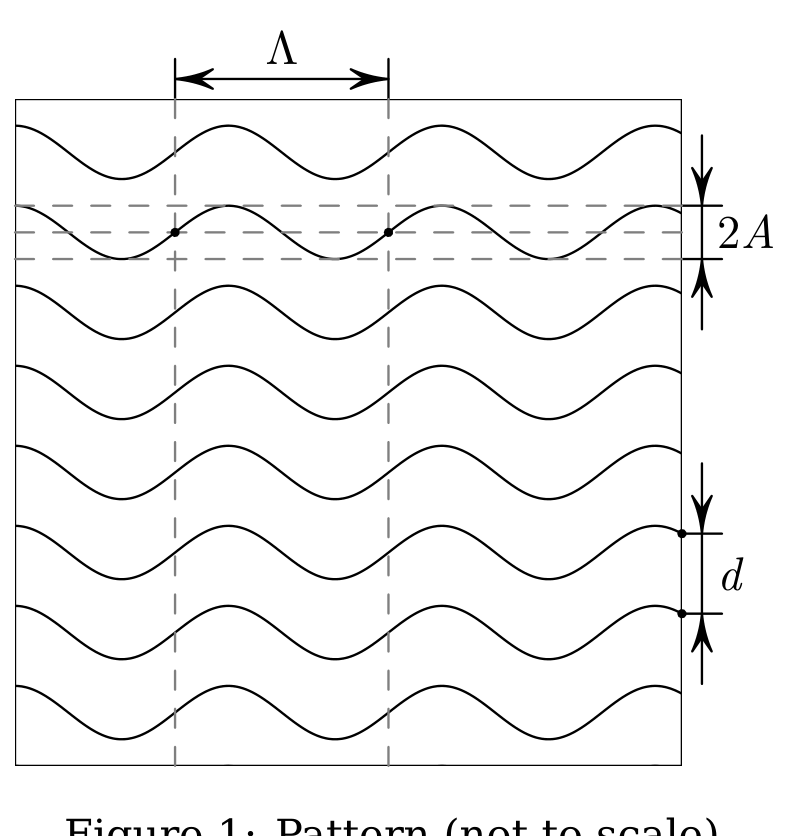
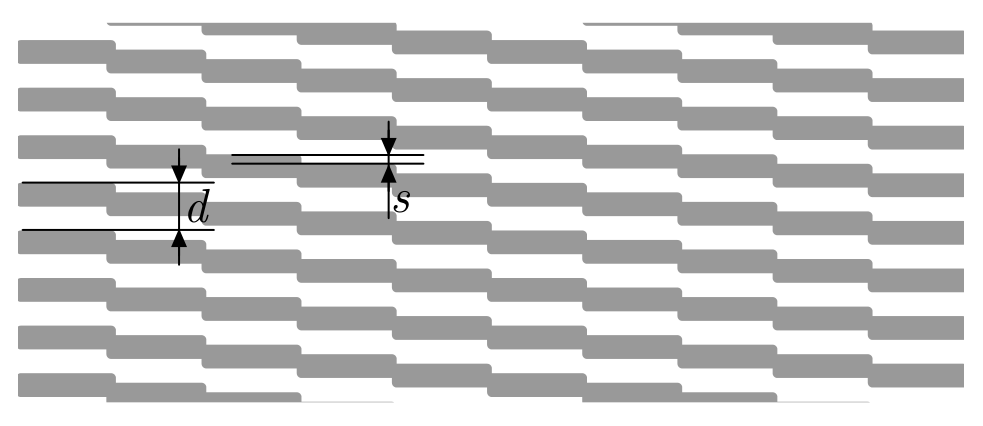
You are given a flat semi-transparent foil with a micro-pattern printed on its surface that is invisible to the naked eye. The pattern consists of a large number of identical sinusoids with amplitude , running horizontally with spatial period , and vertically shifted by distance relative to each other, as schematically shown in Fig. 1. Under a microscope, one can see that the printed pattern is composed of strictly horizontal line segments, each vertically displaced from its neighbours by a constant pitch , as shown in Fig. 2.
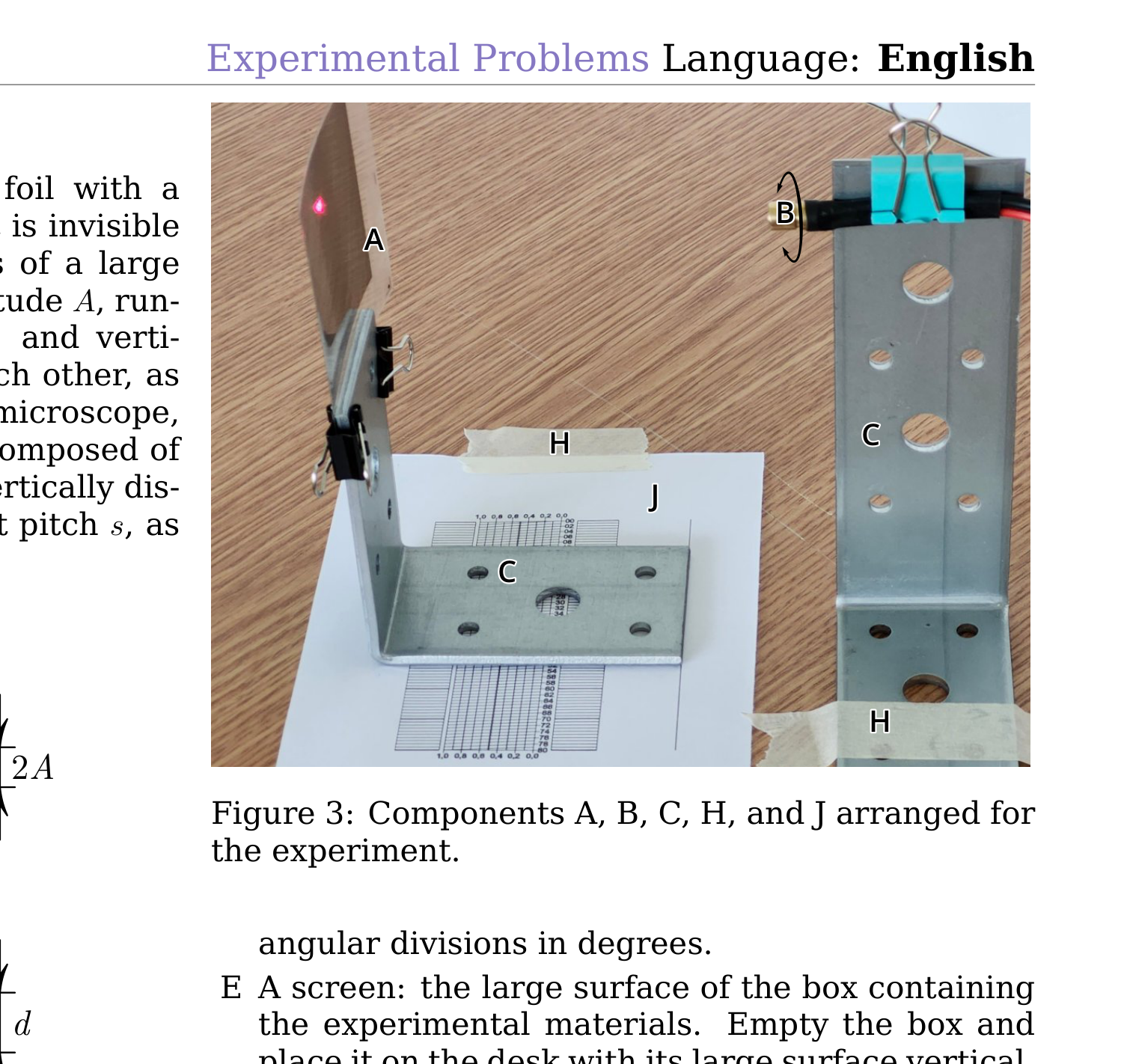
Equipment (see also Fig. 3)
A Semi-transparent foil with a micro-pattern printed on its surface.
B Laser diode with wavelength . The laser diode can be focused to the desired distance by rotating the end cap with a lens inside.
Warning: Do not completely unscrew the end cap! Inside, there is an oriented lens and a spring. No replacement laser will be given if damaged or disassembled.
C Two 90-degree L-shaped steel planks serving as stands for the foil and the laser diode. The foil can be fixed to one of the planks using the provided small clips. The laser diode can be mounted to the other plank with a larger colored clip or with the provided rubber band.
D A sheet of paper with a printed goniometer – a polar coordinate frame with 1-mm radial steps and angular divisions in degrees.
E A screen: the large surface of the box containing the experimental materials. Empty the box and place it on the desk with its large surface vertical.
F Ruler.
G Measuring tape.
H Adhesive tape attached to the ruler. Use pieces of the tape to fix the printed goniometer to the screen or to secure components to the table. You can ask for more tape if needed.
I Millimeter graph paper.
J An 80 mm paper measuring scale with diagonal reference lines that allow you to measure fractions of the main scale divisions, accurate to .
Hint: In all of your measurements you are free to draw or put marks on the screen.
Important: Assume that the surface of the experimental desk is flat, and the screen is strictly perpendicular to the desk.
In all of the tasks you are expected to:
- sketch a setup and/or rationalize a method for measuring the corresponding quantities;
- report your measurements and calculations in a tabular form;
- estimate the desired quantities and their uncertainties graphically, whenever reasonable.
a Determine as precisely as possible: The sinusoid period . (2 pts) [2 т.]
b The vertical offset of the neighbouring sinusoids (2 pts) [2 т.]
c The sinusoid amplitude (3 pts) [3 т.]
d The step height (3 pts) [3 т.]
Решение
Покажи официалното решение
Оригинал в Архива: eupho2025_experiment_problems.pdf · официални решения: eupho2025_experiment_solutions.pdf