GeCAA 2020, Анализ на данни — Задача 3. Hypervelocity stars
GeCAA-2020 — Data Analysis · 55 т.
Условие
In recent years, a new field of research has emerged, that of Hypervelocity Stars (HVS for short). These are stars in our Galaxy (mostly at its outskirts), which are moving with excessive velocities and may be escaping from the Milky Way.
In this question, you will use spectroscopic and astrometric measurements in order to calculate the velocity of one such star, called “HVS1”, consider its origin and whether it may escape the Galaxy.
Figure 3 shows a spectrum of HVS1 in the blue to UV part of the spectrum:
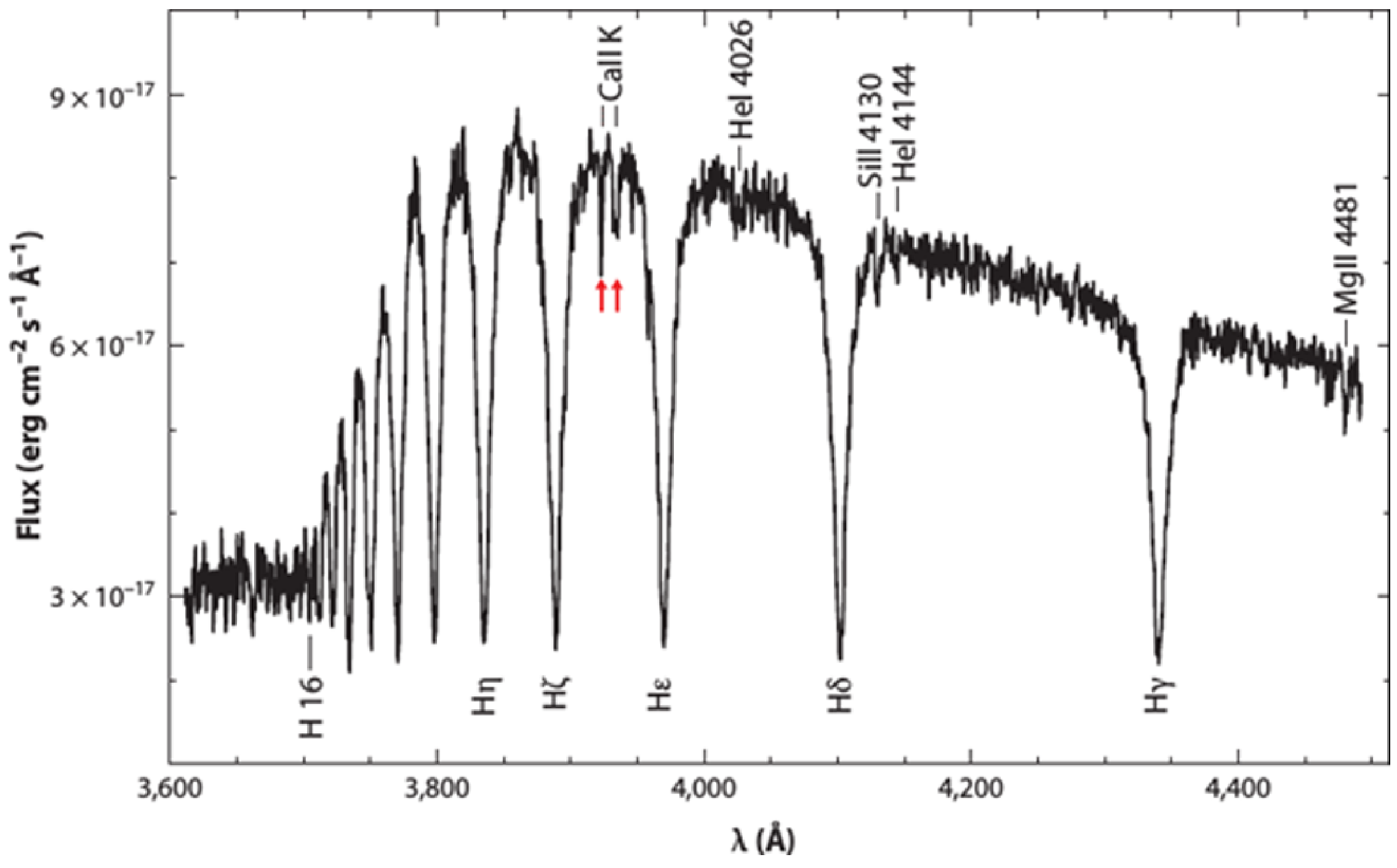
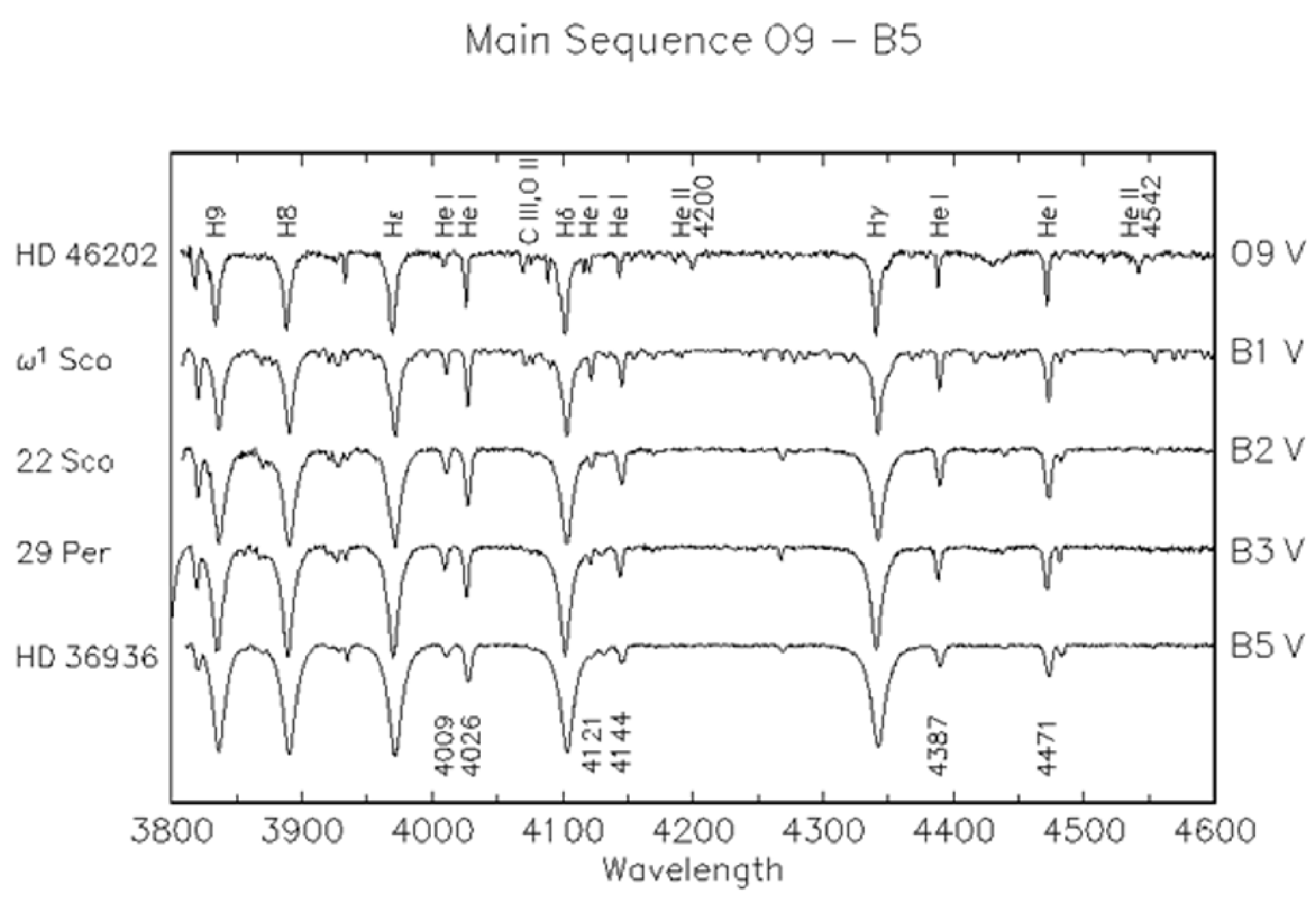
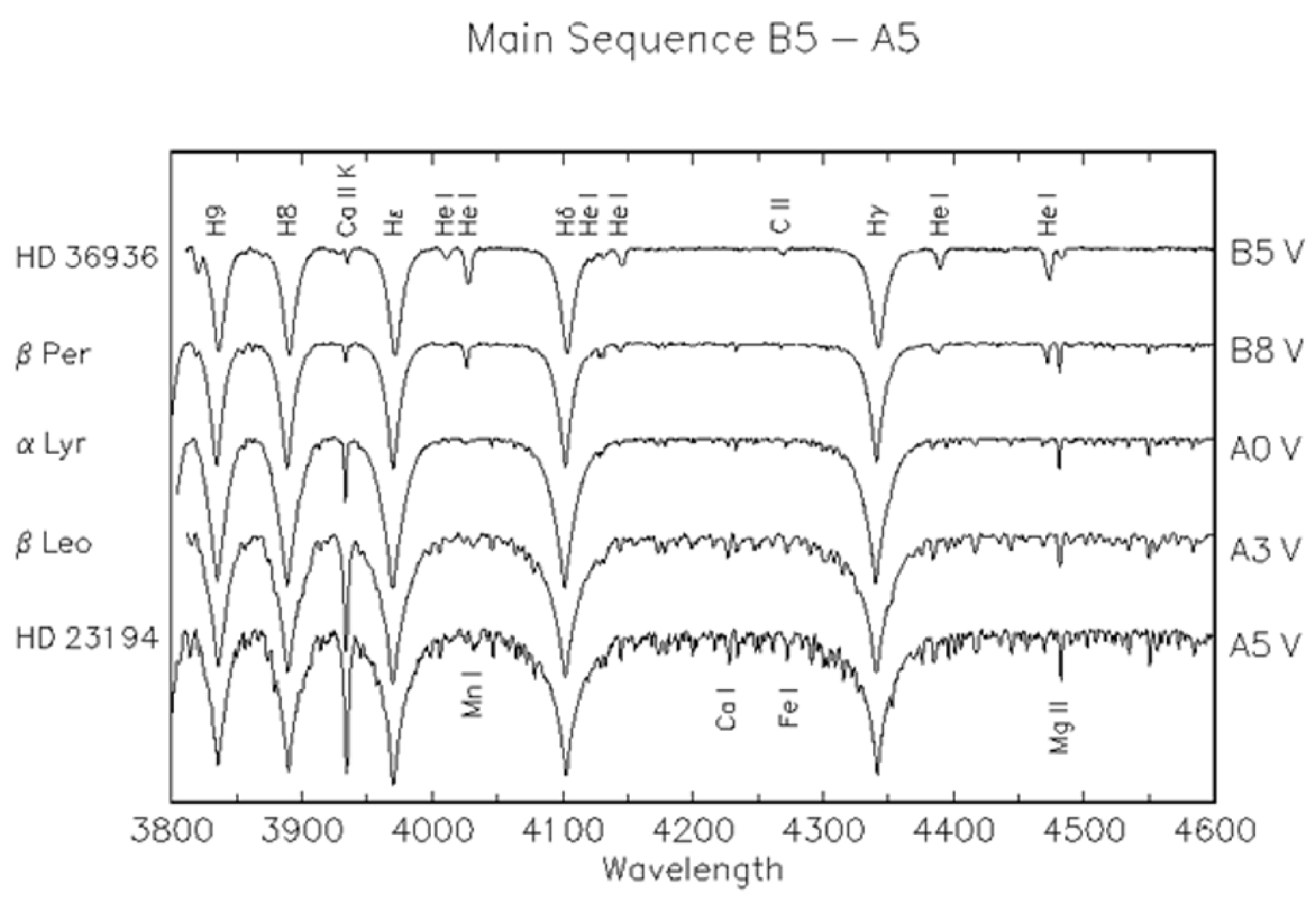
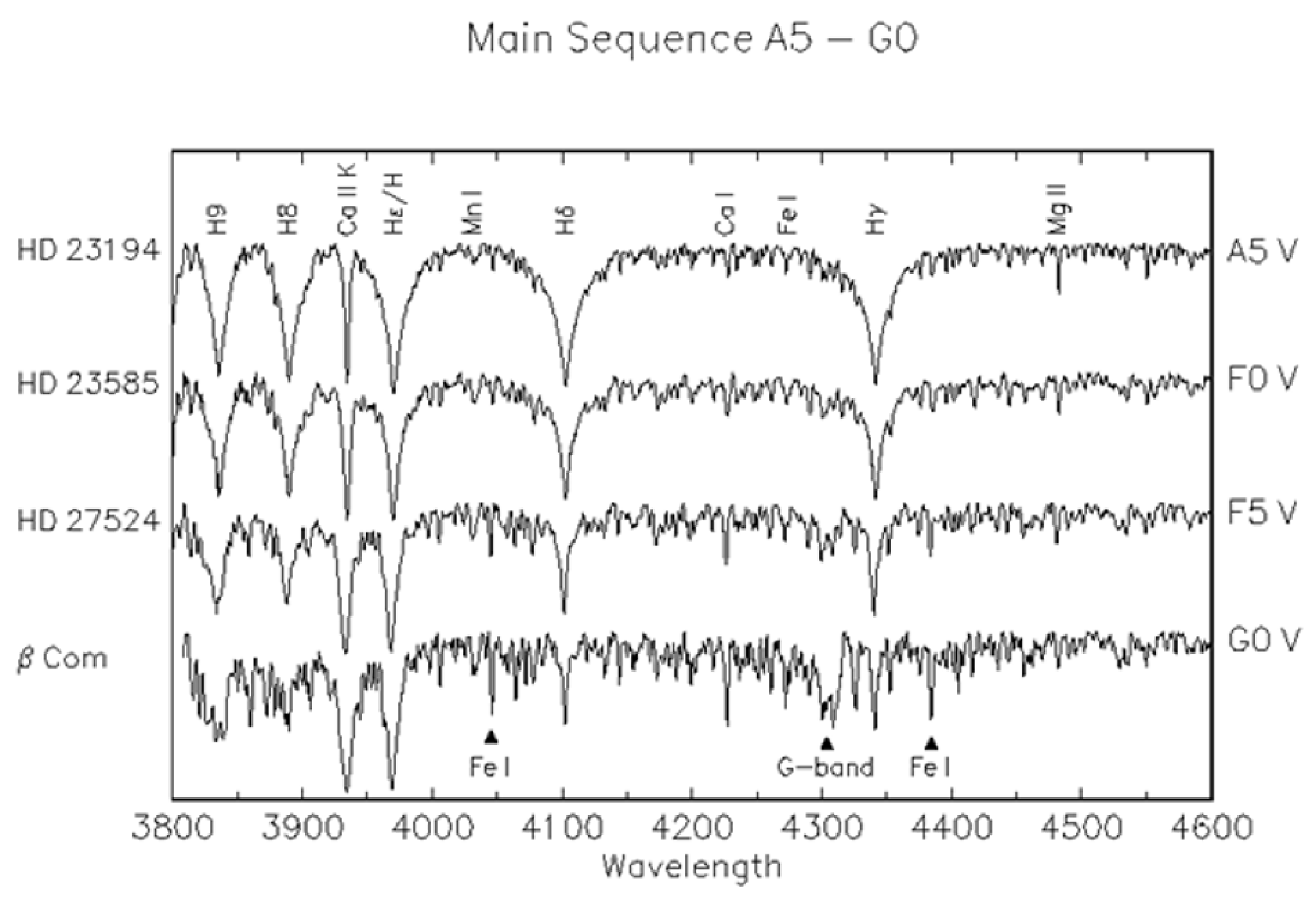
(a) Determine the spectral type of the star using the standard spectra in the Appendix 3 and the absorption lines identified on the spectrum of HVS1. (Note that the spectrum above contains both stellar and interstellar absorption lines.) [7 т.]
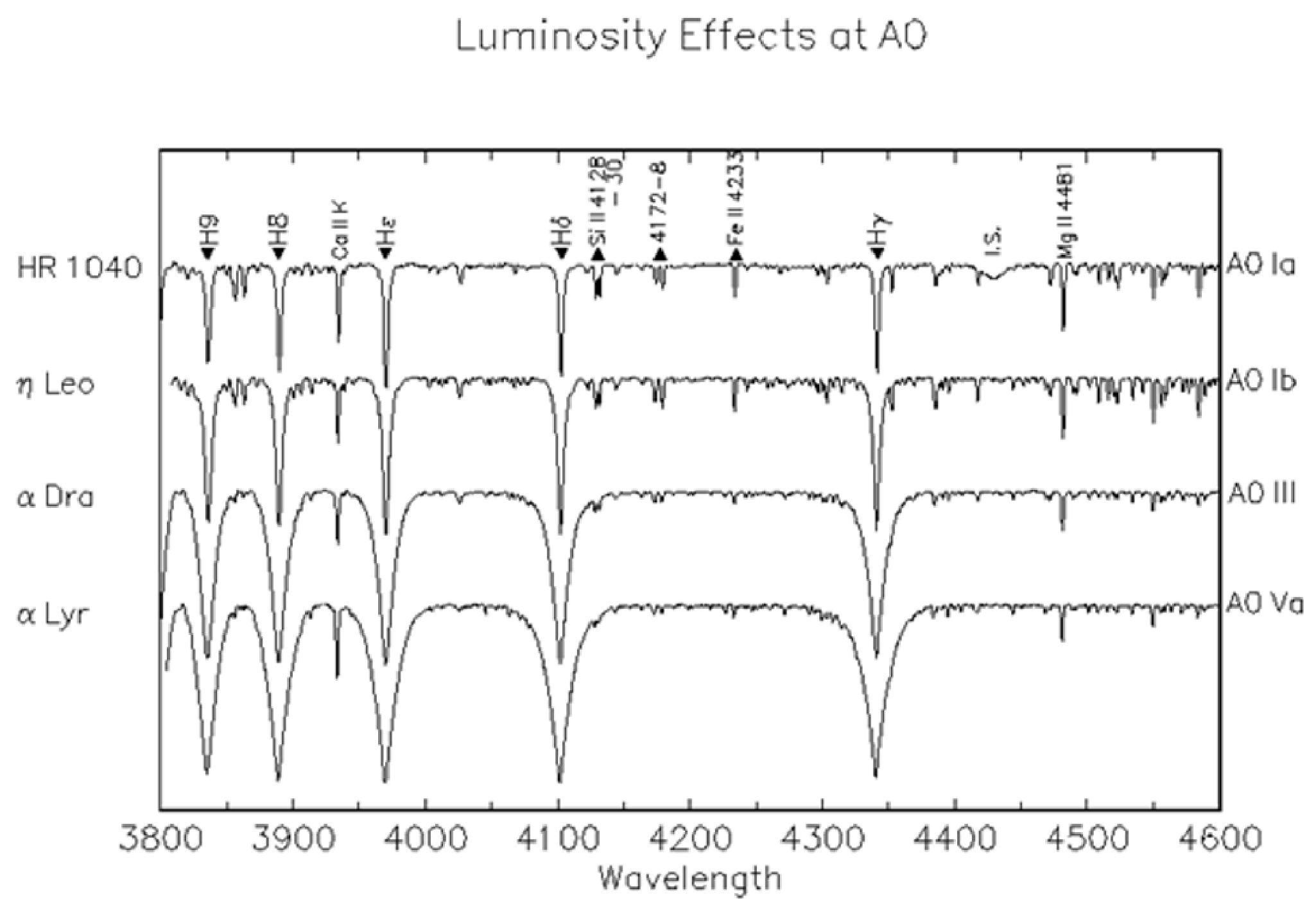
(b) Detailed modeling of the spectral lines places the star between luminosity classes V (Main Sequence) and IV (subgiant).
i. The apparent magnitude of the star in the visual band is . Find the absolute magnitude of the star using Appendix 1 for the two possible luminosity classes.
You may ignore the uncertainty in since the uncertainty in your calculation will be dominated by the uncertainty in .
ii. For both these possible luminosity classes, calculate the star’s distance from the Sun, ignoring interstellar absorption.
iii. The galactic coordinates of HVS1 are , . Is the assumption of ignoring interstellar absorption justified? (YES/NO)
iv. The Gaia mission of the European Space Agency has been mapping the Milky Way since 2014, measuring the parallax and proper motion of 1.5 billion stars to an accuracy between 0.04 and 0.1 milliarcseconds (mas). Could Gaia have measured the parallax of HVS1,
(A) if it is a MS star? (YES/NO)
(B) if it is a subgiant? (YES/NO)
For the rest of this question, adopt the larger of the distances you have calculated above.
v. Assume that the distance of the Sun from the GC is 8.0 kpc. Make a rough sketch of the relative positions of HVS1, the Sun and the Galactic center (GC). Use it to calculate the distance () of HVS1 from the GC. [18 т.]
(c) Here, you will calculate the velocity of HVS1.
i. The spectrum in the figure 3 shows two absorption lines due to Ca II. One is caused by the atmosphere of the star and the other is due to the interstellar medium. The shift of this line is due to the motion of the star with respect to the interstellar medium. Measure this Doppler shift and calculate the radial velocity of HVS1 with respect to the Sun.
ii. We are interested in the velocity with respect to the Galactic center. For this, we first need to take into account the velocity of the Sun due to the rotation of the Galaxy. The following equation transforms the velocity of a star of heliocentric radial velocity to the one in the galactic rest frame (rf), :
where the speeds are measured in . Find for HVS1.
iii. HVS1’s proper motion (milliarcseconds/year) has been measured as:
Calculate the tangential velocity component (in km/s) of HVS1. (You may ignore the correction for declination as the star is near the celestial equator).
iv. Calculate the velocity of the star with respect to the Galactic center magnitude in km/s and angle with respect to the direction of the Galactic center in degrees.
v. Assuming this star was born in the Galactic disc, use your calculation of the velocity to estimate where in the Galactic disc it is more likely to have come from:
- near to the Galactic center
- further out in the Galactic disc [17 т.]
(d) From the energy considerations,
i. Obtain an expression for the escape speed as a function of the distance from the Galactic center and the enclosed mass.
ii. Calculate the mass of the galaxy (in solar masses) within the radius of the distance of HVS1
where pc is a constant of the equation and .
iii. Calculate the magnitude of the escape velocity at the distance of HVS1.
iv. Is this a runaway star? (YES/NO) [6 т.]
(e) How long has it taken for HVS1 to reach this position? Write answer in years. [2 т.]
(f) On the basis of the spectral type and the luminosity class of this star, estimate the age of HVS1. Compare this with your result in the previous part. Which one of the following statements about the origin of the star is true:
- The star was ejected when or shortly after it was formed.
- The star was ejected mid-way through its time on the Main Sequence.
- The star was ejected towards the end of its time on the Main Sequence. [3 т.]
(g) Astronomers looking for HVS-s start by finding a sample of stars in the Galactic halo which are of a spectral type similar to that of HVS1. Explain why by choosing which one of the following statements is true:
- Stars of this spectral type are young and so belong to the native population of the halo.
- Stars of this spectral type are old and so belong to the native population of the halo.
- Stars of this spectral type are young and so do not belong to the native population of the halo.
- Stars of this spectral type are old and so do not belong to the native population of the halo. [2 т.]
Appendix 1
Classification and absolute magnitude of stars ()
| Sp | Supergiants Ia | Supergiants Ib | Bright giants II | Giants III | Sub-giants IV | Main sequence dwarfs V | ZAMS V | White dwarfs VII | Population II: Sub-dwarfs VI | Population II: Red branch | Population II: Horiz. branch |
|---|---|---|---|---|---|---|---|---|---|---|---|
| O5 | −6.4 | −5.4 | −5.7 | ||||||||
| B0 | −6.7 | −6.1 | −5.4 | −5.0 | −4.7 | −4.1 | −3.3 | +10.2 | |||
| B5 | −6.9 | −5.7 | −4.3 | −2.4 | −1.8 | −1.1 | −0.2 | +10.7 | +2.3 | ||
| A0 | −7.1 | −5.3 | −3.1 | −0.2 | +0.1 | +0.7 | +1.5 | +11.3 | +0.8 | ||
| A5 | −7.7 | −4.9 | −2.6 | +0.5 | +1.4 | +2.0 | +2.4 | +12.2 | +0.5 | ||
| F0 | −8.2 | −4.7 | −2.3 | +1.2 | +2.0 | +2.6 | +3.1 | +12.9 | +0.4 | ||
| F5 | −7.7 | −4.7 | −2.2 | +1.4 | +2.3 | +3.4 | +3.9 | +13.6 | +4.8 | +4.8 | +0.4 |
| G0 | −7.5 | −4.7 | −2.1 | +1.1 | +2.9 | +4.4 | +4.6 | +14.3 | +5.7 | +4.1 | +0.3 |
| G5 | −7.5 | −4.7 | −2.1 | +0.7 | +3.1 | +5.1 | +5.2 | +14.9 | +6.4 | +2.0 | −0.1 |
| K0 | −7.5 | −4.6 | −2.1 | +0.5 | +3.2 | +5.9 | +6.0 | +15.3 | +7.3 | −0.2 | −0.6 |
| K5 | −7.5 | −4.6 | −2.2 | −0.2 | +7.3 | +7.3 | +15 | +8.4 | −2.2 | −2.2 | |
| M0 | −7.5 | −4.6 | −2.3 | −0.4 | +9.0 | +9.0 | +15 | +10 | −3 | −3 | |
| M2 | −7 | −2.4 | −0.6 | +10.0 | +10.0 | +12 | |||||
| M5 | −0.8 | +11.8 | +11.8 | +14 | |||||||
| M8 | +16 | +16 |
Appendix 2
| Species and ionization | Identification | Wavelength/nm | Species and ionization | Identification | Wavelength/nm |
|---|---|---|---|---|---|
| Ca II | K | 393.4 | TiO | 545–570 | |
| Ca II | H | 396.8 | Na I | D doublet | 589.0,589.6 |
| H I | Balmer Hε | 397.0 | TiO | 590–610 | |
| Fe I | 404.6 | CH | methane band | 619 | |
| H I | Balmer Hδ | 410.1 | TiO | 620–640 | |
| Ca I | g | 422.7 | H I | Balmer Hα | 656.3 |
| CH | G | 430–432.5 | TiO | 665–700 | |
| H I | Balmer Hγ | 434.0 | O | B (telluric band) | 686.7 |
| He II | 454.2 | HO | a (telluric band) | 716.0 | |
| TiO | 475–490 | CH | methane band | 725 | |
| H I | Balmer Hβ | 486.1 | HO | (telluric band) | 732–738 |
| TiO | 495–510 | O | A (telluric band) | 759.4 | |
| [O III] | oxygen | 495.9 | HO | Z (telluric band) | 790–840 |
| [O III] | oxygen | 500.7 | CH | methane band | 798 |
| TiO | 515–540 | CH | methane band | 887–911 |
Spectral lines useful in the spectral characterization of low resolution stellar spectra of different stars
Appendix 3
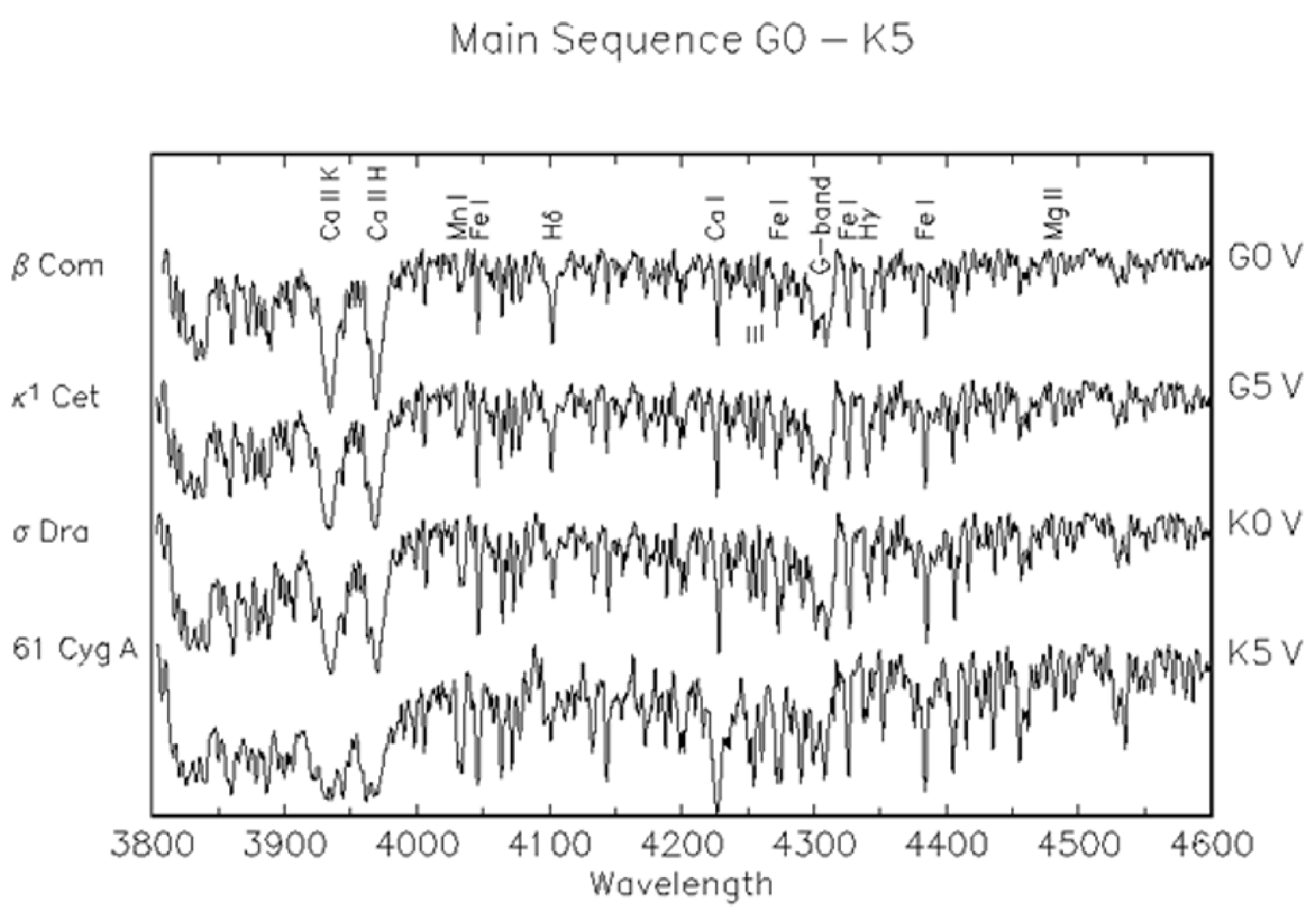
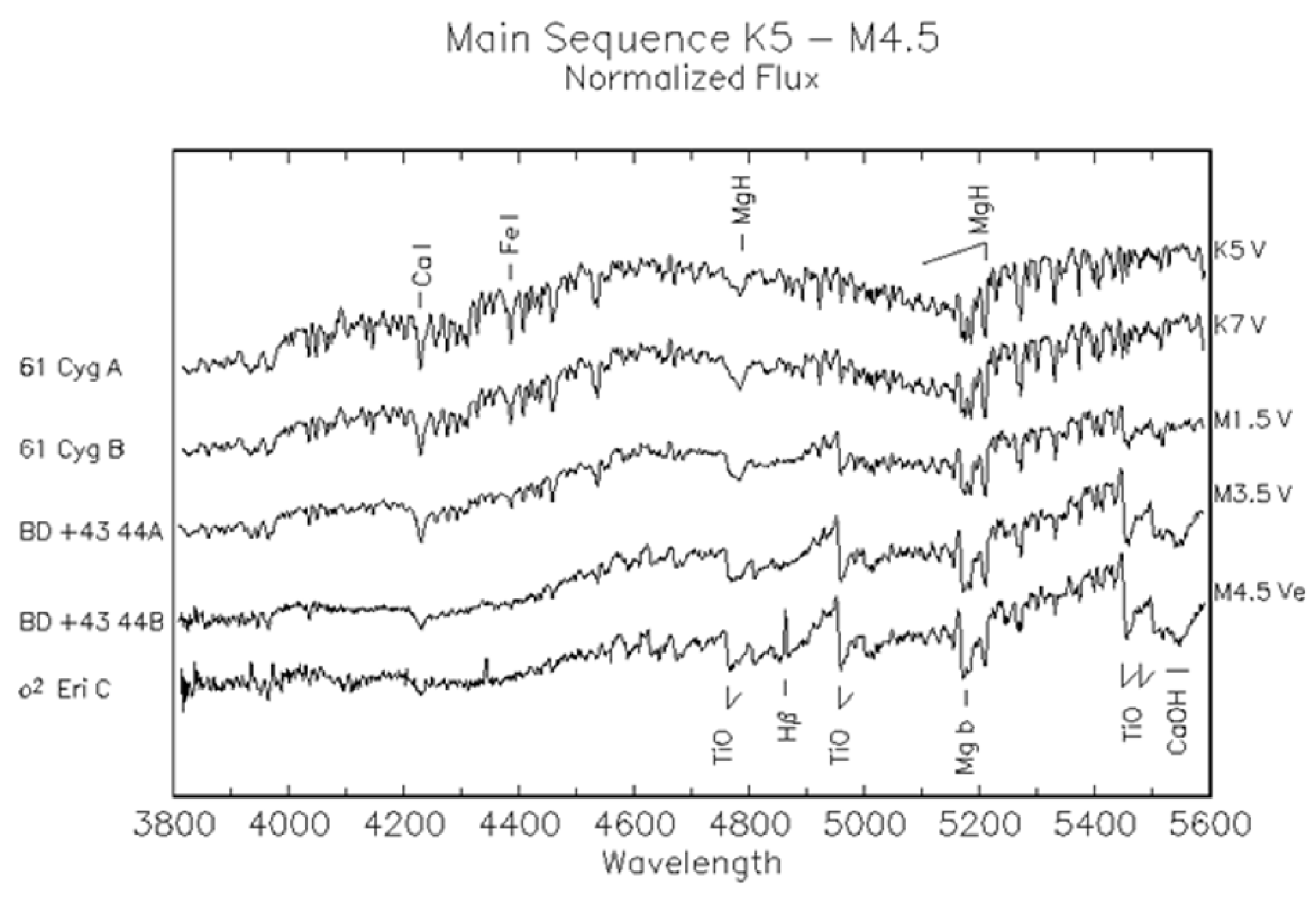
Spectra of main sequence stars of different spectral classes, at the blue end of the spectrum (where there are many absorption lines due to atomic transitions). The spectra have been divided by the respective continuum so that the lines are more easily discernible. The first five panels correspond to MS stars. The sixth panel shows how the lines change for different luminosity classes for the same spectral type.
Отговори
- (a) Between B8 and A0, e.g. B9
- (b) MV ≈ 0.34 (MS), −0.28 (subgiant); d ≈ 79.4 kpc (MS), 105.7 kpc (subgiant); iii YES; iv (A) NO, (B) NO; r ≈ 110 kpc
- (c) vrHC = (840 ± 150) km/s; vrf = (680 ± 130) km/s; vθ = (72 ± 170) km/s; vT = (684 ± 210) km/s at ≈ 6° to the direction of the Galactic center; near to the Galactic center
- (d) vesc = √(2GM/r); M(110 kpc) ≈ 1.2×10¹² M_⊙; vesc ≈ 311 km/s; YES
- (e) yr
- (f) The star was ejected when or shortly after it was formed (t ~ 10⁸ yr).
- (g) Stars of this spectral type are young and so do not belong to the native population of the halo.
Решение
In recent years, a new field of research has emerged, that of Hypervelocity Stars (HVS for short). These are stars in our Galaxy (mostly at its outskirts), which are moving with excessive velocities and may be escaping from the Milky Way.
In this question, you will use spectroscopic and astrometric measurements in order to calculate the velocity of one such star, called “HVS1”, consider its origin and whether it may escape the Galaxy.
Figure 1 shows a spectrum of HVS1 in the blue to UV part of the spectrum:
Figure 1: The spectrum of HVS1 shifted to the rest frame of the star (i.e., there is no Doppler shift due to the motion of the star along the line of sight).
(a) (7 points) Determine the spectral type of the star using the standard spectra in Appendix 3 and the absorption lines identified on the spectrum of HVS1. (Note that the spectrum above contains both stellar and interstellar absorption lines.)
Solution
By comparing with spectral charts in appendix 3, we notice that
- H-lines are the most prominent lines,
- He I feature at is barely visible and
- Ca I feature around is not seen.
Thus, it may be reasonable to restrict the range of spectral types to B5-A5. 2.0
We find that the ratio of the intensity of a pair of lines and compare it with the standard spectra. We see, Ca II/H 2.0
For B8 standard spectra it is , for A0 standard spectra it is . 2.0
Thus, we deduce that the spectral type lies somewhere between B8 and A0. One may write any spectral type in the range, say B9. 1.0
(b) (18 points) Detailed modeling of the spectral lines places the star between luminosity classes V (Main Sequence) and IV (subgiant).
i. The apparent magnitude of the star in the visual band is . Find the absolute magnitude of the star using Appendix 1 for the two possible luminosity classes.
You may ignore the uncertainty in since the uncertainty in your calculation will be dominated by the uncertainty in .
Solution
Appendix 1 gives absolute magnitude for stars of different spectral and luminosity classes. The relevant rows are A0 and B5. 1.0
In order to estimate the absolute magnitude of a B9 star, interpolate between B5 and A0.
For MS:
2.0
For subgiants:
2.0
ii. For both these possible luminosity classes, calculate the star’s distance from the Sun, ignoring interstellar absorption.
Solution
1.0
For MS:
1.0
For subgiants:
1.0
iii. The galactic coordinates of HVS1 are , . Is the assumption of ignoring the interstellar absorption justified? Write “YES” or “NO”.
Solution
Yes. HSV1 is off the galactic plane, well into the halo. interstellar absorption should not be very high. Thus, ignoring it will not affect the distance very much. 2.0
iv. The Gaia mission of the European Space Agency has been mapping the Milky Way since 2014, measuring the parallax and proper motion of 1.5 billion stars to an accuracy between 0.04 and 0.1 milliarcseconds (mas). Could Gaia have measured the parallax of HVS1,
(A) if it is a MS star? Write “YES” or “NO”.
(B) if it is a subgiant? Write “YES” or “NO”.
Solution
(A) if it is a MS star,
Hence, the answer is “No”. 1.0
(B) If it is a subgiant, then the distance is even larger. Hence, the answer is again “No”. 1.0
For the rest of this question, adopt the larger of the two distances you have calculated above.
v. Assume that the distance of the Sun from the Galactic center is .
Make a rough sketch of the relative positions of HVS1, the Sun and the Galactic center. Use it to calculate the distance () of HVS1 from the Galactic center.
Solution
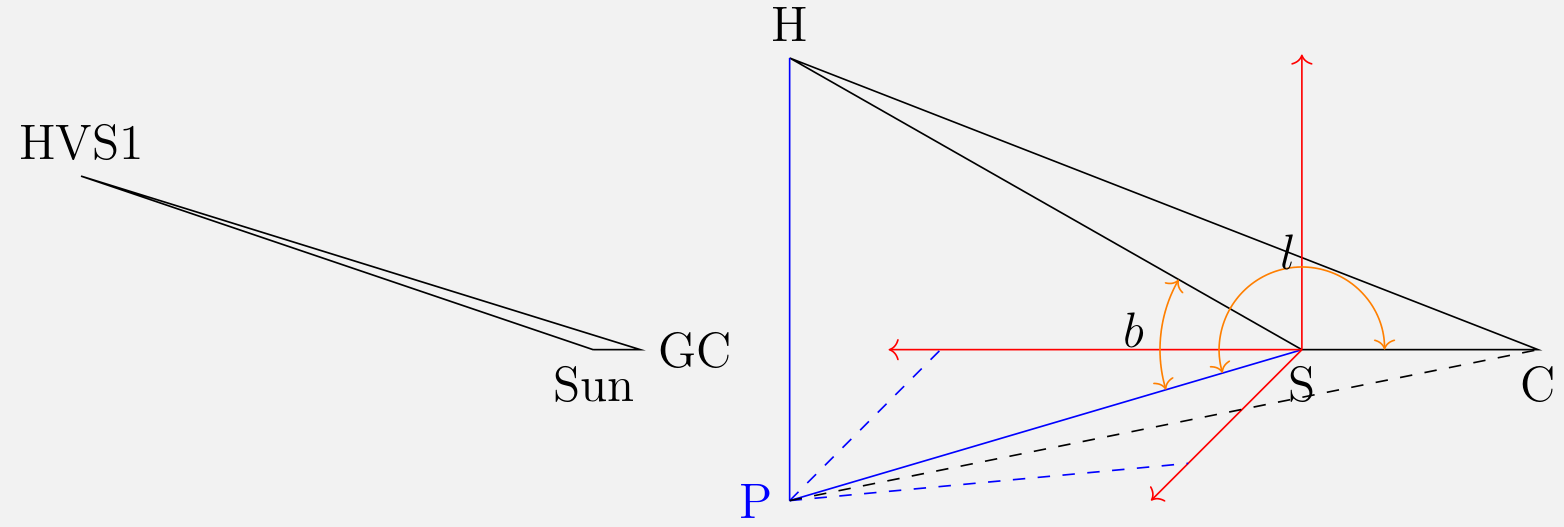
The left panel is to the scale. The right panel shows details of the drawing. 2.0
4.0
(c) (17 points) Here, you will calculate the actual velocity of HVS1.
i. The spectrum in Fig1 shows two absorption lines due to Ca II. One is caused by the atmosphere of the star and the other is due to the interstellar medium. The shift of this line is due to the motion of the star with respect to the interstellar medium. Measure this Doppler shift and calculate the radial velocity of HVS1 with respect to the Sun.
Solution From the spectrum, we can estimate the line shift as
3.0
Doppler shift gives the heliocentric velocity
2.0
ii. We are interested in the velocity with respect to the Galactic center. For this we first need to take into account the velocity of the Sun due to the rotation of the Galaxy. The following equation transforms the velocity of a star of heliocentric radial velocity to one in the Galactic rest frame (rf), :
where the speeds are measured in .
Find for HVS1.
Solution
2.0
iii. HVS1’s proper motion has been measured as:
Calculate the tangential velocity component (in ) of HVS1. (You may ignore the correction for declination as the star is near the celestial equator).
Solution
The length of an arc does not depend on the coordinate system. Thus,
2.0
2.0
iv. Calculate the velocity of the star with respect to the Galactic center (magnitude in and angle with respect to direction of the Galactic center).
Solution
The direction to the Galactic center is also perpendicular to the plane of the sky. Thus,
2.0
i.e. it is almost radial.
2.0
v. Assuming this star was born within the Galactic disc, use your calculation of the velocity to estimate where in the Galactic disc it is more likely to have come from:
(A) near to the Galactic center
(B) further out in the Galactic disc
Solution As the velocity is almost radial, extrapolating backwards, the star would be in galactic disk somewhere close to the galactic centre. Thus, the answer is A. 2.0
(d) (6 points) From the energy considerations,
i. Write expression for the escape speed as a function of the distance from the Galactic center and the enclosed mass.
Solution
1.0
ii. Calculate the mass of the galaxy (in solar masses) within the radius of the distance of HVS1.
where is an constant of the equation and .
Solution
2.0
iii. Calculate the magnitude of the escape velocity at the distance of HVS1.
Solution
2.0
iv. Is this a runaway star? Write “YES” or “NO”.
Solution
Yes. 1.0
(e) (2 points) How long has it taken for HVS1 to reach this position?
Solution If HSV1 originated close to the galactic center and assuming is was ejected at the measured speed, it has been traveling for
2.0
(f) (3 points) On the basis of the spectral type and the luminosity class of this star, estimate the age of HVS1 and compare this with your result in the previous part. Which one of the following statements about the origin of the star is true:
(A) The star was ejected when or shortly after it was formed.
(B) The star was ejected mid-way through its time on the Main Sequence.
(C) The star was ejected towards the end of its time on the Main Sequence.
Solution
Main Sequence life time for the star will approximately be
Comparing with absolute magnitude of the Sun,
This is very similar to the time taken by the star to travel from the disk to present position. Thus, the answer is A. 3.0
(g) (2 points) Astronomers looking for HVS-s start by finding a sample of stars in the Galactic halo which are of a spectral type similar to that of HVS1. Explain why by choosing which one of the following statements is true:
(A) Stars of this spectral type are young and so belong to the native population of the halo.
(B) Stars of this spectral type are old and so belong to the native population of the halo.
(C) Stars of this spectral type are young and so do not belong to the native population of the halo.
(D) Stars of this spectral type are old and so do not belong to the native population of the halo.
Solution Stars of early type are very young, so they cannot belong to the native population of the halo. They must be coming from elsewhere. As a result, they may be moving very fast and some of them may be on their way to abandoning the Milky Way.
C. 2.0
Оригинал в Архива: GeCAA-2020_Data_Analysis.pdf · официални решения: Data Analysis Solutions.pdf