GeCAA 2020, Теория — Задача 6. Occultation of a X-ray Source
GeCAA-2020 — Theory · 20 т.
Внимание: Бележка към темата
Eight complete native whole tasks and 27 requests, with all 25 official key pages, alternatives, marking criteria, and the complete two-page GeCAA-2020 constants companion. This bilingual Russian/English question edition is transcribed from its printed English column; task titles use the matching English key. Russian-only figure captions remain native. Printed scientific and source-edition discrepancies remain with attributed local notes. Task points total 150 by addition; no aggregate paper total or overall time limit is printed, so those fields remain unspecified. Referenced answer sheets/boxes are not in the obtained packet or complete 2020 archive-folder inventory.
Native source editions and gaps
Question masthead: GeCAA-2020 [Russian], Теоретический тур / Theory, with Russian and English columns. Official English key masthead: GeCAA - Theory Solutions, October 3, 2020. That is the printed key edition date; no competition held date/place is inferred. The designated answer sheets/boxes mentioned for Light Curves and Meteor Radiant were not obtained. The primary question/official key wording variants are recorded inside their original tasks.
Table of constants
The dated GeCAA-2020 constants companion prints Russian and English labels alongside the following native values.
Fundamental constants
| Quantity | Symbol | Value |
|---|---|---|
| Speed of light in vacuum | ||
| Planck constant | ||
| Boltzmann constant | ||
| Stefan-Boltzmann constant | ||
| Elementary charge | ||
| Universal gravitational constant | ||
| Universal gas constant | ||
| Avogadro constant | ||
| Wien’s displacement law | ||
| Mass of electron | ||
| Mass of proton | ||
| Mass of neutron | ||
| Atomic mass unit (a. m. u.) |
Astronomical data
| Quantity | Symbol | Value |
|---|---|---|
| 1 parsec | 1 pc | |
| 1 astronomical unit (au) | 1 au | |
| 1 jansky | 1 Jy | |
| Hubble constant | ||
| Solar luminosity | ||
| Apparent angular diameter of Sun | ||
| Effective temperature of Sun | ||
| Obliquity of the ecliptic (Earth) | ||
| Inclination of the lunar orbit w. r. t. ecliptic | ||
| Apparent visual magnitude of full moon | ||
| North Ecliptic Pole (J2000.0) | ||
| North Galactic Pole (J2000.0) | ||
| 1 sidereal day | ||
| 1 tropical year | 365.2422 solar days | |
| 1 sidereal year | 365.2564 solar days |
Solar magnitudes
| Quantity | Value |
|---|---|
| Apparent visual magnitude | |
| Absolute visual magnitude | |
| Apparent bolometric magnitude | |
| Absolute bolometric magnitude |
Solar system
| Object | Mean radius (km) | Mass (kg) | Semi-major axis (au) | Eccentricity |
|---|---|---|---|---|
| Sun | 695500 | — | — | |
| Mercury | 2440 | 0.387 | 0.206 | |
| Venus | 6052 | 0.723 | 0.007 | |
| Earth | 6378 | 1.000000 | 0.016710 | |
| Moon | 1737 | 0.002572 | 0.054900 | |
| Mars | 3390 | 1.524 | 0.093 | |
| Jupiter | 69911 | 5.203 | 0.048 | |
| Saturn | 58232 | 9.537 | 0.054 | |
| Uranus | 25362 | 19.189 | 0.047 | |
| Neptune | 24622 | 30.070 | 0.009 |
Gauss’s formulae
Cosine theorem:
Sine theorem:
Source note: The English native heading is “Gauss’s formulae”; its Russian counterpart is “Сферическая тригонометрия”. Blank source symbol cells remain blank. This is the dated same-competition constants PDF obtained from the GeCAA 2020 archive Constants folder.
Условие
Consider a satellite observing X-ray sources, while orbiting the Earth in the equatorial plane with orbital radius , and orbital time period . Assume that this satellite is pointed in one fixed direction in space for a given length of time. Take the radius of the Earth as .
When the satellite moves ‘behind’ the Earth in its orbit, the X-ray source is ‘occulted’ and the measured X-ray flux from the source drops to zero. However, due to Earth’s atmosphere, this drop is gradual. If the line of sight to the source passes through the atmosphere, the extent of the attenuation depends on the air-mass (i.e. length of air column) along the line of sight.
a) Let us assume that the satellite is pointing towards a fixed source at declination. We consider that the source is occulted when 50% of the light coming from the source gets attenuated due to the atmosphere. Let us say that this happens when the minimum height of the line of sight from the surface of the Earth is . If is the angle between the direction of the source and the direction of the Earth, as measured from the spacecraft, find an expression for . [1 т.]
b) The time duration between the source getting attenuated from 90% of the pre-occultation flux to 10% is defined as the ‘occultation time’ for the source. Assume the flux attenuates to 90% when the minimum height of the line of sight and similarly the flux attenuates to 10% at , where . Find the expression for in terms of , , and . [4 т.]
c) If the satellite was pointing towards a source at an arbitrary declination instead (where is not too large), what will be the expression for ? [15 т.]
Note: If the satellite was not in the equatorial plane, then the problem could have been simply rephrased by assuming the satellite’s orbital plane to be the equatorial plane. In that case, becomes ‘relative declination’.
Отговори
- a) .
- b) .
- c) .
Решение
(a) The solution for first part is obvious from the figure below.
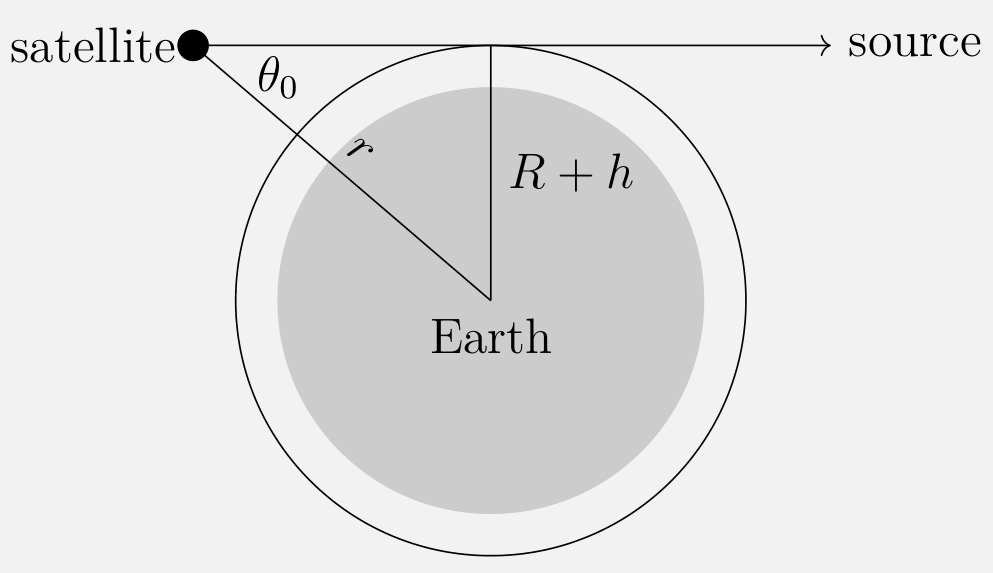
(b) Let us say the satelite has to move in the orbit by for change in height.
(c) Let be the new angle for 50% attenuation. In the diagram below, The line of sight from the satelite (S) to the source is at minimum distance from the centre of the earth (C) at point A. The points S, C and B are in the equatorial plane with line BA normal to the equatorial plane. One also realises that the line BS is normal to the plane defined by A, B and C. [3.0]
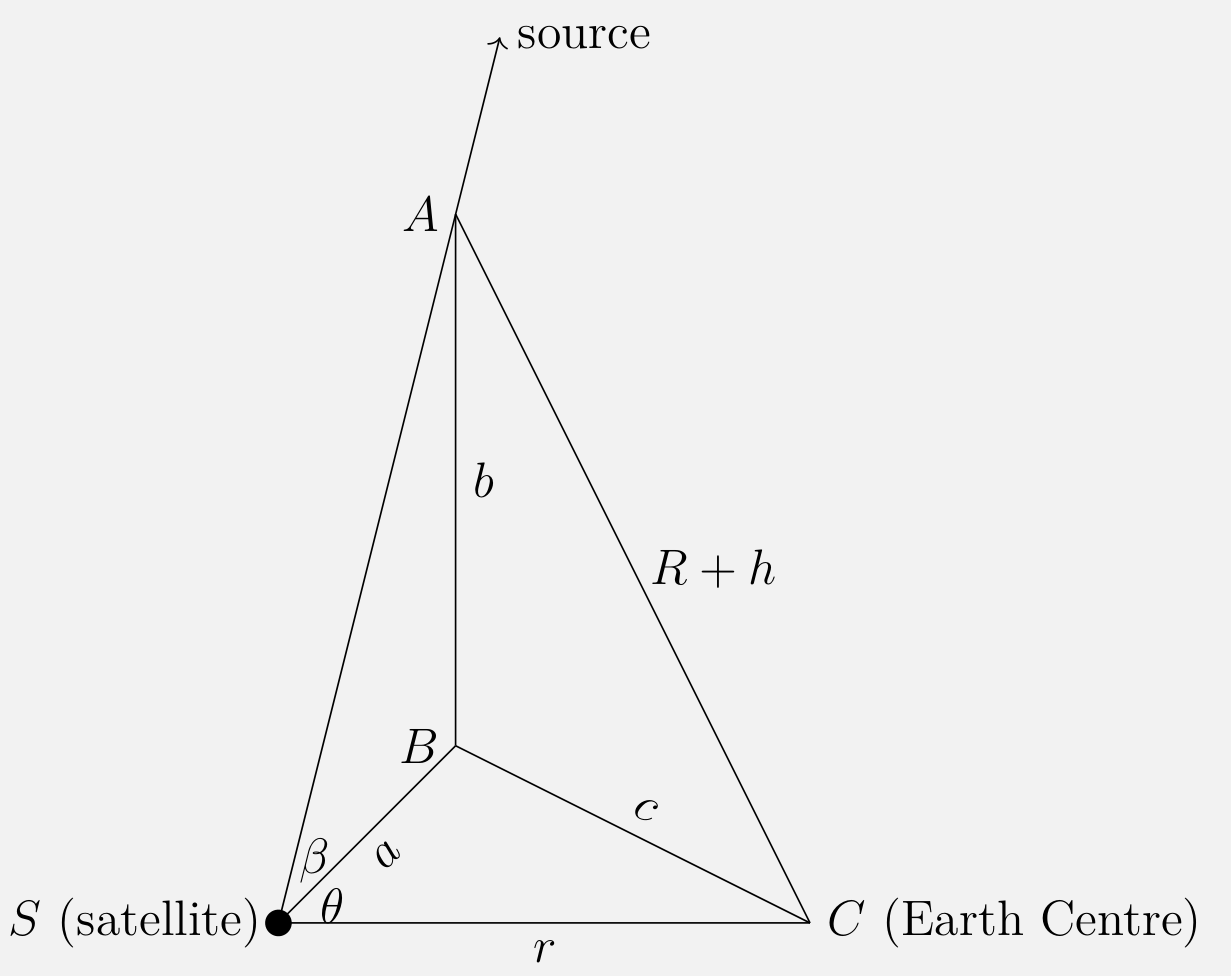
Let us say .
Using similar analysis as the previous part,
Source note: The key’s opening prose in (b) prints , while the immediately following formula uses . The extra divisor in the printed prose is retained; the derivation is transcribed as printed.
Теми и трудност
Оценена трудност: 4/5.
Слънчева система · Небесна сфера и сферична астрономия · Светлина и астрономически измервания · Затъмнения и покрития · Небесни координати · Междузвездно поглъщане
Предпоставки: Гимназиална подготовка, Разширена олимпиадна подготовка
Оригинал в Архива: GeCAA-2020_Theory.pdf · официални решения: Theory Solutions.pdf · допълнителни данни: GeCAA-2020_Constants.pdf