GeCAA 2020, Теория — Задача 7. Radiant of a Meteor Shower
GeCAA-2020 — Theory · 30 т.
Внимание: Бележка към темата
Eight complete native whole tasks and 27 requests, with all 25 official key pages, alternatives, marking criteria, and the complete two-page GeCAA-2020 constants companion. This bilingual Russian/English question edition is transcribed from its printed English column; task titles use the matching English key. Russian-only figure captions remain native. Printed scientific and source-edition discrepancies remain with attributed local notes. Task points total 150 by addition; no aggregate paper total or overall time limit is printed, so those fields remain unspecified. Referenced answer sheets/boxes are not in the obtained packet or complete 2020 archive-folder inventory.
Native source editions and gaps
Question masthead: GeCAA-2020 [Russian], Теоретический тур / Theory, with Russian and English columns. Official English key masthead: GeCAA - Theory Solutions, October 3, 2020. That is the printed key edition date; no competition held date/place is inferred. The designated answer sheets/boxes mentioned for Light Curves and Meteor Radiant were not obtained. The primary question/official key wording variants are recorded inside their original tasks.
Table of constants
The dated GeCAA-2020 constants companion prints Russian and English labels alongside the following native values.
Fundamental constants
| Quantity | Symbol | Value |
|---|---|---|
| Speed of light in vacuum | ||
| Planck constant | ||
| Boltzmann constant | ||
| Stefan-Boltzmann constant | ||
| Elementary charge | ||
| Universal gravitational constant | ||
| Universal gas constant | ||
| Avogadro constant | ||
| Wien’s displacement law | ||
| Mass of electron | ||
| Mass of proton | ||
| Mass of neutron | ||
| Atomic mass unit (a. m. u.) |
Astronomical data
| Quantity | Symbol | Value |
|---|---|---|
| 1 parsec | 1 pc | |
| 1 astronomical unit (au) | 1 au | |
| 1 jansky | 1 Jy | |
| Hubble constant | ||
| Solar luminosity | ||
| Apparent angular diameter of Sun | ||
| Effective temperature of Sun | ||
| Obliquity of the ecliptic (Earth) | ||
| Inclination of the lunar orbit w. r. t. ecliptic | ||
| Apparent visual magnitude of full moon | ||
| North Ecliptic Pole (J2000.0) | ||
| North Galactic Pole (J2000.0) | ||
| 1 sidereal day | ||
| 1 tropical year | 365.2422 solar days | |
| 1 sidereal year | 365.2564 solar days |
Solar magnitudes
| Quantity | Value |
|---|---|
| Apparent visual magnitude | |
| Absolute visual magnitude | |
| Apparent bolometric magnitude | |
| Absolute bolometric magnitude |
Solar system
| Object | Mean radius (km) | Mass (kg) | Semi-major axis (au) | Eccentricity |
|---|---|---|---|---|
| Sun | 695500 | — | — | |
| Mercury | 2440 | 0.387 | 0.206 | |
| Venus | 6052 | 0.723 | 0.007 | |
| Earth | 6378 | 1.000000 | 0.016710 | |
| Moon | 1737 | 0.002572 | 0.054900 | |
| Mars | 3390 | 1.524 | 0.093 | |
| Jupiter | 69911 | 5.203 | 0.048 | |
| Saturn | 58232 | 9.537 | 0.054 | |
| Uranus | 25362 | 19.189 | 0.047 | |
| Neptune | 24622 | 30.070 | 0.009 |
Gauss’s formulae
Cosine theorem:
Sine theorem:
Source note: The English native heading is “Gauss’s formulae”; its Russian counterpart is “Сферическая тригонометрия”. Blank source symbol cells remain blank. This is the dated same-competition constants PDF obtained from the GeCAA 2020 archive Constants folder.
Условие
A stargazer in Chiayi, Chinese Taipei (, , GMT+8) saw two meteors streaking through the sky at 21:00 (Chinese Taipei time) on 25th September 2020. One of the meteors originated directly above the northern horizon at altitude and streaked to meet the horizon exactly due east. The second meteor originated at an altitude of and an azimuth of and ended at an altitude of and an azimuth of .
a) What is the Local Sidereal Time (LST) at the time of observation? [6 т.]
b) Find the alt-az coordinates of the apparent radiant of the two meteors. [16 т.]
c) Find the equatorial coordinates of the apparent radiant. [6 т.]
d) Which of the following constellations is closest to the radiant?
- Crux
- Dorado
- Pavo
- Tucana
- Triangulum Australes [2 т.]
Notes:
- Azimuths are measured from the North () towards the East.
- The Greenwich Sidereal Time (GST) at 00:00 UT on 1st January 2020 is .
Отговори
- a) .
- b) .
- c) .
- d) Triangulum Australes (native spelling).
Решение
Source edition note: The English key’s reprinted first meteor description is: “One of the meteors appeared at horizon exactly due west and streaked to a point at 15° altitude directly above the northern horizon.” The primary bilingual question instead gives 15° above north to the eastern horizon. Both worked methods below use the latter endpoint coordinates. The key’s (d) additionally says to choose one constellation and write the same name in the answer box; that answer box/sheet was not obtained.
(a) Step 1: Determine the GST at the time of observation. Let us denote the GST on at 00:00 UT on 1st January 2020 as . Total 268 days have elapsed since start of the year till UT on 25 September. [1.0]
At 21:00 for GMT+8 timezone, UT will be . Hence,
As longitude of observer is , the LST of observation is,
(b) For horizontal coordinates
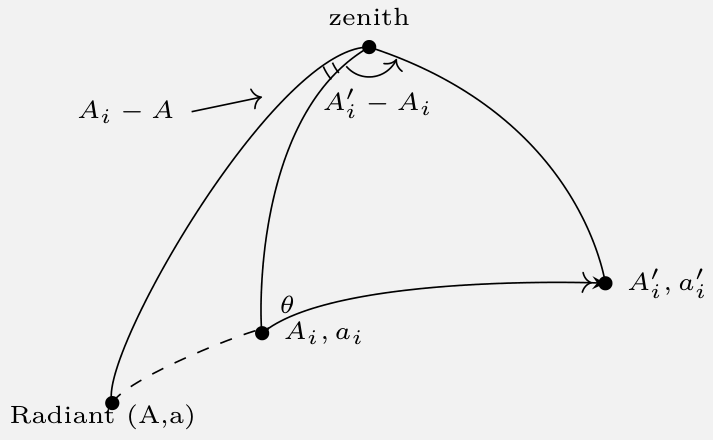
[1.0] The spherical triangle has the radiant, initial position and final position of the -th meteor to be , and , where and denotes the altitude and azimuth respectively. Using the four-parts (cotangent) equation on the left and right triangles, we have, for both meteors:
Similarly,
We can then eliminate to yield:
Multiplying the whole equation by ,
Plugging in , and eliminating by division, we have
where is the RHS defined above (which is a known value). Expanding the equation above and dividing by , gathering terms of , we get
And
Plugging in the respective values from the question,
| Azimuth | Altitude | |
|---|---|---|
| Initial first meteor | ||
| Final first meteor | ||
| Initial second meteor | ||
| Final second meteor |
We get
However, the student should realize that for , the radiant is in the path of the first meteor, which is unrealistic. Hence, it is more likely that the azimuth takes the second value. [1.0] Plugging in for the altitude, we find the coordinate of the radiant to be
As the meteor track origin and end points are rounded to integer degrees, the horizontal coordinates of the radiant will be
Alternative solution
In the vector representation, let the starting and final locations of the meteroids be and respectively. For the subsequent calculations, the vectors are most conveniently represented in Cartesian coordinates. Letting the -axis point east, -axis north, and -axis towards the zenith, we have
For a generic vector with azimuth and altitude . We can therefore compute
The meteors move along great arcs, and the two intersections of the great arcs correspond to the two possible locations of the radiant. A great arc is uniquely defined by its normal vector, denote it with . The normal vector is conveniently calculated through the cross product of the starting and final position, . The cross product can be calculated via the determinant of the following matrix
This yields
Every point on the great circle is perpendicular to . This means that the intersections of the two great circles are perpendicular to both and . The vector parallel to the intersections can therefore be calculated by the cross product of and . Let the vector corresponding to the intersection be . Then
Now all that’s left is to calculate the azimuth and altitude corresponding to . Note that is also an intersection. The equations for the altitude and azimuth can be reverse-engineered from equation (1):
One has to take care that the arctans are signed. This gives the final values of the intersection points to be
As in the first solution, the solution can be eliminated due to it being on the path of the first meteor This gives the final answer of
(c) Now, it is easy to convert the horizontal coordinates of the radiant to equatorial coordinates.
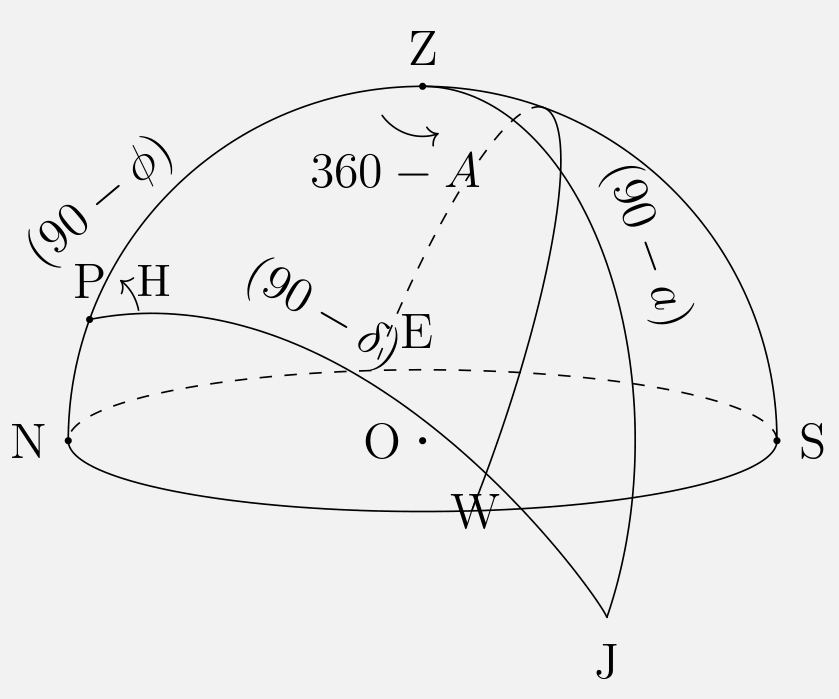
[1.0] Using the cosine rule:
From the relationship between the LST and the Hour Angle (), we get the equatorial coordinates of the radiant to be
Thus, the equatorial coordinates of the radiant are,
(d) Triangulum Australes [2.0]
Source note: The native cotangent derivation’s intermediate multiplied line prints where the preceding multiplier is , and its first line has the right-hand term on a separate row without a printed equality. That arrangement is retained in the aligned transcription. The numeric substitution prints in the denominator, followed by , although the listed second azimuth difference is . The equatorial substitution prints as well as . All printed forms, numerical values, constellation spelling and marking criteria are retained.
Теми и трудност
Оценена трудност: 4/5.
Небесна сфера и сферична астрономия · Време и календари · Небесни координати · Слънчево и звездно време · Звездни карти и съзвездия
Предпоставки: Гимназиална подготовка, Разширена олимпиадна подготовка
Оригинал в Архива: GeCAA-2020_Theory.pdf · официални решения: Theory Solutions.pdf · допълнителни данни: GeCAA-2020_Constants.pdf