GeCAA 2020, Теория — Задача 8. Jupiter’s Great Red Spot
GeCAA-2020 — Theory · 30 т.
Внимание: Бележка към темата
Eight complete native whole tasks and 27 requests, with all 25 official key pages, alternatives, marking criteria, and the complete two-page GeCAA-2020 constants companion. This bilingual Russian/English question edition is transcribed from its printed English column; task titles use the matching English key. Russian-only figure captions remain native. Printed scientific and source-edition discrepancies remain with attributed local notes. Task points total 150 by addition; no aggregate paper total or overall time limit is printed, so those fields remain unspecified. Referenced answer sheets/boxes are not in the obtained packet or complete 2020 archive-folder inventory.
Native source editions and gaps
Question masthead: GeCAA-2020 [Russian], Теоретический тур / Theory, with Russian and English columns. Official English key masthead: GeCAA - Theory Solutions, October 3, 2020. That is the printed key edition date; no competition held date/place is inferred. The designated answer sheets/boxes mentioned for Light Curves and Meteor Radiant were not obtained. The primary question/official key wording variants are recorded inside their original tasks.
Table of constants
The dated GeCAA-2020 constants companion prints Russian and English labels alongside the following native values.
Fundamental constants
| Quantity | Symbol | Value |
|---|---|---|
| Speed of light in vacuum | ||
| Planck constant | ||
| Boltzmann constant | ||
| Stefan-Boltzmann constant | ||
| Elementary charge | ||
| Universal gravitational constant | ||
| Universal gas constant | ||
| Avogadro constant | ||
| Wien’s displacement law | ||
| Mass of electron | ||
| Mass of proton | ||
| Mass of neutron | ||
| Atomic mass unit (a. m. u.) |
Astronomical data
| Quantity | Symbol | Value |
|---|---|---|
| 1 parsec | 1 pc | |
| 1 astronomical unit (au) | 1 au | |
| 1 jansky | 1 Jy | |
| Hubble constant | ||
| Solar luminosity | ||
| Apparent angular diameter of Sun | ||
| Effective temperature of Sun | ||
| Obliquity of the ecliptic (Earth) | ||
| Inclination of the lunar orbit w. r. t. ecliptic | ||
| Apparent visual magnitude of full moon | ||
| North Ecliptic Pole (J2000.0) | ||
| North Galactic Pole (J2000.0) | ||
| 1 sidereal day | ||
| 1 tropical year | 365.2422 solar days | |
| 1 sidereal year | 365.2564 solar days |
Solar magnitudes
| Quantity | Value |
|---|---|
| Apparent visual magnitude | |
| Absolute visual magnitude | |
| Apparent bolometric magnitude | |
| Absolute bolometric magnitude |
Solar system
| Object | Mean radius (km) | Mass (kg) | Semi-major axis (au) | Eccentricity |
|---|---|---|---|---|
| Sun | 695500 | — | — | |
| Mercury | 2440 | 0.387 | 0.206 | |
| Venus | 6052 | 0.723 | 0.007 | |
| Earth | 6378 | 1.000000 | 0.016710 | |
| Moon | 1737 | 0.002572 | 0.054900 | |
| Mars | 3390 | 1.524 | 0.093 | |
| Jupiter | 69911 | 5.203 | 0.048 | |
| Saturn | 58232 | 9.537 | 0.054 | |
| Uranus | 25362 | 19.189 | 0.047 | |
| Neptune | 24622 | 30.070 | 0.009 |
Gauss’s formulae
Cosine theorem:
Sine theorem:
Source note: The English native heading is “Gauss’s formulae”; its Russian counterpart is “Сферическая тригонометрия”. Blank source symbol cells remain blank. This is the dated same-competition constants PDF obtained from the GeCAA 2020 archive Constants folder.
Условие
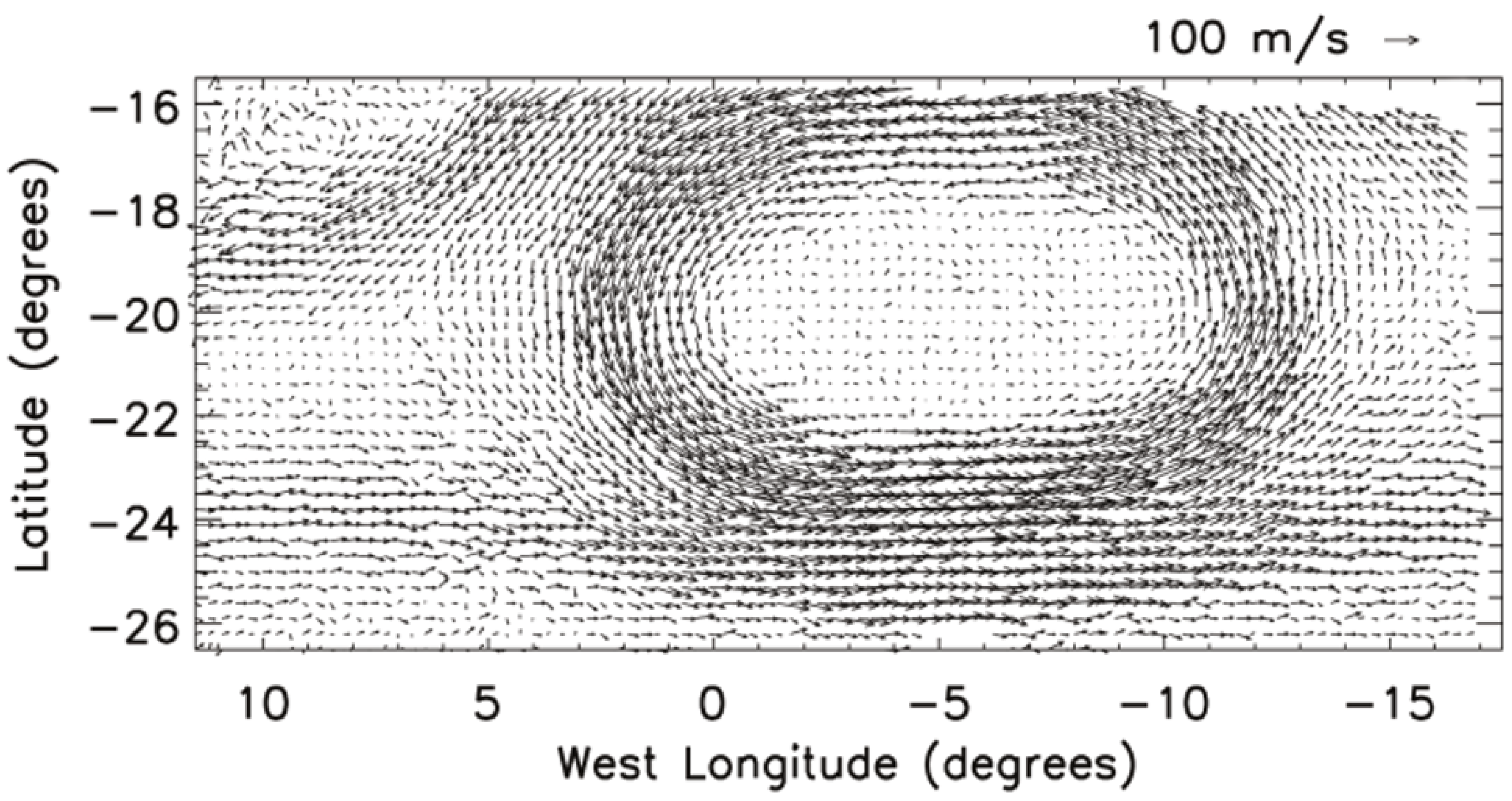
In the following problem, the fluid mechanics of Jupiter’s Great Red Spot (GRS) is studied based on the velocity field data. The diagram on the last page shows a map of relative velocity for GRS and the surrounding region. The arrows are oriented and scaled as per the directions and magnitudes of winds at different points.
Due to the combined effects of gravity and rotation, Jupiter is slightly flattened at its poles. The equation of a spheroid approximating for the shape of Jupiter can be stated as:
where is the equatorial radius of Jupiter, and the polar radius. The radii of curvature of this spheroid in any direction can be calculated by the following equations ():
where and are the zonal (aka in the zone of a particular latitude) and meridional (aka longitudinal) radii of curvature, respectively, as a function of planetographic latitude . The sidereal rotation period of Jupiter is .
a) Calculate the zonal and meridional radii values ( and respectively) at the location of the centre of the GRS. Write numeric answer in km. [4 т.]
b) Estimate the eccentricity of the GRS. [5 т.]
c) ‘Vorticity’ at any point is a measure of local spinning of the fluid as measured by an observer situated in the reference frame of the fluid. Mathematically, it is calculated as ‘curl’ (vector derivative product) of the velocity field. In this case, the average relative vorticity may be estimated by the equation:
where is the maximum value of winds as per the velocity field, is the length of the circumference of the GRS and is the area of the GRS. Estimate average relative vorticity of the GRS. Give the answer in SI units.
Hint: The circumference of an ellipse is well approximated by an average of circumferences of the corresponding auxiliary and minor circles. [6 т.]
d) Find the absolute vorticity by adding the Coriolis parameter
where is the angular velocity of the Jupiter (due to axial rotation) and is the appropriate latitude. Give the answer in SI units. [2 т.]
e) If the absolute vorticity has the same sign as the latitude, we call the storm a ‘cyclonic storm’. If they have opposite signs, the system is ‘anticyclonic’. Is the GRS cyclonic or anticyclonic? [1 т.]
f) Imagine that the GRS moves to another latitude , where the absolute vorticity changes the sign (changes from anti-cyclonic to cyclonic or vice versa). Assuming minimum possible displacement of the GRS, at what value of do we expect this change? Give the answer in degrees, rounded to nearest integer. In your analysis, assume that the GRS at the new location would occupy the same angular span in latitude, as well as have the same wind velocities and eccentricity as the original. [12 т.]
Отговори
- a) , (key’s printed units).
- b) .
- c) .
- d) (as printed).
- e) Cyclonic.
- f) .
Решение
(a) From the figure, the centre of GRS lies at . [1.0]
(b) We use the figure to estimate size major and minor axis of the GRS and hence estimate the eccentricity.
(c) The maximum value of wind velocity () is about 120 m/s. [1.0]
(d) The absolute vorticity will be given by
(e) The GRS is a cyclonic system. [1.0]
(f) For this, we have to write as a function of and then find root of the function closest to the current latitude.
Let us define .
Iterating over , with starting value as ,
| 0.11698 | 0.01121 |
| 0.01121 | 0.01167 |
| 0.01167 | 0.01167 |
[2.0] Thus,
An alternative solution is to try to find this using the plotting method, but one needs to make sure the result is obtained to the equivalent precision.
Source note: The primary question requests the two radii in kilometres; the key prints both results in metres. The key’s absolute-vorticity final line omits its unit, and one line of (f) prints beside before using throughout. These native forms are retained. The repeated velocity diagram on key page 22 is the same data/labels as question page 8, rotated by 180° relative to that native page. It is retained once with the question, with only the explicitly recorded 90° crop rotation for readable presentation. The key’s reprinted introduction says “the diagram on the next page”, although its diagram is above that introduction on page 22.
Теми и трудност
Оценена трудност: 4/5.
Слънчева система · Механика · Свойства на планетите · Въртене на твърдо тяло · Неинерциални отправни системи
Предпоставки: Гимназиална подготовка, Разширена олимпиадна подготовка
Оригинал в Архива: GeCAA-2020_Theory.pdf · официални решения: Theory Solutions.pdf · допълнителни данни: GeCAA-2020_Constants.pdf