GPhO 2016, Теория — Задача 1. Stabilizing unstable states
The 1st Gulf Physics Olympiad — Theoretical Competition · 21 март 2016 г. · 11 т.
Указания
- The examination lasts for 5 hours. There are 3 problems worth in total 30 points. Please note that the point values of the three theoretical problems are not equal.
- You must not open the envelope with the problems before the signal of the beginning of competition.
- You are not allowed to leave your working place without permission. If you need any assistance (broken calculator, need to visit a restroom, etc), please raise your hand until an organizer arrives.
- Use only the front side of the sheets of paper.
- For each problem, there are dedicated Solution Sheets (see header for the number and pictogram). Write your solutions onto the appropriate Solution Sheets. For each Problem, the Solution Sheets are numbered; use the sheets according to the enumeration. Always mark which Problem Part and Question you are dealing with. Copy the final answers into the appropriate boxes of the Answer Sheets. There are also Draft papers; use these for writing things which you don’t want to be graded. If you have written something that you don’t want to be graded onto the Solution Sheets (such as initial and incorrect solutions), cross these out.
- If you need more paper for a certain problem, please raise your hand and tell an organizer the problem number; you are given two Solution sheets (you can do this more than once).
- You should use as little text as possible: try to explain your solution mainly with equations, numbers, symbols and diagrams. Though in some places textual explanation may be unavoidable.
- After the signal signifying the end of examination you must stop writing immediately. Put all the papers into the envelope at your desk. You are not allowed to take any sheet of paper out of the room. If you have finished solving before the final sound signal, please raise your hand.
Условие
Part A. Stabilization via feedback (3.5 points)
Let us study, how an initially unstable equilibrium position can be stabilized. First we consider a reversed pendulum: a thin long rod of homogeneous mass distribution and length is fixed at its lowest point to a hinge so that it can freely rotate around the hinge. We describe the position of the rod via the angle between the rod and a vertical line. We shall assume that ( is much smaller than 1). The free fall acceleration .
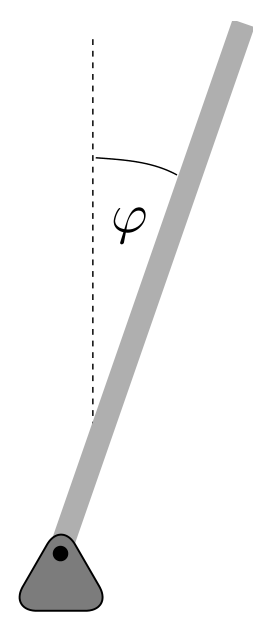
A.i. Express the angular acceleration of the rod in terms of , and the parameters and . Show that the inclination angle as a function of time is expressed as , where and are constants which depend on the initial position and initial angular speed of the rod, and is a characteristic time. Express in terms of and . (You may use dimensional analysis, but then you’ll lose 0.5 pts.) Hint: for a rod of length and mass , the moment of inertia with respect to its endpoint is . [1,5 т.]
A.ii. Now, a boy tries to keep a long thin rod standing vertically on his palm. For instance, as soon as the rod starts falling leftwards, he moves his palm to an even greater distance leftwards so that the rod’s centre of gravity would be positioned rightwards from the rod’s support point. Then, the torque of the gravity force would rotate the rod rightwards, decreasing the previously observed leftwards angular speed. Estimate, for which rod lengths the boy can keep the rod vertically if his reaction time is estimated as . (The reaction time is the time lag between the command sent by brain to hands, and the corresponding motion of the hands.) [0,5 т.]
A.iii. Humans and birds keep their standing position similarly and move the support centre (the point at the bottom of their feet where the total normal force is applied), e.g. by adjusting the angle between a leg and the foot, so as to oppose the falling motion of the upper part of their body. A small bird of length can stand on its feet; estimate the upper bound for its reaction time. [0,5 т.]
A.iv. Equilibrium on a bike is also kept by displacing the support centre which lies on the line connecting the wheel-ground contact points; that line can be conveniently displaced by turning the handlebar while driving forth. Estimate the minimal driving speed of a bicyclist by which the equilibrium can be maintained in such a way. Assume that for the bicyclist, the characteristic falling time is the same as for a rod of length ; the distance between the centres of the wheels . [1 т.]
Part B. Tightrope walker (3.5 points)
A tightrope walker cannot move the support point in the direction perpendicular to the rope. His equilibrium is kept by displacing the centre of gravity, instead. Let us make a simple model of a man balancing on a rope.
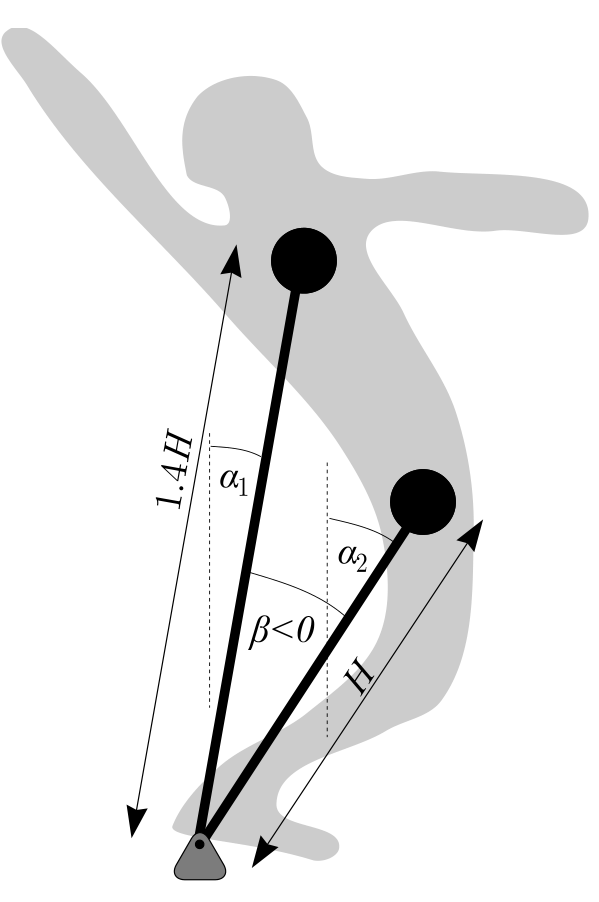
Lower half of the body is modelled by a point mass at height , and the upper half of the body — by an equal point mass at the height . The mutual position of these point masses can be changed by bowing right or left; for the sake of simplicity, let us assume that the distance of the point masses from the rope will remain unchanged, i.e. these behave as if being fixed to the endpoints of two thin rods of lengths and respectively, see figure. Let the rods form angles and with the vertical line (positive angles correspond to clock-wise rotation), so that the angle between the rods is . A tightrope walker can control the value of the angle by bowing.
B.i. Let us assume that initially, the tightrope walker was standing in an almost perfect equilibrium (). Due to instability of this equilibrium, he starts slowly falling clock-wise, which he notices at when . He bows rapidly to stop falling: assume that the angle takes almost instantaneously a new value . Express the new values of the angles and in terms of and . [1 т.]
B.ii. So, the tightrope walker is now bowing and keeps this body shape () for the time period , upon which he straightens himself almost instantaneously and makes thereby . His aim is to resume the motionless standing position with . Should he have bowed clock-wise () or counter-clock-wise? Motivate your answer. [0,5 т.]
B.iii. From now on, we assume that . Immediately after he has straightened himself, neither his angular speed nor angle are zero: zero values will be achieved much later. Which value (expressed in terms of and ) should the ratio take at that moment? [1 т.]
B.iv. Express the required duration in terms of , , , and assuming that . [1 т.]
Part C. Kapitza’s pendulum (4 points)
In 1908 Andrew Stephenson found that the upper position of a pendulum can be stable, if its suspension point oscillates with a high frequency. The explanation of this phenomenon was provided in 1951 by Russian physicist Pyotr Kapitza. In what follows we’ll find the stability criterion of such a pendulum. Apart from being just a nice toy, the Kapitza’s pendulum demonstrates the method of separating fast and slow processes which plays an important role in physics. High frequency oscillations can drive a slow motion in various systems, e.g. high frequency electric fields act on charges with an effective average force known as the ponderomotive force.
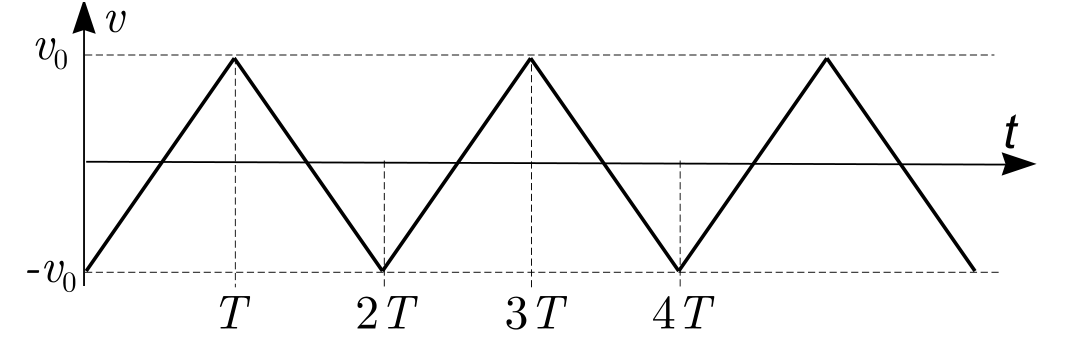
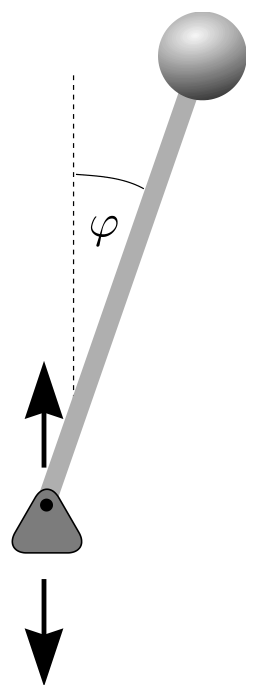
We consider a pendulum of length , similar to that of Part-A-Question-i, but now the rod is massless, with a point mass at its end, and the suspension point oscillates vertically (see the figure). Let the velocity of the suspension point depend on time as shown in the graph below ( corresponds to upward motion); the oscillations’ half-period . We also assume that so that for questions i–ii you may ignore the free fall acceleration. In order to simplify calculations, you’ll need to study this process in the frame of reference of the suspension point (keep in mind: reference frame’s acceleration gives rise to an inertial force acting on a body of mass ).
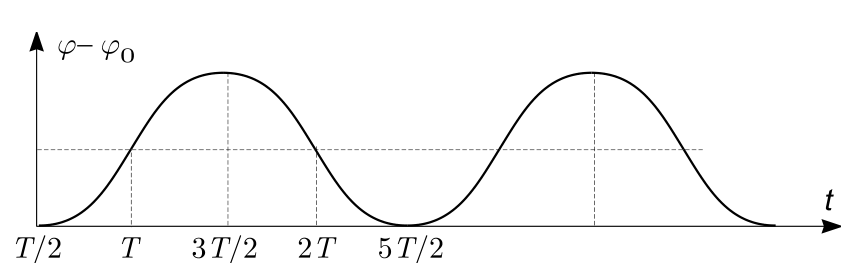
C.i. Suppose that at , the pendulum was motionless and inclined by a small angle . Sketch the graph of the inclination angle as a function of time, and determine the angular displacement of the pendulum for the moment , i.e. . You may assume in your calculations that (this is valid because ). [1,5 т.]
C.ii. Since we still neglect gravity, only inertial force exerts a torque on the pendulum. Determine the average value of this torque (with respect to the suspension point, averaged over the full period ). [1,5 т.]
C.iii. Now, let us take into account that there is also the gravity field of the Earth. Determine, which inequality must be satisfied for , , and in order to ensure the stability of the vertical position of such a pendulum (some of these parameters may not be needed for your inequality). [1 т.]
Отговори
A.i.
A.ii. 0.59 m
Rod length lr = τr² · 3g/2 ≈ 0.59 m.
A.iii. 0.065 s
A.iv. 2.7 m/s
B.i.
B.ii. Clockwise ().
B.iii.
B.iv.
C.i.
C.ii.
C.iii.
Решение
Part A. Stabilization via feedback (3.5 points)
i. (1.5 pts) The moment of inertia of the rod is . The torque is . (0.4 pts)
so that the Newton’s 2nd law is written as
(0.4 pts)
If we take , then . (0.3 pts)
Substituting this into the equation of motion (1) we get
(0.4 pts)
This means that is the solution for the equation of motion.
ii. (0.5 pts) The boy has to react before the rod falls over the angle . Boy notices that the rod is falling, and tries to react. If the rod falls faster than his reaction time, he cannot keep it in balance. In the expression , the dominating term is the first one (the second one decays in time), so we can put , where is the angle at . Hence, the falling time depends on the initial angle , but logarithmic dependence is very slow — the logarithm remains always of the order of unity. So we can estimate the falling time just as the characteristic time of the rod. This means that
(0.3 pts)
(0.2 pts)
iii. (0.5 pts) The bird won’t be able to rebalance itself when it has fallen over . Similarly to the previous question, we can say that the bird’s reaction time must be equal to the characteristic time . (0.3 pts)
Then we get
(0.2 pts)
iv. (1 pt) The cyclist is able to balance himself by turning the handlebar so that the line connecting the wheels will move to the desire direction. For that line to move, the bike must move forward to a distance which is of the order of inter-wheel separation. So we can require , where is bike’s characteristic falling time. (0.5 pts)
Note that with this equation we neglect the cyclists’ reaction time (which makes balancing more difficult) but on the other hand the line connecting the wheels moves slightly already at a twice smaller forward-displacement of the bike (which makes balancing easier). Anyway, we are only making an estimate, so a mistake by a factor of 2 is perfectly OK.
Then we get
(0.2 pts)
(0.3 pts)
Part B. Tightrope walker (3.5 points)
i. (1 pt) From the conservation of angular momentum
(0.3 pts)
Partial credit 0.2 pts if the conservation is mentioned without writing equation. This process is instantaneous, i.e. and are very large, much large than that constant at the right-hand-side (which is defined by the initial falling speed), hence we can put .
(0.2 pts)
This simplifies into
(0.1 pts)
We also have
(0.2 pts)
Solving the equations (1) and (2) we get
(0.1 pts)
(0.1 pts)
ii. (0.5 pts) In order to be able to straighten himself, the walker’s centre of mass has to move leftwards, by a negative angle. (0.1 pts)
By changing the upper body’s angle by , the lower body’s angle will change by . The centre of mass will then move by
(0.3 pts)
Because the centre of mass will have to move by a negative angle, needs to be positive, which means that the walker has to bow clockwise. (0.1 pts)
iii. (1 pt) We can write the equation of motion
Similarly to the question i. in part A, the solution for this differential equation is , where . (0.2 pts)
Because the time it takes to get to the vertical position is infinite, the component needs to be 0, meaning that . (0.3 pts)
By taking time derivative, we obtain . (0.3 pts)
For the instance when the boy straightened himself, , the equations take form and . So, , which can be rewritten as
(0.2 pts)
iv. (1 pt) After the walker has straightened himself, the angle which he is at is still , because during stage where he is bowing, the torque is much larger than when he is straightened, meaning that the change in angular speed is much larger than the change in the angle. (0.1 pts)
As found in the previous subquestion, the speed before and after the bowing are and respectively. Then the change in the angular momentum is
(0.3 pts)
Because during the falling stage the change in angle is minuscule, we can express the change in angular momentum as , where is the torque during bowing stage.
(0.2 pts)
During the bowing stage, the angles of the body segments are
The torque can be expressed as
(0.3 pts)
Writing out we get
(0.1 pts)
Part C. Kapitza’s pendulum (4 points)
Throughout the entire problem, we use the system of reference of the suspension point.
i. (1.5 pts) During these periods of time when the suspension point accelerates upwards (and force of inertia is downwards), the equation of motion of the pendulum can be written as
where is the frame’s acceleration. (0.4 pts)
Incomplete attempts at writing Newton second law will be partially credited (0.2 pts).
The relative change of is assumed to be small, so we can approximate to obtain
(0.2 pts)
During the rest of the time, the same equation can be used if is changed to . (0.2 pts)
Therefore, the graph consists of parabolic segments, as depicted in the Figure. (0.4 pts)
The amplitude is found as
(0.3 pts)
ii. (1.5 pts)
The average torque . (0.3 pts)
Let us note that . (0.3 pts)
Therefore we can rewrite the average torque as
(0.3 pts; if wrong sign 0.2 pts)
It is easy to see that the average of over the entire period equals to the average over the time interval . Straightforward integration yields
(0.4 pts)
Upon substituting this result into the previous expression we obtain
(0.2 pts)
iii. (1 pt) Gravity field does not affect the expression for the average torque of the force of inertia. So, we can use the result of the previous question. However, it gives rise to an additional contribution to the average torque, equal to . (0.4 pts)
Therefore, the equation of motion can be written as
(0.4 pts)
The stability is ensured if the factor at the right-hand-side is negative, i.e. if . (0.2 pts)
Оригинал в Архива: th.pdf · официални решения: th_sol.pdf