GPhO 2016, Теория — Задача 2. Gravitational waves
The 1st Gulf Physics Olympiad — Theoretical Competition · 21 март 2016 г. · 10 т.
Указания
- The examination lasts for 5 hours. There are 3 problems worth in total 30 points. Please note that the point values of the three theoretical problems are not equal.
- You must not open the envelope with the problems before the signal of the beginning of competition.
- You are not allowed to leave your working place without permission. If you need any assistance (broken calculator, need to visit a restroom, etc), please raise your hand until an organizer arrives.
- Use only the front side of the sheets of paper.
- For each problem, there are dedicated Solution Sheets (see header for the number and pictogram). Write your solutions onto the appropriate Solution Sheets. For each Problem, the Solution Sheets are numbered; use the sheets according to the enumeration. Always mark which Problem Part and Question you are dealing with. Copy the final answers into the appropriate boxes of the Answer Sheets. There are also Draft papers; use these for writing things which you don’t want to be graded. If you have written something that you don’t want to be graded onto the Solution Sheets (such as initial and incorrect solutions), cross these out.
- If you need more paper for a certain problem, please raise your hand and tell an organizer the problem number; you are given two Solution sheets (you can do this more than once).
- You should use as little text as possible: try to explain your solution mainly with equations, numbers, symbols and diagrams. Though in some places textual explanation may be unavoidable.
- After the signal signifying the end of examination you must stop writing immediately. Put all the papers into the envelope at your desk. You are not allowed to take any sheet of paper out of the room. If you have finished solving before the final sound signal, please raise your hand.
Условие
Part A. Dipole radiation (2.4 points)
Static electric and gravity fields are described by identical set of equations — as long as we are far from black holes. However, if we add terms describing time variations of the fields, the equations become different. Therefore, expressions for electromagnetic waves cannot be directly carried over to gravitational waves. Still, for expressions given below, the difference will be only in the value of numerical prefactors.
Charges moving with acceleration lose kinetic energy by radiating electromagnetic waves; this radiation is known as the dipole radiation. The total radiation power is expressed as
where is the second time derivative of the dipole moment, is the speed of light, and — vacuum permittivity. Dipole moment for a system of charges is defined as , where is vector pointing from the origin to the position of -th charge. For harmonically oscillating dipoles, the radiated wave frequency equals to the frequency of oscillations.
A.i. Consider an electron of charge and mass , circulating around an atomic nucleus of charge at distance ; neglect quantum mechanical effects. Express the total radiated power, and the wavelength of the radiated waves in terms of , , , , and physical constants. [1,4 т.]
A.ii. Let us try to carry over Eq. (1) to gravitational waves; then, the total radiation power would be proportional to , where is the gravitational dipole moment, and two dots denote the second time-derivative. Analogously to the electrical dipole, gravitational dipole moment for a system of point masses is defined as . Show that always . [1 т.]
Part B. Quadrupole radiation (7.6 points)
Let us consider a binary star consisting of two stars of equal mass which rotate around a circular orbit of radius with angular speed .
B.i. Express in terms of , , and constants. [1 т.]
B.ii. While there is no gravitational dipole radiation, there is a quadrupole one. In analogy with the dipole radiation, it should be proportional to squared time-derivatives of the quadrupole moment. For this problem, it is enough to know that for our binary star, the gravitational quadrupole moment components are the order of . So, we expect the total radiation power to have a form , where the factor may depend on and physical constants (here is an independent parameter, though for a binary star it depends on and ). Find expression for using dimensional analysis. [0,8 т.]
B.iii. The effect of gravitational waves is measured by strain ; here is a distance between two points in space, and is the change of that distance due to the wave. As usual for waves, the energy flux density (radiation energy per unit time and unit area) is proportional to the squared wave amplitude: ( denotes the wave amplitude). Based on dimensional arguments, express the factor in terms of constants and the angular frequency of the wave . [0,8 т.]
B.iv. The dipole radiation is distributed over propagation directions anisotropically, but let us ignore this: for the sake of simplicity, assume isotropic radiation. Express the amplitude of gravitational waves at distance in terms of , , and physical constants. [1 т.]
The energy of the binary star decreases in time due to the emission of gravitational waves. So, the distance between the two stars decreases. This process will continue until the stars collide and merge ( becomes of the order of the radius of a star). In LIGO experiment (reported on 11th February 2016), gravitational waves emitted right before a merger of two black holes were observed. For the radius of a black hole, we’ll use the Schwarzschild radius which is defined as such a critical distance from a point mass that light cannot escape due to gravitational pull from distances . To derive properly an expression for , theory of general relativity is needed.
B.v. Express in terms of and physical constants. Use the following fact: if we neglect general relativity and use special relativity together with Newtonian gravitation law, we obtain a result which is exactly half of the correct one. [1 т.]
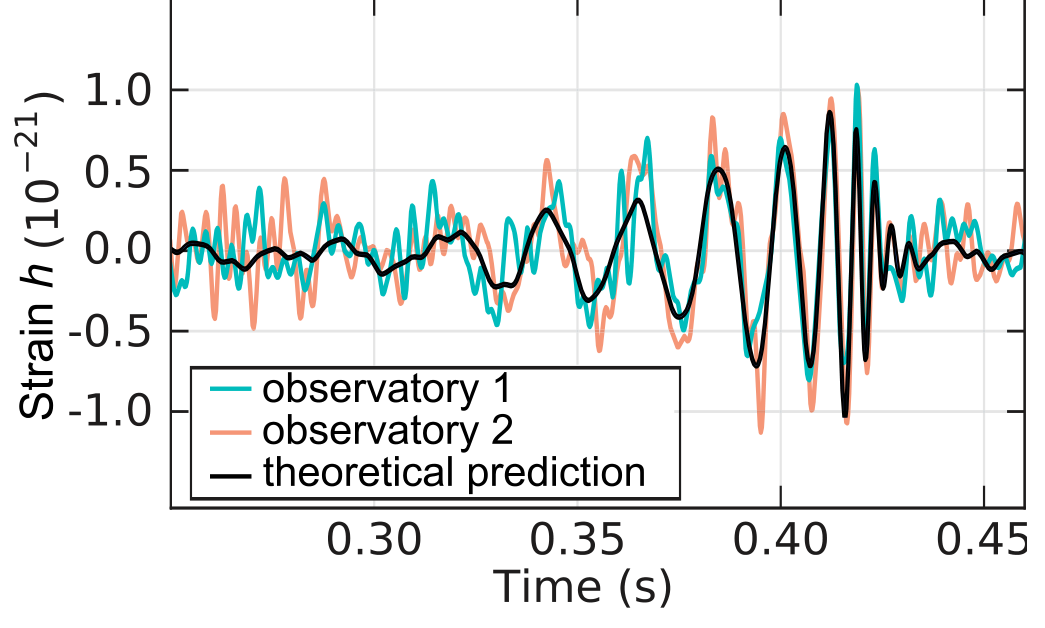
B.vi. In LIGO experiment, using a 4-km-long laser interferometer, the strain (see question iii) was measured as a function of time; the result is given in the graph below. Using this graph and assuming that the masses of the two black holes were equal, estimate the mass of each of them numerically. Gravitational constant ; . [1,5 т.]
B.vii. Using the same data as for question vi, estimate the distance to these black holes. [1,5 т.]
Отговори
A.i.
A.ii. and the centre of mass moves uniformly, so and .
B.i.
B.ii.
B.iii.
B.iv.
B.v.
B.vi. kg
The official solution gives M = 1.45 × 10³² kg = 72 M☉ (orbital period read from the graph T ≈ 0.006 s, ω = 1000 rad/s).
B.vii. m
The official solution gives L = 4.21 × 10²⁴ m = 136 Mpc (with h0 ≈ 0.9 × 10⁻²¹ read from the graph).
Решение
Part A. Dipole radiation (2.4 points)
For the sake of convenience, let us denote
i. (1.4 pts) The total dipole moment can be expressed as , (0.2 pts)
where and are the position vectors of the electron and nucleus respectively. Then , (0.1 pts)
but because the mass of the nucleus is much larger than , we can neglect the second term. Then
(0.3 pts)
(0.2 pts)
We can express as . (0.2 pts)
We get from the relation , then . (0.3 pts)
Finally
(0.1 pts)
ii. (1 pt) We know that . Let us recall that the distance to centre of mass is
Then (0.3 pts)
(0.2 pts)
(Equivalently one can notice that the net momentum.) is constant because there aren’t any external forces acting on the system. (0.3 pts)
This means that and . (0.2 pts)
Part B. Quadrupole radiation (7.6 points)
i. (1 pt) The force acting on one of the stars is
(0.6 pts)
From here we can express the star’s speed . We can express the star’s angular speed from the relation . (0.2 pts)
(0.2 pts)
ii. (0.8 pts) The dimensions for need to be
(0.2 pts)
can only consist of the gravitational constant , speed of light and angular velocity . (0.2 pts)
We can write a system of equations for every unit, m, s and kg. If we take the power of , and to be , and respectively, we can write out for metres
(0.1 pts)
for seconds
(0.1 pts)
and finally for kilograms
(0.1 pts)
Solving the equations we get , and , which means that
(0.1 pts)
iii. (0.8 pts) The solution for this subquestion is the same as for the previous one. The units for are
(0.2 pts)
can only depend on , and , (0.2 pts)
if we take their powers to be , and respectively, we can write out for metres
(0.1 pts)
for seconds
(0.1 pts)
and finally for kilograms
(0.1 pts)
Solving the equations we get , and , which means that
(0.1 pts)
iv. (1 pt) The flux at distance is , (0.4 pts)
on the other hand we can express flux as . This means that
(0.4 pts)
and finally
(0.2 pts)
v. (1 pt) At distance from the black hole, it takes all the energy for an object to overcome the potential energy . This means that
(0.7 pts)
(If non-relativistic energy is used, deduct 0.3 pts.) From here we can express
(0.1 pts)
This answer is 2 times smaller than the correct one, which means that
(0.2 pts)
vi. (1.5 pts) We can estimate the mass of the black holes by finding the orbital frequency and then using the expression we found in the first subquestion (Kepler’s III law). (0.3 pts)
The strain is maximal when the orbital radius for the black holes is . (0.3 pts)
Reading from the graph, we get that the orbital period is (0.3 pts)
and frequency . Then
(0.2 pts)
substituting we obtain
(0.2 pts)
The mass of a black hole is
(0.2 pts)
In reality the masses of the black holes were and , where is the mass of Sun.
vii. (1.5 pts) As mentioned previously the maximal strain is when the black hole’s orbital radius is , reading from the graph we get that the strain is . (0.4 pts)
Then, using the result of question iv,
(0.4 pts)
Substituting we obtain
(0.3 pts)
The distance to the black hole is
(0.2 pts)
numerically
(0.2 pts)
This can be also expressed in megaparsecs, . In reality, the distance was .
Оригинал в Архива: th.pdf · официални решения: th_sol.pdf