GPhO 2016, Теория — Задача 3. Magnetars
The 1st Gulf Physics Olympiad — Theoretical Competition · 21 март 2016 г. · 9 т.
Указания
- The examination lasts for 5 hours. There are 3 problems worth in total 30 points. Please note that the point values of the three theoretical problems are not equal.
- You must not open the envelope with the problems before the signal of the beginning of competition.
- You are not allowed to leave your working place without permission. If you need any assistance (broken calculator, need to visit a restroom, etc), please raise your hand until an organizer arrives.
- Use only the front side of the sheets of paper.
- For each problem, there are dedicated Solution Sheets (see header for the number and pictogram). Write your solutions onto the appropriate Solution Sheets. For each Problem, the Solution Sheets are numbered; use the sheets according to the enumeration. Always mark which Problem Part and Question you are dealing with. Copy the final answers into the appropriate boxes of the Answer Sheets. There are also Draft papers; use these for writing things which you don’t want to be graded. If you have written something that you don’t want to be graded onto the Solution Sheets (such as initial and incorrect solutions), cross these out.
- If you need more paper for a certain problem, please raise your hand and tell an organizer the problem number; you are given two Solution sheets (you can do this more than once).
- You should use as little text as possible: try to explain your solution mainly with equations, numbers, symbols and diagrams. Though in some places textual explanation may be unavoidable.
- After the signal signifying the end of examination you must stop writing immediately. Put all the papers into the envelope at your desk. You are not allowed to take any sheet of paper out of the room. If you have finished solving before the final sound signal, please raise your hand.
Условие
Magnetic fields are everywhere around us. Some typical magnetic B-field values: Earth’s magnetic field: ; at Sunspots: ; strong permanent magnets: around ; continuously maintained magnetic fields in laboratory: up to ; neutron stars and magnetars: up to . In what follows we study few aspects of strong magnetic fields.
Magnetic field energy density , where is the vacuum permeability, and — the relative permeability of the medium. System tries to move towards a lower energy state and so ferromagnetic materials with are pulled towards regions with strong magnetic fields, and diamagnetic materials with are pushed out. For diamagnetic materials, the magnetic susceptibility is small, , and so the effect is small unless the field is strong. Water is a diamagnetic with and animals are mostly made of water. So, a frog can levitate in a magnetic field if the field is strong enough, see the photo.

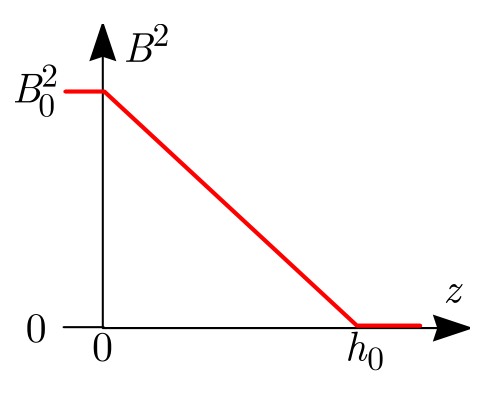
i. Let the frog height be not more than , and let us assume simplifyingly that the squared magnetic field depends linearly on height , see figure. Find how strong magnetic field (in Teslas) is needed to keep this frog in levitation. Assume that the frog is made entirely of water (density ); free fall acceleration . Hint: for , we can write ; hence, the energy density associated with the presence of water is . [1,5 т.]
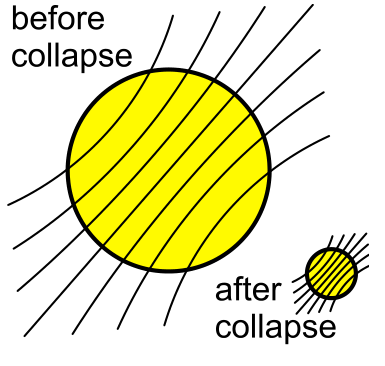
Stars are made of a plasma which is a good electrical conductor. Because of that, magnetic field lines behave as if being “frozen” into the moving plasma (this follows from the Faraday’s induction law and Kirchoff’s voltage law: due to the absence of electrical resistance, the voltage drop along a closed fictitious contour inside the plasma must be zero, hence the magnetic flux cannot change). If a star were to collapse into a neutron star, this effect would lead to an instantaneous increase of the magnetic field, see the sketch of the magnetic field lines before and after the collapse (recall that magnetic field strength is proportional to the density of field lines).
ii. Assuming that the polar magnetic field of a star is and its average density , what would be its polar magnetic field strength after its collapse into a neutron star due to the compression of magnetic field lines as depicted above? The neutron star density . [1 т.]
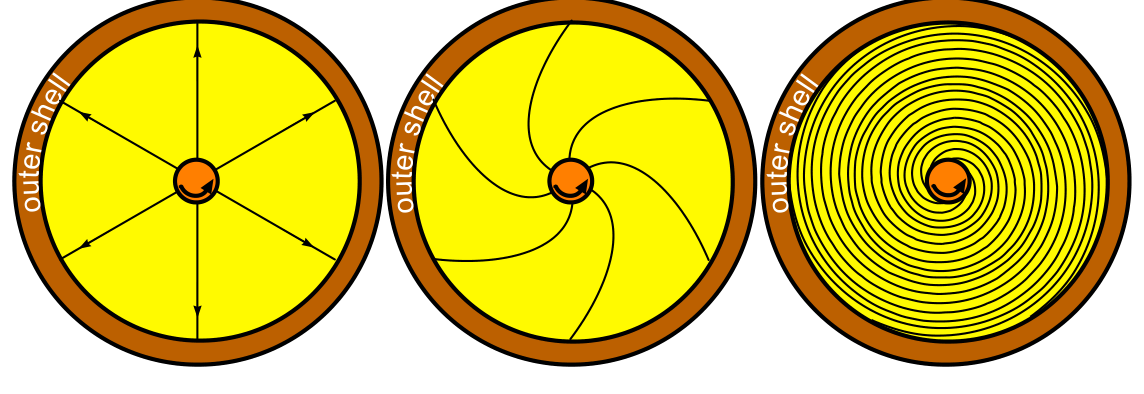
iii. In reality, magnetic fields of neutron stars are generated differently. Let us consider a very simplified model. Interior part of the star has collapsed to a neutron star’s size and density, but the exterior parts remains of the same size. Assume that before the collapse, the star was rotating as a solid body with angular speed . Express the new angular speed of the interior part of the star in terms of , and . [1 т.]
iv. Rotation speeds of the inner- and outer parts are different, hence the field lines will be stretched, see figure.
For the sake of simplicity: (a) we use 2-dimensional geometry, i.e. consider stars as being cylindrical; (b) while the initial field was a dipole field, we assume that it was cylindrically symmetric as shown in figure; (c) endpoints of field lines are attached to the inner cylinder (the neutron star) and to the outer cylindrical shell (the remnant of the original star). Let the initial magnetic field at the outer shell be . Express the magnetic field as a function of time in the region where field lines are being stretched for in terms of and . [1,5 т.]
v. So, the energy is converted during the star collapse as follows: gravitational energy is converted into kinetic one (let us neglect thermal energy), which is later on converted into the magnetic one. Based on this scenario, estimate the maximal strength of the magnetic field for a neutron star of mass and radius . Recall that . [1 т.]
vi. Very strong magnetic fields affect chemical properties of matter by changing the shape of electron orbits. This happens when the Lorenz force acting on an orbital electron becomes stronger than the Coulomb force due to the atomic nucleus. Estimate the strength of the magnetic field needed to distort the electron orbit of an hydrogen atom which has radius . Note that , , and electron mass . [1 т.]
vii. In very strong magnetic fields, atomic electron clouds take cylindrical shape. Estimate the length-to-diameter ratio of such electron clouds for hydrogen atoms near a neutron star, in magnetic field . Note that the Planck’s constant . Hint: the radius of the cyclotron orbit for an electron in quantum-mechanical ground state can be estimated using uncertainty principle. [2 т.]
Отговори
i. 5.32 T
ii. 500000 T
iii.
iv.
v. T
vi. 256000 T
vii. 40
The official solution gives κ = 39 ≈ 40.
Решение
i. (1.5 pts) If we change the frog’s height by , the change in potential energy needs to be smaller than the change in magnetic energy. (0.2 pts)
Note that for every point in frog, the change in magnetic energy is the same, thus we can express it as
(0.6 pts)
The change in potential energy is
(0.3 pts)
Then
(0.2 pts)
This means that
(0.1 pts)
and numerically
(0.1 pts)
ii. (1 pt) Let us observe a piece of the star with a volume before the collapse and volume after the collapse. The mass before and after are same. This means that
(0.1 pts)
The radius of the star scales as , (0.1 pts)
and the cross-sectional area as . (0.1 pts)
The total magnetic field through the volume is also the same before and after the collapse:
(0.4 pts)
Now we can express
(0.2 pts)
and numerically
(0.1 pts)
iii. (1 pt) During the collapse there is no torque on the star, this means that the angular momentum remains constant. Thus
(0.6 pts)
Recall that is inversely proportional to . (0.2 pts)
Now we can express
(0.2 pts)
iv. (1.5 pts) After time , the neutron star has turned by an angle . (0.2 pts)
The magnetic fields pass any radial line from the centre of the neutron star on average times. (0.3 pts)
The total magnetic flux entering the outer shell remains constant, and thus is always equal to , (0.3 pts)
where is the radius of the outer shell. This means that the flux through any radial line is . (0.4 pts)
Then
(0.2 pts)
And finally
(0.1 pts)
v. (1 pt) We can find the gravitational energy by integrating: we imagine removing the material layers of thickness one by one, starting from the outermost one. The potential energy for a hollow sphere with a thickness in the gravity field of the matter inside it is
(0.2 pts)
Integrating from to we get
(0.3 pts)
A partial credit of 0.2 pts is given is if integration is substituted by a simplifying product.
This potential energy is equal to the magnetic energy
(0.3 pts)
Solving for we get
(0.1 pts)
and numerically
(0.1 pts)
vi. (1 pt) The electron orbit will get distorted when the Lorentz force becomes in the same order of magnitude as Coulomb force. (0.1 pts)
The Coulomb force is
(0.2 pts)
On the other hand,
(0.2 pts)
We can express the velocity of electron
(0.1 pts)
Then the Lorentz force is
(0.2 pts)
Upon substituting we obtain
From the condition we can express the magnetic field strength
(0.1 pts)
and numerically
(0.1 pts)
vii. (2 pts) Perpendicularly to the magnetic field, the Lorentz force is much larger than the Coulomb force since the magnetic field is much larger than the magnetic field found in the previous question. This means that in the perpendicular plane, the electrons move along a circular cyclotron orbit. (0.2 pts)
Then we can write
(0.2 pts)
where is the orbit’s radius. Now we apply the uncertainty principle. The uncertainty of the momentum is
(0.3 pts)
and uncertainty of the coordinate
(0.2 pts)
So we have
(0.2 pts)
Substituting to the first equation we get
(0.1 pts)
Then
(0.1 pts)
The length of the cylinder will still remain in the order of magnitude of because the Lorentz force doesn’t act on the electron in that axis (parallel to the magnetic field). (0.5 pts)
Then the ratio of the length and diameter is approximately
(0.1 pts)
and numerically
(0.1 pts)
Note that if we were to make calculations for magnetars with , the orbital electrons would be ultrarelativistic.
Оригинал в Архива: th.pdf · официални решения: th_sol.pdf