GPhO 2017, Теория — Задача 1. Main sequence stars
The 2nd Gulf Physics Olympiad — Theoretical Competition · 2 април 2017 г. · 11 т.
Корица
- The examination lasts for 5 hours. There are 3 problems worth in total 30 points. Please note that the point values of the three theoretical problems are not equal.
- You must not open the envelope with the problems before the signal of the beginning of competition.
- You are not allowed to leave your working place without permission. If you need any assistance (broken calculator, need to visit a restroom, etc), please raise your hand until an organizer arrives.
- Use only the front side of the sheets of paper.
- For each problem, there are dedicated Solution Sheets (see header for the number and pictogram). Write your solutions onto the appropriate Solution Sheets. For each Problem, the Solution Sheets are numbered; use the sheets according to the enumeration. Always mark which Problem Part and Question you are dealing with. Copy the final answers into the appropriate boxes of the Answer Sheets. There are also Draft papers; use these for writing things which you don’t want to be graded. If you have written something that you don’t want to be graded onto the Solution Sheets (such as initial and incorrect solutions), cross these out.
- If you need more paper for a certain problem, please raise your hand and tell an organizer the problem number; you are given two Solution sheets (you can do this more than once).
- You should use as little text as possible: try to explain your solution mainly with equations, numbers, symbols and diagrams. Though in some places textual explanation may be unavoidable.
- After the signal signifying the end of examination you must stop writing immediately. Put all the papers into the envelope at your desk. You are not allowed to take any sheet of paper out of the room. If you have finished solving before the final sound signal, please raise your hand.
Условие
In all your subsequent calculations you may use the following physical constants and their numerical values.
Stefan-Boltzmann constant
(Note that gives the black body thermal radiation power per unit area at temperature .)
Boltzmann constant .
The rest mass of a proton .
Rest energy of a proton , where .
Rest energy of a helium nucleus .
Rest energy of an electron and positron .
Speed of light ,
Universal gas constant
Avogadro’s number
Part A. Lifetime of Sun (3 points)
For this Part, the following values can be also used.
The mass of Sun .
The radius of Sun .
Surface temperature of Sun .
A.i. The Sun emits thermal radiation as a perfectly black body. Determine the total radiation power of the Sun (in watts). [0,7 т.]
A.ii. The Sun maintains its temperature owing to the fusion reaction, the net effect of which can be written as , where denotes a proton, — a helium nucleus, — a positron, and — an electron neutrino of negligible rest energy. Show that the energy released by such a fusion of four protons is . [0,5 т.]
A.iii. Antimatter cannot co-exist with matter: upon meeting, a positron and an electron disappear by producing two photons. How much energy per each fusion of four protons into a helium nucleus must leave Sun (carried away by photons and neutrinos) in order to keep it at a thermal equilibrium? [0,5 т.]
A.iv. Assuming that only the central part of the Sun (the Sun’s nucleus) which makes of the total mass of the Sun is hot enough for fusion reaction to take place, and neglecting the energy carried away by neutrinos, estimate the total lifetime of the Sun. Note that there is no convection in the central parts of the Sun, and therefore the particles inside the Sun’s nucleus remain trapped therein. Based on your result, comment on the current age of Sun, . [1,3 т.]
Part B. Mass-luminosity relationship of stars (4.5 points)
Inside the nuclei of the so-called main sequence stars (such as our Sun), the fusion reaction takes place in a stable regime: if fluctuations were to increase the reaction rate slightly, the increased thermal output would lead to an increase of the pressure, to a thermal expansion of the fusion plasma, and as a result, to a decrease of the reaction rate. The reaction rate grows very rapidly with temperature and because of that, even if the reaction rates in different stars of different masses may differ considerably, the interior temperatures remain fairly similar. In what follows, you may assume that the temperature of the nuclei of stars is independent of the stellar mass and equal to
this approximation holds particularly well for stars larger than Sun.
In order to make our next calculations mathematically easier, we make the following additional approximations.
(a) The mass of the stellar core is and its radius is , where is the total mass of the star and — the radius of the star.
(b) The mass density , pressure , and temperature inside the stellar core can be approximately taken to be constant throughout its volume.
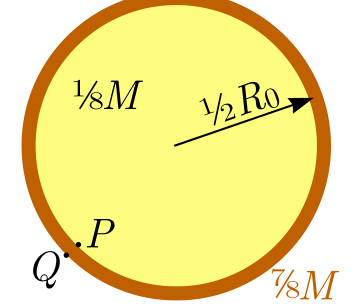
(c) For tasks i–iv, we assume also that all the mass of the outer layers of the star is concentrated into a very narrow spherical layer of radius around the core, see figure. In reality, this is certainly not true — the layer is not narrow. However, this approximation will have only a minor effect on the expression for the pressure (in task iv).
B.i. Express the free fall acceleration immediately above the narrow spherical layer (point in figure) in terms of and . [0,4 т.]
B.ii. Express the free fall acceleration immediately beneath the narrow spherical layer (point in figure). [0,4 т.]
B.iii. Express the gravity force acting on a small piece of the narrow spherical layer in terms of its surface area , and . [0,4 т.]
B.iv. Express the pressure in terms of the radius and mass of the star; (we overestimate it only by a factor which is less than two). [0,4 т.]
B.v. Derive another expression for the pressure , this time in terms of , , and the core temperature . Assume that the nucleus of a star is made of a fully ionised hydrogen, i.e. there are free protons and free electrons, both of which can be described as an ideal gas. [1 т.]
B.vi. Based on your previous results, express the radius of a star in terms of its mass and temperature . [0,4 т.]
B.vii. The radiative power of a star is limited by at which rate the produced heat can travel through the outer layers of the star and reach the surface. The heat conductivity is defined as the proportionality coefficient between the heat flux density (thermal power per unit area) and temperature gradient , where is the distance from the centre of the star. For a plasma, the heat conductivity is inversely proportional to its density, . Assume simplifyingly that is constant throughout the bulk of a star, up to the near-surface regions at where the temperature , and is equal to . Show that the total radiative power of a star is proportional to , and find the exponent . [1,5 т.]
Part C. Proton-proton fusion chain (3.5 points)
We say that a constant is fundamental if it cannot be expressed in terms of other fundamental constants; for instance, the Stefan-Boltzmann constant can be expressed in terms of , speed of light , and Planck’s constant . However, majority of the fundamental constants are created artificially by physicists due to a non-fundamental way of choosing the units. For instance, SI system of units needs electrostatic constant , but for Gauss system of units, charge units are such that . So, majority of the “fundamental” constants are not really that fundamental, and depend on our (essentially arbitrary) choice of units. However, there are also dimensionless combinations of physical constants, which can be considered as the parameters of our Universe, and which define the way in which matter and fields evolve.
C.i. Find a dimensionless combination and calculate its value using the following subset of fundamental constants (it may happen that only few constants will enter the expression for ):
,
,
,
,
,
,
.
Note that any power of is also dimensionless; you are asked to find the simplest combination of constants which yields . Hint: before applying dimensional analysis, all units need to be expressed using the base units (m, s, A, K, kg, mol). [1,5 т.]
C.ii. The first and limiting step in the fusion of four protons into a helium atom inside a star of sub-solar mass is the fusion of two protons,
This process is obstructed, however, by a coulomb repulsion of two protons. You may assume that until the distance between the centres of two protons remains larger than the proton radius , there is only a Coulomb force; at distances smaller than , an attractive strong force steps into play and dominates over the Coulomb force. Estimate the temperature required for the fusion of two protons if there were no quantum-mechanical effects. Compare this result with the value of . [1 т.]
C.iii. What enables the fusion of stellar hydrogen is the quantum-mechanical tunnel effect. With this task, you’ll learn that the fusion reaction rate depends on the dimensionless parameter , thus we can say that the parameter defines the production rate of heavier nuclei in our Universe. (It appears that in a slightly different Universe with a slightly different value of , no carbon nuclei necessary for the existence of life would have been produced.)
It appears that a particle can tunnel through an energy barrier (a region in space where the potential energy is larger than the total energy ) with probability
where the integral is to be taken over the range at which . Express the tunnelling probability for the proton-proton fusion reaction for head-on collision of two counter-moving protons of speed in terms of , and . You may assume that the proton radius is much smaller than the radius at which the proton “dives into the tunnel” , and make use of the equality .
J. Barrow and F. Tipler, The Anthropic Cosmological Principle, Oxford, (1988) [1 т.]
Отговори
A.i. W
A.iii. 26 MeV
A.iv. y
B.i.
B.ii.
B.iii.
B.iv.
B.v.
B.vi.
B.vii. 3
C.i.
The official solution gives α itself (7.3 × 10⁻³), i.e. α⁻¹ ≈ 137.
C.ii. K
C.iii.
Решение
Part A. Lifetime of Sun (3 points)
i. (0.7 pts) Since the Sun behaves as a perfectly black body it’s total radiation power can be expressed from the Stefan-Boltzmann law as
(Formula 0.5, number 0.1, units 0.1 pts.)
ii. (0.5 pts) From the energy conservation law
(0.2 pts). Then
(Formula 0.1, number 0.1, units 0.1 pts.)
iii. (0.5 pts) The fusion of four protons creates two positrons which in turn annihilate with two electrons meaning that an additional energy of is released. Then the total energy released is . (Noticing that 4 particles annihilate per one He atom 0.2, formula 0.1, number 0.1, units 0.1 pts.)
iv. (1.3 pts) Over the course of Sun’s lifetime the central part of the Sun will undergo fusion and release energy. The total number of reactions that will take place is
(0.3 pts). And thus, the total energy released is
(0.3 pts). The total lifetime of the Sun can be approximated as
(Formula 0.4, number 0.1, units 0.1 pts.)
The current age of the sun is approximately two times smaller than the calculated theoretical age (0.1 pts).
Part B. Mass-luminosity relationship of stars (4.5 points)
i. (0.4 pts) Since all of the star’s mass is below the point , the gravitational acceleration is the same as that of a point mass with a mass of (0.2 pts). Then
(0.2 pts).
ii. (0.4 pts) By applying Gauss’s law for gravity for a sphere surrounding the stellar core
(0.2 pts);
(0.2 pts).
iii. (0.4 pts) Since the gravitational acceleration decreases linearly along the thickness of the spherical layer, the average acceleration experienced by the spherical layer is (0.1 pts). Furthermore, a piece of the small spherical layer with an area has a mass of
(0.1 pts). From the Newton’s second law
(0.2 pts).
iv. (0.4 pts) The previously calculated force acting on the small piece of the narrow spherical layer can also be expressed as
(0.3 pts). Then
(0.1 pts).
v. (1 pt) From the ideal gas law
where is the number of moles of protons and electrons inside the stellar core (0.6 pts; 0.4 if electrons are forgotten). Since the mass of an electron is negligible compared to the mass of a proton, (0.3 pts). Then
and
(0.1 pts).
vi. (0.4 pts) Combing both expressions for , one gets
(0.2 pts).
(0.2 pts).
vii. (1.5 pts) Writing out the energy balance for a spherical shell with a radius of and thickness concentric to the star
(0.4 pts) and rearranging the terms, one gets
(0.2 pts). Integrating from to yields
(0.2 pts). Then
(0.3 pts). When similar expression is obtained without integration (leading to a wrong factor), only 0.2 for integration is lost.
Substituting , and , we ultimately end up with
(0.3 pts). Thus (0.1 pts).
Part C. Proton-proton fusion chain (3.5 points)
i. (1.5 pts) First, we must convert the units to base units:
,
,
(0.1 pts),
,
(0.1 pts),
,
(0.1 pts).
Let . Then we can create an equation for each unit:
m:
s:
kg:
K:
mol:
C: .
(0.1 pts for each equation.) After solving the system of equations and setting , we get , , , , , , and (apart from and , 0.1 pts for each value). Thus
(0.1 pts for the numerical value.)
ii. (1 pt) Let the distance to the centre of mass for both protons be . Then the force acting on one of the protons is and thus the potential energy is
(0.3 pts out which 0.1 goes for correctly treating the distance to the centre of mass and distance between the protons.) By applying the energy conservation law at and , we get
(0.2 pts). Furthermore
(0.3 pts). can be expressed as
(0.1 pts for formula). This is around times larger than the actual temperature of the stellar core (0.1 pts).
iii. (1 pt) The total energy of a proton moving at speed is and the potential energy, as expressed in the last subtask, is . The moment at which the proton ”dives into the tunnel” happens when (0.3 pts). Thus (0.1 pts). Then the probability of the tunnelling taking place is
(0.3 pts)
(0.3 pts).
Оригинал в Архива: th.pdf · официални решения: th_sol.pdf