GPhO 2017, Теория — Задача 2. Water tube
The 2nd Gulf Physics Olympiad — Theoretical Competition · 2 април 2017 г. · 8 т.
Корица
- The examination lasts for 5 hours. There are 3 problems worth in total 30 points. Please note that the point values of the three theoretical problems are not equal.
- You must not open the envelope with the problems before the signal of the beginning of competition.
- You are not allowed to leave your working place without permission. If you need any assistance (broken calculator, need to visit a restroom, etc), please raise your hand until an organizer arrives.
- Use only the front side of the sheets of paper.
- For each problem, there are dedicated Solution Sheets (see header for the number and pictogram). Write your solutions onto the appropriate Solution Sheets. For each Problem, the Solution Sheets are numbered; use the sheets according to the enumeration. Always mark which Problem Part and Question you are dealing with. Copy the final answers into the appropriate boxes of the Answer Sheets. There are also Draft papers; use these for writing things which you don’t want to be graded. If you have written something that you don’t want to be graded onto the Solution Sheets (such as initial and incorrect solutions), cross these out.
- If you need more paper for a certain problem, please raise your hand and tell an organizer the problem number; you are given two Solution sheets (you can do this more than once).
- You should use as little text as possible: try to explain your solution mainly with equations, numbers, symbols and diagrams. Though in some places textual explanation may be unavoidable.
- After the signal signifying the end of examination you must stop writing immediately. Put all the papers into the envelope at your desk. You are not allowed to take any sheet of paper out of the room. If you have finished solving before the final sound signal, please raise your hand.
Условие
Consider a tube which is obtained when two metallic cylinders are welded together as shown in the figure. Upper cylinder has internal cross-sectional area , and the lower one — . Two pistons are connected with a narrow (rigid but light) steel bar of length ; the distance from the lower piston to the welding area is . The space between the pistons is filled with water of density and temperature . The mass of each of the pistons (neglect the mass of the rod connecting them) free fall acceleration and the atmospheric pressure . The tube stands vertically on a solid horizontal surface; the pistons can move freely up and down, friction force can be neglected. The distance between the bottom of the lower piston and the horizontal surface is more than .
i. Let denote the pressure at a point at the bottom of the water column, and — at a point at the bottom. Find . [0,5 т.]
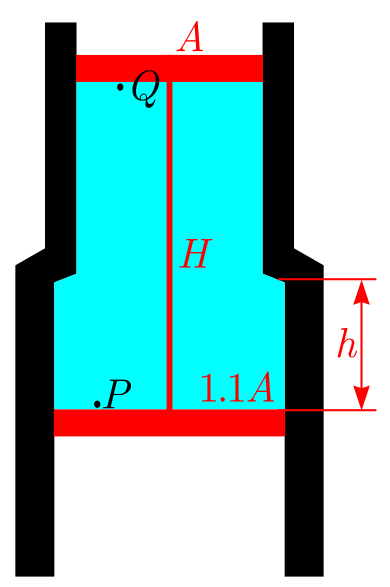
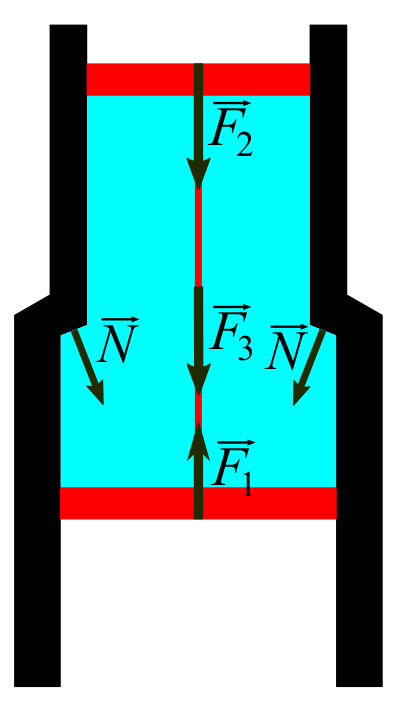
ii. Consider the two pistons, steel bar, and water column as a single compound body. Make a sketch and mark on it all the forces acting on this compound body by arrows (denote them by letters — , , etc.). Determine the values of all these forces. [1,5 т.]
iii. Determine the values of and . [1,2 т.]
iv. Determine the tension force in the steel bar. [0,8 т.]
v. Now, the whole system is slowly raised to a height (this is the distance between the horizontal surface and the bottom edge of the tube), and released. The system falls due to gravity, hits the surface (assume the impact to be plastic, i.e. the kinetic energy of the metallic tube is converted into heat), remains standing vertically on the horizontal surface for a brief period of time , and jumps up into air. Why does it jump? Provide a qualitative explanation. [1 т.]
vi. Find the duration during which the tube remains standing on the surface (after falling and before jumping). [3 т.]
Отговори
i. 3000 Pa
ii. F1 = 1.1Ap0 = 110 N, F2 = Ap0 = 100 N, F3 = (M+m)g = 4.1 N, N = 5.9 N
iii. pP = 60 kPa, pQ = 57 kPa
iv. -43.5 N
The negative sign means that the steel bar is compressed.
vi. 0.31 s
Решение
i. (0.5 pts) There is a water column of height between points and creating an additional pressure of . (Formula 0.3 pts, value 0.1 pts, units 0.1 pts.)
ii. (1.5 pts) The external forces acting on the system are sketched on the figure to the right. (formula 0.1 pts, value with units 0.1 pts) and (formula 0.1 pts, value with units 0.1 pts) is the atmospheric pressure acting on the pistons. (formula 0.1 pts, value with units 0.1 pts) is the gravitational force acting on the water-piston system, where (formula 0.1 pts, value with units 0.1 pts) is the mass of the water column. is the total normal force exerted by the metal cylinder. There is no horizontal component for the normal force since it cancels out due to symmetry. can be expressed from the Newton’s 2nd law applied on the vertical axis
(Formula 0.2 pts, value with units 0.1 pts.) Each correctly shown force in the sketch: 0.1 pts (0.4 pts overall).
iii. (1.2 pts) Notice that (0.6 pts), where
(formula 0.2 pts) is the pressure at the joint of the two tubes. Therefore,
(Formula 0.1 pts, value with units 0.1 pts.) and
(Formula 0.1 pts, value with units 0.1 pts.)
Alternatively, applying the Newton’s law on the vertical axis for the piston, one gets
(0.3 pts),
(0.3 pts),
(formula 0.2 pts, value with units 0.1 pts).
(formula 0.2 pts, value with units 0.1 pts).
iv. (0.8 pts) Newton’s 2nd law on the vertical axis for the top piston can be written out as
(0.4 pts).
The negative sign of the tension force means that the steel bar is being compressed, not stretched. (Formula 0.2 pts, value with units 0.1 pts, sign or direction of 0.1 pts.)
v. (1 pt) During the impact, the metallic tube comes to rest but the two pistons keep moving downwards because the pistons and the tube aren’t strongly connected (0.3 pts). As a result, the volume between the two pistons increases (since the area of the bottom piston is larger than the top piston) and vacuum is created (0.3 pts). This causes the atmospheric pressure to try to reverse the change and push the pistons upwards (0.2 pts). Because no energy is lost in the water-piston system (for simplicity we assume the friction between the tube and water / pistons to be negligible), after the pistons have returned to their initial position, their speed will be of equal magnitude and of opposite sign, pointing upwards, which in turn makes the tube jump (0.2 pts).
vi. (3 pts) Neglecting the pressure of water vapors and of the water column of , the pressure between the pistons is zero, hence the net force acting on the system “water + pistons” is
(1.3 pt). Because the force is constant throughout the whole process, the change of momentum for the water-piston system can be expressed as
(1.3 pt)
where is the speed of the tube when it reaches the ground. Thus
(Formula 0.2 pts, value 0.1 pts, units 0.1 pts.)
Оригинал в Архива: th.pdf · официални решения: th_sol.pdf