GPhO 2017, Теория — Задача 3. Accelerating shock wave
The 2nd Gulf Physics Olympiad — Theoretical Competition · 2 април 2017 г. · 11 т.
Корица
- The examination lasts for 5 hours. There are 3 problems worth in total 30 points. Please note that the point values of the three theoretical problems are not equal.
- You must not open the envelope with the problems before the signal of the beginning of competition.
- You are not allowed to leave your working place without permission. If you need any assistance (broken calculator, need to visit a restroom, etc), please raise your hand until an organizer arrives.
- Use only the front side of the sheets of paper.
- For each problem, there are dedicated Solution Sheets (see header for the number and pictogram). Write your solutions onto the appropriate Solution Sheets. For each Problem, the Solution Sheets are numbered; use the sheets according to the enumeration. Always mark which Problem Part and Question you are dealing with. Copy the final answers into the appropriate boxes of the Answer Sheets. There are also Draft papers; use these for writing things which you don’t want to be graded. If you have written something that you don’t want to be graded onto the Solution Sheets (such as initial and incorrect solutions), cross these out.
- If you need more paper for a certain problem, please raise your hand and tell an organizer the problem number; you are given two Solution sheets (you can do this more than once).
- You should use as little text as possible: try to explain your solution mainly with equations, numbers, symbols and diagrams. Though in some places textual explanation may be unavoidable.
- After the signal signifying the end of examination you must stop writing immediately. Put all the papers into the envelope at your desk. You are not allowed to take any sheet of paper out of the room. If you have finished solving before the final sound signal, please raise your hand.
Условие
In interstellar space, shock waves can accelerate charged particles to very high energies. We shall use an idealized model of a shock wave, and assume that it is a potential barrier of a constant height which moves with a constant velocity along the -axis:
In the frame where the shock wave is at rest, the energy of an electron is conserved. This means that as long as the kinetic energy of an electron of mass and charge moving towards the shock wave is insufficient (, where denotes the speed with which the electron is approaching the shock wave), it is reflected back from the shock wave in the same way as an elastic ball bounces from a rigid wall. In what follows, unless otherwise mentioned, we assume that the electron is bounced elastically by the shock wave. You can always use the parameters , , , , and to express your answers. Unless otherwise specified, the velocity of the electron is assumed to be non-relativistic.
i. Let the initial speed of the electron be , with . Determine the velocity (i.e. the components , , ) of the electron after being hit by the shock wave. [1 т.]
ii. Now, there is also an homogeneous magnetic field of induction , parallel to the -axis. At the beginning, electron rests at the origin, and at is hit by the shock wave. Sketch qualitatively the trajectory drawn by the electron; cover the time period from until at least . [1 т.]
iii. Find the curvature radius of the electron’s trajectory immediately after its first collision with the shock wave. [0,5 т.]
iv. The electron undergoes soon, at , a second impact; write down an equation for determining . Use numerical calculation to obtain an expression for . [1 т.]
v. Determine the average -directional velocity of the electron (averaged over the time interval between two subsequent collisions of the electron with the shock wave). [0,5 т.]
vi. As time goes on, the electron undergoes many collisions with the shock wave. Show that during its motion, , where is a constant; express in terms of , and . [1,5 т.]
vii. From now on, let us consider the limit . Determine the average -directional acceleration of the electron (express it in terms of , and or constant introduced by task vi). [1 т.]
viii. It appears that at the limit , the time interval between subsequent collisions becomes shorter and shorter, hence we can assume that . This means that during a time interval between two subsequent collisions the velocity vector of the electron will change only by a very small angle and hence, its acceleration vector can be assumed to be constant.
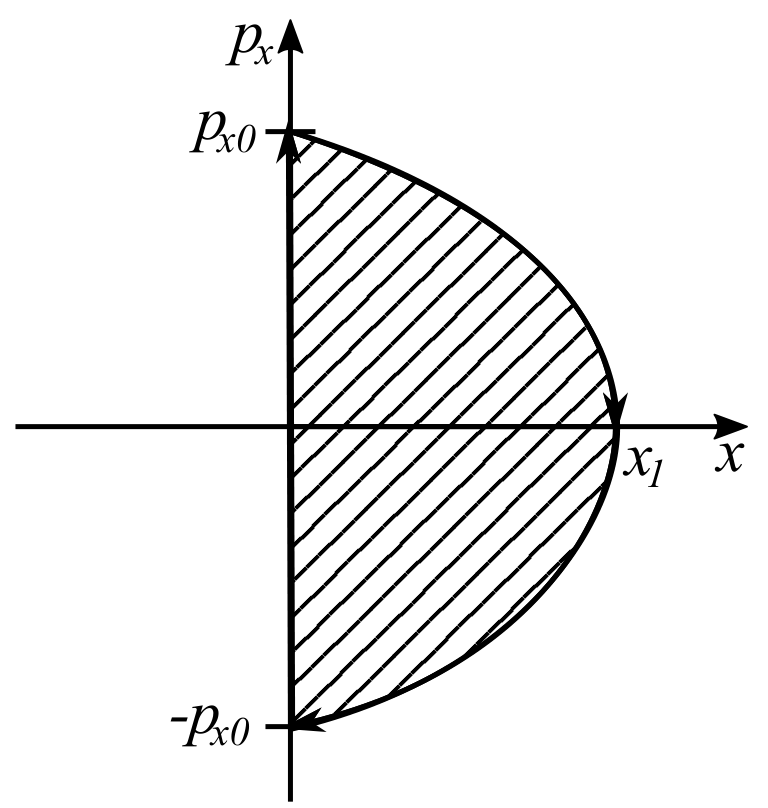
Let us use now the shock wave’s frame of reference, and consider the electron’s phase diagram, i.e. a diagram which describes the state of the electron as a point in the -plane, where the vertical axis corresponds to the -component of the momentum, and denotes the distance from the shock wave. Depict qualitatively the electron’s phase trajectory, i.e. the curve drawn in phase diagram during one period (between two subsequent collisions of the electron with the shock wave). Grades for this task are based purely on the shape of the curve. [1 т.]
ix. As time goes on, the width and height of the phase trajectory will change; however, it appears that the surface area of the region surrounded by the phase trajectory (referred to as the adiabatic invariant) will remain constant with a very good precision. For an initially resting electron, the adiabatic invariant appears to be approximately equal to . Determine the total kinetic energy of the electron when it falls behind the shock wave; express it in terms of , , and , which is defined as ; assume that . [1,5 т.]
x. This final task is independent from the previous tasks. Consider the propagation of a shock wave as described before, but under the absence of a magnetic field. A relativistic electron moves parallel to the front (in the laboratory frame, the perpendicular component of its velocity is strictly zero). Assuming that and (with denoting the speed of light), what should be the relativistic energy of the electron so that it could fall behind the shock wave? You can use any reasonable approximations. [2 т.]
Отговори
- i.
- iii.
- iv.
- v.
- vi.
- vii.
- ix.
- x.
Решение
i. (1 pt) In the reference frame of the shock wave, the electron’s initial velocity is (0.3 pts). After deflecting against the shock wave, the horizontal component of the velocity gets flipped (0.2 pts). Thus, the electron’s velocity in the moving frame of reference, after deflecting against the shock wave, is (0.1 pts). Moving back into the laboratory frame of reference, the final velocity is (0.2 pts for component, 0.1 both for and components).
ii. (1 pt) After being hit by the shock wave, the electron starts moving with speed . Due to the magnetic field, it moves along a circular trajectory, and at the initial moment of time, the trajectory is perpendicular to the front. Additionally, the electron periodically undergoes collisions against the shock wave, and the -coordinates of the collision points grow in time. This is enough to draw an approximate sketch of the electron’s trajectory.
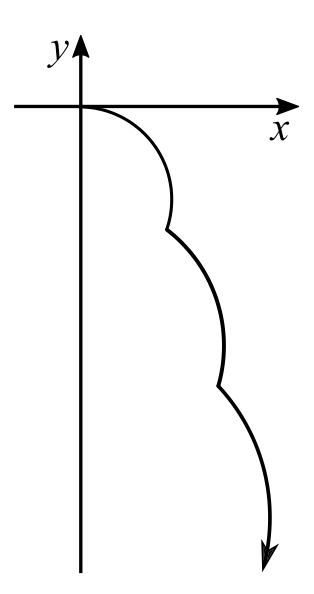
Grading: trajectory is made from circular segments (0.3 pts) which are connected at the reflection points so that instantaneous change of direction is clearly seen (0.2 pts). 0.2 pts if the trajectory starts parallel to the -axis, 0.1 pts if the direction of motion is shown by arrow or described in another way; 0.2 pts if the reflection points advance in the same direction as the shock wave.
iii. (0.5 pts) The Lorentz force acting on the electron acts as a centripetal force
(0.4 pts). Thus (0.1 pts).
iv. (1 pt) Before the first collision, the electron’s -coordinate is (0.2 pts) and the shock wave’s -coordinate is (0.1 pts). The second impact happens when (0.2 pts). Thus
(0.1 pts). Substituting , one gets
(0.2 pts). This equation can be solved numerically to get (0.1 pts). Thus (0.1 pts).
v. (0.5 pts) Every time a collision happens, the electron and the front are at the same place, with the same value of the -coordinate. This means that the electron’s and shock wave’s average velocities in the direction of the -axis are the same. In other words, (0.5 pts).
vi. (1.5 pts) It is easier to find the value of by taking a derivative from both sides of the equation as it gets rid of the constant. Then (0.2 pts). The only forces acting on the electron are the Lorentz force and the repulsion forces between the electron and the shock wave (0.3 pts). Since the shock wave affects the electron only in the horizontal direction (0.2 pts), the acceleration’s vertical component comes purely through the Lorentz’s force (0.2 pts). This means that holds throughout the electron’s motion (0.2 pts). In other words, . Plugging this to the conservation law, we get (0.3 pts). Thus (0.1 pts).
vii. (1 pt) By taking a derivative from the conservation law , we get (0.5 pts). Over the long run, the average -directional moving speed of the electron is the same as that of the shock wave’s. Thus (0.4 pts) and (0.1 pts).
viii. (1 pt) Over the course of one period, there is a constant acceleration acting on the electron in the -direction, both in the lab frame, and in the shock wave’s frame; the behaviour is the same what would be if there were a free fall acceleration . If we let be the relative distance between the electron and the shock wave, and the initial -directional momentum at be , then the quantity is conserved over the course of one period (energy conservation law) (0.2 pts). Thus (0.1 pts). On the phase diagram, this corresponds to a parabola who’s axis of symmetry is at (0.2 pts). Furthermore, at , the momentum of the electron gets flipped due to the collision against the shock wave, meaning that there is a straight line from to (0.3 pts). This gives enough information to draw the phase diagram (correctly drawn figure 0.1 pts, arrow shown 0.1 pts).
ix. (1.5 pts) The area under the phase diagram can be found by integrating from to and multiplying the result by two (since the phase diagram is symmetrical about ). Thus
(0.3 pts). Due to the conservation of this quantity (we use its initial value taken from the problem text),
(0.3 pts), where is the electron’s speed at . The electron will fall behind the shock wave when or (0.2 pts). The horizontal acceleration comes from Lorentz force (0.3 pts). Thus
(0.2 pts).
Since ,
(0.2 pts).
x. (2 pts) In the reference frame of the shock wave, initially, the electron’s -directional and -directional momenta are and respectively. In the limiting case, the electron’s final -directional momentum is 0. Since the shock wave acts only in the direction, will stay same throughout the motion. The Lorentz invariant of the 4-momentum, initially and after the electron has come to rest, can be written out as
(0.6 pts),
(0.6 pts). Subtracting one equation from the other, we get . Thus
(0.2 pts),
(0.2 pts) with minus sign we would obtain which is not acceptable. Thus, we need to take the plus sign (0.2 pts):
for we can approximate (0.1 pts). So, the electron will fall behind the shock wave if its relativistic energy (0.1 pts).
Оригинал в Архива: th.pdf · официални решения: th_sol.pdf