GPhO 2019, Теория — Задача 1. Zero gravity
The 3nd Gulf Physics Olympiad — Theoretical Competition · 7 октомври 2019 г. · 10 т.
Указания
- The examination lasts for 5 hours. There are 3 problems worth in total 30 points. Please note that the point values of the three theoretical problems are not equal.
- You must not open the envelope with the problems before the signal of the beginning of competition.
- You are not allowed to leave your working place without permission. If you need any assistance (broken calculator, need to visit a restroom, etc), please raise your hand until an organizer arrives.
- Use only the front side of the sheets of paper.
- For each problem, there are dedicated Solution Sheets (see header for the number and pictogram). Write your solutions onto the appropriate Solution Sheets. For each Problem, the Solution Sheets are numbered; use the sheets according to the enumeration. Always mark which Problem Part and Question you are dealing with. Copy the final answers into the appropriate boxes of the Answer Sheets. There are also Draft papers; use these for writing things which you don’t want to be graded. If you have written something that you don’t want to be graded onto the Solution Sheets (such as initial and incorrect solutions), cross these out.
- If you need more paper for a certain problem, please raise your hand and tell an organizer the problem number; you are given two Solution sheets (you can do this more than once).
- You should use as little text as possible: try to explain your solution mainly with equations, numbers, symbols and diagrams. Though in some places textual explanation may be unavoidable.
- After the signal signifying the end of examination you must stop writing immediately. Put all the papers into the envelope at your desk. You are not allowed to take any sheet of paper out of the room. If you have finished solving before the final sound signal, please raise your hand.
Условие
In all your subsequent calculations, you may use the following physical constants and their numerical values.
The radius of Earth .
Free fall acceleration at the sea level .
Part A. Zero-g flight (3 points)
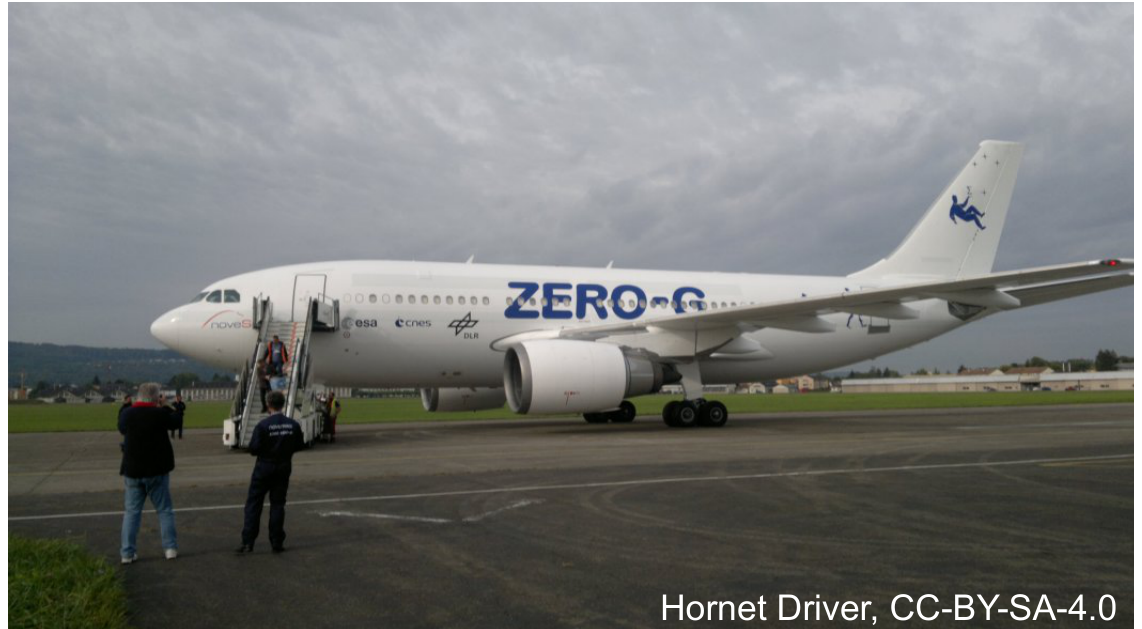
Astronauts can experience weightlessness during their spaceflight. However, there is a cheaper way to experience weightlessness other than boarding a spaceship: there are airplanes specifically designed to create weightlessness on board during a certain time period. Such an airplane is shown in the photo.
For this Part, the following values can be also used.
The speed of sound at the flying altitude .
The altitude (from the sea level) at which the airplane starts zero-g-flight (the flight segment during which the objects on board the aircraft have zero weight) is .
The speed of the airplane when it starts zero-g-flight is .
The angle between the horizontal plane and the direction of the velocity vector at the moment when the airplane starts zero-g-flight .
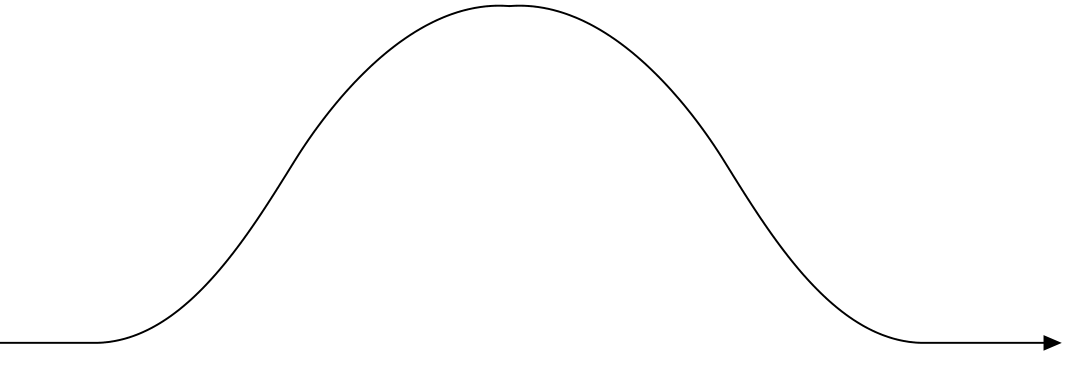
A.i. Below is a sketch of a zero-g flight trajectory (the one providing the longest duration of weightlessness might be slightly different). Mark on it the point where zero-g flight starts, and the point where it ends. [0,5 т.]
A.ii. What should be the direction and magnitude of the acceleration of the airplane to ensure that the passengers would feel weightlessness? [0,5 т.]
A.iii. What is the speed of the airplane at the highest point of its trajectory? [0,5 т.]
A.iv. How long does it take for the airplane to reach the highest point on its trajectory from the moment when it starts zero-g-flight? [0,5 т.]
A.v. What is the altitude of the airplane at the highest point of its trajectory from the sea level? [0,5 т.]
A.vi. The possible values of the initial speed and initial ascending angle are limited by the robustness of the airplane’s construction, and by the maximal thrust provided by the engines; the numerical values given above can be considered to be optimal, i.e. yielding the longest period during which the passengers experience weightlessness. Assuming that there are no restrictions on the final diving angle (the angle between the horizontal plane and the direction of the velocity vector at the moment when the airplane ends zero-g-flight) while the only limitation on the speed is that it cannot be larger than the speed of sound, what is the maximal total duration of a zero-g flight segment? [0,5 т.]
Part B. Glass of water in weightlessness (3 points)
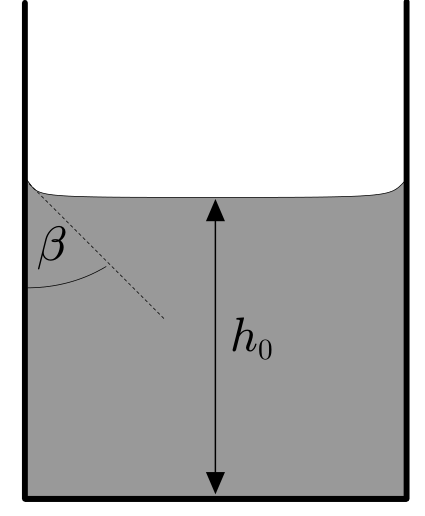
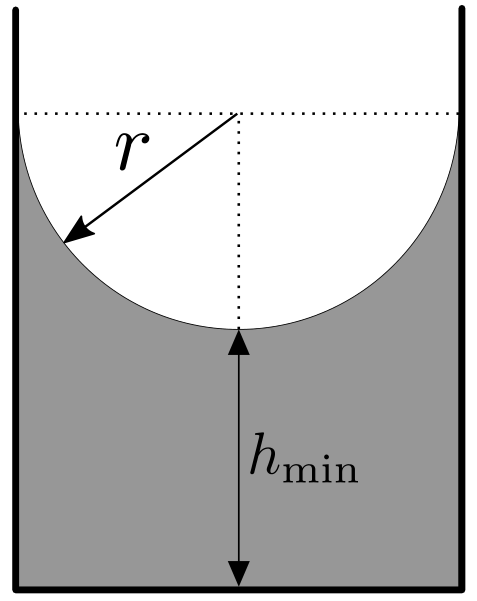
Consider a partially filled glass of water on board this aircraft. The glass is cylindrical, of radius ; the walls of the glass are negligibly thin. At the moment when the airplane starts zero-g flight, the water surface is flat except for the small meniscus of negligible height near the walls of the glass (see the figure depicting axial cross-section of the glass), and the depth of water is . The contact angle of the water in the glass (the angle between the tangent to the water surface and the surface of the glass at the point where the water surface and glass are in direct contact, see the figure) is (the figure is illustrative).
B.i. Under the condition of weightlessness, the water surface will take a new equilibrium shape. Sketch the shape of the water surface at the axial cross-section of the glass. [1 т.]
B.ii. What is the minimal distance between the water surface and the bottom of the glass at the new equilibrium state? [1 т.]
B.iii. Under normal conditions, this glass can hold up to water. What is the maximal volume of water which can be held in this glass in weightlessness? Sketch also the corresponding shape of the water surface at the axial cross-section of the glass. [1 т.]
Part C. Sharpshooter on geostationary orbit (4 points)
Weightlessness can be experienced also on spaceships performing ballistic motion (motion when engines are switched off). Let us consider an astronaut on geostationary orbit. This is a circular orbit around Earth which lies in the equatorial plane, and the period of motion on which is equal to .
C.i. What is the radius of the geostationary orbit? [0,7 т.]
C.ii. For research reasons, the astronaut wants to hit his own spaceship with a bullet fired from a rifle equipped onto the spaceship. The speed of the bullet leaving the rifle is , the bullet’s velocity lies on the orbital plane. Under which angle with respect to the vector pointing towards the centre of the Earth does he needs to aim the rifle if he wants to hit the spaceship within the next 40 hours? You don’t need to prove that there is only one suitable shooting angle.
You may use the expression for the total energy of an elliptical orbit, , where is the semi-major axis. [1,8 т.]
C.iii. He also tries out another rifle the bullet speed of which can be freely adjusted from zero to the maximal speed . With this rifle, he aims strictly along the motion of the spaceship. What is the bullet’s smallest possible travel time until hitting the spaceship? [1,5 т.]
Отговори
A.ii. Constant acceleration pointing vertically down, of magnitude g.
A.iii. ≈ km/h
A.iv. ≈ s
A.v. 8045 m
A.vi. ≈ s
B.i. A hemispherical surface of radius r, concave, tangent to the walls of the glass.
B.ii. ≈ cm
B.iii. ≈ cm³
C.i. ≈ km
C.ii. ≈ °
C.iii. ≈ h
The official solution prints “T = 4T0 = 96 days”; with T0 = 24 h the value is 96 hours (4 days) — the unit is misprinted in the source.
Решение
Part A. Zero-g flight (3 points)
i. (0.5 pts) In order for the people on board to experience weightlessness, the plane would need to be in free-fall and follow a parabolic trajectory. This means that on the figure, only the part with parabolic trajectory (curved down) corresponds to zero-g flight.
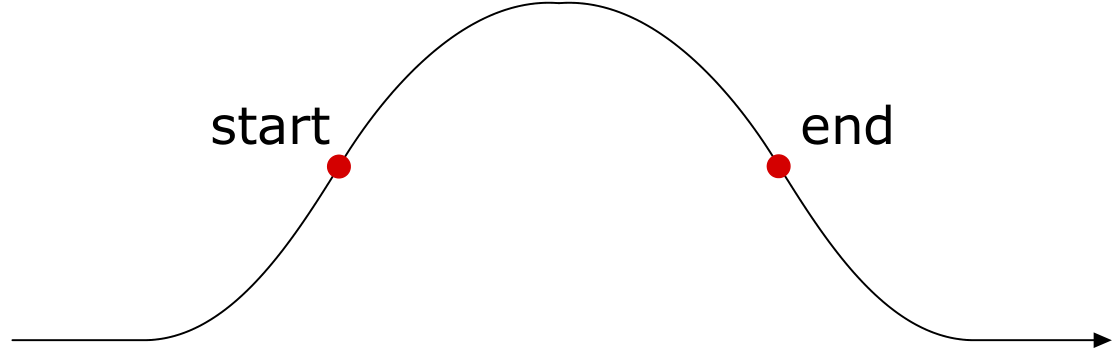
(0.5 pts)
ii. (0.5 pts) Since the plane needs to be in free-fall, there has to be constant acceleration pointing vertically down of magnitude .
direction (0.2 pts)
magnitude (0.3 pts)
iii. (0.5 pts) Since the plane is in free-fall, the horizontal component of the velocity remains constant and at the highest point of its trajectory, the vertical component is 0. (0.2 pts)
Therefore, the speed of the airplane at its highest point is
(0.3 pts)
iv. (0.5 pts) Because the vertical component is changing with uniform acceleration from to 0, (0.2 pts)
the time taken to reach the highest point is
(0.3 pts)
v. (0.5 pts) The altitude of the airplane at its highest point can be expressed using the equation for uniform acceleration: (0.2 pts)
(0.3 pts)
vi. (0.5 pts) It is clear that, in order to maximize the time of weightlessness, the final speed needs to be as big as possible, equal to . (0.1 pts)
At the end of weightlessness, the horizontal component of the velocity is still , the vertical must then be . (0.2 pts)
Finally, we get the maximal duration to be
(0.2 pts)
Part B. Glass of water in weightlessness (3 points)
i. (1 pt) The reason why the water retains its shape is due to surface tension holding it back. In general, when you have a surface with radius , the pressure difference between the inside and outside is given by . In weightlessness, the pressure inside the liquid is uniform throughout the volume because there is no gravity to pull it down. Therefore, the pressure difference, and hence the radius of curvature, is the same everywhere along the surface. In other words, the surface of the liquid must form a part of a sphere with the contact surface with the glass still being at an angle . Because the surface is tangent with the glass, the radius of curvature of the surface must be as shown in the figure.
(1.0 pts)
ii. (1 pt) The volume of water will be the same in both scenarios. (0.1 pts)
Under normal gravity, the volume was (the volume of a cylinder). (0.2 pts)
Afterwards, the water can be divided into a cylindrical part of height and spherical part (or more precisely, a cylinder with a sphere cut out of it) of radius . (0.2 pts)
The volume of the cylindrical part is simply
(0.1 pts)
The volume of the spherical part is equal to the difference of a cylinder with height and radius equalling to , and a half-sphere of radius . That corresponds to a volume of
(0.2 pts)
The total volume is therefore
and so
(0.2 pts)
iii. (1 pt) When the glass is continuously filled, the water surface will slowly creep up along the glass while maintaining the same spherical shape. When the water-air-glass interface reaches the edge of the glass, the surface normal of the glass wants to flip by (corresponding to going from inside the glass to outside), but this must happen continuously since the angle of contact between the water and the glass must always be and the glass is filled slowly. This means that while filling the glass, the surface of the water will slowly “invert” and start from having a radius of curvature curving inwards to, first, getting flatter while maintaining a spherical shape, and then becoming completely flat when the volume of the water is , to slowly curving outwards until finally having a radius of curvature of as shown in the figure. Note that you cannot fill the glass any more because then the outside of the glass would get wet. (0.3 pts)
As we can see, the glass will hold the normal volume of the water that a glass can hold, , and additionally a half-sphere of radius . (0.2 pts)
This corresponds to a total volume of
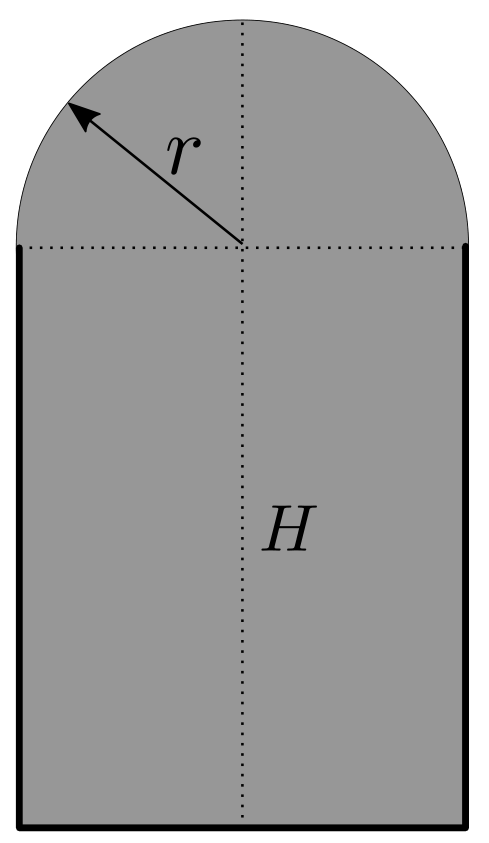
(0.2 pts)
(0.3 pts)
Part C. Sharpshooter on geostationary orbit (4 points)
i. (0.7 pts) From Kepler’s III law,
(0.3 pts)
where is the radius of the geostationary orbit and Earth’s mass. We don’t know the value of , but we do know the gravitational acceleration on Earth:
(0.2 pts)
Solving (1) and (2) yields
(0.2 pts)
alternatively, instead of using Kepler’s III law, a student could write down the force balance (0.3 pts)
ii. (1.8 pts) The spaceship moves with speed
(0.1 pts)
The bullet will start moving with velocity , where the angle between and can be freely varied. Like any other satellite, the bullet will start moving along an ellipse around the centre of Earth. (0.1 pts)
Obviously, the bullet can only hit the spaceship at points where the trajectories of the bullet and spaceship intersect. This corresponds to intersections of an ellipse and a circle, and in this case, there are 2 intersections, since any satellite has only one closest approach to the centre of mass. (0.2 pts)
One of the intersection points is already known — the point at which the bullet is shot out. From here, it is hopefully easy enough to see that a sufficient solution would be to make the bullet have an orbital period of 24 h, since then, both the bullet and the spaceship will collide after 24 h. (0.5 pts)
The rest boils down to finding at what angle does one have to shoot to maintain the same orbital period. For this one can use the following reasoning. First note that from Kepler’s III law, orbital period relates to the semi-major axis as . Therefore, if we want to maintain , the semi-major axis needs to be fixed. (0.2 pts)
The semi-major axis is related to the total energy as
As we can see, fixing the semi-major axis means that the total energy needs to stay constant and since total energy = kinetic energy + potential energy, the total speed of the bullet and the spaceship need to be equal at the instant when the bullet is shot! (0.4 pts)
This can be easily achieved by making the angle between and such that , , and form an isosceles triangle. From simple geometry, one gets the desired angle to be
(0.3 pts)
iii. (1.5 pts) Note that similarly to the previous part, the only way to make the bullet and the spaceship collide is to make the bullet and the spaceship meet at the original intersection point after some number of orbital rotations. (0.2 pts)
In this case, there are actually no other intersection points because the circle and the ellipse are touching at the point where the bullet was shot. (0.2 pts)
Now, let us find the maximal and minimal orbital period of the bullet.
If the speed of the bullet is chosen to be , then the speed in the laboratory frame is . The total energy per mass expressed at the point where the bullet was shot is
(0.2 pts)
Therefore,
(0.1 pts)
From Kepler’s III law,
(0.2 pts)
hence
(0.2 pts)
We can simplify this by noting that
so
can go from 0 to so the orbital period can vary from to . (0.1 pts)
By inspection, it is easy to see that choosing the speed such that would guarantee the smallest number of orbital period before the collision. Then the collision would happen after four orbital periods of the spaceship (three for the bullet). In other words, the smallest possible travel time until hitting the spaceship is
(0.3 pts)
Оригинал в Архива: th.pdf · официални решения: th_sol.pdf